



The Harness Gets Better. By Itself.
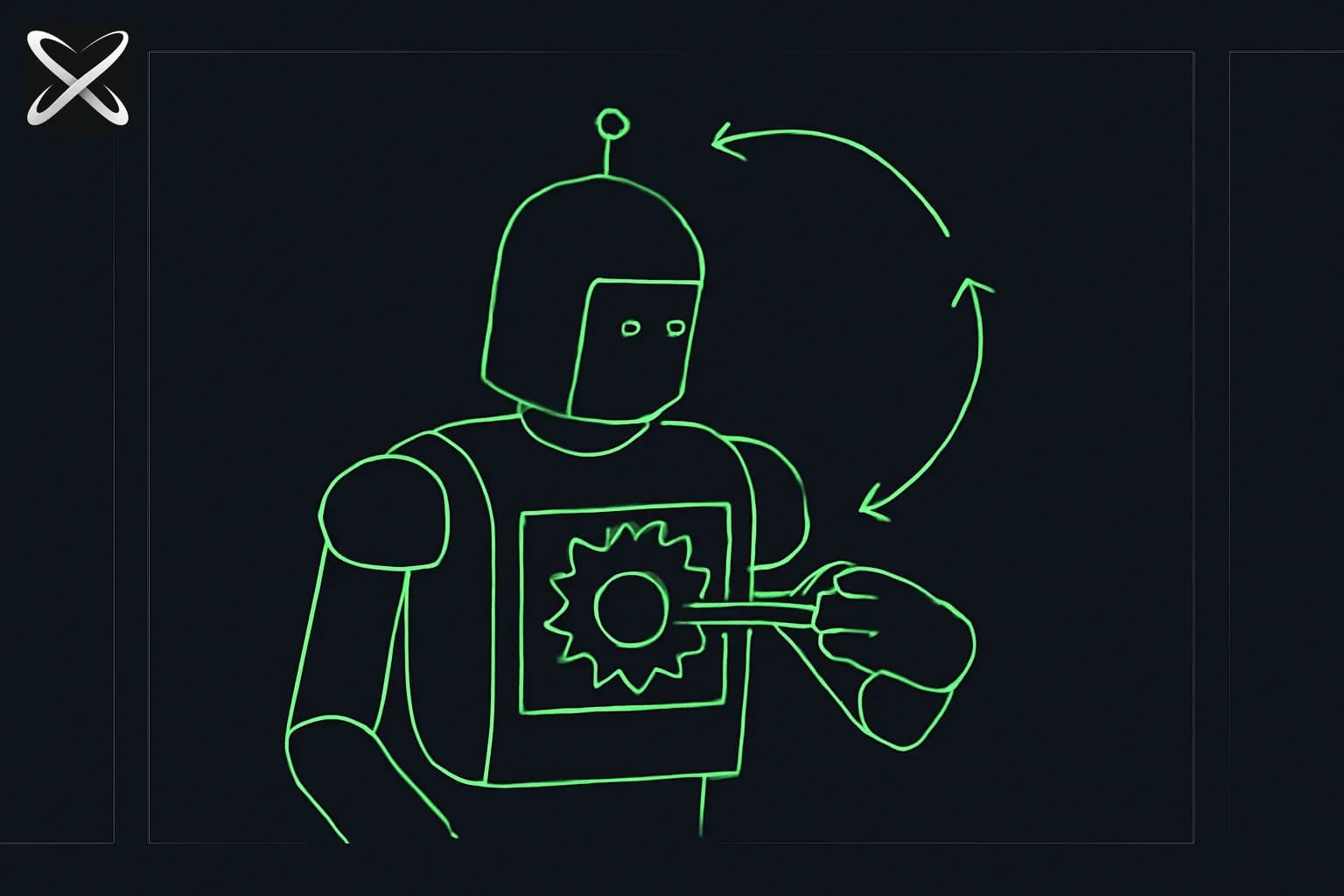
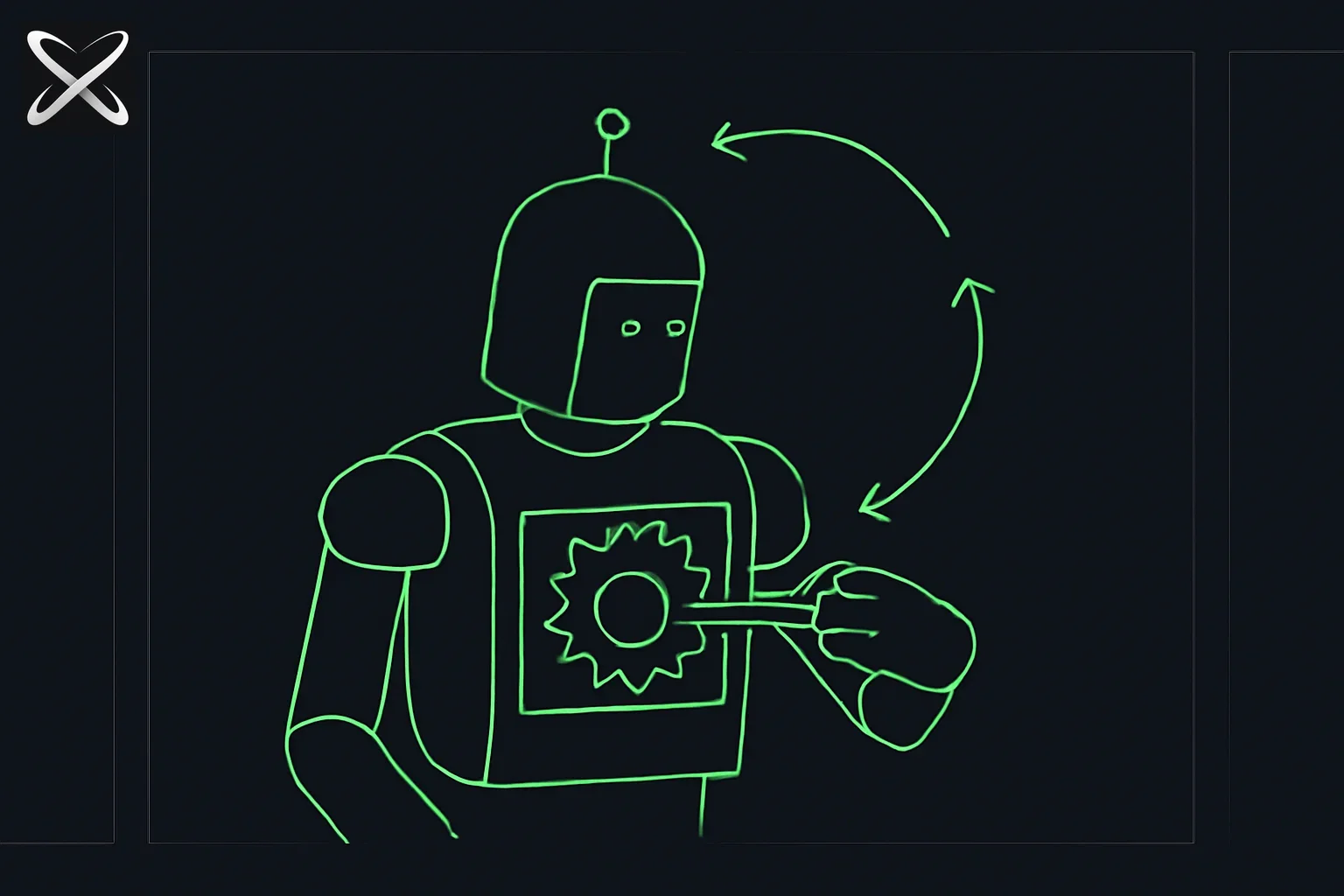 Self-harness AI agent diagram: a robot adjusting a gear inside its own open chest panel with looping diagnose-fix-validate arrows
When you wrap an AI model in a harness — the scaffolding code that manages tool calls, retries, context, and verification — you make a bet. You bet that you understand the model's failure modes well enough to engineer around them before deployment.
That bet frequently loses.
Real failure patterns only emerge at scale, under production load, across the full diversity of tasks your model actually encounters. A human engineer can analyze a sample of failures and update the harness. But the rate at which new models ship and task distributions shift has outpaced what manual harness engineering can keep up with.
Self-harness is the pattern that closes this gap. Instead of waiting for a human engineer to analyze failures and update the scaffolding, the agent does it itself. The model mines its own execution traces for weaknesses, proposes targeted harness changes, and validates those changes through regression testing — all without a human in the loop and without a stronger external model.
The June 2026 arXiv paper Self-Harness: Harnesses That Improve Themselves demonstrated this concretely: applying self-harness to three diverse models on Terminal-Bench 2.0 produced 14–21 percentage point absolute gains, coming entirely from harness modifications while the base models stayed constant.
Self-Harness vs. Agent Harness: The Relationship
Before explaining how self-harness works, it helps to clarify what it is not.
An agent harness is the infrastructure layer that makes an agent run: task definition, context management, tool execution, loop control, verification, and failure handling. The harness is the difference between a one-shot prompt and a system that runs until a goal is reached.
A self-harness is the meta-process by which that infrastructure gets better over time. The relationship:
Agent Harness:    wraps the model, executes tools, runs the loop
Self-Harness:     analyzes the harness's failures, proposes improvements, validates them
You cannot have a self-harness without a harness to improve. In practice, self-harness sits above the operational harness: it uses the agent's own capabilities to examine how the harness is performing and output specific, validated changes to it.
A useful analogy: an agent harness is a factory floor. A self-harness is the process improvement system that studies why certain stations keep failing and installs targeted fixes — without stopping production for a human engineering review.
Why Human Harness Engineering Doesn't Scale
The typical harness improvement cycle:
- Deploy agent with initial harness
- Observe failures in production or on benchmarks
- Human engineer analyzes failure traces
- Engineer proposes harness changes (system prompt edits, tool wrapper fixes, verification additions)
- Test the changes manually
- Deploy updated harness
- Repeat
This cycle works for one model with a stable task distribution. It breaks when:
- You deploy across multiple model families (GPT, Claude, Gemini, Qwen, GLM) — each with distinct failure patterns
- Your task distribution shifts faster than your engineering team can analyze
- You need model-specific optimizations that require deep trace analysis per model
- You are running harness tuning as a continuous process, not a one-time event
Each new model family requires essentially a new analysis cycle. Agent harness engineering documented this: LangChain's Deep Agents team achieved significant Terminal-Bench 2.0 gains with harness-only changes, but that process required skilled engineers spending meaningful time on trace analysis and iteration.
Self-harness replaces the human engineer role in that loop with the model itself.
The Three-Stage Self-Harness Loop
Stage 1: Weakness Mining
The agent runs against a set of tasks and produces execution traces: every tool call made, every response received, every error encountered, every success or failure.
Weakness mining analyzes these traces to identify recurring failure patterns — not one-off failures, but systematic issues that appear across multiple tasks.
What gets identified:
- Tool prerequisite failures (e.g., consistently forgetting to configure git user.name before commits)
- Context loss in multi-step tasks (e.g., losing a database connection string by step 5 of a 7-step task)
- Missing verification (e.g., assuming a file write succeeded without checking)
- Planning failures (e.g., attempting steps out of order, skipping dependency checks)
- Error recovery gaps (e.g., no handling for common tool timeouts)
The output is a ranked list of weaknesses — ordered by frequency and impact — with concrete examples from the execution traces.
Example weakness extracted from traces:
Weakness: W-042
Pattern: Agent fails git operations by not configuring git user.name
Frequency: 12 failures across 89 tasks
Example traces: Task 23, Task 45, Task 67 (all commit-related)
Category: Tool prerequisite missing
Stage 2: Harness Proposal
For each identified weakness, the agent generates 3–5 candidate harness modifications that would address it. The key design constraint is minimality: proposals must be small and targeted, not large rewrites.
Proposal types span the full harness stack:
System prompt additions:
# Before
You are an AI agent with access to terminal commands.

# After
You are an AI agent with access to terminal commands.
+ Before any git commit, verify git user.name and user.email are configured.
+ If unset: git config user.name "Agent" && git config user.email "agent@localhost"
Tool wrapper changes:
# Self-harness proposes wrapping file creation with verification
def create_file(path, content):
    write_file(path, content)
    if not os.path.exists(path):
        raise FileNotFoundError(f"Failed to create {path}")
Planning template updates:
# Before
Plan: {steps}

# After
Plan:
+ 1. Verify prerequisites (dependencies, configs, permissions)
{steps}
+ N+1. Verify expected outcomes before declaring done
Generating multiple diverse proposals per weakness is intentional — different approaches address the root cause differently, and only the validated one gets accepted.
Stage 3: Proposal Validation
This is the stage that makes self-harness safe: no proposal is accepted without passing regression testing.
The validation process:
- Run the current harness against a held-out validation task set — record which tasks pass
- Run the proposed harness against the same set — record which tasks pass
- Accept the proposal only if:
- Zero regressions: every task that passed before still passes
- Net improvement: overall pass rate increased
- Targeted improvement: at least one task from the target weakness now passes
If any previously passing task fails with the proposed harness, the proposal is rejected. This strict no-regression requirement prevents cascading harness failures where one fix breaks three things it was never designed to touch.
Accepted proposals are merged into the harness and used as the baseline for the next iteration. The loop runs until gains converge — typically 5–7 iterations.
What the Results Look Like
The three-stage loop is not theoretical. Applied to three diverse models on Terminal-Bench 2.0:
| Model | Baseline | After Self-Harness | Absolute Gain |
|---|---|---|---|
| MiniMax M2.5 | 40.5% | 61.9% | +21.4 points |
| Qwen3.5-35B-A3B | 23.8% | 38.1% | +14.3 points |
| GLM-5 | 42.9% | 57.1% | +14.2 points |
Each model generated different harness modifications — the weakness patterns were model-specific, which is exactly the point. The same self-harness framework produced distinct, validated improvements for each model architecture without requiring human analysis of each.
The improvement curve converges: most gains come in the first 3–4 iterations, diminishing returns set in by iteration 5–6, and the harness stabilises. No overfitting — the gains hold on the held-out validation set, not just on training tasks.
How Self-Harness Differs From Related Approaches
vs. External-Model Scaffolding
Some systems use a stronger model (e.g., GPT-5.5) to analyze a weaker agent's failures and propose fixes. This works but introduces a dependency: you need access to a model stronger than the one you are optimizing, and that stronger model must be capable of reasoning about the weaker model's failure modes.
Self-harness uses the same model to improve its own harness. No external model required. The model that fails at the task is the same model that analyzes why it failed and what to fix.
vs. Prompt Engineering
Prompt engineering tunes the single-shot instruction given to the model. Self-harness modifies the full harness — system prompts, yes, but also tool wrappers, validation steps, and planning templates. The scope is much broader, and the improvements are grounded in actual failure traces rather than human intuition about what the model might need.
vs. Manual Harness Engineering
Manual harness engineering produces high-quality changes when done by skilled engineers with deep trace analysis. Self-harness trades depth of individual changes for automation and scalability. The practical comparison:
| Manual Harness Engineering | Self-Harness | |
|---|---|---|
| Speed | Days to weeks per model | Hours (automated) |
| Scalability | Limited by engineer bandwidth | Scales with compute |
| Model-specificity | Requires manual analysis per model | Discovers patterns automatically |
| Safety | Human judgment on each change | Regression testing on each change |
| Initial architecture | Human designed | Still requires human architecture |
The right answer for most teams is the hybrid: humans design the initial harness architecture and safety guardrails; self-harness handles the model-specific tuning and continuous improvement.
What Self-Harness Cannot Fix
Self-harness improves the harness. It cannot improve the model.
If the base model genuinely cannot reason through a problem — not because of a missing prerequisite check or poor context management, but because the reasoning task is beyond its capability — self-harness will not help. The three-stage loop will converge without finding fixes because there are no harness modifications that address a fundamental model capability gap.
This mirrors the limitation of agent harnesses in general: a harness extracts more of what the model is capable of. Self-harness makes that extraction more systematic and automatic. Neither changes the floor of the model's capability.
The practical implication: self-harness is most effective when your benchmark gap is explained by harness-fixable issues — tool prerequisites, context loss, missing verification, planning template gaps. If your agent fails at 40% of tasks and all 40% reflect genuine reasoning failures the model cannot perform, self-harness will not move that number.
Implementing Self-Harness: Where to Start
If you want to apply the self-harness pattern to your own agent, the sequence:
1. Instrument your traces. Every tool call, every error, every success and failure needs to be captured with enough context to identify patterns. You cannot mine weaknesses from sparse logs.
2. Build a validation task set. Before running any self-harness loop, carve out a held-out set of tasks that you will not train on. These are your regression tests — they protect you from proposals that improve performance on the training distribution while breaking something else.
3. Define a minimal initial harness. Self-harness works best starting from a minimal harness, not an already-optimized one. Give the agent the basic scaffolding and let self-harness find what it specifically needs.
4. Run weakness mining manually first. Before automating the loop, do one manual pass of weakness mining yourself. This builds intuition for what kinds of patterns your specific model produces and validates that your trace instrumentation is capturing the right data.
5. Add the validation gate last. The regression check is non-negotiable — do not deploy self-harness improvements without it. But you can start the loop informally (human-reviewed proposals, manually validated) and automate later once you trust the pattern.
The Anthropic Claude Code research on 400K+ coding sessions shows how loop-based patterns at scale reveal systematic failure modes that are invisible in individual sessions. Self-harness applies the same principle: aggregate trace analysis at scale finds patterns that session-by-session review misses.
Self-Harness and the Broader Harness Ecosystem
Self-harness does not replace the other components of a harness engineering practice. It sits within it:
- What Is an Agent Harness? — The foundation: what the harness is, what components it contains, and why it determines agent performance as much as the model does.
- Agent Harness Engineering — The practice: how to design and tune harnesses manually, the seven planes of harness configuration.
- Anthropic Engineer: Stop Prompting, Build Loops — The shift from prompt engineering to loop engineering as the primary productivity lever.
- ByteDance DeerFlow 2 and Super-Agent Harnesses — Multi-agent harness patterns at scale, where self-harness concepts extend to coordinating agent collectives.
- Self-Harness Research Paper Deep Dive — The full technical breakdown of the June 2026 arXiv paper, including pseudocode, iteration dynamics, and reproduction guide.
Self-harness is not the end state of harness engineering — it is the point where harness improvement becomes a workload the model can own rather than a workload that blocks on human engineering time.
Related Reading
- How AI Agents Actually Edit Code Using Python — diff-based vs AST-based file editing, the mechanism underneath any self-harness's own edit tool
- What Is an Agent Harness? Complete Guide
- Self-Harness: AI Agents That Improve Their Own Framework (arXiv Paper)
- EvoHarness-RL: An 8B Model Matches Claude Opus 4.5 on ALFWorld
- Agent Harness Engineering: Terminal-Bench and LangChain
- Anthropic Engineer: Stop Prompting, Build Loops
- ByteDance DeerFlow 2: Super-Agent Harness with LangGraph
- Anthropic Claude Code: Expertise and Agentic Coding Research