



Update — July 8, 2026: Anthropic extended the 50% weekly Fable promo through Sunday July 12, 11:59pm PT — credits-only from July 13. Extension guide →
Update — July 7, 2026: Thariq confirmed Fable leaves subscriptions after 11:59:59pm PT tonight — superseded by July 8 email extension. Will Fable return to subscription plans?
TL;DR — July 1, 2026: Anthropic published Redeploying Fable 5 (June 30) and posted on X: export controls lifted, Fable 5 global starting July 1, new cyber classifiers (some coding/debugging → Opus 4.8), 50% of weekly usage limits through July 7 then credits-only, plus a Glasswing jailbreak severity framework with Amazon, Google, and Microsoft. This is the authoritative product detail behind the status hub.
What Anthropic Announced
On June 30, 2026, Anthropic confirmed:
Claude Fable 5 will be available again globally tomorrow.
The companion blog post explains why the ban happened, what safeguards changed, and how billing works on restore — details leaked strings and prediction markets did not fully capture.
TL;DR — Official Terms at a Glance
| Topic | Official answer (July 1, 2026) |
|---|---|
| Global restore | Yes — Claude.ai, Platform, Code, Cowork, July 1 |
| Export controls | Lifted June 30 |
| Included usage | Up to 50% of weekly limits through July 7 (Pro, Max, Team, premium Enterprise) |
| After July 7 | Usage credits required for Fable on those plans |
| Standard Enterprise | No included Fable — credits only; enable credits or Fable won't work |
| Coding on Fable | May route to Opus 4.8 when classifiers flag cyber-adjacent requests — not a full coding ban |
| Invisible limits | ~0.03% of traffic — frontier LLM dev requests degraded on Fable, no fallback |
| API fallback billing | Opus rates if blocked early; Fable + Opus mix if blocked midstream |
| Commerce lift | June 30 letter to Tom Brown — controls withdrawn; reevaluation clause remains |
| Mythos 5 | Glasswing US orgs — not general global like Fable |
| Cloud APIs | Bedrock / Vertex / Foundry — re-enabling ASAP |
| Jailbreak framework | Draft with Amazon, Microsoft, Google, Glasswing partners |
Full usage breakdown: Fable 5 rate limits and credits guide.
Timeline — Ban to Redeploy
| Date | Event |
|---|---|
| June 9 | Fable 5 + Mythos 5 launch |
| June 12 | Export controls after Amazon report on safeguard bypass for vuln identification |
| June 12–29 | Global suspension — no nationality verification at scale |
| June 26 | US government approves Mythos for select US Glasswing orgs |
| June 30 | Export controls lifted; official Redeploying Fable 5 post |
| July 1 | Fable 5 global restore begins |
| July 7 | End of included Fable on subscription weekly limits → credits |
| Coming weeks | Classifier refinement; jailbreak framework details; cloud re-enable |
Background: Why the US banned Fable 5 · When will Fable be available again.
New Classifiers — Why Coding May Hit Opus 4.8
Anthropic redeployed Fable with new classifiers trained with the US government to block the Amazon-reported bypass — blocking the technique in over 99% of cases per Anthropic and CAISI (Commerce Center for AI Standards and Innovation) testing.
Tradeoff: The classifiers also false-positive on benign coding and debugging. When blocked:
- User gets notified
- Request routes to Opus 4.8
Anthropic: "In the near term, some routine tasks like coding and debugging will fall back to Opus 4.8. We'll continue to refine these classifiers over the coming weeks."
Safety margin explainer: Fable launched with a wider safety margin than prior models — deliberately blocking ambiguous cyber-adjacent prompts. The redeploy tightens specific bypass paths but does not remove the margin entirely.
Anthropic's official post illustrates the tradeoff with two classifier diagrams:
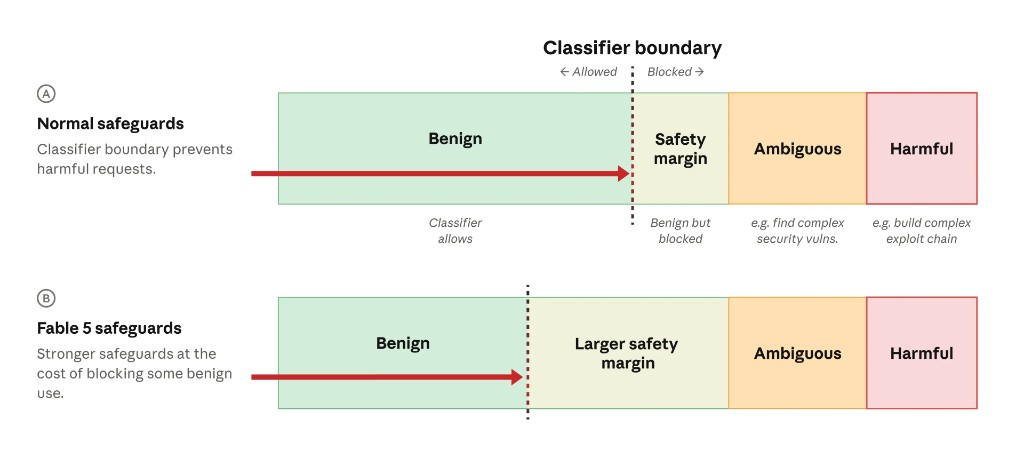 Normal safeguards vs Fable 5 safeguards — Fable uses a larger safety margin that blocks more benign-but-cyber-adjacent requests
How to read the diagram:
| Zone | Meaning |
|---|---|
| Benign (green) | Classifier allows — routine coding, docs, non-cyber work |
| Safety margin (pale yellow) | Benign but blocked by default — extra caution buffer |
| Ambiguous (orange) | e.g. find complex security vulns — defensive cyber, hard to classify |
| Harmful (pink) | e.g. build complex exploit chain — clearly offensive |
Row A — normal safeguards: The classifier boundary sits after a small safety margin. Most benign requests pass.
Row B — Fable 5 safeguards: The boundary shifts left — a larger safety margin blocks more requests that are probably benign but touch cybersecurity. That is why routine coding and debugging can false-positive after restore: they land in the expanded yellow zone, not because Fable thinks you are attacking a bank.
The Amazon-reported bypass was a minor jailbreak (row C below) — recovering safety-margin behavior, not Mythos-level offense. The new classifier targets that specific path (over 99% block rate) but the wide margin remains.
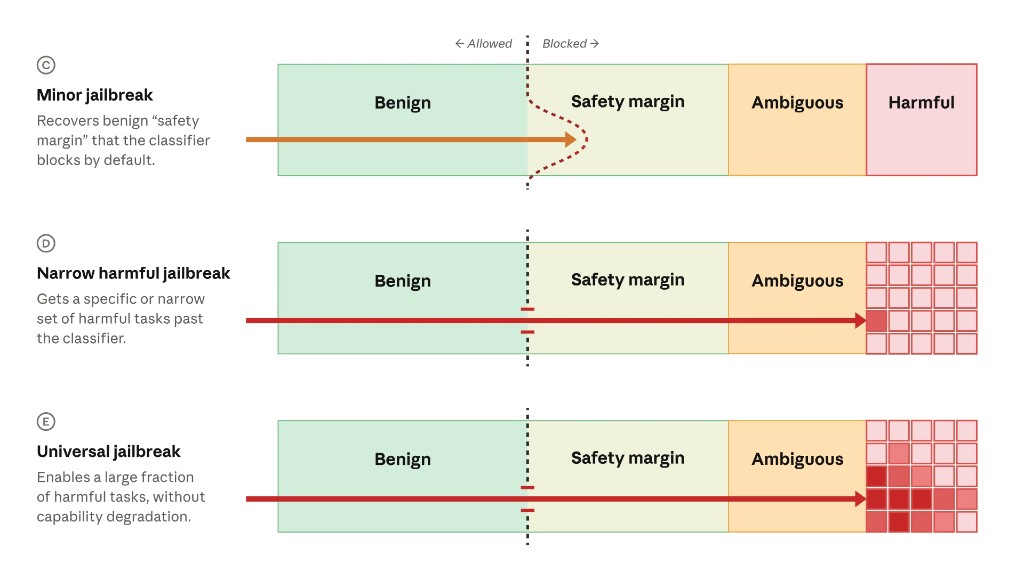 How jailbreaks interact with Fable 5 classifiers — minor, narrow harmful, and universal jailbreak severity
Jailbreak severity (rows C–E):
| Type | What it unlocks | Severity |
|---|---|---|
| C — Minor | Benign safety-margin content the classifier blocks by default | Low — what Amazon's report described |
| D — Narrow harmful | One specific harmful task past the classifier | Moderate |
| E — Universal | A large fraction of harmful tasks without capability loss | Critical — none found for Fable at launch |
Anthropic argues the June 12 export control targeted a row C finding while Opus 4.8 and Kimi K2.7 could match vuln identification — the policy fight is partly about where the boundary sits, not unique Fable-only offense.
For Claude Code users: expect Fable in the picker but Opus handoffs mid-session on security-flavored prompts. See Fable on Claude Code.
HN confusion: "Can you code on Fable at all?"
The July 1 X announcement compressed the classifier tradeoff into one line — "some routine tasks like coding and debugging will fall back to Opus 4.8" — which many readers (including top Hacker News comments) parsed as Fable no longer being a coding model.
The full blog post tells a different story:
- Fable 5 ships globally on Claude Code alongside Claude.ai and the API
- Coding is still the primary use case — the issue is false positives, not a blanket ban
- Anthropic: classifiers "flag benign requests more often during routine coding and debugging tasks" and will refine precision over coming weeks
Practical read: If your prompt smells like vuln hunting, exploit chains, or hardening a security-critical codebase, expect Opus 4.8 with a notification. Normal feature work, refactors, and app logic should stay on Fable — until a classifier misfires. "In the near term" is doing real work; treat fallbacks as probabilistic, not deterministic.
Three Safeguard Types — Not All Route to Opus
Redeploy is not one monolithic filter. Anthropic's Fable 5 system card and redeploy post describe three distinct intervention classes:
| Safeguard type | Trigger examples | User-visible behavior | Fallback model? |
|---|---|---|---|
| Cybersecurity | Vuln ID, exploit-adjacent coding, Amazon-reported bypass paths | Notification + route to Opus 4.8 | Yes — Opus 4.8 |
| Biology / chemistry | Dual-use bio/chem misuse | Refusal | No — blocked |
| Frontier LLM development | Pretraining pipelines, distributed training infra, ML accelerator design | Silent effectiveness limits (prompt mods, steering, PEFT) | No — stays on Fable but degraded |
Competitive-model safeguards are the subtle one HN surfaced via the system card:
"Unlike our interventions for cybersecurity, biology and chemistry, and distillation attempts, these safeguards will not be visible to the user. Fable 5 will not fall back to a different model."
Anthropic estimates ~0.03% of traffic, concentrated in under 0.1% of organizations — requests that would accelerate competing frontier model development (already a ToS violation, but now enforced via hidden steering). Claude still responds; effectiveness on pretraining-scale tasks is intentionally capped.
Why developers care: Cyber fallbacks are annoying but visible. Competitive-use limits are invisible — bad outputs on ML infra prompts may look like model stupidity, not policy. That fed HN threads about trust erosion when combined with June's export-control whiplash.
API Billing When Classifiers Fire
If you bill through the API rather than Claude.ai subscription limits, fallback economics matter:
| Scenario | Typical billing |
|---|---|
| Blocked before Fable generates output | Opus 4.8 rates for the completed response |
| Blocked midstream | Fable rates for tokens already emitted + Opus rates for the remainder |
| Competitive-use stealth limit | Fable rates — no model swap |
Community reports on launch day (HN thread, Claude dev forums) highlight this: you can pay Fable-tier pricing for partial output then Opus-tier for the handoff — or skip Fable entirely if your workflow triggers classifiers often. Sonnet 5 may be cheaper for volume coding until classifiers calm down.
Commerce Letter — June 30 Lift (Tom Brown, Not Dario)
Export controls ended via a June 30, 2026 letter from Commerce Secretary Howard Lutnick to Tom Brown (Anthropic Chief Compute Officer) — not CEO Dario Amodei. The letter (widely circulated on X) states:
- Anthropic took steps "in close coordination with the U.S. government" on Mythos and Fable risks
- Anthropic agreed to proactively detect and address security risks, work on protocols and standards for future releases, and inform the U.S. government of any malicious activity
- June 12 controls withdrawn — no license required for export, reexport, or in-country transfer of Mythos or Fable
- Commerce reserves the right to reevaluate and reimpose licensing if circumstances change or commitments fail
Negotiation context: Prior reporting placed Tom Brown and Sarah Heck in active Commerce talks while Dario's early-June calls with Lutnick, Bessent, and Kessler were described as tense — including a disputed "wellness retreat" scheduling clash. The June 30 letter going to Brown rather than Amodei matches the shift from CEO-led crisis diplomacy to compute-policy operators closing the deal. See Mythos Lutnick letter breakdown for the June 26 Mythos-only predecessor.
HN takeaway: Controls lifted fast relative to the 18-day ban — but ongoing government reporting obligations and reevaluation clauses mean the "pause" can return without new legislation. That unpredictability, not classifier annoyance alone, drove threads about not building load-bearing workflows on a single US frontier API.
Usage Limits — 50% Through July 7, Credits After
This confirms and supersedes leaked app strings about credits:
Pro, Max, Team, select Enterprise (premium seats):
- Through July 7, 2026: Fable draws from up to 50% of weekly usage limits at no extra cost beyond subscription
- After July 7: Fable requires usage credits
Standard Enterprise seats: No included Fable allowance ever — all Fable usage bills through credits. If credits disabled, Fable does not work.
Social reaction on launch day (Fix on X, HN thread — 430+ points) highlighted frustration:
| Complaint | Detail |
|---|---|
| Shorter window | Many expected ~14 days of restored access; official terms are 7 days (through July 7) |
| 50% cap | Fable only draws from half of weekly limits — easy to exhaust on long Claude Code agent runs |
| Credits cliff | After July 7, Fable is credits-only on consumer plans — not unlimited subscription tier |
| Classifier tax | Paying Fable rates for output that finishes on Opus; or burning Opus when you wanted Fable |
| Trust | Export ban → sudden lift → stricter filters + government reporting — "damage is done" threads |
"Why stay subbed?" is a fair question if your workflow is Fable-heavy coding without a credits budget. Counter-arguments on HN: model swap fallbacks (Sonnet, GLM, Kimi), the gap is narrowing on open Chinese weights, and most teams already treat models as substitutable — but that requires eval harnesses most companies skipped while Fable was briefly SOTA.
Practical read: Use Fable for frontier long-horizon work in the July 1–7 window; default Sonnet 5 for volume coding; budget credits after July 7; keep alternatives wired if Commerce reevaluates.
What HN Got Right — Business and Policy Read
The launch thread clustered around a few durable points worth separating from launch-day heat:
1. Predictability beats peak capability. Several commenters argued the real harm was rule-by-decree — no public timeline for pauses, no statutory process, Commerce reserving unilateral reevaluation. Investors and EU teams cannot plan around "lifted tomorrow, stricter classifiers today, credits in a week."
2. Substitutability is a strategy, not a given. Swapping models sounds trivial until you account for different tool schemas, context habits, and eval baselines. Teams that skipped eval work during the Fable window feel locked in; teams with loop engineering harnesses report easier downgrade paths.
3. Amazon's dual role still matters. The ban followed an Amazon researcher report; restore followed Anthropic–government commitments that include joint protocols with Amazon, Google, and Microsoft. Whether you read that as legitimate security coordination or investor-regulator capture, it is now the operating model for US frontier releases.
4. Mythos lift ≠ Mythos for everyone. Commerce lifted controls on both model names, but Mythos 5 consumer access remains Glasswing / approved orgs — not the Claude.ai picker. Confusing the two model tiers was common in comment threads.
5. Fable still worth using for many devs. Despite classifier noise, heavy users who had ~10 hours of pre-ban Fable time consistently report large quality gaps vs Opus 4.8 on long-horizon research and one-shot complex apps — enough to slam usage in the July 1–7 window before credits economics bite.
Amazon Report — What Anthropic Says Was Unique
The June 12 directive followed an Amazon researcher report: prompting Fable to identify vulnerabilities; in one case, produce exploit demonstration code.
Anthropic's retest:
| Finding | Detail |
|---|---|
| Vuln identification | Opus 4.8, GPT-5.5, Kimi K2.7 also found same vulns |
| Exploit demo | Multiple models including Haiku/Sonnet/Opus tiers and GPT-5.4/5.5 produced similar demos |
| Mythos-level offense? | No — borderline Fable safeguard case, routine defensive cyber framing |
| Fix | New classifier; not full model retrain |
Amazon's role as investor and reporter remains politically charged — see ban origin story.
Glasswing Jailbreak Framework
Anthropic + Amazon, Microsoft, Google, Glasswing partners drafting consensus jailbreak severity scoring:
- Capability gain — vs existing tools and weaker models
- Breadth — narrow target vs many offensive tasks
- Ease of weaponization — skilled multi-prompt vs one-shot
- Discoverability — specialist knowledge vs widely posted online
Goal: shared vocabulary like CVSS for software vulns — triage for developers and governments. The four scoring criteria map to the diagram above: minor vs narrow vs universal jailbreaks need different response urgency.
Also announced:
- HackerOne program for Fable cyber jailbreak submissions
- 24/7 monitoring of jailbreak channels for severe cases
- Pre-release government access for frontier national-security-relevant models
- Rapid information sharing on misuse patterns
- Dedicated Anthropic teams + compute for joint government research
Ties to June 2 Executive Order framework (August 1 deadline).
Fable vs Mythos — Access After Restore
| Model | Who gets it July 1 |
|---|---|
| Fable 5 | Global — consumers, developers, Claude Code (with classifier + billing caveats) |
| Mythos 5 | Approved US Glasswing organizations; broader partner expansion in coordination with government |
Do not assume Mythos is in the Claude.ai picker for general subscribers. Fable is the safeguarded general-use tier; Mythos remains offensive cyber-capable with restricted distribution.
Regional and Platform Checklist
- UK · Europe · India — included in global Fable restore
- China / fingerprinting — global on paper; access still complicated
- International access hub
- 35 use cases for restore week — prioritize before July 7 limit window closes
- Open alternatives if credits economics fail
- GPT-5.6 — still on limited preview; timeline
What to Do Today
- Confirm Fable in picker /
/v1/models— rollout may lag hours; cloud APIs (Bedrock, Vertex, Foundry) re-enable ASAP per Anthropic - Track weekly limit consumption — 50% cap through July 7 only; long agent runs burn it fast
- Enable usage credits before July 7 if you depend on Fable post-window
- Expect Opus fallbacks on cyber-flavored coding — not a full coding ban; rephrase or split security work across sessions
- Watch API invoices — midstream fallback can mix Fable + Opus token rates on one request
- Enterprise admins — verify premium vs standard seat Fable policy; enable credits
- Reserve Fable for tasks Sonnet 5 cannot carry — see loop engineering for efficient harnesses
- Plan for reevaluation risk — Commerce can reimpose licensing; keep status hub and a fallback model on standby
Related on explainx.ai
- Fable 5 After Relaunch — Developer Reaction — classifiers, fallbacks, workflows
- Is Fable 5 Back? — live status hub
- Fable 5 Rate Limits and Credits — 50% / July 7 detail
- Claude App Strings — Credits + ID
- Fable 5 on Claude Code
- US Government Ban — Full Story
- Mythos Trusted Partners / Lutnick Letter
Official sources
- Redeploying Fable 5 — Anthropic, June 30, 2026
- Anthropic on X — restore announcement — export controls lifted
- Anthropic on X — classifier detail — coding fallback wording (source of HN confusion)
- Hacker News discussion — Commerce lift thread, 430+ points, July 2026
Terms reflect Anthropic's official June 30, 2026 post and July 1 X announcement. Classifier behavior, cloud availability, and credit pricing may change — verify in Claude Console and plan settings.