



A headline circulating this week says TSMC "demands operational control" of Elon Musk's Terafab site and that the two sides are clashing. The verifiable record is narrower. A newsletter reported that TSMC was exploring ways to help operate Terafab's factories, Musk replied on X on October 7, 2026 that "we will build and run the fab," and TSMC's chief executive has said only that talks are at an early stage. No party has published terms, and the word "demand" does not appear in any primary statement we could find. Here is what is confirmed, what is claimed, and why a Texas fab matters to anyone paying for AI compute.
For background on the project, see our explainer What is Terafab.ai?. For the demand side of the same supply chain, see ASML's Q3 results on EUV supply and TSMC's record Q3.
TL;DR: claimed vs. verified
| Claim | Status | Source |
|---|---|---|
| TSMC was exploring a role operating Terafab | Reported, not confirmed by TSMC | Tim Culpan newsletter, Oct 2, via secondary summaries |
| TSMC "demanded operational control" | Not found in any primary statement | Headline wording only |
| Musk and TSMC have talked | Confirmed by Musk ("Just discussions, but something may come of it") | Musk on X, per press reports |
| Musk will build and run the fab | Stated by Musk on Oct 7 | Bloomberg via Taipei Times |
| TSMC may sublease part of the site | Musk's offer, "if they want" | Same |
| Talks are at an early stage | Stated by TSMC chairman and CEO C.C. Wei | ANI via Devdiscourse |
| Intel stays in the project | Stated by Intel CEO Lip-Bu Tan to Bloomberg, Oct 7 | Taipei Times (Bloomberg) |
| Ownership structure, investments | Not finalized | Devdiscourse/ANI |
What actually happened, in order
Early October: the report. The first claim traces to a newsletter by analyst Tim Culpan on October 2, which said TSMC was exploring ways to help operate Terafab's factories, with one option reported as Tesla acting as an anchor customer for a new Texas campus. Separately, Bloomberg reported the same week that TSMC was weighing a larger chipmaking campus in Texas, on top of the roughly $265 billion it has already committed to Arizona, according to posts quoting that report.
Musk's earlier answer. Musk confirmed contact before the denial, writing in substance that these were "just discussions, but something may come of it," as quoted in trade coverage.
October 7: the denial. Responding on X to reports that TSMC could own and operate the facility, Musk wrote: "No, we will build and run the fab. Let there be ZERO doubt about that. Maybe TSMC subleases part of the Terafab if they want, but nothing more than that." Bloomberg's account, republished by Taipei Times, notes that TSMC did not immediately respond to a request for comment.
Same day: Intel. Intel CEO Lip-Bu Tan told Bloomberg in Tokyo that Intel would stay involved. Per Cleanroom Technology, Intel joined in April and is expected to contribute its 14A process plus work on design, construction and packaging.
 A circular wafer with a grid of squares representing the semiconductor fabrication capacity at stake in the Terafab dispute
Where the "operational control" wording came from
We could not trace the exact phrase "operational control" to TSMC, Musk, Bloomberg or Reuters. It reads like an aggregator's compression of two things: reports that TSMC might "own and operate" the plant, with SpaceX investing and buying its chips or taking a majority stake in the reverse arrangement, and Musk's rebuttal that his companies will "run" it. The two-option structure comes from secondary summaries of earlier reporting; we could not confirm it in an original document, so treat it as a description of possibilities under discussion, not a TSMC proposal.
Two readings are consistent with the evidence. In one, TSMC floated a role close to running the facility and Musk said no. In the other, press reports overshot the substance of early conversations and Musk corrected the record. Neither is established, and TSMC has said nothing public about demands. That is why the honest label for this story is "claimed", not "clash".
The site and the numbers
Per Cleanroom Technology, the site is in Grimes County, Texas. SpaceX and Tesla named it in August, and the first phase is estimated at about $16.8 billion with up to $119 billion across all phases. These are press-reported figures from public records and company filings, not a published project budget, so we repeat them with attribution only.
On timing, C.C. Wei said a new wafer fabrication plant could take two to three years, with expansion of capacity taking one to two years more, per the ANI summary. That matters: even in the best case, Terafab does not change AI compute supply in 2026 or 2027. Our earlier coverage of the other end of the chain, in ASML's Q3 report, said EUV tool demand already exceeds supply into 2027 and 2028, and tools are a prerequisite for any new leading-edge fab, whoever runs it.
Why it matters for AI builders
You do not buy wafers, but you pay for what they cost. Four mechanisms connect a Texas fab dispute to your API bill:
- Leading-edge capacity is concentrated. TSMC makes most of the world's advanced AI accelerators. TSMC's record quarter shows AI demand at the center of its results.
- Operating know-how is the scarce asset. Building a fab is capital; running one at high yield is craft. This is why a Musk-run fab with Intel's 14A process and possibly TSMC's expertise is a real question, and why a sublease offer is not a trivial detail.
- Diversification takes years. Other US efforts, such as GlobalFoundries' Malta expansion, add capacity at different nodes. None replaces leading-edge supply quickly.
- Vertical integration is a bet by Musk's companies. Tesla, SpaceX and xAI want chips on their own schedule, as we covered in Musk's Grok 4.7 and SpaceX training timeline and the Nvidia stake in the SpaceX-xAI merger.
What each side plausibly wants (our analysis, not reporting)
None of the following comes from a statement by either company; it is our reading of incentives, so weigh it accordingly.
TSMC's interest in Texas is straightforward. Customers want advanced capacity on US soil, and TSMC has already committed heavily to Arizona. A role at Terafab, whether as operator, tenant or supplier of know-how, would keep a potentially large customer group inside its ecosystem rather than leaving it to a rival process. Control matters to a foundry because yield, process secrecy and customer confidentiality all depend on who runs the line.
Musk's interest is speed and ownership. His companies have said repeatedly that they need more chips than the market supplies, and a fab he runs sets the schedule. Conceding operations to TSMC would trade that independence for proven execution. The sublease line suggests he is willing to take TSMC's money or demand, but not its management.
If both statements are accurate, the likely outcomes are a narrow lease, a technology arrangement, or no deal. A joint-venture structure would contradict Musk's public wording, which is why we would treat any report of one with caution until a filing or joint statement appears.
What to watch next
- A TSMC statement. The cleanest resolution would be TSMC describing in a filing or press statement what role, if any, it would take. Until then the "control" claim is unresolved.
- A signed sublease or investment. Musk's own wording leaves a tenant arrangement open. A named lease or investment would be the first hard fact.
- Intel milestones. Intel's 14A commitment is the process anchor Musk named; progress or slippage there matters more than headlines about TSMC.
- Permits and equipment orders. Tool orders are visible in suppliers' results, which is where ASML-style reports will show it first.
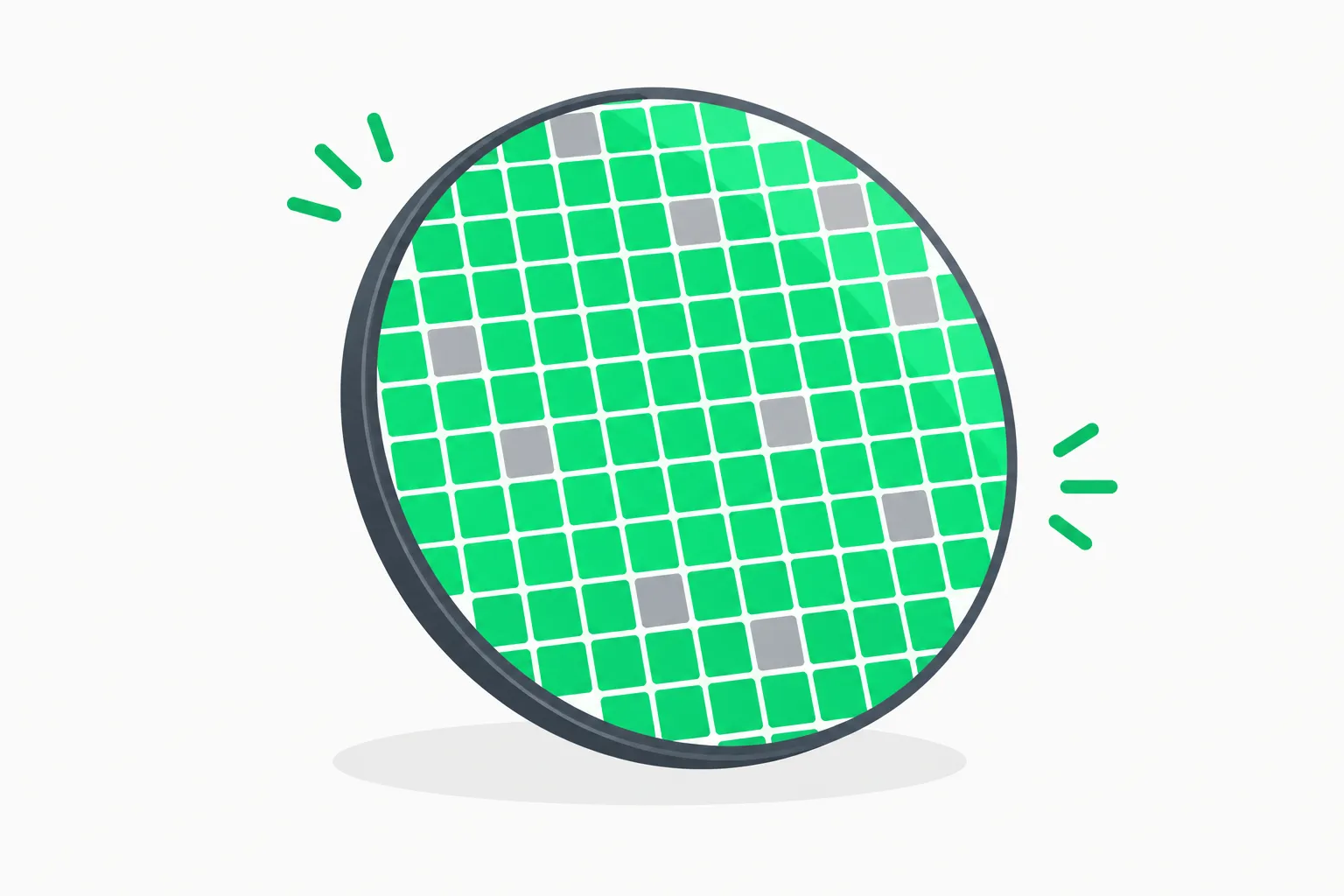 A wafer with most squares green and a few gray, a visual shorthand for fab yield, the skill TSMC would bring to a new US fab
How to read stories like this
When a headline attributes a demand to a company, ask four questions. Is the quote from the company or from an anonymous source? Has the company confirmed or denied it? Is the verb in the headline ("demands") in the source text, or did an aggregator choose it? What is the date of the primary statement relative to the headline? Here, the primary statement is Musk's October 7 post, which is a rebuttal, and the headline arrived later. Check the originals: Bloomberg's account on Taipei Times and the ANI summary are both short and carry the actual quotes.
Treat any figure about Terafab's cost or capacity as an estimate until a company document says it. If you build on top of AI infrastructure, the practical takeaway is to not plan around a Terafab dividend before the end of the decade, and to keep an eye on the tool and process suppliers that gate everyone's capacity.
Related reading
- What is Terafab.ai?
- TSMC Q3 2026: record profit and 2nm
- ASML Q3 2026: AI demand exceeds EUV supply
- GlobalFoundries Malta, Japan and Commerce stake
- Nvidia's $21 billion SpaceX stake
- Musk on Grok 4.7 and SpaceX training
Details are accurate as of October 15, 2026. Terafab terms and TSMC's position may change; check the linked sources for updates.