



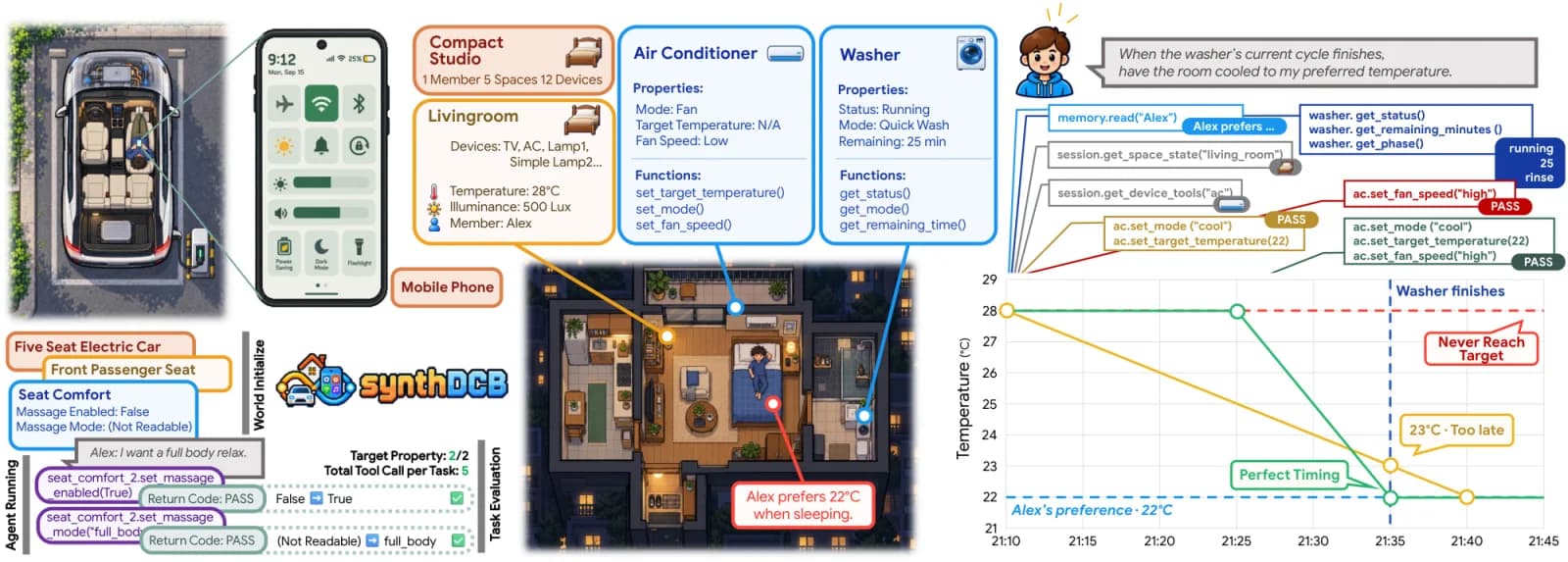
SynthDCB is an open benchmark that uses world distillation to turn device manuals and protocols into executable smart-home, car, and phone worlds, then scores tool-using agents on thousands of verifiable tasks. Authors at SJTU X-LANCE Lab published arXiv 2611.18639 and, on November 24, 2026, announced the complete dataset and code on Hugging Face.
Why device-control evaluation breaks at scale
 Local inference stack beside a smart-home hub illustration
Hand-written smart-home demos do not keep pace with new SKUs, OTA firmware, and multilingual intents. SynthDCB argues you must scale both the interactive world and the task bank. World distillation (WD) automates that by compiling device behaviors, constraints, and environmental effects into modular executables.
Consumer assistants already promise unified control—lights, thermostats, car climate, phone settings—but eval suites lag Matter, CarPlay, and OEM APIs. A distilled world lets you add a new device class by re-running WD on an updated protocol PDF, not by authoring 200 manual tasks.
What explodes without automation
| Manual eval pain | WD-style automation |
|---|---|
| Engineer writes one-off JSON per device | Parser emits function catalog |
| QA copies prompts from spreadsheets | Generator samples 8 instruction styles |
| Flaky tests on real hardware | Deterministic sim state checks |
| No shared failure vocabulary | 12-category error report |
That is why agent platform teams track Duopra full-duplex tool calls and mobile agent testers in CI—tool loops need repeatable worlds, not demo scripts.
Five task families and eight instruction styles
The paper organizes five task families with 32 subtypes and supports eight instruction styles (natural language templates that stress different user phrasing). For product teams, that mimics real smart-home traffic: some users say device names, others say rooms, others use vague goals (make it cozy). Benchmarks that only test canonical JSON commands overfit.
When you run SynthDCB on your model, slice metrics by instruction style before you trust a single Pass@1. A model that aces imperative commands may fail indirect requests—exactly what Anthropic's enterprise adoption study warns about in knowledge work, applied here to IoT.
Diagnostic metrics for reward design
20+ diagnostic metrics are the underappreciated part of the release. RL teams need partial credit signals that are not gameable:
- Did the agent call the right tool but with wrong arguments?
- Did state change transiently then revert?
- Did the agent ignore safety interlocks?
SynthDCB exports explicit states and tool-call traces, so you can build shaped rewards for AWS agent training stacks without guessing from pixel observations.
Failure taxonomy in practice
The 12 error categories across 4 groups are meant for human review at scale: sort thousands of failed trajectories into buckets before you read ten deeply. That workflow mirrors peak-cut style ops tooling—aggregate, then drill down.
Example planning questions for your retro:
- Discovery errors — agent never found the capability in the tool list.
- Parameterization errors — right tool, illegal parameter combo for device state machine.
- Ordering errors — steps correct in isolation, illegal order (arm security then unlock).
- Environment awareness errors — agent ignored room context or car ignition state.
| Component | Role |
|---|---|
| Capability representation | Links tool discovery, world execution, task synthesis |
| Executable modules | Deterministic checks for state and traces |
| Task generator | Emits 8 instruction styles across 32 subtypes |
That design complements Hugging Face Harbor agent eval guidance and Greptile computer-use trees—but focuses on IoT state, not desktop GUIs.
What is inside the benchmark
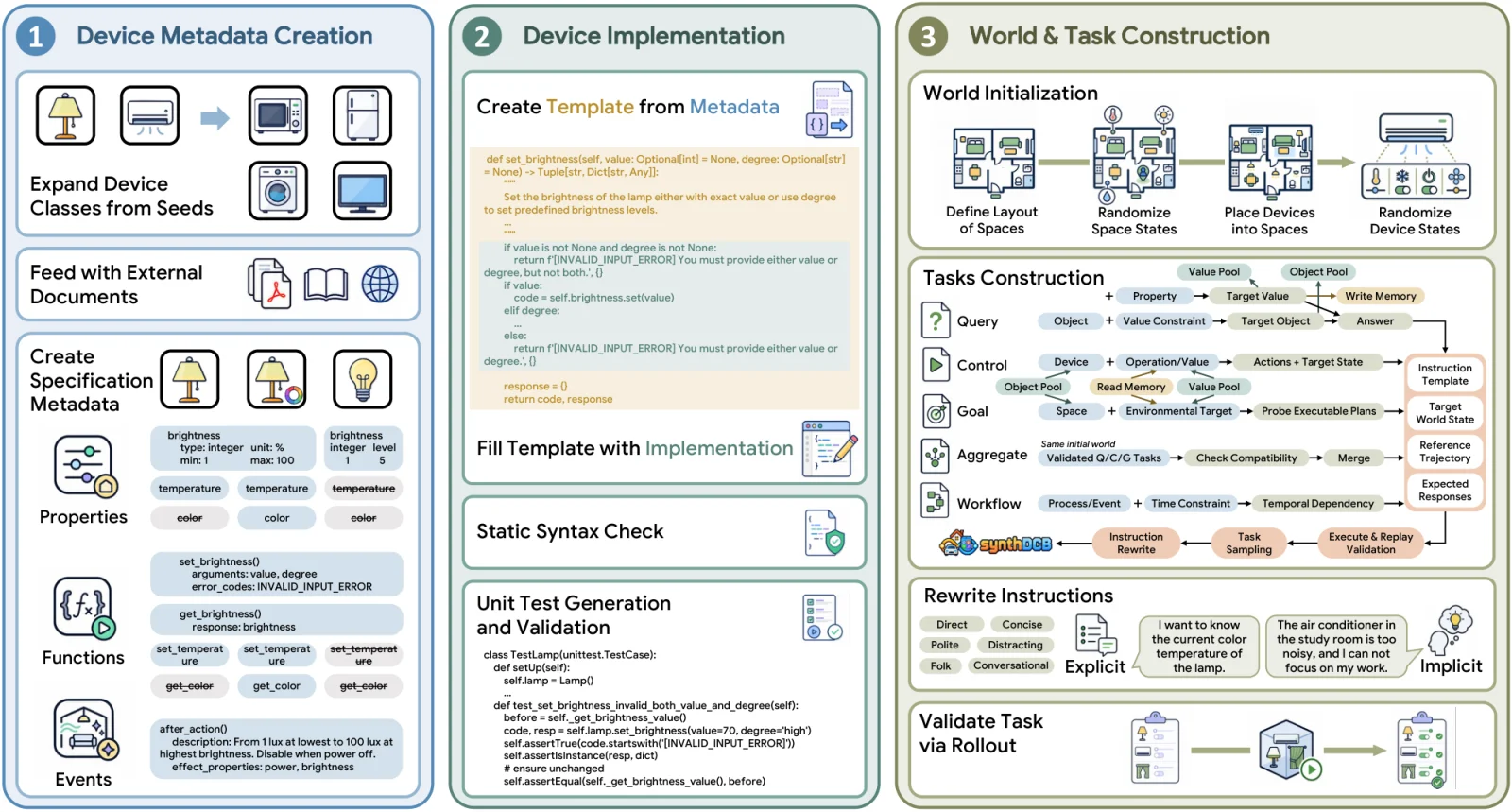 SynthDCB pipeline from device metadata through world distillation to benchmark tasks
Image: SJTU X-LANCE Lab
From the paper abstract and November 24 author thread:
- Domains: Home, Car, Phone
- Device classes: 114
- Functions: 1,166
- Events: 95
- Test tasks: 2,560 across 32 subtypes
- Models evaluated: 22 in the paper tables
- Best mean Pass@1: 88.8%
20+ diagnostic metrics track task outcome, state correctness, and execution behavior, aimed at reward design for downstream RL, not just a single accuracy number.
Authors also taxonomy failures with 12 error categories in 4 groups across all failed first attempts—useful for agent incident postmortems.
World distillation efficiency claims
The Hugging Face post highlights construction economics:
- Three domains built in hours via parallel WD.
- RobotVacuum world from a real protocol with 51.5–86.7% fewer tokens per fully covered requirement than Codex (xhigh) + GPT-5.6 Sol, per authors.
- Coverage at L3: 22/23 property dimensions on the paper checklist; 1,000 generated tasks cover 69.8% of 172 intents and 81.6% of 854 reference instructions drawn from industrial test cases.
Treat token savings as internal baselines until you reproduce WD on your appliance docs.
How to run SynthDCB
- Visit https://x-lance.github.io/SynthDCB/ for the task catalog overview.
- Clone https://github.com/X-LANCE/SynthDCB after the November 24 full drop.
- Pick a domain aligned with your product—Phone if you automate settings, Home for voice assistants, Car for IVI agents.
- Run Pass@1 on your model API and archive tool-call traces for regression tests in CI.
- Map failure categories to product backlog items instead of generic agent is bad tickets.
Comparison to related ideas
| Project | Focus | SynthDCB difference |
|---|---|---|
| Code as Worlds | Physics for VLMs | Device protocols and consumer IoT |
| OSWorld-style desktop evals | GUI pixels | Structured device state |
| AWS Strands Decider | Hosted decision agents | Open sim with published tasks |
Security note for agent builders
Device-control benchmarks can include dangerous actions if ported to real hardware. SynthDCB worlds are simulated, but wrappers that hit live APIs need approval tiers, rate limits, and audit logs when you move from eval to production accounts—especially for cameras, locks, and vehicle subsystems.
Never pipe SynthDCB success directly to production OAuth tokens without human approval tiers. Treat 88.8% Pass@1 as lab performance on synthetic distributions, not safety certification.
Integrating SynthDCB into CI
A practical rollout for startups:
- Nightly job runs 50 held-out tasks per domain on main.
- Block releases on regression > 2 points in Pass@1 or spikes in safety-category failures.
- Store traces beside GitHub Actions parallel QA logs for shared debugging.
- Pair with red-team prompts from libernt ReactOS agent forks only if you need adversarial wording—otherwise stay on published task splits.
World distillation vs manual world building
| Approach | Time to add dishwasher class | Risk |
|---|---|---|
| Manual QA scripts | Days of engineer time | Stale on firmware update |
| WD from protocol | Hours per authors | Parser gaps on PDF tables |
| Record-replay on hardware | High fidelity | Flaky, not parallelizable |
Authors claim three domains in hours—replicate on one appliance family you care about before you trust the token savings figure against Codex.
Ecosystem positioning
SynthDCB is not a felony-bench incident; it is preventive instrumentation. It sits beside Hugging Face Harbor as infrastructure for the next wave of on-device agents teased in Qualcomm phone forecasts-adjacent coverage and Amazon worker pushback on data centers—more devices, more API surface, more need for sim.
Limits
- Pass@1 on synthetic tasks may overstate real-world reliability.
- 22-model table uses authors' picks; your frontier model may not be listed yet.
- Chinese lab release—docs may bias toward Mandarin device names in examples.
- Star count was modest on release day; expect setup friction.
Mapping SynthDCB scores to product SLAs
If Pass@1 is 88.8% in sim, do not promise 99.9% uptime on real devices. A conservative translation:
| Sim Pass@1 bucket | Suggested production stance |
|---|---|
| Below 70% | Research only — no user-facing automation |
| 70–85% | Human confirm on irreversible actions |
| 85–92% | Limited autonomies with undo and audit |
| Above 92% (in sim) | Still require hardware soak tests |
Pair sim gains with Amazon Bedrock trusted access patterns when models touch cloud accounts.
Week-one replication checklist
- Pin commit hash after the November 24 full data announcement.
- Run smoke tests on CPU-only laptop to validate install, then scale up.
- Export one failure per error category for design reviews.
- Compare your agent against paper's 22-model table only on tasks you actually support.
- Document token use if you re-run WD on a proprietary manual—watch NDA boundaries.
What to do next
- Reproduce one Home subtype and publish traces.
- Feed failure codes into your Claude Code parallel QA harness.
- Compare WD token cost against your in-house world builder.
- Watch X-LANCE for dataset revisions.
Related reading
- Hugging Face agentic evaluation guide
- Greptile Trex computer-use benchmark
- AWS Strands Decider v2
- Autopilot visual agent harness
- Duopra full-duplex agency tool calls
- Code as Worlds executable physics
Sources: arXiv 2611.18639, project page, GitHub, Hugging Face paper page
Historical note
Simulated device graphs powered voice assistant research for a decade; SynthDCB's twist is automated distillation from protocols at benchmark scale. Expect forks that target industrial PLCs or hospital beds—the WD harness is the portable part.
Accurate as of November 24, 2026. Scores and token comparisons are author-reported.