



Pixels are evidence of the physical world, not its ontology — and the #1 Hugging Face paper on August 31, 2026 turns that line into a training pipeline.
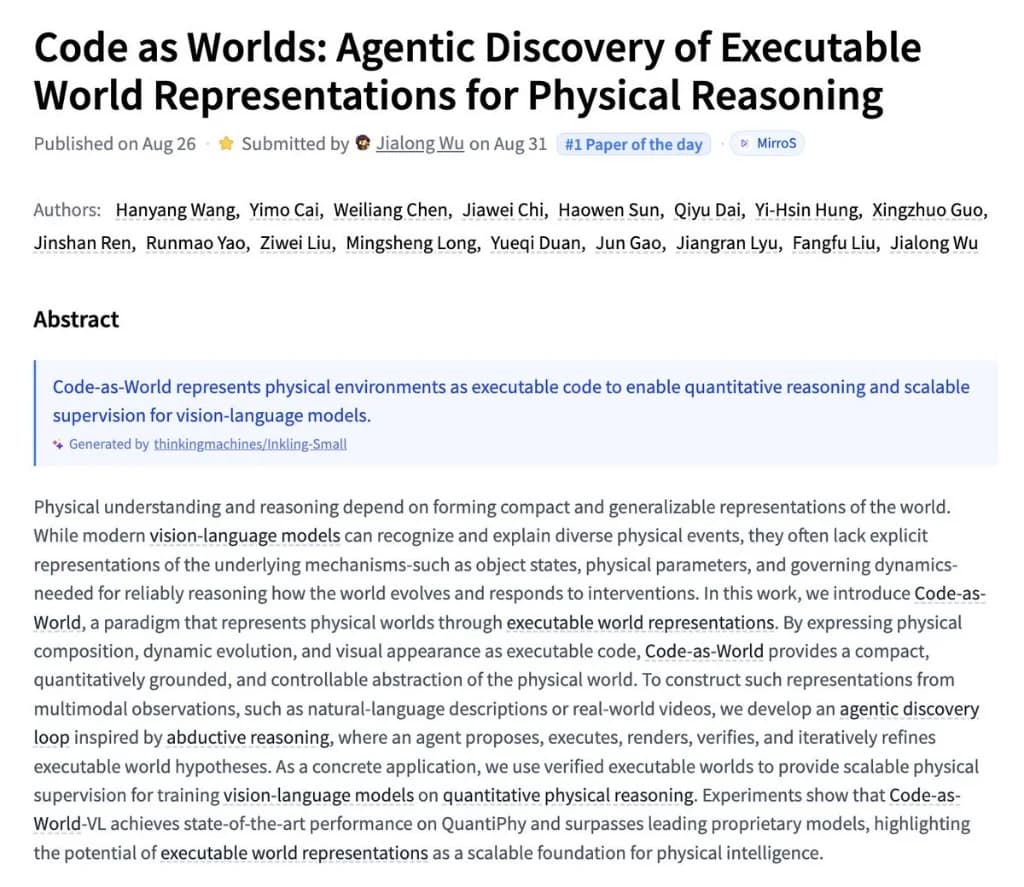
On August 26, 2026, researchers published Code as Worlds: Agentic Discovery of Executable World Representations for Physical Reasoning (arXiv 2608.27549). By August 31, Hugging Face ranked it #1 Paper of the day with MirroS community traction. The core claim: represent physical scenes as executable code, discover that code with an agentic loop, then train vision-language models on verified executable worlds for quantitative physical reasoning.
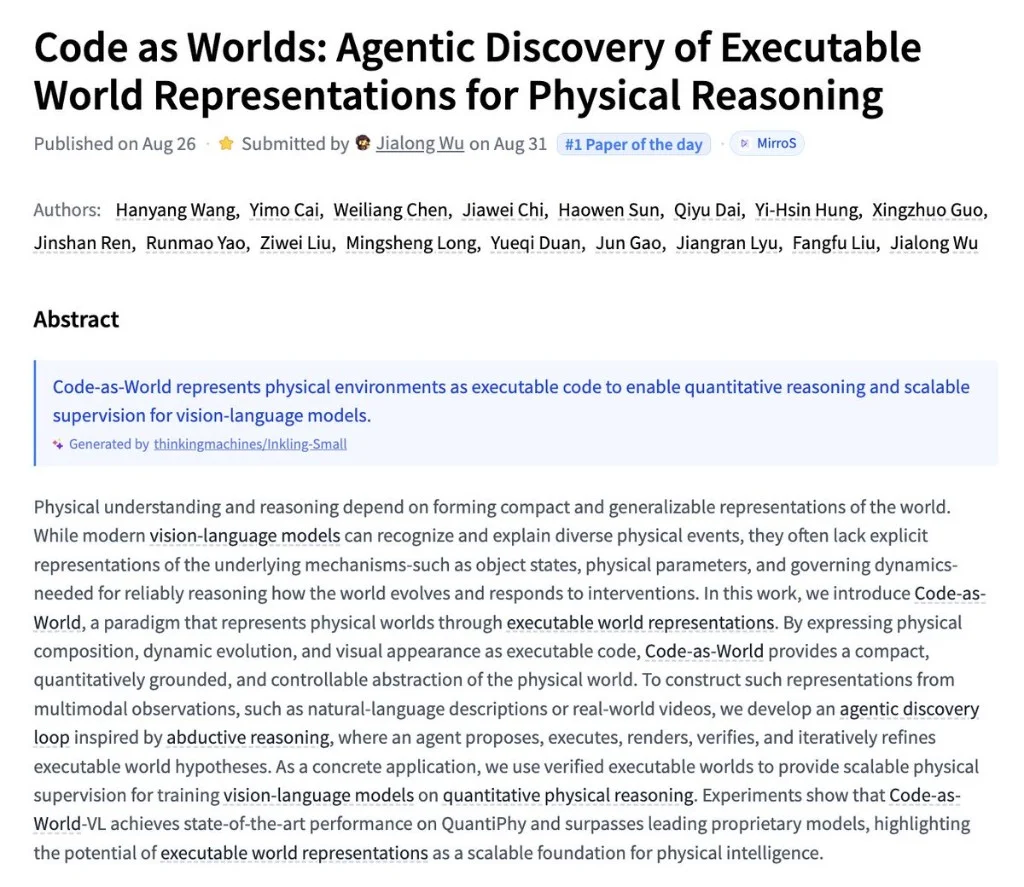 Code as Worlds paper on Hugging Face Papers — executable world representations for physical reasoning
Lead author Jialong Wu summarized the thesis on the paper page: observations become reusable physical data — explicit states, dynamics, and mechanisms — not just what was seen but the world that could have produced it.
TL;DR — what people are asking
| Question | Direct answer |
|---|---|
| What's new? | Executable code as the world representation + agentic abductive discovery from video/text |
| Why not pixels? | VLMs recognize events but lack explicit state/dynamics for intervention reasoning |
| Loop steps? | Propose → execute → render → verify → refine hypotheses |
| Results? | Code-as-World-VL SOTA on QuantiPhy; beats proprietary VLMs per authors |
| Models on HF? | Multiple VL checkpoints (5B/9B class) citing the paper — check cards for license |
| Builder relevance? | Inspectable simulators as scalable supervision — aligns with eval-heavy agent stacks |
The problem — VLMs see but do not simulate
Modern vision-language models describe collisions, pours, and balances convincingly. The paper argues they still lack compact mechanisms: object states, physical parameters, and dynamics that predict what happens if you change something.
That gap matters for:
- Robotics policy learning with counterfactuals
- Quantitative QA ("how far?", "how fast?", "will it tip?")
- Scalable supervision without hand-labeling every frame
explainx.ai covered the adjacent robotics angle in Dyna-2 world action models and Yann LeCun's physical-agents critique. Code-as-World is the VLM-centric branch: make the world model runnable and inspectable, not only latent.
Code-as-World — three layers in one program
The paradigm expresses:
| Layer | Encoded as code |
|---|---|
| Composition | What objects exist and how they relate |
| Dynamics | How states evolve over time under physics |
| Appearance | How the scene renders for comparison to video |
Because the representation executes, you can measure predictions — distances, velocities, contact forces — instead of scoring prose plausibility. That connects to Paul Graham's verifiable-answers thread: physics with a simulator is a grader.
Agentic discovery — abduction as a loop
Constructing code from raw video is underspecified. The paper's loop:
- Propose an executable world hypothesis from language and/or video
- Execute the simulation
- Render predicted visuals or quantities
- Verify against observations
- Refine until mismatch falls below threshold
This is the same structural move as strong agent harnesses: tool use with a critic, but the tool is a physics runtime and the artifact is world code.
For builders running coding agents, the parallel is Programmatic Tool Calling — keep intermediate state out of context by executing in an environment — except the environment is a physical simulator.
Training Code-as-World-VL
Verified executable worlds become scalable physical supervision for VLM fine-tuning. Reported outcome: Code-as-World-VL reaches state-of-the-art on QuantiPhy and exceeds leading proprietary models on those quantitative tasks.
Hugging Face already hosts four model repos citing the paper (5B and 9B variants). Treat them as research checkpoints until you validate on your domain — same discipline as any fresh HF release.
What people are asking — limitations
Simulation fidelity. Executable worlds are only as good as the physics model class the agent searches over. Exotic materials or fine deformables may sit outside the hypothesis space.
Compute. Discovery loops burn simulation + VLM calls. Budget like any multi-step agent eval, not a single forward pass.
Not a robot stack by itself. This trains reasoning VLMs. Embodied control still needs actuators, latency budgets, and safety envelopes — see on-device multimodal robots for the deployment end of the pipeline.
Complement, not replacement, for neural world models. When you need photoreal rollouts at video rate, neural predictors still win. When you need quantitative guarantees and inspectable state, code worlds earn their keep.
Prompt sketch — reproducing the idea in your stack
If you are experimenting without the paper codebase:
Given this 10s clip of a block sliding on an incline:
1. Propose minimal Python (or MuJoCo/Box2D) code whose state variables include
   angle, friction, and block mass.
2. Simulate and predict stop position.
3. Compare to measured pixel trajectory; list top-3 parameter edits that reduce error.
4. Output only the final executable world file and numeric error table.
Run inside a sandbox — untrusted generated physics code is still code.
Related on explainx.ai
- Dyna-2 world action model — robotics scaling
- Yann LeCun — LLMs vs physical agents
- What is an agent harness?
- Terminal Bench 2.0 — agent evaluation
- Gemma 4 on Open Duck Mini — on-device embodied AI
- Paul Graham — verifiable answers and graded domains
Paper published August 26, 2026; Hugging Face ranking and model uploads as of August 31, 2026. Benchmark claims per author preprint — reproduce on your workload before betting product direction.