



On July 8, 2026, Cognition launched SWE-1.7 — the most capable model they have trained, available today in Devin at 1000 tokens per second via Cerebras. The pitch is not raw benchmark crown — it is frontier-class agentic coding at a fraction of the cost, advancing what they call the cost-performance Pareto curve.
 SWE-1.7 — Cognition's frontier coding model on FrontierCode and Terminal-Bench, July 8 2026
The same day Cursor shipped Grok 4.5 and OpenAI rolled out GPT-Live, Cognition's drop targets long-horizon software engineering — the async tasks Devin was built for, not chat-optimized coding assists.
TL;DR
| Question | Answer |
|---|---|
| Launch? | July 8, 2026 in Devin (Web, Desktop, CLI) |
| Speed? | 1000 tok/s via Cerebras |
| Base? | Kimi K2.7 Code + Cognition RL |
| FrontierCode 1.1? | 42.3% (GPT-5.5: 43.0%, Opus 4.8: 46.5%) |
| Terminal-Bench 2.1? | 81.5% (Opus 4.8: 86.9%) |
| SWE-Bench Multilingual? | 77.8% (Opus 4.8: 84.4%) |
| Open weights? | No — Devin platform |
| RL ceiling? | Cognition argues no — big gains after K2.7 RL |
Benchmark Table (Cognition-Reported)
| Benchmark | SWE-1.7 | Kimi K2.7 | GPT-5.5 | Opus 4.8 | Composer 2.5 | GLM-5.2 |
|---|---|---|---|---|---|---|
| FrontierCode 1.1 Main | 42.3% | 30.1% | 43.0% | 46.5% | 25.6% | 24.5% |
| Terminal-Bench 2.1 | 81.5% | 72.7% | 84.2% | 86.9% | 76.0% | 81.0% |
| SWE-Bench Multilingual | 77.8% | 73.5% | 76.8% | 84.4% | 71.6% | 74.5% |
All models evaluated at maximum reasoning effort per Cognition. Terminal-Bench uses Devin CLI for non-Anthropic/OpenAI models; Anthropic via Claude Code, OpenAI via Codex.
SWE-1.7 sits within a few points of GPT-5.5 on FrontierCode while Cognition's cost curve plots it far left on dollars per rollout — the economic story matters for agent products billing per task.
Training: Four Ideas That Moved the Needle
1. Entropy preservation (top-p sampling replay)
Long RL runs often hit entropy collapse — policies stop exploring, rewards plateau. Cognition uses top-p sampling plus sampling distribution replay so trainer and inference distributions stay aligned.
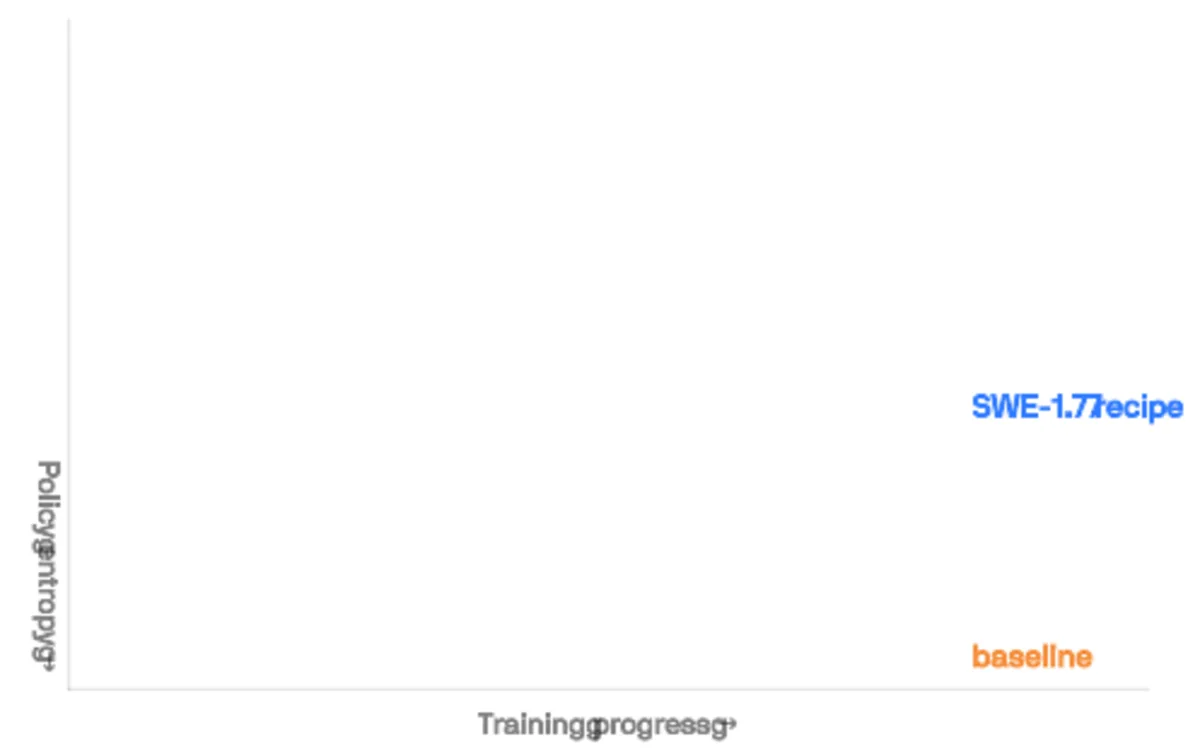 Policy entropy across training — SWE-1.7 recipe holds entropy steady vs baseline decay
 Training-inference mismatch — sampling replay keeps divergence bounded
2. Multi-cluster RL across three continents
Only the trainer needs one high-bandwidth cluster. Rollout inference engines run globally; compressed weight deltas (~99% smaller than full weights) sync through object storage in 1–2 minutes for trillion-parameter-class models.
3. Self-compaction + alternating length penalty
Rollouts reach up to six hours by having the model summarize working state and resume. Alternating phases — unconstrained success-only training vs budget phases — compress verbosity on easy tasks without killing hard-task reasoning.
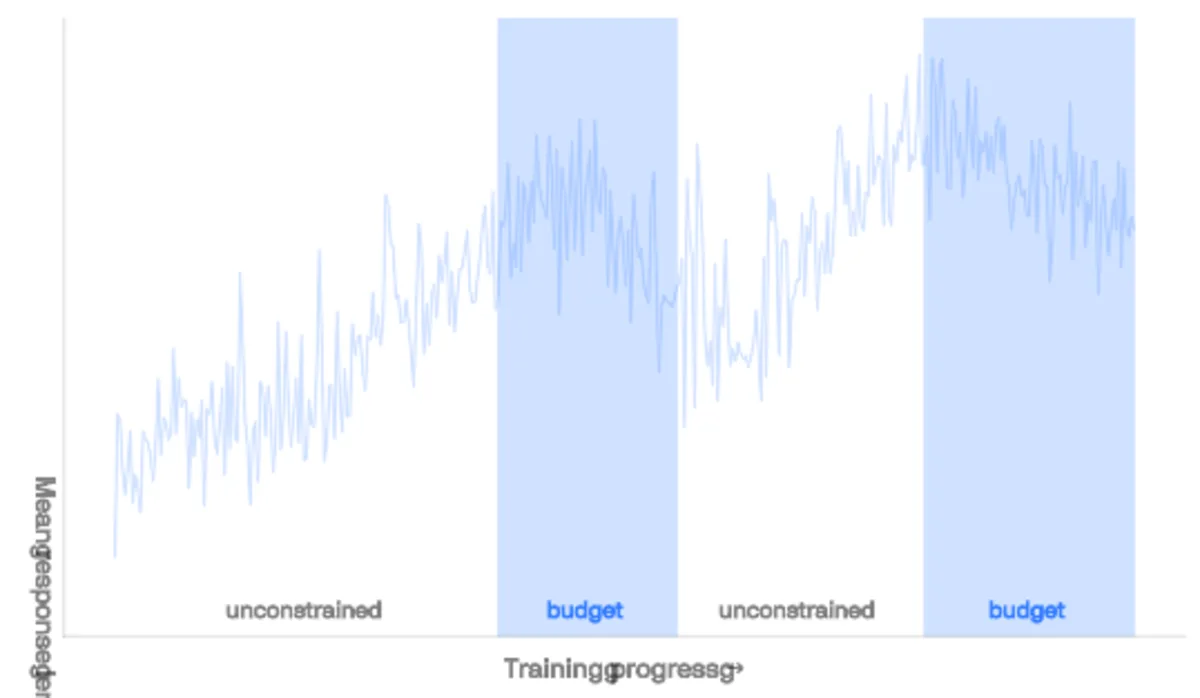 Mean response length under alternating length penalty
4. Verifier-hardened data
False positives and reward hacking are treated as poison. Sandboxes are network-restricted; git history stripped; cheating attempts get zero reward regardless of outcome.
Behavioral Shift vs Kimi K2.7
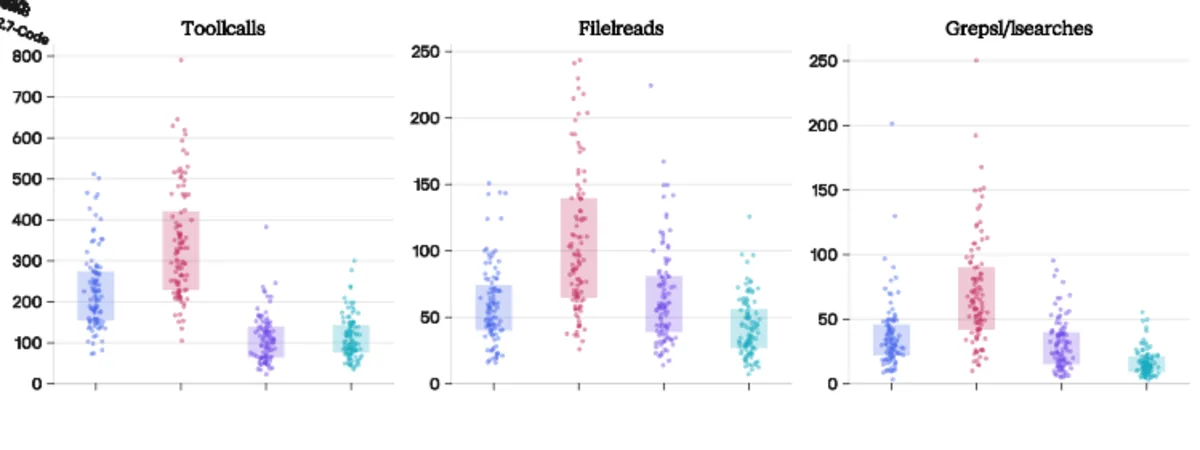 Behavioral tendencies — SWE-1.7 makes more tool calls, reads, and searches per run
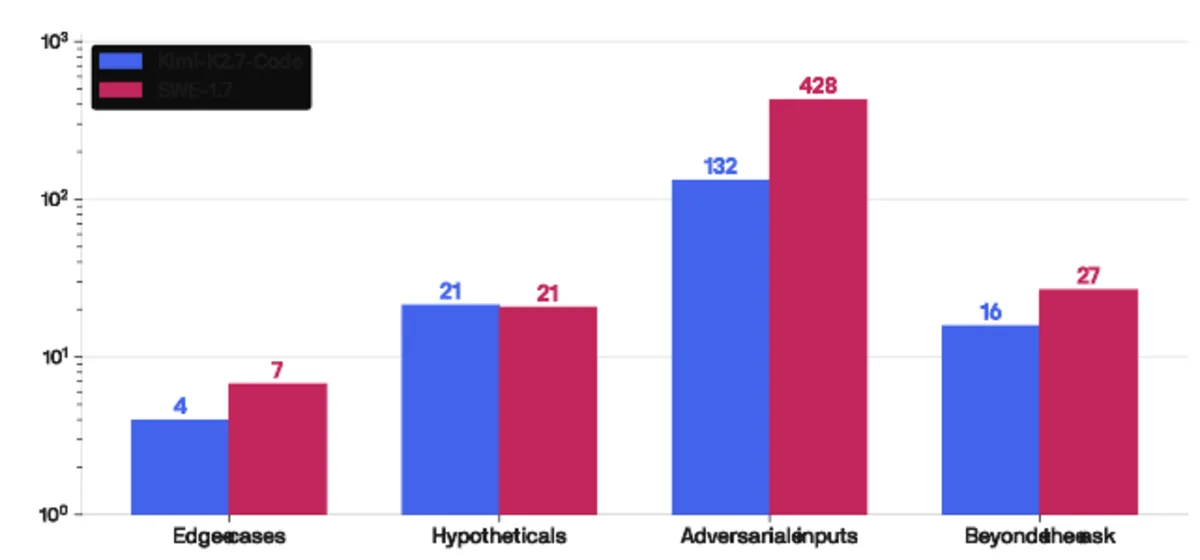 Edge-case probing in chain-of-thought — SWE-1.7 vs Kimi K2.7 on FrontierCode
Cognition highlights:
- More exploration before edits — reads, greps, small probe scripts
- Condensed chain-of-thought — shorter sentences, fewer function words
- Root-cause bug fixes — beyond the reported symptom
- Tradeoff: slightly wider file touch on some tasks as reasoning depth grows — an industry-wide pattern they flag explicitly
SWE-1.7 vs Open Weights (GLM, Kimi)
| Path | SWE-1.7 / Devin | GLM-5.2 / Kimi OSS |
|---|---|---|
| Access | Devin subscription | API + open weights |
| Speed | 1000 TPS Cerebras | Varies by host |
| Eval focus | FrontierCode merge quality | Public leaderboards |
| Trust | Cognition trustworthiness post | Self-host control |
Teams on Kimi K2.7 in GitHub Copilot get model intelligence without Devin's harness. SWE-1.7 is the bet that harness + RL + inference co-design beats raw weights alone.
Honest Limitations
- Not open — you cannot self-host SWE-1.7 or audit weights
- Devin lock-in — compare against Claude Code, Cursor Composer 2.5, and Codex on your repos
- Self-reported evals — FrontierCode is Cognition-owned; cross-vendor Terminal-Bench uses different harnesses
- Cost claims — mean USD per rollout is internal; reproduce on your task mix
The Bottom Line
SWE-1.7 is Cognition saying RL is not tapped out — not after Kimi K2.7, not after SWE-1.6's 9.4% FrontierCode. The infrastructure story (multi-continent rollouts, entropy control, six-hour compactions) is as important as the scoreboard.
If you live in Devin, you get 1000 TPS frontier-near coding today. If you live in open weights, GLM-5.2 and Kimi still win on control and price — different Pareto point.
Update (September 10, 2026): Marc Andreessen's a16z Cognition announcement cites Devin writing 90%+ of Cognition production code (up from 13% in a year) plus Mercedes COBOL, Rivian test-gen, and Itau vuln-remediation wins.
Update (September 11, 2026): Successor shipped — SWE-2 hits 50.0% FrontierCode 1.1 (vs SWE-1.7's 42.0%), 92.8% Terminal-Bench 2.1, Kimi K3 base at 2.8T-param RL scale, with medium effort at 58% fewer turns and 81% lower cost than SWE-1.7.
Update (September 12, 2026): Cognition shipped Fusion to Devin CLI and Desktop — a frontier planner paired with SWE-2 as a cheap executor, cutting coding-benchmark costs roughly 36-39%.
Related on explainx.ai
- Devin Fusion in CLI: 39% cheaper coding-agent runs (Sep 2026) — dual-model harness built on SWE-2 as sidekick
- Marc Andreessen: Devin writes 90%+ of Cognition production code (Sep 2026)
- Cognition Acquires Poke Maker Interaction — Devin's maker buys a texting-agent company, July 23, 2026
- Terminal-Bench 2.0 Agent Evaluation — benchmark context
- Kimi K2.7 GitHub Copilot — SWE-1.7's base lineage
- GLM-5.2 China Open Weights Wave — open alternative
- Cursor Composer / Grok 4.5 — IDE-native frontier coding
- Agent Harness Engineering — why harness beats model alone
- Claude Code vs Codex vs GLM — routing guide
Sources: Cognition — SWE-1.7 · Cognition on X (July 8, 2026).
Benchmarks and availability per Cognition's July 8, 2026 post — verify in Devin before procurement decisions.