




Stripe has told its own investors that OpenRouter will join Stripe as its largest-ever acquisition. The August 19, 2026 letter — signed Patrick, John, and Will — is the first-party confirmation after Bloomberg's August 17 report of a $7B+ deal. Axios later said the letter put the price above $8 billion, mostly stock. The four pages of the letter we have do not print a dollar figure. They do say the deal should close in the coming weeks, that OpenRouter's token consumption is compounding at 9% per week year-to-date, and that Stripe now thinks of a developer's intelligence pipeline the way it already thinks of a revenue pipeline.
If you route model calls through OpenRouter — or you've been weighing it against a direct provider API, Cloudflare's AI Gateway, or a self-hosted router — this is not a stock story. A payments company is buying the routing layer a large share of AI builders depend on. That has implications for what you pay and what you can rely on.
This isn't a stock story. explainx.ai doesn't cover valuations for their own sake — but when the acquirer is a billing infrastructure company and the target is the API layer millions of builders route inference traffic through, the deal mechanics are secondary to the practitioner question: what changes about what you build or pay?
TL;DR
| Question | Answer |
|---|---|
| What happened? | Stripe's Aug 19 letter: OpenRouter joins as largest-ever acquisition; close expected in coming weeks |
| Price | Bloomberg $7B+ (Aug 17). Axios: letter said $8B+, mostly stock. The letter pages themselves do not print a number |
| What is OpenRouter? | Unified API across 400+ models; Stripe calls it the world's largest token routing engine |
| Who founded it? | Alex Atallah (co-founder of OpenSea) in 2023 |
| How big is it? | ~8 million users; letter says token consumption compounding 9% per week YTD |
| Prior valuation | $1.3 billion, 82 days before Bloomberg's report — a 5x+ jump if the $7B/$8B reporting holds |
| Sibling deals | Bridge, Privy, Metronome — same "economic infrastructure for AI" stack |
| Does the API change today? | No announced changes — deal is not closed yet |
| What should builders watch? | Close date, pricing, billing/Metronome depth, rate limits, provider-neutrality |
 Stripe OpenRouter acquisition illustration: payments coins and AI tokens merging into one routing conduit
What Stripe's August 19 letter actually adds
Until this week, the deal was a Bloomberg leak. The letter is Stripe talking to its own shareholders. Dated August 19, 2026, signed Patrick, John, and Will, it puts OpenRouter in a stack Stripe has already been assembling:
"We're reaching out because we're announcing that OpenRouter will be joining Stripe, as our largest-ever acquisition. This comes after the recent acquisitions of Bridge, Privy, and Metronome."
And later:
"We expect the deal to close in the coming weeks."
That last line matters more than the adjective "largest-ever." It is not closed. API terms, logging defaults, and invoices should be treated as pre-close until OpenRouter or Stripe says otherwise.
The letter's actual thesis for why OpenRouter: developers already have Stripe as a revenue pipeline; they now need the same kind of boring reliability for an intelligence pipeline — cost per unit, which models handle which tasks, who pays, when, time-value of delay. Stripe says it has already seen that parallel inside its own products: Radar (built for financial fraud) is "proving extremely effective at guarding against token fraud," and Metronome — used by Anthropic, Nvidia, and others — is how metered billing and token serving become the same problem.
On OpenRouter specifically, the letter claims:
- world's largest and most trusted token routing engine
- all major models and providers
- token consumption compounding at 9% per week year-to-date
Nine percent a week is a Stripe figure, not an audited traffic report. If it holds, it is why a payments company would pay "largest-ever" prices for a router. If it doesn't, it is the same class of unverifiable internal metric as the firm-creation "singularity" claim in the same envelope.
The letter also sketches the rest of the stack it wants agents to live on — discovery (Stripe Directory, Projects, Provisioning API), usage (Metronome), payment (Bridge, Agentic Commerce Suite, Tempo, MPP), fund storage (Privy, Open Standard). That is the practitioner map: OpenRouter is the model-call hop; the rest is how an agent finds a seller, meters the work, and settles.
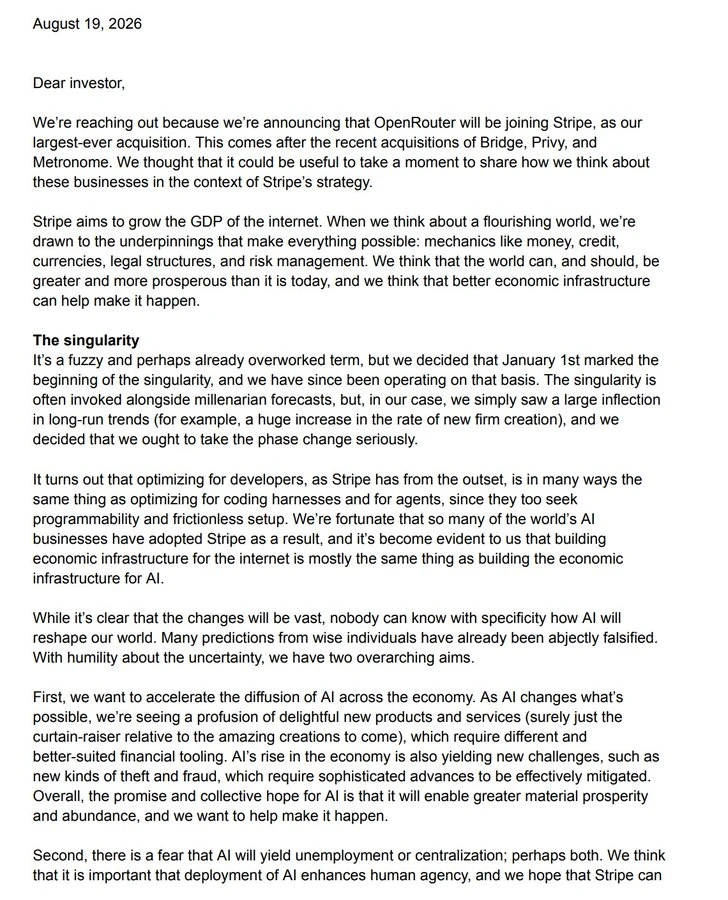 Page 1 of Stripe's August 19, 2026 investor letter announcing OpenRouter as its largest-ever acquisition
Stripe investor letter, August 19, 2026, page 1. Attribution: Stripe.
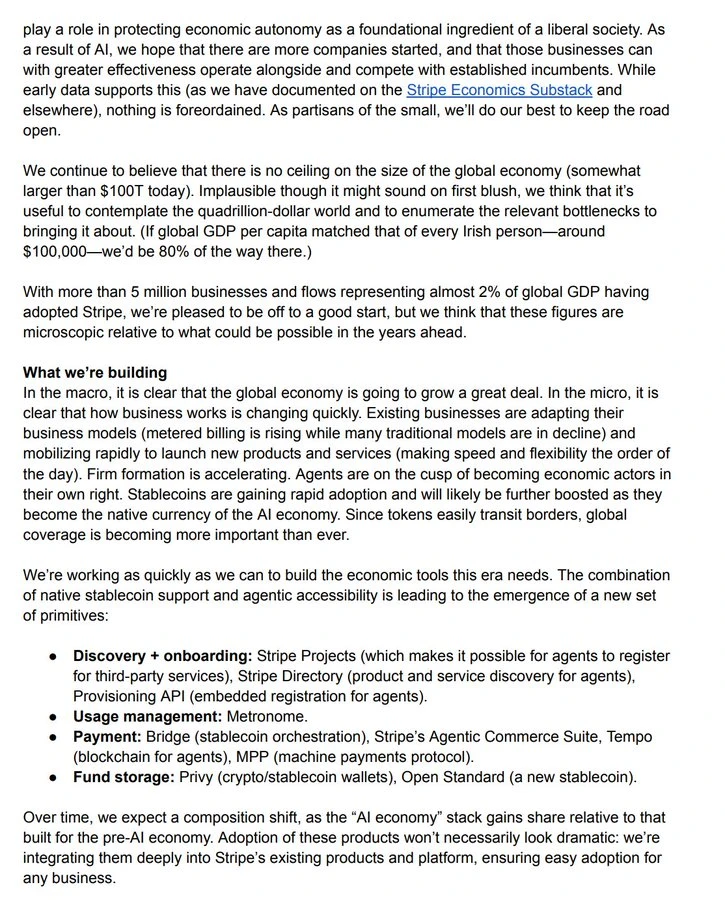 Page 2 of the same letter, on Stripe's AI-economy product stack
Page 2 — discovery, Metronome, Bridge/Privy, and the "no ceiling" GDP aside.
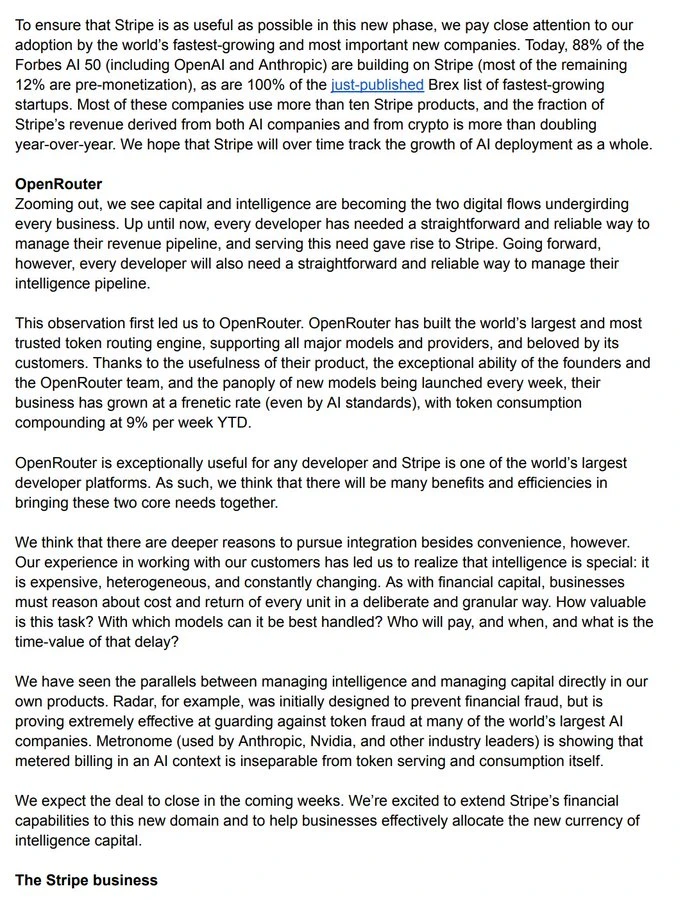 Page 3 of the letter, on OpenRouter as the intelligence pipeline
Page 3 — OpenRouter, 9%/week token growth, Radar vs token fraud, close in coming weeks.
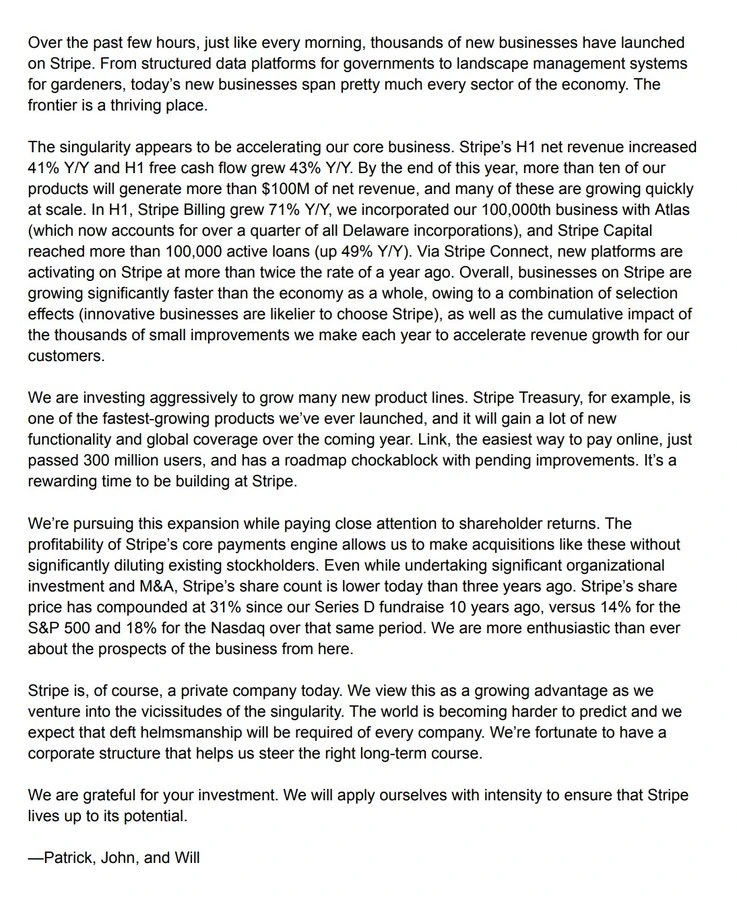 Page 4 of the letter, Stripe H1 2026 business metrics
Page 4 — H1 +41% revenue / +43% FCF, Billing +71%, Atlas 100,000th business, Link at 300 million users. Not an OpenRouter API changelog.
The same letter still contains the January 1 "singularity" line. We take that claim apart — definition, evidence, Chollet/Marcus — in the companion post. This page stays on the routing layer you might already have in production.
What OpenRouter actually does, and why it matters to builders
OpenRouter's pitch is simple: instead of integrating separately against OpenAI's API, Anthropic's API, Google's API, and every open-weight provider you want to try, you integrate once against OpenRouter and get all of them. It routes requests across 400+ models from dozens of providers, optimizing for cost, latency, and availability, with automatic fallback when a given provider has an outage.
For teams that have been thinking hard about AI token pricing and what a model swap actually costs to implement, that abstraction is the entire value proposition. Without a router, switching from one model to a cheaper or faster one means new SDK calls, new auth, new error handling, and new prompt formatting quirks per provider. With a router, it's a config change. That's also why OpenRouter shows up so often in explainx.ai's own coverage — Hermes Agent hit #1 on OpenRouter's global app rankings burning 271 billion tokens through it, Asian open-weight models reportedly account for 60% of OpenRouter's token volume, and OpenRouter's own web search benchmarks have become a reference point for agent builders deciding how to ground their tools in live search. It's not a niche utility — it's load-bearing infrastructure for a meaningful slice of the AI-building ecosystem, including multi-model fusion setups and teams using it as a Fable 5 alternative when direct access is constrained.
That's what makes the acquisition worth a post rather than a passing mention: this is money-and-billing infrastructure changing hands underneath a tool a lot of readers already have in their stack.
What changed: the deal, the number, the timeline
The reported facts, per Bloomberg via multiple X accounts (@business, Andrew Curran, NIK, Kalshi):
- Stripe's August 19 letter says OpenRouter will join Stripe as the largest-ever acquisition, expected to close in the coming weeks — not a closed merger today.
- Bloomberg (August 17) had more than $7 billion; Axios said the letter put it above $8 billion, mostly stock. The letter pages do not print a number.
- OpenRouter raised at a $1.3 billion valuation 82 days before Bloomberg's report.
- Stripe already handled OpenRouter's billing — vendor becoming owner.
- Stripe's letter adds the 9%/week token figure and the intelligence-pipeline framing, and groups the deal with Bridge, Privy, and Metronome.
The 5x-in-82-days jump is worth noting as one data point about how fast AI infrastructure valuations are moving, not as a thesis to build out further — that's a stock-market rabbit hole, and it's not the point of this post. One reply worth citing for balance: a commenter (@midnightbobarun on X) argued the price actually looks low given how little direct competition OpenRouter has in LLM routing at its scale — a fair bull case, even if the number still moved fast.
What this means for what you build or pay
This is the part that actually matters if you're building on OpenRouter, evaluating it against alternatives, or competing with it.
1. What OpenRouter actually solves, concretely, is bigger than "one API for many models." Beyond avoiding per-provider integration work, teams use OpenRouter as a single procurement and security review instead of a dozen — one vendor to get approved instead of separately vetting OpenAI, Anthropic, Google, and every open-weight lab you want access to. It also collapses billing to one invoice instead of a stack of provider invoices, and it removes the "stranded credit" problem of prepaying one provider and being stuck with unused balance if you switch models. A pattern that shows up often in practice: builders keep a primary tool like Claude Code and use OpenRouter specifically as the fallback path to open-weight models — GLM, DeepSeek, and similar — the moment they hit a usage limit or cost ceiling, without maintaining a second integration for that fallback alone.
2. Billing infrastructure and OpenRouter's usage layer just got a lot more aligned — and there's a real bull case for why Stripe specifically is well-positioned here. Stripe's core competency is routing high-volume, latency-sensitive requests across many providers with wildly different characteristics — that's what it already does for payments, routing across card networks, banks, and regions. The argument for Stripe owning LLM routing is that it's a narrower version of a problem Stripe has solved at larger scale for over a decade. The bigger monetization thesis floated around the deal: OpenRouter under Stripe could eventually let a user buy tokens once and spend them across any model or provider, collapsing the fragmented, every-vendor-prices-differently mess of usage-based AI billing into one balance — something closer to prepaid tokens that work anywhere, rather than credits locked to one lab. The blue-sky version of that thesis has Stripe evolving into something like an AWS-for-tokens layer over time. None of this is confirmed roadmap — it's the shape of the opportunity Stripe just paid for.
3. That bull case has a real counterargument worth taking seriously. Payments companies process enormous transaction volume, but that's not the same as processing API call volume at the scale of a large consumer or ad-tech platform — Stripe doesn't have an obvious infrastructure edge over any other well-funded company that wanted to build a router from scratch. Read charitably, this deal may be more about buying OpenRouter's existing distribution, developer trust, and locked-in payment volume than about a unique technical moat Stripe alone could supply. Both things can be true: Stripe is a credible operator for this problem, and the $7B price is still substantially a bet on OpenRouter's existing position rather than a technology no one else could build.
4. Provider-neutrality is the thing to actually monitor. OpenRouter's value to builders has always rested on being a neutral middle layer — it doesn't care which model you pick, it just routes to whichever fits your cost/speed/quality constraints. A payments company has its own incentives: higher-margin routing, deeper Stripe-ecosystem lock-in, or steering traffic toward providers with better billing terms. None of that has happened yet, and nothing in the reporting says it will. But it's the single most important thing to watch over the next few months if you depend on OpenRouter for genuinely unbiased multi-provider access.
5. On the data-privacy question specifically: check the setting, don't assume it changed. If you're wondering whether routing your traffic through a payments company changes how much of your prompt/response data gets logged, the relevant fact predates this deal and is worth knowing either way — OpenRouter's own privacy documentation states prompt and completion logging is off by default, opt-in rather than opt-out. That's a real, checkable setting in your account, not a talking point, and it's worth re-verifying it hasn't changed once the acquisition closes rather than assuming either outcome.
6. Hyperscaler competition is real, but so is a coverage gap that currently favors OpenRouter. AWS Bedrock and Azure both run their own model marketplaces with the enterprise procurement and IAM integration large customers want, and they're the natural competitors to OpenRouter for that exact buyer. But as of this deal, Bedrock still lacks Gemini support and doesn't carry some open-weight and Chinese models that OpenRouter does — a concrete, current gap, not a permanent one, that's part of why OpenRouter's routing layer still matters even against hyperscaler-backed alternatives.
7. Pricing and rate limits are unknown, not confirmed unchanged. No pricing changes have been announced. If you're running production traffic through OpenRouter, this is a reasonable moment to check your fallback plan — not because anything is wrong today, but because "no changes announced yet" and "no changes coming" are different claims, and a newly-acquired company under new ownership is exactly when terms tend to move.
8. This is a data point for teams evaluating routers vs. direct APIs vs. self-hosted gateways. If you've been comparing OpenRouter against Cursor's own auto-model router, a self-hosted option like Omniroute, or going direct to provider APIs and eating the integration cost, ownership changes are a legitimate factor in that decision now — not because OpenRouter is worse today, but because concentration risk (one company now owns both your model router and, potentially, more of your billing pipeline) is worth pricing in.
9. The "AI equivalent of Stripe" framing is a signal, not just a soundbite. OpenRouter's own leadership wanted to become the payments-and-infrastructure layer for AI the way Stripe became it for e-commerce. Getting acquired by the actual Stripe, rather than becoming a competitor to it, tells you which company won that particular race — and suggests Stripe sees AI inference routing as adjacent enough to its core billing business to pay a premium for it now rather than build or compete later.
Why some analysts are skeptical of routing as a durable business
It's worth being honest about the other side of this. Foundation model providers keep shipping the same features that made third-party routers valuable in the first place — automatic fallback, cost-optimized model selection, native multi-model access inside a single provider's own API. As those native capabilities mature, the argument goes, a standalone routing layer risks being a feature the platforms absorb rather than a business that stays independent. OpenRouter's own web search benchmarks actually illustrate this tension directly — the company is simultaneously the neutral judge of which model-plus-tool combination wins and a business that needs routing to stay valuable as a separate layer.
The counterpoint, also worth weighing: OpenRouter has comparatively little direct competition at its current scale — 8 million users and a large share of open-weight model traffic is not a trivial moat to replicate, and a $7B price tag from a company that already saw its billing data up close is a stronger signal than an outside guess at the number would be. A detailed developer discussion of the deal on Hacker News (208 points, 147 comments as of publication) landed roughly in this same split — split between the "Stripe is uniquely good at exactly this kind of routing problem" bull case and the "payments volume isn't API volume, this is about buying distribution" skeptical read — which is a reasonable summary of where the open questions actually sit.
What to watch if you're building on OpenRouter today
If you currently route LLM calls through OpenRouter, or you're choosing between it and alternatives, here's the practical checklist:
- Pricing changes — watch for any shift in OpenRouter's per-model markup or fee structure over the coming months.
- Billing integration depth — a deeper tie-in with Stripe's metering and invoicing products could be a genuine upgrade if you're building a usage-billed AI product; track how it's rolled out and whether it's opt-in.
- API continuity — confirm nothing changes in endpoint behavior, auth, or model availability as the integration proceeds; keep your fallback path (direct provider API or a second router) documented and tested, not just theoretical.
- Provider-neutrality signals — if you notice routing decisions consistently favoring certain providers without a clear cost/quality reason, that's the tell to watch for.
- Rate limits and SLAs — enterprise-tier terms are the most likely place for changes to show up first, ahead of anything visible on the free or pay-as-you-go tiers.
None of this is cause for alarm today. It's cause for the same diligence you'd apply to any critical vendor dependency changing hands — know your fallback, watch your invoice, and don't assume "no news" means "no change coming."
Bottom line
Stripe buying OpenRouter for $7B+ is a genuinely large deal by dollar figure, but the number isn't the story for builders — the story is that a payments company now owns the unified API a lot of AI applications route through, at the exact moment usage-based AI billing is becoming its own category. Nothing has changed in OpenRouter's API today. What's worth tracking is whether that stays true, and whether the "neutral routing layer" that made OpenRouter useful survives being owned by a company with billing incentives of its own.
Update — August 18, 2026: A day later, a Hacker News thread jumped on OpenRouter showing GPT-5.6 Sol at "50% off" and speculated it might be tied to this acquisition. It isn't confirmed — OpenRouter runs similar promos regularly, and the discount is OpenRouter-side, not an OpenAI price cut. Full breakdown: GPT-5.6 Sol Is Not 50% Cheaper — OpenRouter Is Just Running a Promo.
Update — August 20, 2026: Stripe's August 19 investor letter is now the primary source: OpenRouter is the largest-ever deal, not yet closed ("coming weeks"), token consumption claimed at 9% per week YTD, and the intelligence-pipeline framing above. Axios reported the letter put the price above $8 billion, mostly stock; those four pages do not print the number. Singularity claim and the rest of the business metrics: Stripe Says the Singularity Started January 1.
Update — August 21, 2026: OpenRouter added Ox Alpha (stealth/ox-alpha) — a free 1M-context stealth model already drawing heavy traffic from Claude Code and Hermes Agent. Specs, privacy caveats, and API setup: Ox Alpha stealth model guide.
Related on explainx.ai
- What Is OpenRouter? The Complete Guide for Enterprises (2026) — evergreen hub: how routing, failover, and BYOK billing work, and why enterprises adopt it
- OpenRouter vs. Direct Provider APIs: An Enterprise Decision Guide (2026) — the vendor-risk angle on this deal, plus a full framework for choosing OpenRouter vs. going direct
- OpenRouter Ox Alpha: free 1M-context stealth model for coding agents — Aug 20, 2026 release; Claude Code and Hermes traffic
- Stripe Says the Singularity Started January 1 — Here's the Actual Evidence — the definitional fight over the same letter, plus the H1 metrics Axios excerpted
- GPT-5.6 Sol "50% Off" on OpenRouter: Promo, Not a Price Cut
- Hermes Agent hits #1 on OpenRouter's global rankings
- OpenRouter's web search benchmarks for agent grounding
- Asian AI models now 60% of OpenRouter's tokens
- OpenRouter Fusion: the mixture-of-agents debate
- Stripe Directory: Machine Payments for AI agent commerce
- OpenRouter · Metronome · Stripe Directory · Bridge · Privy · Tempo · MPP · Stripe
- AI token pricing, explained
- What an AI agent costs per month
- Omniroute: a free, self-hosted LLM gateway
Primary source: Stripe investor letter, August 19, 2026 (Patrick, John, and Will) · Bloomberg via X, August 17, 2026 · Axios (Dan Primack and Ryan Lawler) on the $8B-mostly-stock figure · developer discussion on Hacker News (208 points, 147 comments)
Accurate as of August 20, 2026. The letter says the acquisition is expected to close in the coming weeks — terms, logging, and pricing can still move. The $7B/$8B figures are news reports of the deal, not a number printed on the four letter pages reproduced here. Follow @explainx_ai for updates.