



Ask ten engineering leads what "OpenRouter" means and you'll get versions of the same sentence: one API key, hundreds of models, one bill. That simplicity is exactly why it now sits underneath a meaningful slice of production AI traffic — and why Stripe agreed to acquire it for more than $7 billion in August 2026, in what Stripe itself called its largest-ever acquisition.
This is the hub post for explainx.ai's OpenRouter-for-enterprises series. If you're evaluating OpenRouter as a vendor — not just as a developer convenience — this is the "what is it and how does it actually work" reference. Two companion posts go deeper on the decisions that follow from here: how OpenRouter's routing and cost optimization actually works under load, and OpenRouter versus calling provider APIs directly.
Update — August 27, 2026: Multi-model routing is also the practical hedge against platform risk — see what a model provider's venture money changes for what you build.
TL;DR
| Question | Answer |
|---|---|
| What is OpenRouter? | A unified API/gateway routing requests across 400+ models from 60+ providers through one OpenAI-compatible endpoint |
| Do I need separate API keys per provider? | No — one OpenRouter key covers every model it routes to |
| What happens if a provider goes down? | OpenRouter can automatically fail over to an equivalent model from another provider |
| Is the request format the same for every model? | Yes — OpenRouter normalizes requests/responses to the OpenAI chat-completion schema |
| Can I keep my own provider contracts? | Yes, via BYOK (bring your own key) — you keep your negotiated rate and data terms |
| What does it cost? | Provider's published rate plus a platform fee (commonly cited around 5.5% on standard billing) |
| Who owns OpenRouter now? | Stripe — acquisition reported at $7B+, announced August 19, 2026, not yet closed |
| Does the API change because of the acquisition? | Not as of publication — no announced changes to endpoints, pricing, or logging |
| Biggest limitation? | Added latency vs a direct call, and dependency on a third party's uptime and roadmap |
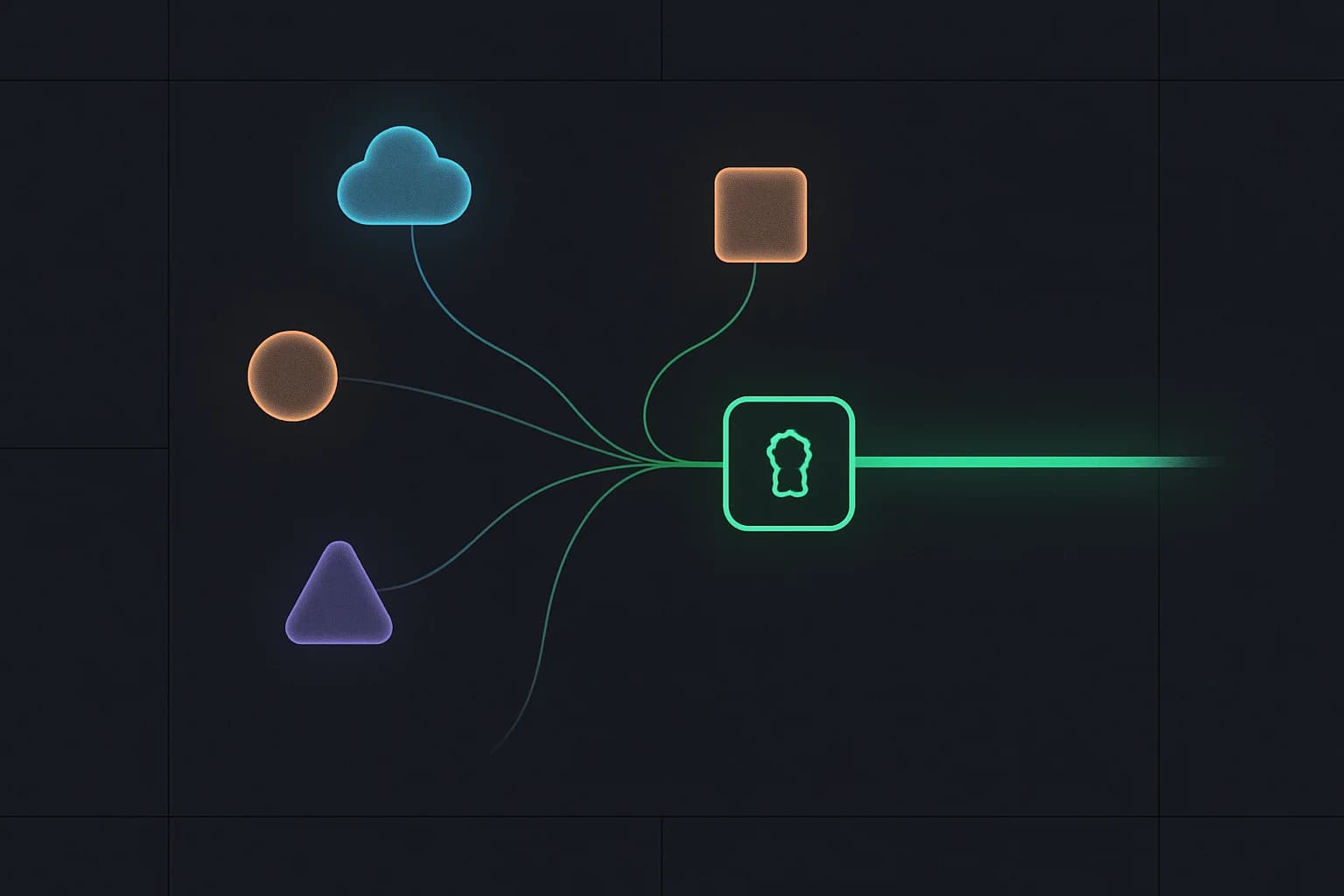
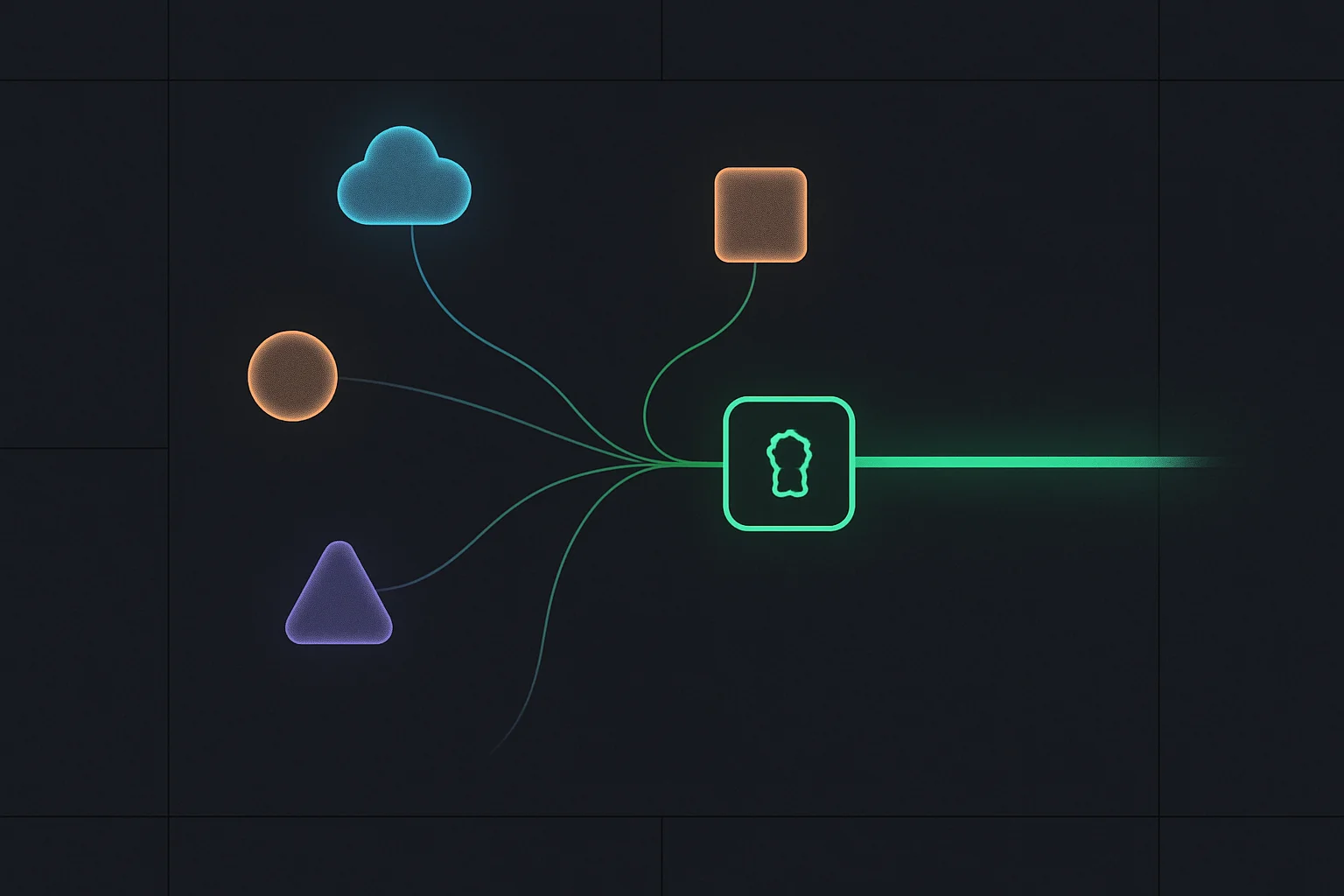 Multiple AI model provider nodes routing through a single unified OpenRouter gateway for enterprises
What is OpenRouter?
OpenRouter is a unified API — sometimes called an LLM gateway or model router — that sits between an application and dozens of AI model providers. Founded in 2023 by Alex Atallah (a co-founder of OpenSea), it now routes traffic across more than 400 models from 60+ providers, including OpenAI, Anthropic, Google, Meta, Mistral, xAI, and a long tail of open-weight labs.
The pitch is deliberately simple: instead of integrating separately against OpenAI's API, Anthropic's API, Google's API, and every open-weight provider you want to try — each with its own auth scheme, request format, error codes, and rate-limit behavior — you integrate once against OpenRouter and get all of them behind one API key and one OpenAI-compatible endpoint.
For a deeper look at what a model swap actually costs to implement without that abstraction, see our companion guide on AI token pricing — the integration tax is often bigger than the per-token price difference between models.
How OpenRouter works, mechanically
It helps to walk through the actual request path rather than treat OpenRouter as a black box.
1. One API key, one endpoint
Your application authenticates once against https://openrouter.ai/api/v1/chat/completions using a single OpenRouter API key. Every model — whether it's served by OpenAI, Anthropic, a Chinese open-weight lab, or a small inference provider — is addressed through that same endpoint, selected with a model string like openai/gpt-latest or anthropic/claude-opus-latest.
2. A standardized request/response format
OpenRouter's endpoint speaks the OpenAI chat-completion schema regardless of which provider actually serves the model. Your code sends the same JSON shape whether the request ends up at OpenAI, Anthropic, or an open-weight inference host — OpenRouter translates the request into whatever format the underlying provider expects, and translates the response back into the OpenAI schema before returning it to you. Swapping models becomes a config change (a different model string) rather than a new SDK integration.
3. Model routing and automatic failover
This is the mechanical core of the product. When a request comes in, OpenRouter can route it based on cost, latency, or availability rules you set, and if the primary provider for a model is down, rate-limited, or degraded, it can automatically retry against a fallback — either the same model served by a different inference provider, or a comparable model entirely. The calling application doesn't need custom retry logic per provider; that failover behavior lives in the routing layer. Our companion post digs into the mechanics of routing and cost optimization in more depth, including how provider selection actually gets decided under load.
4. BYOK — bring your own key
Enterprises with existing provider contracts don't have to give those up. Through BYOK, you supply your own OpenAI, Anthropic, or other provider API key, and OpenRouter routes through it instead of its own pooled account. You keep your negotiated rate, your data-processing agreement, and your provider-side compliance terms, while still getting OpenRouter's unified endpoint, fallback logic, and cross-provider usage analytics layered on top. It's the middle path between full OpenRouter billing and going fully direct.
5. Centralized usage analytics and billing
Every request, regardless of which provider served it, lands in one usage dashboard and one invoice. For a team running five or six different models across different providers, that collapses what would be five or six separate billing relationships, rate-limit dashboards, and support channels into one.
Why enterprises actually use OpenRouter
Four reasons come up consistently in how teams justify adopting a router instead of going direct to each provider.
| Reason | What it solves |
|---|---|
| Avoiding vendor lock-in | No single provider's outage, price change, or deprecation takes down your whole application — swapping models is a config change |
| Centralized billing and analytics | One invoice and one usage dashboard across every provider, instead of a separate bill and dashboard per vendor |
| Access to 400+ models from one integration | Open-weight and closed models, dozens of providers, without a new SDK integration per model |
| Uptime via automatic failover | A provider outage or rate-limit event triggers a fallback instead of a user-facing error |
Avoiding vendor lock-in
Model quality and pricing shift fast. A model that's the best cost/quality tradeoff this quarter may not be next quarter. With a direct integration, switching from GPT to Claude to an open-weight model means new auth, new error handling, and new prompt-formatting quirks per provider. With OpenRouter, it's a string change in a config file. That flexibility is also a hedge against a single provider's policy or availability changes — a real concern for any enterprise that's watched a flagship model get suspended or export-restricted with little notice, as covered in our post on OpenRouter Fusion as an alternative when direct model access got constrained.
One procurement review instead of many
For enterprise buyers, the integration convenience is only half the story — the other half is vendor risk and procurement overhead. Getting OpenAI, Anthropic, Google, and every open-weight provider you want approved through legal, security, and procurement separately is slow. Routing through OpenRouter often means one vendor review and one contract instead of a dozen, even when the underlying model choice changes month to month.
Centralized billing and usage analytics
One invoice, one usage dashboard, across every model and provider in use. That also removes the "stranded credit" problem — prepaying one provider and being stuck with an unused balance if the team switches models — and gives finance and engineering a single source of truth for cost-per-model instead of reconciling invoices from five vendors.
Access to 400+ models from one integration
Enterprises building agents or evaluation pipelines increasingly want to compare open-weight and closed models side by side — OpenRouter's own usage data has shown open-weight models from Asian labs accounting for a majority of its token volume, which is only a realistic option to test cheaply when the integration cost per model is close to zero.
Uptime and fallback
Every model provider has outages. A router that automatically fails over to an equivalent model when the primary provider is degraded turns a provider-side incident into a latency blip instead of a customer-facing error — as long as the fallback model is genuinely equivalent for your use case, which is worth testing rather than assuming.
The 2026 development enterprise buyers can't ignore: Stripe
On August 19, 2026, Stripe sent its investors a letter — signed by Patrick, John, and Will — stating that OpenRouter will join Stripe as its largest-ever acquisition, expected to close in the coming weeks. Bloomberg had reported the deal at more than $7 billion two days earlier; Axios later reported the letter put the figure above $8 billion, paid mostly in stock. The letter itself, as reproduced in our full acquisition coverage, does not print a dollar figure — it calls OpenRouter the "world's largest and most trusted token routing engine" and says OpenRouter's token consumption has been compounding at 9% per week year-to-date.
For context on scale: OpenRouter raised at a $1.3 billion valuation roughly three months earlier, in a Series B that included Sequoia, Andreessen Horowitz, Menlo Ventures, and Alphabet's CapitalG. A jump from $1.3B to $7B+ in under three months is one of the fastest valuation moves in recent AI infrastructure history — reporting worth citing, not a claim explainx.ai can verify independently.
What this means for enterprise vendor-risk evaluation
If you're an enterprise buyer weighing OpenRouter against direct provider APIs — a comparison our companion post covers in full — the acquisition changes the risk calculus in ways worth naming explicitly, even though nothing in the product has changed yet:
- Provider neutrality is now a question, not an assumption. OpenRouter's value has always rested on being neutral middleware — it doesn't care which model you pick, it just routes to what fits your constraints. A payments company has its own incentives around billing depth and margin. Nothing has happened yet, but it's the single most important signal to monitor over the next several months.
- Roadmap continuity is genuinely uncertain. Stripe's letter groups OpenRouter with Bridge, Privy, and Metronome as one "economic infrastructure for AI" stack — discovery, usage metering, payments, fund storage. That's a coherent vision for Stripe, but there's no confirmed public roadmap for what happens to OpenRouter's own product priorities once it's inside that stack.
- Concentration risk is now real, not theoretical. If your application's billing already runs through Stripe and your model routing runs through OpenRouter, one company will soon own both layers. That's operationally convenient if the integration goes well, and a single point of failure if it doesn't.
- Nothing has changed in the API today. No pricing changes, no logging changes, and no rate-limit changes have been announced. The deal is not closed. Treat "no changes announced" as exactly that — not a guarantee nothing is coming.
The practical move for enterprise buyers: keep a tested, documented fallback path — a second router, or a direct provider integration for your highest-volume model — regardless of how the acquisition plays out. That's sound vendor-risk practice independent of this specific deal, and it's exactly the kind of resilience OpenRouter itself is supposed to provide against any single provider's outage.
Honest limitations
A hub post that only lists benefits isn't useful for a buying decision. Three tradeoffs are worth weighing seriously before routing production traffic through any gateway, OpenRouter included.
Added latency vs. a direct API call
Every request makes an extra network hop — your application to OpenRouter, OpenRouter to the underlying provider, and back. For most applications that's single-digit to low double-digit milliseconds, immaterial next to model inference time. For latency-sensitive workloads — real-time voice, low-latency agent loops — that overhead is worth benchmarking against your own SLAs rather than assuming it's negligible.
Dependency on a third party's uptime
Routing through OpenRouter adds a dependency: if OpenRouter itself has an outage, it doesn't matter that every underlying provider is healthy — your traffic still can't get through. A router that protects you from any single model provider's downtime also becomes, itself, a single point of failure for everything routed through it. This is the direct tradeoff for the uptime benefit described above, and it's worth pricing in rather than treating the failover benefit as a one-way win.
Pricing markup considerations
OpenRouter passes through each provider's published rate and adds a platform fee on top — commonly cited around 5.5% on standard pay-as-you-go billing. At high volume, that markup is a real line item worth comparing against the integration and procurement overhead it replaces. BYOK is the lever enterprises use to reduce or eliminate the per-token markup while keeping the unified API and fallback layer — worth evaluating specifically if your OpenRouter spend is large enough that a percentage markup meaningfully moves your total bill. Our AI token pricing guide and the tokenizer-efficiency piece on why price-per-token is misleading are both worth reading before comparing OpenRouter's effective per-token cost against a direct provider rate — the same tokenizer differences that make cross-model comparisons tricky apply whether you're calling a provider directly or through a router.
What people are asking
Is OpenRouter free? No — you pay for the underlying model usage at the provider's rate plus OpenRouter's platform fee, though OpenRouter does list some free-tier and promotional models, including a subset of open-weight models at no cost.
Do I need separate contracts with every provider I want to use? Not for standard billing — OpenRouter handles the provider relationship. For BYOK, you supply your own key and keep your existing contract terms.
How is this different from AWS Bedrock or Azure AI Foundry? Bedrock and Azure run their own model marketplaces with enterprise procurement and IAM baked in, which some large buyers prefer for compliance reasons. But as of the Stripe acquisition, Bedrock still lacked Gemini support and some open-weight and Chinese models that OpenRouter carries — a coverage gap, not a permanent one, but a real factor today.
Does OpenRouter log my prompts? OpenRouter's own privacy documentation states prompt and completion logging is off by default, opt-in rather than opt-out. That predates the Stripe acquisition and is worth re-verifying as an account setting rather than assuming either outcome once the deal closes.
What happens to pricing once Stripe's acquisition closes? Unknown. No pricing changes have been announced as of publication, and the deal itself hasn't closed. This is exactly the kind of open question the full acquisition post tracks in more depth.
Bottom line
OpenRouter solves a real integration and vendor-risk problem: one API key, one request format, and automatic failover across 400+ models from 60+ providers, instead of a separate integration and contract per provider. That's genuinely valuable for enterprises that want model flexibility without rebuilding their integration layer every time a better or cheaper model ships.
The tradeoffs are real too — added latency, a pricing markup on top of provider rates, and now, a dependency on a payments company's roadmap rather than an independent startup's. None of that makes OpenRouter a bad choice today. It does mean enterprise buyers should treat the routing layer the way they'd treat any critical vendor dependency: know your fallback, watch your invoice, and don't assume "no changes announced" means "no changes coming."
For the mechanics of how routing decisions actually get made and how to optimize cost across providers, see OpenRouter model routing and cost optimization for enterprises. For the head-to-head decision between OpenRouter and calling providers directly, see OpenRouter vs. direct provider APIs for enterprises.
Related reading
- Stripe Acquires OpenRouter for $7 Billion: What Builders Should Know — full acquisition coverage, deal timeline, and what to watch
- OpenRouter model routing and cost optimization for enterprises — series companion, routing mechanics under load
- OpenRouter vs. direct provider APIs for enterprises — series companion, head-to-head decision framework
- OpenRouter's web search benchmarks for agent grounding
- OpenRouter Fusion API: an alternative when direct model access is constrained
- AI token pricing, explained
- Why "price per token" doesn't tell you what a model actually costs
- OpenRouter · Model/Agent routing · BYOK · Metronome
Primary sources: Stripe investor letter, August 19, 2026 · Bloomberg (Stripe/OpenRouter deal report, August 17, 2026) · OpenRouter's own model and provider documentation.
Accurate as of August 21, 2026. Model counts, provider counts, and pricing mechanics change frequently — verify current figures against OpenRouter's own documentation before making a procurement decision. The Stripe acquisition is reported at $7B+ and had not closed as of publication; follow @explainx_ai for updates.