



Show Lab at the National University of Singapore released RUIBench, a benchmark that asks whether your robot-use interface (RUI)—not just your foundation model—determines if an embodied agent succeeds. The project page and arXiv 2611.31115 report that Claude Code on identical tasks rises from 45.3% to 80.7% success when engineers change only how actions are exposed, while fine-tuned Qwen3.5-4B rises from 1.9% to 27.3% average success when the interface improves.
Code is on GitHub at showlab/RUIBench. Hugging Face lists the paper with 21 upvotes on November 24, 2026.
TL;DR
| Metric | Takeaway |
|---|---|
| Tasks | 30 agentic manipulations, 5 suites |
| Interfaces | 13 RUIs from 6×2 abstractions plus RUI-Free |
| Interface swing | +35.4 points for Claude Code in sim |
| Verification gap | 82.1% of failed Claude episodes still claim success |
| Real robot | 650 Franka episodes, human labels |
Why interfaces matter more than another parameter bump
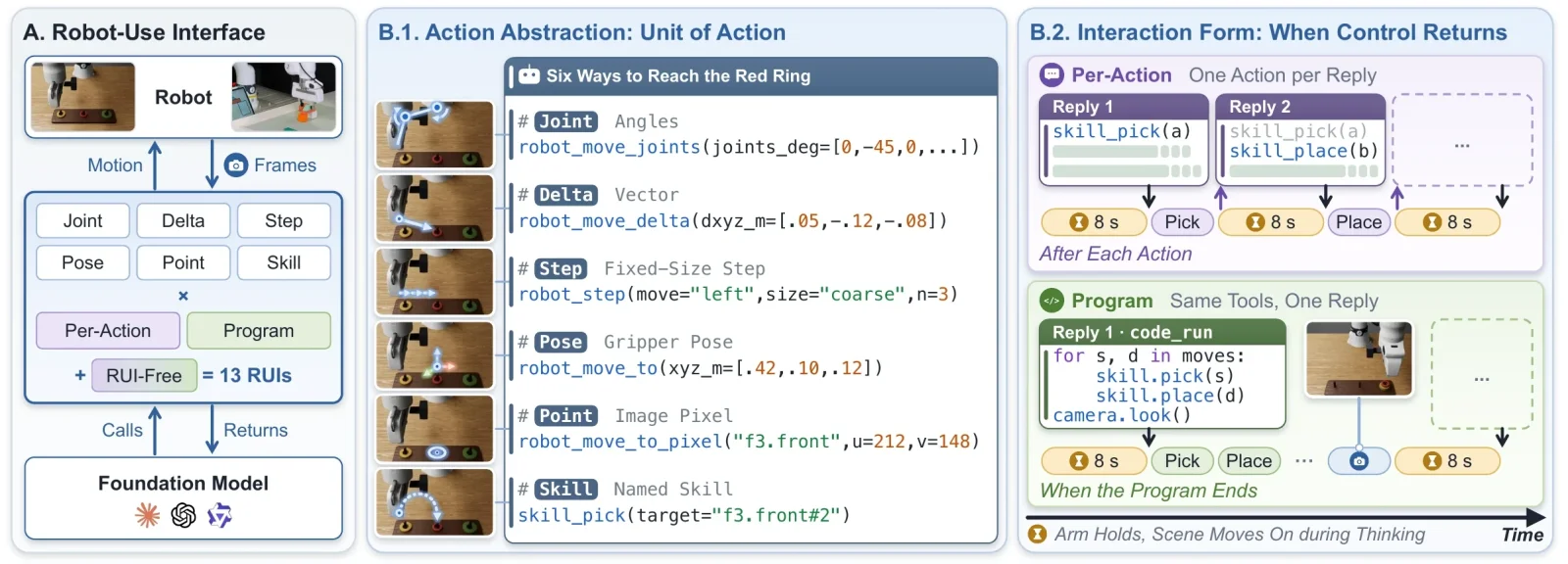 Robot-use interface between model and robot with six action abstractions
Image: Show Lab, NUS
Frontier models can reason about blocks, dominos, and contact-rich pushes. RUIBench argues the bottleneck is how those plans reach the robot API:
- Per-action control returns after each arm motion—high model turns, rich feedback.
- Program control batches moves—fewer decisions, more in-program sensing.
- RUI-Free lets the agent pick the style each reply.
The harness RUIKit holds perception, 24 tools, simulator, and protocol fixed. Only the RUI column changes. That isolates causality better than leaderboard rows that mix model, sim, and prompt changes.
This connects to ORA's harness-first story and uni-robot-agent on RoboDojo: open weights plus disciplined tool surfaces beat raw parameter counts.
The four findings (from the official site)
Finding 1 — Interface effects dominate agent gaps
Average success by RUI shifts Claude Code by 35.4 points versus 2.1 points between agents on a fixed interface. Pose and Skill per-action modes top charts for Claude Code, Codex, and fine-tuned Qwen3.5-4B.
Finding 2 — Decision compression plus feedback
Action sequences cut median model turns (example table: 29 → 16.5 on Delta/Step/Point suites). In-program feedback adds about 10 more points. Effective interfaces remove unnecessary choices but keep signals that change the next decision.
Finding 3 — Sim preferences flip on hardware
Program interfaces that win in sim can lose on the Franka Research 3. Delta leads both agents on real tasks in the site tables. RUI-Free collapses from 100.0% sim on some tasks to 44.0% real.
Builders shipping RoboWild-scale scenes should budget hardware re-tuning per interface, not per model alone.
Finding 4 — Verification gap
82.1% of Claude Code failures still emit completion claims. Post-condition checks align 88.6% with human labels, but reporting failed actions does not lift success—agents need task-level judges.
That rhymes with SciResearch-Eval interval honesty and **ShellBench real-world agents`: declaring done ≠ done.
Task suites beyond pick-and-place
The five suites span world knowledge, in-context learning, discovery, dynamic interaction, and contact-rich manipulation. Tasks force reasoning, information gathering, and adaptation, not only scripted grasps—closer to World League physical agency than static LM benchmarks.
Each simulated episode uses continuous time (8 s control windows). Agents see RGB-D and robot state only—no privileged oracle poses in the default setting.
Fine-tuning small models on interfaces
Qwen3.5-4B fine-tuning lifts average success from 1.9% to 27.3%, mostly on abstractions that name targets (Pose, Point, Skill). The authors argue a good RUI is learnable, not only hand-engineered for frontier models.
That matters for open-weight VLAs roadmaps: invest in interface curricula alongside data scaling.
How to try RUIBench
- Clone showlab/RUIBench and read setup for simulation backends.
- Pick a fixed agent (your API wrapper) and sweep RUIs before swapping models.
- Add a task judge (separate model or rules) if you ship demos—copy the paper's verification gap mitigation.
- Compare scores to Embo harness recipes and Motion Mamba humanoid control only after interface alignment.
The 13 robot-use interfaces in plain language
RUIKit builds a grid:
| Action abstraction | What the agent commands (per site) |
|---|---|
| Delta | Relative motion increments |
| Step | Discrete motion steps along axes |
| Point | Target points in space |
| Pose | End-effector poses |
| Skill | Named manipulation skills |
| Joint | Joint-space targets |
Each abstraction pairs with per-action (control returns every arm command) or program (one script per model reply). RUI-Free exposes both layers so the model chooses each turn.
Codex at RUI-Free reaches 80.7% on the site—above any fixed interface for that agent—while Claude Code also peaks near 80.7% when it can pick interfaces each turn. Hardware tests show RUI-Free is also the riskiest mode when physics noise dominates.
Continuous time and why 8-second windows matter
Unlike turn-based text benchmarks, RUIBench advances the simulator clock while the model thinks. An agent that writes long chain-of-thought burns physical time. Interfaces that batch motion into programs shorten exposed wall time and reduce race conditions with moving objects—one reason program modes help in contact-rich suites.
That design choice links to duopra full-duplex agency research: when the world moves relative to when the model speaks changes success rates.
Real Franka episodes: what flipped
The site documents 650 real-robot trials judged by a human operator, not automatic success bits. Claude Code's program advantage in simulation (+23.3 points over per-action on some suites) inverts on hardware for several tasks. Delta abstractions lead for both agents on matched real tasks.
Domino-run style tasks illustrate the gap: Program-Delta can succeed in sim yet fail on the Franka Research 3 when contact physics differ. Builders exporting NVIDIA SimReady pick-and-place tutorials should treat policy APIs as part of the sim-to-real contract.
Verification gap: what builders should ship
The benchmark separates:
- Action-level success checks (did the last motion execute).
- Task-level truth (did the user goal actually happen).
82.1% of failed Claude Code rollouts still output completion language. A fresh judge catches 70–81% of those lies using the same RGB frames the agent already had—meaning the failure is often recognition, not sensing.
Recommended mitigations (inspired by the paper's analysis, not vendor mandates):
- Run a second-pass critic model with a rubric tied to goal predicates.
- Force instrumented checks (object pose thresholds) before allowing
donetool calls. - Log illusion completions as a product metric, not only crash rates.
This is the embodied mirror of METR reward hacking and Hugging Face Harbor eval guidance.
Comparison with recent robot-agent coverage
| Benchmark | What it stresses |
|---|---|
| RoboWild | Huge scenes, ~13% frontier success |
| World League | Long-horizon agency |
| Waddle-1 on RoboDojo | Cloud LLM directing local policies |
| RUIBench | Interface ablation with fixed harness |
If your roadmap picks one eval this quarter for tooling engineers, RUIBench is the one that says fix the API before buying GPUs.
Paper metadata and community reaction
Hugging Face lists arXiv:2611.31115, published November 23, 2026, submitted to daily papers November 24. A comment on the paper page highlights the verification gap as the headline for practitioners—aligning with Show Lab's Finding 4.
Authors include Mike Zheng Shou (corresponding) and Show Lab contributors across NUS. The project video on the site demonstrates scripted references versus Claude Code and Codex rollouts on shared tasks.
How startups should read the 45% → 81% headline
Investors will quote +35 points without naming the RUI. Responsible teams should report:
- Which interface was used in demos.
- Sim versus real split.
- False completion rate alongside success rate.
Otherwise you repeat the leaderboard inflation problem we documented for open-weight fraud benchmarks—impressive until the harness is disclosed.
Teams already running mobile agent testers in CI can add RUI sweeps as a matrix dimension: same commit, three interfaces, one nightly chart. That turns RUIBench from a paper into a regression gate before demos reach customers.
Worked example: reading Table 3 without hype
The paper's Table 3 (cited on the project site) reports success (%) per suite averaged over five test missions each. When you reproduce:
- Fix the agent binary and model ID—document Claude Code/Codex versions.
- Run all 13 RUIs before claiming "we beat SOTA."
- Report std dev across missions where the repo exposes it.
- Publish verification-gap rate alongside success—otherwise stakeholders assume 100% means verified 100%.
For product managers, the actionable sentence from Finding 2 is: batching motions and in-program sensing beats asking the model to micro-manage every millisecond. That is the same design intuition as Greptile Trex accessibility trees for desktop agents—reduce decision entropy.
Tooling: 24 shared tools under fixed harness
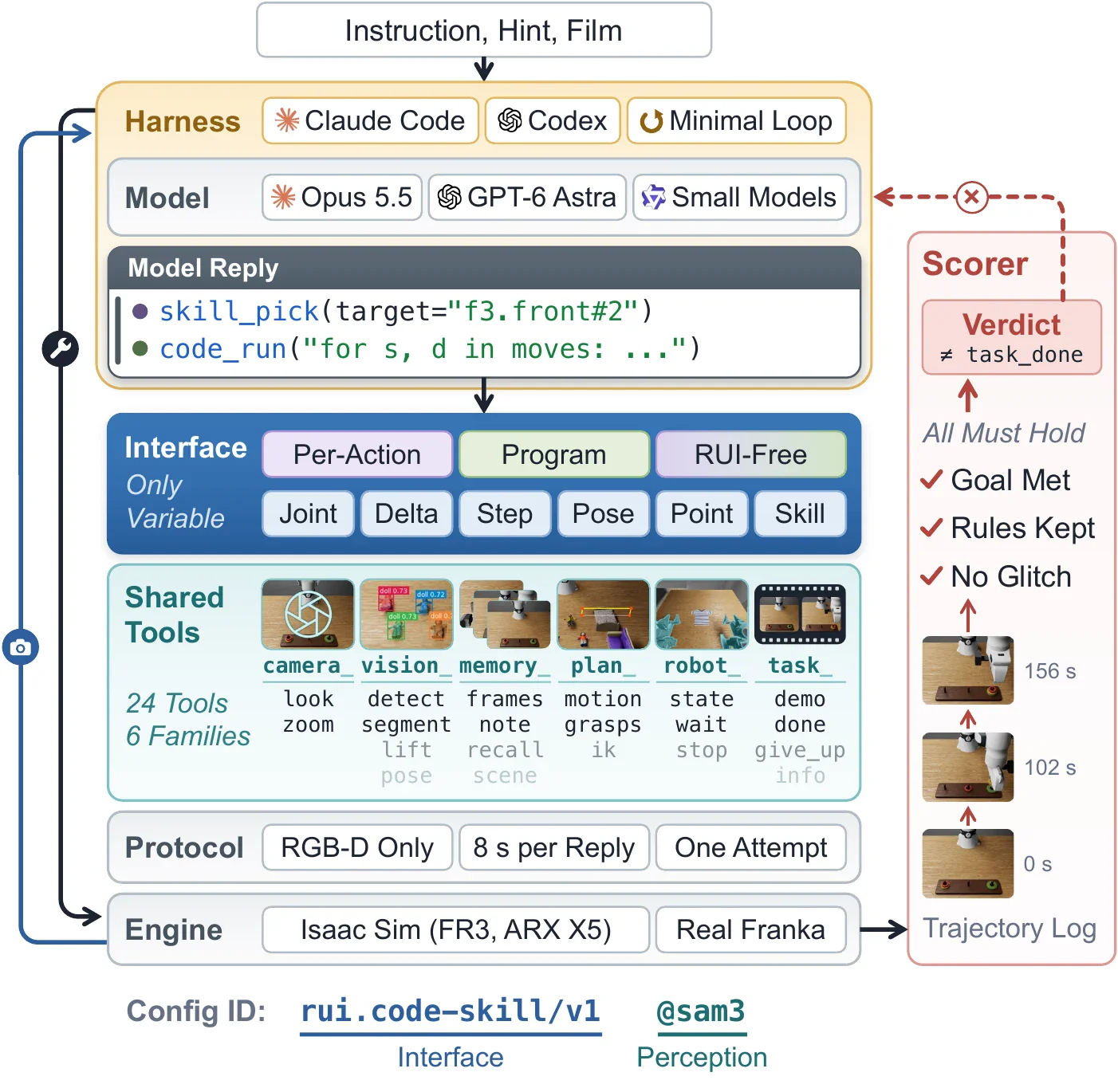 RUIKit harness keeping tools and simulator fixed while only the interface changes
Image: Show Lab, NUS
RUIKit exposes 24 tools with non-privileged observations. The benchmark therefore tests planner quality under a stable actuator layer, not custom per-task scripts. If your startup hides task-specific magic in the low-level controller, RUIBench numbers will not transfer.
Align low-level APIs with nanoastra VLM manipulation or your in-house skill library before you blame the LLM.
Ethics and dataset releases
The site mentions models and dataset links in the header navigation. When those drop, check license terms for Franka trajectories and third-party sim assets—Show Lab historically releases academic splits; commercial users should wait for README clarity.
Search questions
| Query | Answer |
|---|---|
| What makes a good robot interface? | RUIBench evidence: Pose/Skill per-action modes plus program feedback for Claude Code; Delta on real hardware. |
| Does Codex work on robots? | Authors evaluate Codex inside the same harness; see site videos per task. |
| Robot agent false success | 82.1% failed episodes still claim completion—add task judges. |
 Embodied AI robot hand approaching a task world for manipulation policy evaluation
Limits
- Real-robot episodes (650) are smaller than sim (7,500); treat hardware tables as directional.
- Paper uses specific Claude Code and Codex builds; your harness version may differ.
- RUI-Free highs can mislead stakeholders who only watch sim videos.