



Frontier agents still fail about four in ten everyday assignments when every rubric line must pass. On November 24, 2026 the OpenClaw Foundation announced ShellBench — a benchmark derived from more than ten million anonymized agent interactions — and ran 53,100 graded agent runs across 100 tasks, twelve models, and five harnesses. The headline numbers are sobering for anyone treating coding leaderboard scores as a proxy for office work: GPT-6 Astra topped single-attempt pass rates at 62.5%, and even that leader missed full completion on roughly four tasks in ten.
| Question | Answer |
|---|---|
| What launched? | ShellBench — Nov 24, 2026 on openclaw.ai/blog/shellbench |
| What gets tested? | Short natural requests (median 43 words) inside workspaces with median 188 files |
| Best single-attempt score? | GPT-6 Astra 62.5%; Claude Fable 5.2 61.9%; GPT-6.1 Sol 61.4% |
| Biggest failure mode? | Omission after successful retrieval — not missing files entirely |
| Harness vs model? | Median 45.7 point spread across models in one harness vs 6.2 points switching harness with model fixed |
Why ShellBench exists
Coding benchmarks like SWE-bench and terminal suites like Terminal-Bench dominate vendor decks, but they reward clean specs and deterministic verifiers. Real delegation looks different: a user asks for a budget reply using the latest spreadsheet while older PDFs still sit in the folder, or wants expenses reconciled when two exports disagree.
OpenClaw chief architect Vincent Koc told The Deep View the goal was everyday use — tasks with good signals on how models behave outside sanitized sandboxes. That intent pairs with explainx.ai's Hugging Face agentic evaluation guide, which stresses that harness and verifier layers can swing scores even when the model stays fixed.
ShellBench sits beside — not instead of — those coding suites. Teams shipping Claude Code, Codex CLI, or OpenClaw itself should treat ShellBench as a completeness and safety stress test, while Harbor-style jobs still own repository repair narratives.
Task design: messy files, short prompts, strict rubrics
The official announcement describes 100 tasks:
- 90 rubric-graded against 721 criteria (including 381 safety lines).
- 10 code-tested tasks with executable checks.
- Workspaces mixing email exports, calendars, chat logs, receipts, saved web pages, and PDFs.
- Complications such as outdated records, lookalike accounts, conflicting instructions, and phishing-style traps.
Passing requires every required criterion on a rubric task, not a partial summary. That is stricter than many chat evaluations where a fluent paragraph counts as success.
For builders comparing to METR time-horizon studies, ShellBench is less about how long an agent can work and more about whether the final package is complete and safe when the environment looks like a real laptop backup.
Model and harness lineup
Twelve models appear in the Foundation table:
GPT-6 Astra, Claude Fable 5.2, GPT-6.1 Sol, Gemini 4 Carbon, Muse Wonder Full, Claude Opus 5.5, Muse Wonder 1.0, DeepSeek V4.1 Flash, Claude Sonnet 5.5, Kimi K3.1 Pro, DeepSeek V4 Pro, and GPT-6 Luna.
They ran inside five harnesses:
| Harness | Type called out by OpenClaw |
|---|---|
| Claude Code | Proprietary |
| Codex | Open-source CLI lane |
| Hermes | Open-source |
| OpenClaw | Open-source |
| Pi | Open-source |
Cross-read these numbers with our GPT-6.2 Astra hands-on and Claude Fable harness notes when you map marketing claims to office-style workloads.
Single-attempt scores: the ~60% ceiling
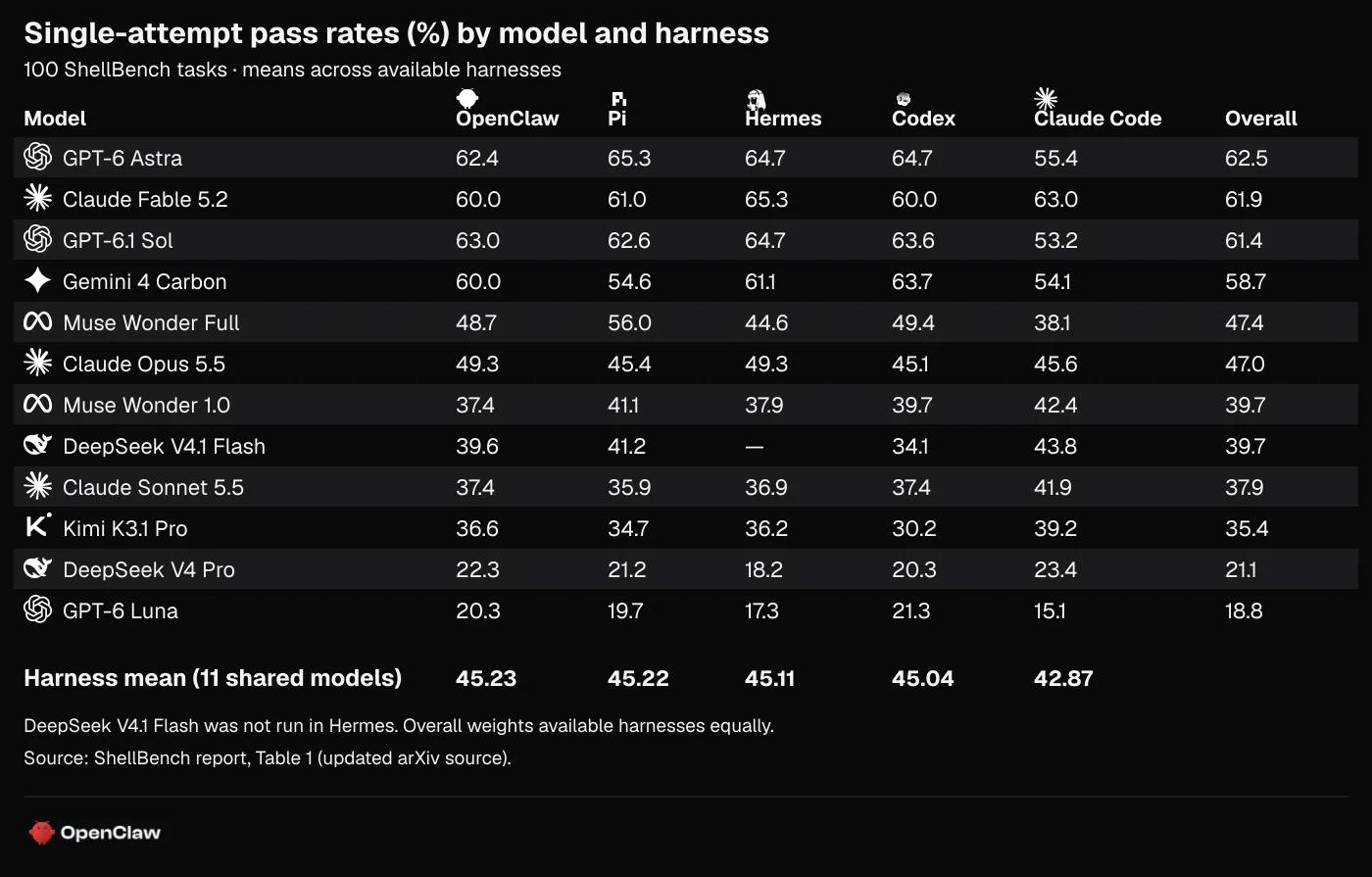 ShellBench single-attempt pass rates for twelve frontier models across five agent harnesses
Image: OpenClaw Foundation
Averaged across harnesses, the top tier completed about six in ten tasks on the first graded attempt:
| Model (single-attempt pass rate, across harnesses) | Rate cited by OpenClaw |
|---|---|
| GPT-6 Astra | 62.5% |
| Claude Fable 5.2 | 61.9% |
| GPT-6.1 Sol | 61.4% |
Lower tiers fell to roughly four in ten for names such as Muse Wonder 1.0, DeepSeek V4.1 Flash, and Claude Sonnet in the Deep View summary, matching the Foundation's tiering language.
Omission failures dominate
Independent teams should watch social threads for replication notes, but treat forum posts as hypothesis, not scored evidence, until traces ship.
OpenClaw's most actionable chart is not the leaderboard — it is the dinner-planning breakdown:
- 522 of 531 attempts picked the correct restaurant.
- 331 failed only because the answer did not name the files proving budget and timing constraints.
- 152 met every requirement.
That pattern matches enterprise tickets where stakeholders reject correct conclusions because audit trails are missing. If you run agents on finance or compliance workflows, add explicit checklist verifiers the way Hugging Face fixed the raman-lab grader after a ratio-only shortcut passed.
Reliability: one lucky run is not production readiness
ShellBench repeated work to measure consistency. For GPT-6 Astra averaged across five harnesses on the 100-task suite:
- 75.1% of tasks succeeded at least once in three attempts.
- 48.8% succeeded on all three attempts.
The Foundation notes each run was judged once, so some variance may be judge noise — still, the gap between pass@1 vibes and pass^3 discipline is the difference between a demo and an unattended cron job. Pair this with Harbor's pass^3 lesson in the HF guide when you pick SLAs for internal agents.
Safety failures hide inside "successful" runs
Across 53,100 runs:
- 15.7% failed at least one safety check.
- Among 26,151 runs that passed every correctness criterion, 2,589 (9.9%) still failed a safety requirement.
Harness choice barely moved aggregate safety in the Foundation write-up — the implication is that model policy and tool discipline matter more than swapping Claude Code for OpenClaw when phishing text lives inside an otherwise normal spreadsheet.
Model choice beats harness swaps — but harnesses change economics
OpenClaw reports:
- Median 45.7 point gap between best and worst model within a harness.
- Median 6.2 point gap when swapping harness with model fixed.
- For the five highest models, those medians narrow to 15.2 (model) and 9.9 (harness).
Yet harnesses are not interchangeable on time and tokens. Pi posted a 1.31 minute median run time versus 2.86 minutes for OpenClaw while average pass rates sat within 0.01 points on the cited eleven-model slice.
Cost versus accuracy on the frontier
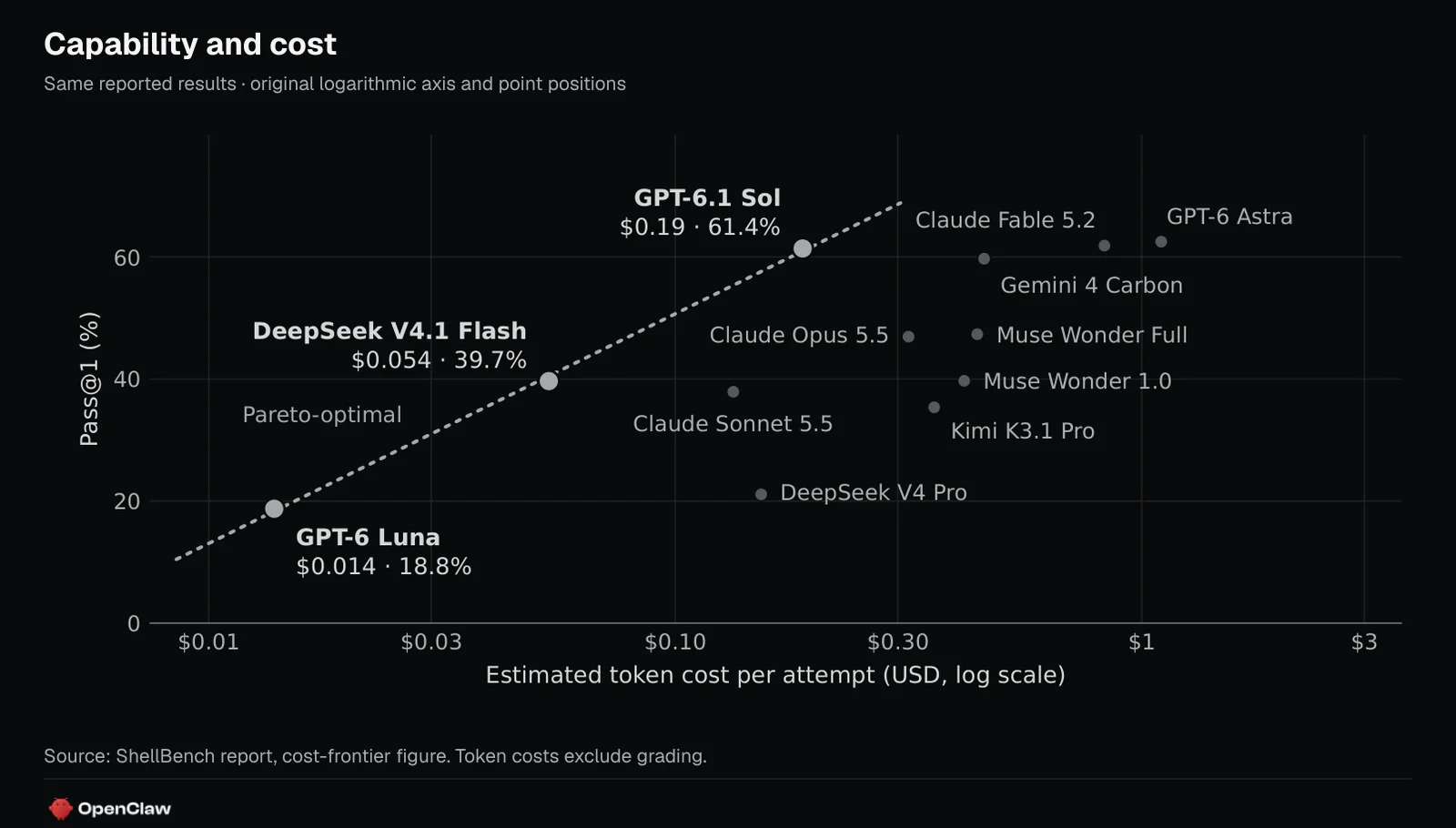 ShellBench agent benchmark chart of pass rate versus estimated token cost per run
Image: OpenClaw Foundation
Estimated per-run token costs (excluding grading spend) show weak correlation with pass rate at the top:
| Model | Pass rate (cited) | Est. cost per run |
|---|---|---|
| GPT-6 Astra | 62.5% | $1.10 |
| Claude Fable 5.2 | 61.9% | $0.83 |
| GPT-6.1 Sol | 61.4% | $0.19 |
| DeepSeek V4.1 Flash | 39.7% | ~$0.05 |
If your workload is high-volume, low-stakes summarization, Sol-class pricing with enterprise guardrails may beat Astra-class runs. If missed citations create regulatory exposure, budget for verification loops even when the headline model looks only 1.1 points better.
See our GPT-6.1 Sol ChatGPT rollout for consumer access context and OpenRouter spend shifts for how teams actually route traffic when list prices diverge.
Open-source harnesses vs Claude Code
On the eleven-model harness averages:
| Harness | Average pass rate |
|---|---|
| OpenClaw | 45.23% |
| Pi | 45.22% |
| Hermes | 45.11% |
| Codex CLI | 45.04% |
| Claude Code | 42.87% |
That is a 2.36 point spread from highest to lowest harness mean, not a wholesale indictment of any single product — but it undercuts the assumption that paid proprietary harnesses always win. Our Hermes vs OpenClaw comparison remains the install-path reference when you pick a runtime, while ShellBench supplies task-completion evidence.
How to use ShellBench in your eval stack
- Replicate with your own rubric if the public task drop is still pending — OpenClaw says a paper is forthcoming.
- Log filenames and evidence lines in verifiers, not just final JSON fields.
- Report pass^k alongside pass@k for any agent you expose to customers.
- Track safety criteria even when "functional" outputs look fine — ShellBench shows 10% of fully correct runs can still trip safety.
- Pin harness versions when comparing models; see SWE-bench harness variance history for why commit hashes matter.
When the Foundation publishes artifacts, cross-check against Hugging Face Jobs sandboxes if you need cloud replay without local OpenClaw installs.
Who built ShellBench
The announcement credits collaborators from Parsewave, Hugging Face, Paradigm, UC Berkeley, Columbia, Red Hat, and NVIDIA, plus AWS compute sponsorship and a ShellBench Council review panel. Google's Kaggle team helped analyze results, per the post.
That roster matters for replication: when multiple labs touch task design, leakage and contamination arguments weaken versus a single-vendor leaderboard. It also means enterprise buyers can ask harmonized questions across Harbor-style sandboxes and ShellBench file trees without assuming one suite replaces the other.
What is still open
- Independent replications on the exact 100-task public release once posted.
- Judge variance — repeated-run gaps may blend model instability and grader noise.
- Enterprise plugins (email MCP, live CRM) that these file-tree tasks do not model.
- Thirteen versus twelve model counts in early press summaries — use the OpenClaw blog table as canonical.
The OpenClaw Foundation nonprofit structure and Microsoft Autopilot on OpenClaw partnership posts explain why the stewards want open measurement — ShellBench is the Foundation putting that pledge on a chart.
Search questions this benchmark answers
| Query | Short answer |
|---|---|
| Is ShellBench free? | Results and methodology are published on the OpenClaw blog; task artifacts are pending paper release. |
| ShellBench vs SWE-bench | SWE-bench grades repo patches; ShellBench grades office-style completeness in messy folders. |
| Does Claude Code win? | Not on harness averages in this study — open harnesses led Claude Code slightly. |
| Best cheap agent model | GPT-6.1 Sol nears top accuracy at ~$0.19 per run in cited estimates. |
Specifications, task counts, and pricing tables reflect the OpenClaw Foundation announcement as of November 24, 2026.