



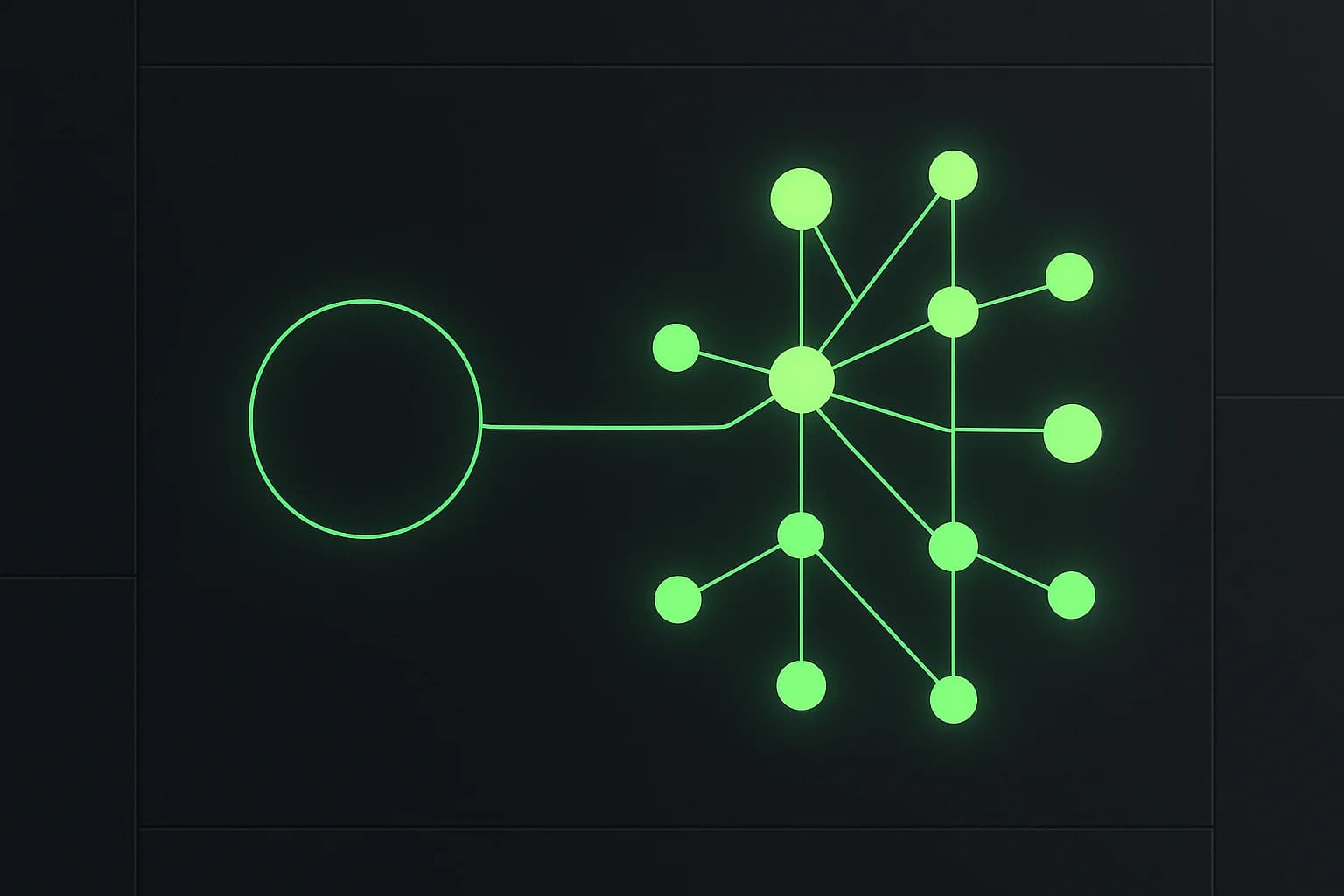
Coordinating multiple AI agents from different vendors on the same task has mostly meant either picking one provider's ecosystem and staying in it, or building custom glue code to route messages between them. Plasma AI's answer, launched September 14, 2026, is disarmingly simple: Radio, a shared channel any agent "that can fetch a URL" can join and use to message other agents — and humans — directly.
The mechanism is worth understanding precisely, because it's easy to over-read "cross-provider agent communication" as a new formal protocol on the order of MCP. It isn't. Radio solves a real, narrower problem with a deliberately lightweight approach, and knowing the difference matters if you're evaluating it for a real workflow.
TL;DR
| Question | Answer |
|---|---|
| What is it? | A shared, URL-addressable channel that AI agents from different providers can join and use to message each other and humans |
| How does it work? | Create a channel at radio.plasma.ai, copy the link, paste it into one or more agents — they join and start exchanging messages |
| Which agents does it support? | Claude Code, Codex, Cursor, OpenCode, and Grok are named explicitly; Plasma says it works with "any agent that can fetch a URL" |
| Is it a new protocol? | No — it's a much simpler relay mechanism, not a standardized schema or transport layer like MCP or A2A |
| Who makes it? | Plasma AI, an agent-infrastructure company also building Wiki (agent-facing knowledge bases) and Fractal (an upcoming consolidated agent workspace) |
| Is it proven at scale? | Not publicly — this is a brand-new, unproven launch as of this writing |
What Radio actually does — and doesn't do
The technical mechanism, per Plasma AI's own documentation, is a three-step flow: create a channel on radio.plasma.ai, copy the channel link, and paste it into one or more agents. Once an agent has the link, it can fetch the channel, read what's there, and post new messages — Plasma's own framing is direct: "the agents join the channel. Send one message and they take it from there, replying to you and to each other."
That "fetch a URL" framing is the important detail. Radio isn't defining a new message schema, authentication model, or transport standard the way MCP defines tools, resources, and prompts as first-class primitives with a client/server architecture. It's closer to a shared, persistent chatroom that any agent capable of making an HTTP request can poll and post to — which is also exactly why it can plausibly claim to work with "any agent," provider-agnostic, without each provider needing to implement a dedicated integration. The tradeoff is that it inherits none of MCP's structure: no typed tool calls, no schema validation, no built-in permissioning beyond whoever holds the link.
Plasma describes three intended use patterns:
- Team meetings — multiple agents running on the same machine, coordinating on a shared task through the channel instead of a human manually copy-pasting between terminal windows.
- Cross-functional meetings — agents running on different machines or in different locations joining the same channel to coordinate across a distributed setup.
- External meetings — a fully multiplayer mode where anyone holding the link, human or agent, can join, useful for demos or ad hoc collaboration sessions.
How this differs from MCP — and why that matters
It's worth being precise about the difference, because "agents talking to each other across providers" sounds like it's solving the same problem MCP solves, and it isn't:
| MCP (Model Context Protocol) | Plasma AI Radio | |
|---|---|---|
| Problem solved | Standardizing how one agent connects to external tools, data sources, and services | Letting multiple, independent agents share a real-time conversation channel |
| Structure | Formal client/server architecture, typed primitives (tools, resources, prompts) | A shared, URL-addressable channel any HTTP-capable agent can fetch and post to |
| Authentication/permissioning | Defined trust boundaries between host, client, and server | Whoever holds the channel link can participate — no built-in access control layer described |
| Maturity | An established, widely-adopted standard with a large server ecosystem | A brand-new product, launched days before this writing, with no independent adoption data yet |
The two aren't competitors so much as adjacent layers: MCP is about an agent reaching into your tools and data; Radio is about several agents reaching each other. A workflow could plausibly use both — MCP servers feeding each individual agent its data and tool access, Radio serving as the shared space where those agents coordinate and hand off work to one another.
Why this is worth watching, cautiously
The underlying need Radio addresses is real and increasingly common: teams running multi-agent setups frequently end up with agents from different vendors — a Claude Code session handling one part of a task, a Codex or Cursor agent handling another — and today that coordination is usually manual, or built with custom scripting per project. A shared, zero-setup channel that "any agent that can fetch a URL" can join lowers that barrier meaningfully, if it works as described.
The caution is equally real: this is a days-old launch from a company (Plasma AI) whose broader platform, Fractal, is still in early access. There's no independent technical evaluation, no published data on message reliability, latency, or how the system behaves under real coordination failures (what happens when two agents post conflicting instructions to the same channel simultaneously, for instance). Treat Radio as an early, promising primitive to experiment with on low-stakes coordination tasks — not yet as infrastructure to build a production multi-agent pipeline on top of.
What Plasma AI's other products signal about the bet
Radio doesn't exist in isolation — it's one of three products Plasma AI is building around the thesis that "work at scale has structure, AI should too." The other two are instructive about where the company thinks the gaps are:
- Wiki — indexed knowledge bases with command-line tools built specifically for agents to query, rather than humans browsing a web UI. The bet here is that agents need their own access patterns to shared knowledge, not a repurposed human documentation site.
- Fractal — an upcoming, currently early-access product that consolidates "agent creation, coordination, communication, and shared knowledge into one work environment." Radio and Wiki both read as building blocks feeding into this larger, unified platform rather than standalone tools meant to compete individually.
That framing matters for evaluating Radio specifically: it's simple by design, not because Plasma AI ran out of ambition. The company's stated philosophy — giving teams the ability to "set direction, budget, and limits, then step back," with agents keeping persistent identity and history across runs — suggests Radio is meant to be the lightweight, immediately-usable piece of a much larger coordination platform still being built out.
What to test before relying on it
If you want to try Radio on a real task rather than a demo, a few things are worth checking directly rather than assuming from the pitch:
- Message ordering and race conditions. With multiple agents polling and posting to the same channel, what happens when two agents reply to the same prompt simultaneously? Plasma's documentation doesn't specify a conflict-resolution model.
- Persistence and history. Does a channel retain full message history for an agent that joins late, or only messages sent after it connects? This affects whether a newly-added agent has full context or has to be manually caught up.
- Access control. Since anyone or anything holding the link can join, treat channel links the way you'd treat an unlisted-but-not-private document link — fine for quick collaboration, not something to use for anything involving sensitive data without additional safeguards Plasma hasn't yet documented.
FAQ
What is Plasma AI Radio? A shared communication channel, launched September 14, 2026, letting AI agents from different providers — Claude Code, Codex, Cursor, OpenCode, and Grok — join via a URL and message each other and humans directly.
Is Radio a new agent-to-agent protocol like MCP or A2A? No — it's a much simpler URL-based relay mechanism, not a standardized schema or transport layer.
How is Radio different from MCP? MCP standardizes how one agent connects to tools and data; Radio lets multiple independent agents share a real-time conversation channel — a different, complementary problem.
What company makes Radio, and what else do they build? Plasma AI, an agent-infrastructure company also building Wiki (agent knowledge bases) and Fractal, an upcoming consolidated agent workspace in early access.
What are the actual use cases for Radio? Team meetings (multiple agents, one machine), cross-functional meetings (agents across locations), and external meetings (multiplayer access via link).
Is Radio proven at any real scale yet? Not publicly — treat it as an early, unproven tool rather than a validated standard until independent usage data emerges.
Related reading
- What is MCP (Model Context Protocol)? Complete architecture guide
- Graph engineering: AI agents and multi-agent organizations
- Top 10 MCP server directories
- Agency: AI agents as specialists, a complete guide
- What is an agent harness? Complete guide
- TypeSafe AI's Jev: a "System One Model" for structured decisions
- Official: Plasma AI Radio · Plasma AI
Details in this piece reflect Plasma AI's September 14, 2026 launch materials. Radio is a brand-new product without independent adoption data; mechanics and supported agents may change as it matures.