




OpenAI published Searching for distant planets with Astra on November 24, 2026, describing how two amateur astronomers used Codex and Astra to mine NASA Kepler and TESS archives for transit signals. The post does not announce confirmed planets; it documents candidates now entering professional follow-up, including 49 TESS leads from Ethan Byrd and two Kepler stars Kevin Bond highlighted with SETI Institute cross-checks.
TL;DR
| Who | Tool | Data scope | Outcome |
|---|---|---|---|
| Kevin Bond (OpenAI engineer) | Codex multi-agent coding | ~100,000 Kepler stars | 200+ signals, 2 new stars of interest |
| Ethan Byrd (Primitive founder) | Astra workflows | ~19 million TESS stars | 49 candidates, 1 submitted for analysis |
| Professionals | Independent review | Same public archives | Months-to-years confirmation path |
Why exoplanet hunts are a coding problem again
Astronomers have confirmed more than 6,400 exoplanets since 1992, per NASA's Exoplanet Archive figures OpenAI cites through November 24, 2026. Most discoveries begin as tiny, repeating brightness dips—transits—buried in years of photometry.
Classic pipelines apply published detrending and period-finding code across massive star lists. OpenAI's story argues Codex and Astra help amateurs compose, test, and iterate those pipelines without a full-time astrophysics grad student.
That parallels NASA–IBM lunar foundation models and NVIDIA's SETI agent work at the Allen Telescope Array, but stays closer to consumer-grade agents plus public archives anyone can download.
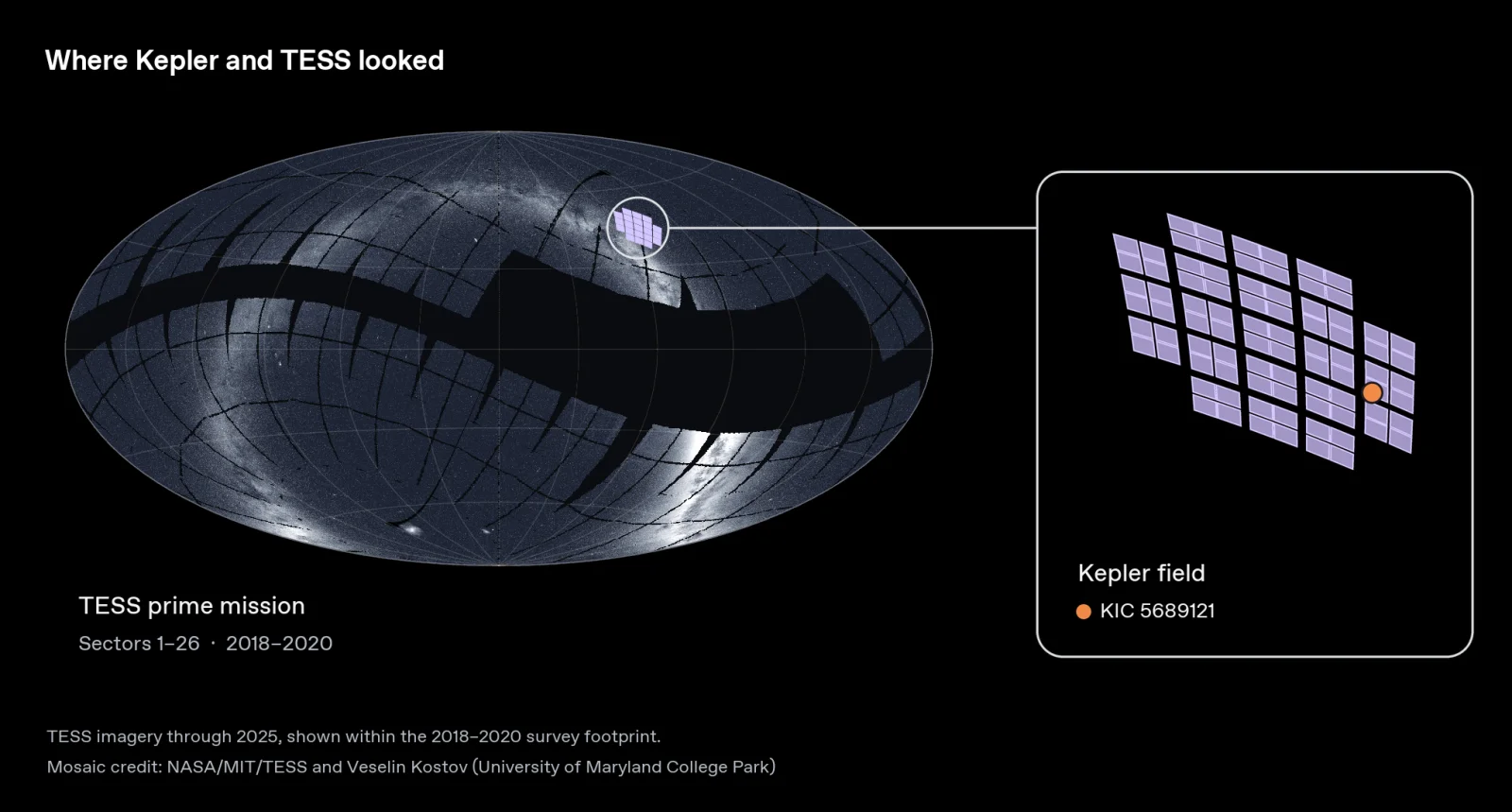 Kepler and TESS star fields map for OpenAI Astra exoplanet citizen science
Image: OpenAI / NASA TESS
Kevin Bond's Codex pipeline on Kepler
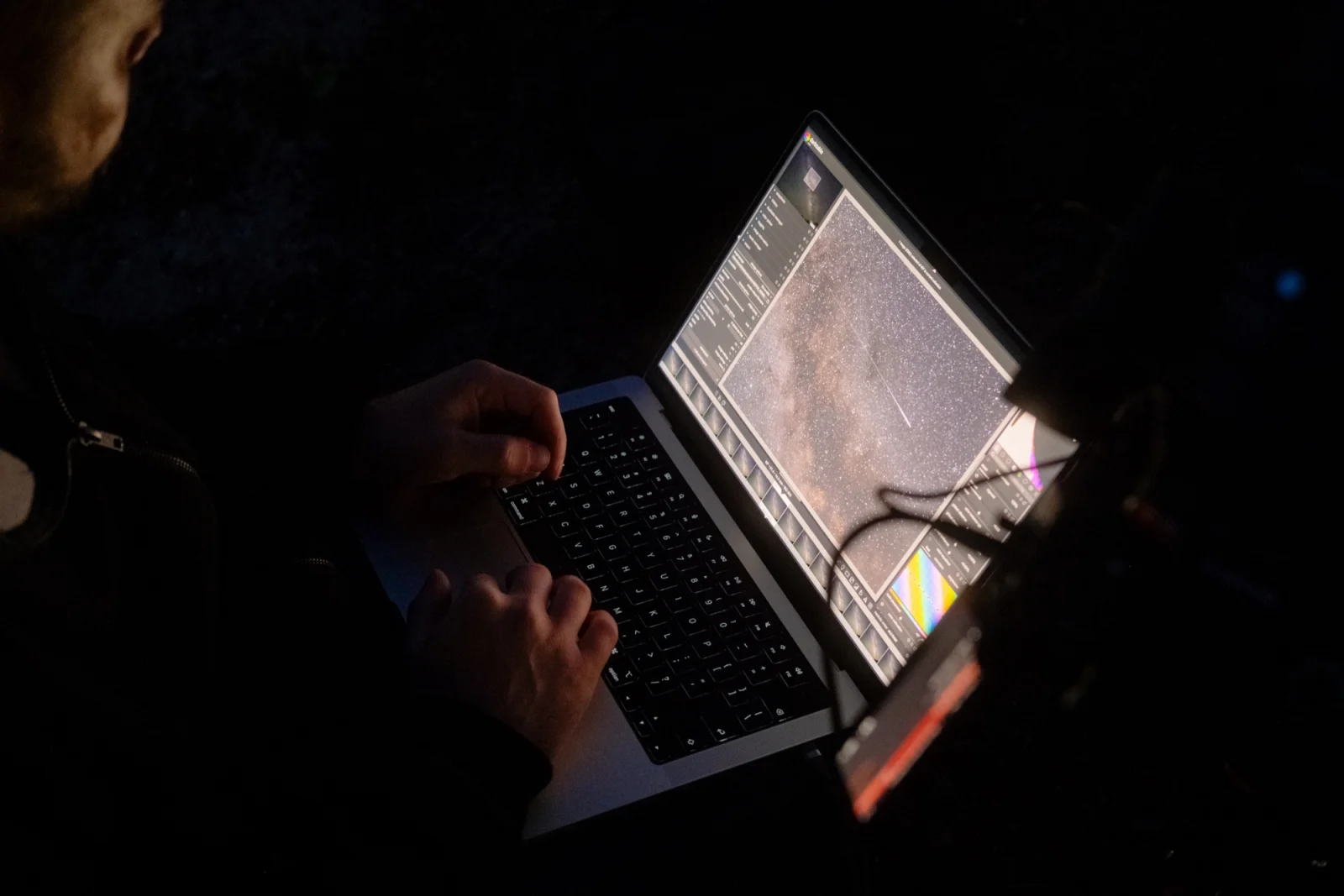 Laptop shows a star field during OpenAI Codex Kepler transit search
Image: OpenAI
Bond, an OpenAI engineer who came to astronomy through night-sky photography, used Codex to compare transit methods, merge them into one program, and assign one agent to scan curves while another validates candidates.
On public Kepler data (~100,000 stars), the run produced 200+ signals, including 10 known planets—evidence the pipeline rediscovers confirmed physics.
Two new stars stood out on OpenAI's page:
- KIC 5689121 in Lyra: 13.8-day dips; if planetary, roughly 2.4× Earth's diameter
- KIC 6691030: 4.8-day pattern consistent with a sub-Neptune
Vishal Gajjar at the SETI Institute independently recovered both signals. His quoted comment highlights the Kepler Bonus Catalog, a large star set traditional searches may skip.
Ethan Byrd's Astra searches on TESS
Byrd built two Astra-designed studies: a general candidate hunt and a habitable-zone search across ~19 million stars in TESS and other public sets.
The first pass produced 49 candidates. One went to TESS mission researchers; two more awaited submission when OpenAI published. OpenAI notes Kepler watched one patch for four years, while TESS mapped both hemispheres in its early sectors—changing how often you catch repeat transits.
Confirmation is still observatory work
OpenAI lists false-positive sources: binary stars, thermal drift, and instrument quirks. Confirmation needs more photometry, sometimes radial velocity, and peer review.
Treat headlines like Harvard exoplanet radio hype as a warning: AI plus public data accelerates lead generation, not catalog acceptance.
Multi-agent pattern builders can copy
Bond's split—scanner agent plus skeptic agent—matches how teams structure SciResearch eval harnesses and GPT-6.2 Astra Lean workflows: one model proposes, another audits before humans see results.
Steps to replicate responsibly:
- Download Kepler or TESS light curves from MAST archives
- Implement a published detrend (e.g., SAP to PDC conversion) before neural shortcuts
- Require known-planet recovery on a holdout list before tweeting discoveries
- Submit candidates to NASA Exoplanet Watch or professional partners
Citizen programs OpenAI cited
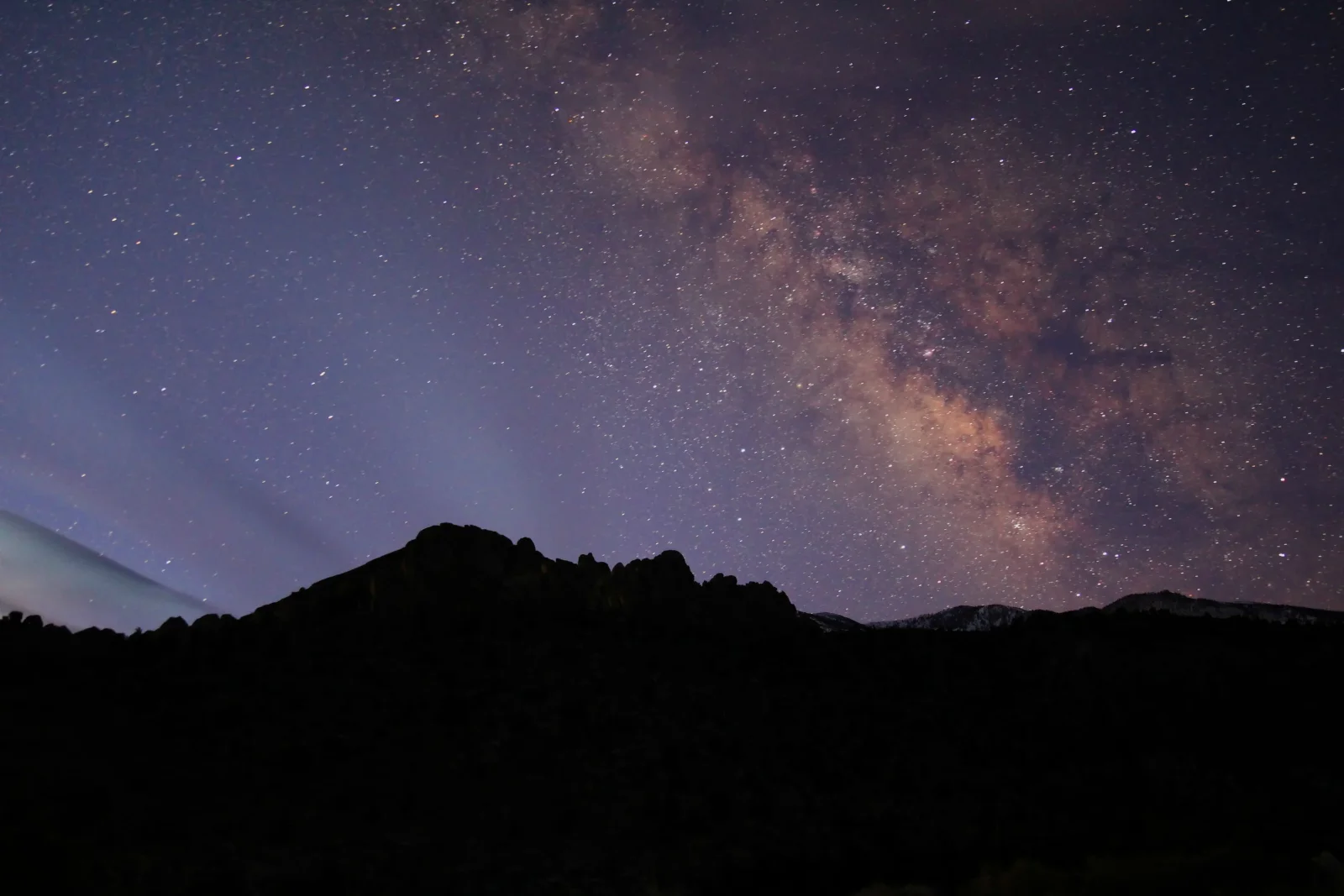 Kevin Bond photographs the Milky Way for OpenAI Astra exoplanet citizen science
Image: OpenAI
You do not need Astra to participate:
- NASA Exoplanet Watch teaches light-curve plotting
- AAVSO Exoplanet Observing Program coordinates backyard measurements
- Unistellar citizen campaigns catch long transits across time zones
OpenAI frames Bond and Byrd inside a century-long tradition of curiosity-driven observers sharing leads—a useful contrast to AI music chart panic stories where generative output skips verification.
Where this fits OpenAI's November science lane
The exoplanet essay sits beside OpenAI science access posts, OpenWorks small-business pilots, and GPT-6.2 Astra comparison work. It is a story about tooling, not a new model release.
For teams picking between Astra and Claude for science, pair this piece with Top Gemini 4 Argon science demos and remember: the bottleneck is still telescope time, not prompt engineering alone.
Radial velocity and the next verification step
When transits suggest a planet, radial velocity spectrographs measure Doppler shifts from the star's gravitational wobble. OpenAI explains that path for readers who stop at light curves.
If Bond's 13.8-day signal holds, observers can predict the next transit and schedule ground or space follow-up. Byrd's TESS candidates need similar ephemeris checks because TESS sectors sample each field for shorter baselines than Kepler's four-year stare.
Reading a transit light curve (the skill amateurs still need)
OpenAI's post walks through brightness-versus-time plots where a planet blocks a fraction of starlight. The depth tells you something about planet size relative to the star; the period tells you orbital distance if you assume a Keplerian orbit.
KIC 5689121 is described as cooler and about half the Sun's size, which changes how you interpret a 2.4× Earth diameter estimate—you need stellar radius models, not just raw dip depth. KIC 6691030 is fainter, so signal-to-noise is harder; that is why professional follow-up matters more than social captions.
Bond included figures aligning four curves on a 13.77-day cycle in OpenAI's article—exactly the kind of phase folding astronomers use to stack weak transits. If you rebuild the pipeline, reproduce those plots before you claim discovery.
Kepler-90 and the 2017 neural-network precedent
OpenAI cites Google's 2017 work training a network on 15,000 labeled Kepler signals, eventually helping spot Kepler-90i, an eighth planet in a known system. That history matters because it shows ML assists professionals on curated labels, while the November 2026 story features amateurs steering Codex on less curated catalogs.
Neither path skips physics. The 2017 system still needed astrophysicists to vet candidates. The 2026 path adds agentic coding so a single motivated engineer can iterate pipelines overnight.
Data access paths for builders
OpenAI does not ship a public Git repo in the announcement, but the data it names is open:
| Archive | What you get | Typical first step |
|---|---|---|
| MAST Kepler | Long-cadence light curves | Pick a quarter, download SAP flux, detrend |
| TESS SPOC | Sector light curves | Choose 2-minute or 30-minute cadence products |
| NASA Exoplanet Archive | Confirmed planet parameters | Build a recovery test set |
Pair downloads with NASA Exoplanet Watch tutorials so you learn manual vetting alongside Codex automation.
How this differs from radio SETI agent stories
Our NVIDIA SETI agent coverage focused on telescope-time scheduling and real-time processing. OpenAI's exoplanet story is batch analytics on archived CSVs—closer to datasette and SQL charting for historians than to Holoscan on the sky.
That lowers hardware barriers but raises statistical barriers: you can run 19 million star queries from a laptop and still flood yourself with false alarms if multiple-testing correction is missing.
Ethics, credit, and who gets telescope time
OpenAI highlights amateurs turning curiosity into leads. Professional astronomers still allocate follow-up slots. When you use Codex inside OpenAI or Astra subscriptions, disclose model assistance in emails to mission teams, the same way journals now ask for LLM disclosure in AI-assisted papers controversies.
Giving SETI Institute and TESS maintainers first look at Bond and Byrd's lists is the right credit ordering. Copying their star IDs into blog SEO without adding verification value does not help science.
What not to claim in demos or press releases
- Do not call 49 candidates "49 new planets."
- Do not imply SETI endorsement beyond Gajjar's quoted initial checks.
- Do publish your pipeline commit hashes if you fork Bond's approach—reproducibility is how citizen science earns professional time.
OpenAI visualization and archive refresh dates
OpenAI's interactive Milky Way exoplanet map uses NASA Exoplanet Archive positions with a snapshot retrieved November 19, 2026 per the post footer. The distance labels scale with zoom—they are illustrations, not live parallax measurements.
When you fork Bond's star list, record which Kepler data release and which TESS sector products you used. Archive revisions recalibrate fluxes; a candidate can appear or vanish after reprocessing without any model change.
MedChemBench and other OpenAI science posts the same week target paid researchers; the exoplanet story targets hobbyists with laptops. Pick the lane that matches your actual hardware before you clone Bond's agent pattern.
Related reading
- NASA–IBM lunar foundation model
- NVIDIA SETI agents at the Allen Telescope Array
- Harvard exoplanet signals: verified vs hype
- GPT-6.2 Astra Lean hard problems
- GPT-6.2 Astra vs Claude Fable hands-on
- SciResearch: scientific judgment evals for agents
- OpenAI OpenWorks stipend pilot
- Gemini 4 Argon NASA and Mars demos