




A chart is making the rounds on X: Nvidia's Vera Rubin NVL72 can train a 10-trillion-parameter model on 100 trillion tokens in one month with roughly 16,000 GPUs, where GB200 would need about 64,000. The "75% fewer GPUs" headline comes from that arithmetic. It is a real Nvidia claim, but a narrower one than the headline suggests, and no one outside Nvidia has measured it yet.
Here is what the company's own pages say, what the footnote assumes, what the social posts added, and how to read it if you plan capacity or buy cloud compute. This is a claimed-versus-verified post: we attribute each number to its source and flag what is unconfirmed.
TL;DR
| Question | Answer |
|---|---|
| What is the claim? | Vera Rubin NVL72 trains MoE models with one-fourth the GPUs of GB200 NVL72 |
| What is the assumed job? | 10T-parameter MoE, 100T training tokens, fixed timeframe of one month (Nvidia's footnote) |
| Where do 16,000 and 64,000 come from? | Social posts reading the chart; Nvidia's page states the ratio and footnote |
| Who verified it? | No independent training benchmark found; Nvidia labels it "projected performance subject to change" |
| Does it mean a quarter of the cost? | No: Rubin GPUs cost more, and power, network and utilization also matter |
| What should you do? | Ask for measured results on your workload; do not plan budgets around a projection |
What Nvidia says on its own page
The Vera Rubin NVL72 product page says the rack "delivers AI training with one-fourth the GPUs and AI inference at one-tenth the cost per million tokens versus NVIDIA Blackwell." In its performance section it repeats the training line: "NVIDIA Vera Rubin NVL72 trains mixture-of-experts (MoE) models with one-fourth the number of GPUs compared to NVIDIA GB200 NVL72."
The footnote is the important part: "Projected performance subject to change. Number of GPUs based on a 10T MoE model trained on 100T tokens in a fixed timeframe of 1 month comparing NVIDIA GB200 NVL72 and NVIDIA Vera Rubin NVL72."
That tells you four things.
- It is a projection. Nvidia's own label says the performance may change.
- It is a single scenario. One model size, one token budget, one deadline.
- It is a model, not a measurement. A 10T-parameter MoE trained on 100T tokens is far beyond models whose training details have been published.
- The baseline is GB200 NVL72. Not B300, and not a Hopper cluster.
The same page and Nvidia's technical blog on the platform list "one-fourth as many GPUs to train, 10x higher inference throughput, and 10x lower cost per token" among the platform's headline results. The inference figures use a separate setup: cost per million tokens is based on the Kimi-K2-Thinking model with 32K input and 8K output tokens, comparing GB200 NVL72 and Vera Rubin NVL72.
Where "16,000 versus 64,000" came from
The concrete GPU counts are not in Nvidia's footnote as we read it. They appear in social posts that interpret the chart. One widely shared post quoted that training a 10T-parameter model on 100T tokens in a month "would just require roughly 16,000 Rubin GPUs," and the headline figure of 64,000 GB200 GPUs follows from a one-fourth ratio: 16,000 is 25% of 64,000. That is simple arithmetic, not a second data point.
Replies were mixed. One account noted the new chips will cost more; another mocked Nvidia's charts. Those are opinions, not tests. We name the posts here as reactions only; the numbers above are reproducible from Nvidia's ratio.
Why a ratio is not a price
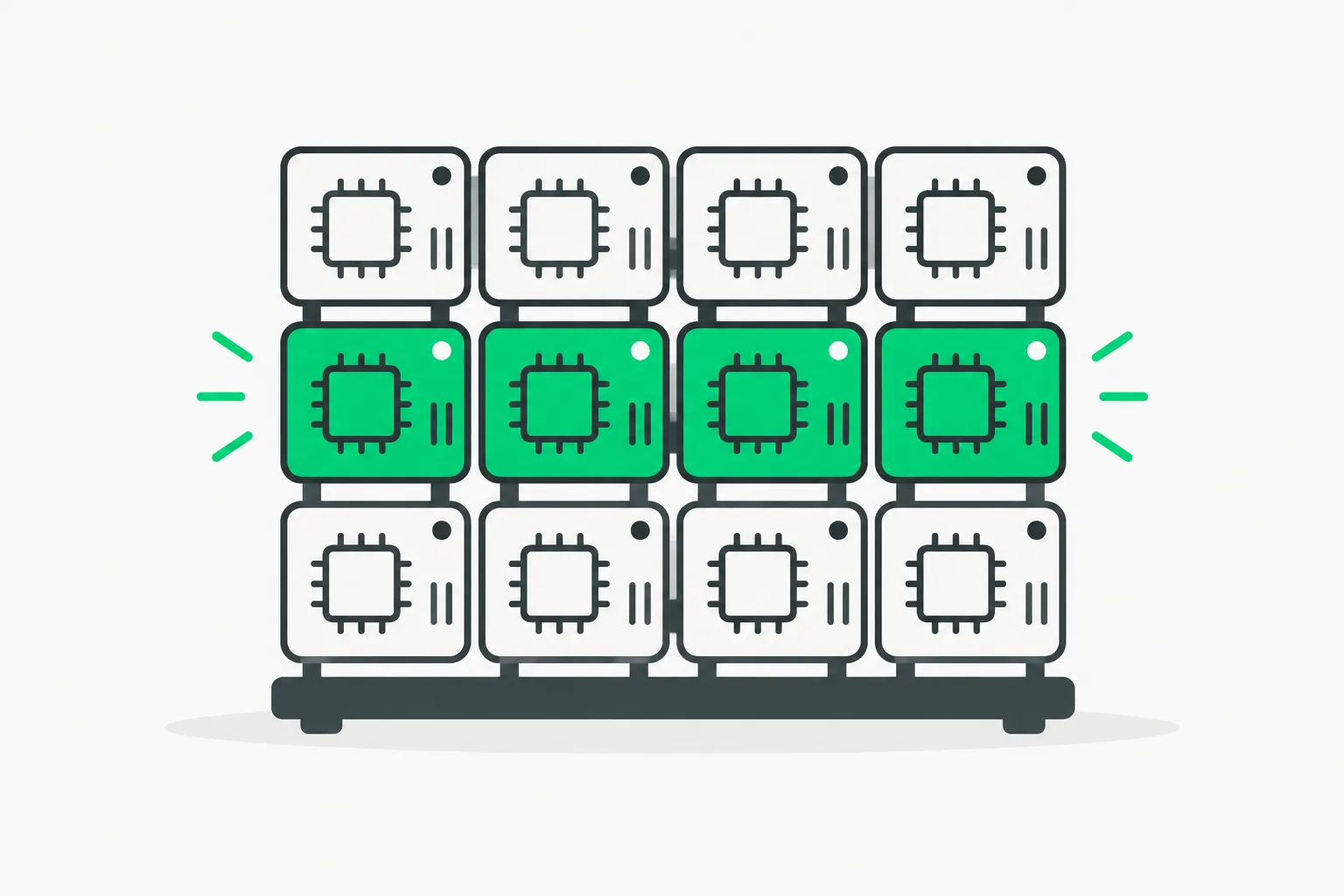 A grid of GPU chip squares with one row lit, showing how fewer Vera Rubin NVL72 GPUs can cover the same training job
"One-fourth the GPUs" sounds like "one-fourth the cost," but the two diverge.
- Unit price. Nvidia has not published list prices for Rubin GPUs in the pages we read. Commentators expect them to be higher than Blackwell.
- Per-GPU performance. Nvidia's spec table lists 35 petaflops of dense NVFP4 training per Rubin GPU and 2,520 petaflops per NVL72 rack. Its technical blog lists Blackwell at 10 petaflops NVFP4 training. That is 3.5 times per GPU on paper, so a roughly 4x GPU reduction implies gains beyond raw compute: networking, memory bandwidth and utilization.
- Fixed deadline. The scenario fixes training time at one month. If your job is not deadline-bound, fewer, slower GPUs over a longer time may be cheaper.
- Power and facilities. A rack's power draw, cooling, and the cost of the network around it do not scale down with GPU count.
- Utilization. Real training runs lose time to failures, restarts, data stalls and stragglers. A projection assumes a well-behaved run.
Cloud pricing matters most for builders. When Rubin capacity reaches rental markets, the price per GPU-hour, not the GPU count, will decide whether the claim helps you. For context on how fast rental prices move, see our post on H100 rental prices and the Silicon Data claim.
Why MoE, and why NVLink size matters
MoE models split capacity across many expert sub-networks and route each token to a few of them. Training that way produces heavy all-to-all traffic: tokens and gradients move between experts on different GPUs. Nvidia's argument is that a larger, faster scale-up domain, here 72 GPUs on sixth-generation NVLink with 216 TB/s of NVLink bandwidth per rack in its spec table, keeps expert dispatch inside the rack and cuts the time GPUs spend waiting.
That is a plausible mechanism, and it matches how the industry has been moving. But it means the claim applies where communication dominates. A dense model, a smaller model that fits in fewer GPUs, or a job with different parallelism may see a smaller gain. Nvidia's footnote does not describe the parallelism strategy, precision recipe, batch size or software version behind the projection.
What would count as verification
Several things would turn a projection into evidence.
- MLPerf Training submissions on Vera Rubin NVL72 at scale, with the benchmark workloads and rules published by MLCommons.
- A customer or lab disclosure of a large MoE run on Rubin with GPU counts, wall-clock time and tokens, which would show real utilization.
- Cloud benchmarks from providers that now offer Rubin capacity. We covered Google Cloud's A5X Vera Rubin NVL72 availability, where customers will eventually publish measured throughput.
- Third-party analysis that normalizes cost per trained token, including power and networking.
Until then, the safest reading is: Nvidia expects a large MoE training job to need about a quarter of the GPUs on Rubin, under assumptions it has not fully published.
The wider context: demand, supply and who is buying
Rubin is not a paper product. Nvidia's page says Vera Rubin is "ramping into full production," and it cites a national AI infrastructure project in Japan with 27,500 Rubin GPUs. Our earlier coverage shows how the ecosystem is lining up: Meta's Prometheus supercluster, Nvidia's Mission Control 2.5 for self-healing GPU clusters and the GTC Berlin keynote roundup.
Supply, not only design, limits how soon anyone can use it. ASML says AI demand exceeds EUV supply into 2029, optical parts are reported sold out into 2029, and transformer lead times have stretched to 160 weeks. A faster chip helps less if the data hall has no power to run it. And for neoclouds that financed older generations, a four-to-one efficiency claim cuts both ways; see our neocloud shakeout analysis.
What this means for people who build or buy
 A rising stack of boxed chips, illustrating how Nvidia Rubin supply and pricing shape who can use the claimed savings
- If you train frontier-scale MoE models, the claim is a reason to ask providers about Rubin allocation, but plan with measured throughput from a pilot, not the slide.
- If you fine-tune or run inference, the training claim is mostly irrelevant. Watch the inference cost per token instead, and note that Nvidia's one-tenth figure is also a projection on a specific model and sequence length.
- If you rent compute, compare price per trained token and ask how the provider handles failures and restarts. A cheaper per-GPU price on older hardware can still win.
- If you follow the AI financing story, efficiency gains of this size shorten the useful life of earlier-generation fleets, which matters for lenders and leases.
- If you write about it, quote the footnote with the claim. "75% fewer GPUs" without "projected, 10T MoE, 100T tokens, one month" misstates what Nvidia said.
What is confirmed and what is not
| Claim | Status |
|---|---|
| Vera Rubin NVL72 trains MoE models with one-fourth the GPUs of GB200 NVL72 | Nvidia's claim, on its product page, labeled projected |
| Assumed job: 10T MoE, 100T tokens, one month | Stated in Nvidia's footnote |
| About 16,000 Rubin vs 64,000 GB200 GPUs | Arithmetic and social posts; not a separate Nvidia datapoint on the page we read |
| One-tenth the cost per million tokens for inference | Nvidia's projection on Kimi-K2-Thinking, 32K/8K tokens; separate claim |
| Rubin GPUs cost more than Blackwell | Commentary from observers; no list price in the sources we read |
| Independent training benchmark at this scale | None found |
To check for yourself, read the Nvidia product page footnotes and the platform technical blog, then watch MLCommons results and cloud provider benchmarks for measured numbers.
Related reading
- Google Cloud A5X Vera Rubin NVL72 availability
- Meta Prometheus supercluster: what is confirmed
- GTC Berlin 2026 keynote: everything announced
- Nvidia Mission Control 2.5
- ASML: AI demand exceeds EUV supply
- Neocloud shakeout and Nvidia exposure
- H100 rental prices: claimed vs verified
Information is current as of October 26, 2026. Nvidia's figures are projections and may change; confirm on Nvidia's pages.