



NVIDIA's own developer blog, published August 21, 2026, reports something unusual: an agent built to evolve GPU kernels just scored a perfect 100.00 on an interactive reasoning benchmark it was never designed for. The system is called AVO (Agentic Variation Operators), and until this post it had one job — autonomously optimizing CUDA kernels on NVIDIA's own hardware. NVIDIA took the same agent loop, swapped the task interface, and pointed it at ARC-AGI-3, the interactive benchmark explainx.ai has tracked since Claude Opus 5's 30.2% leaderboard jump and OpenAI's retained-reasoning tripling of GPT-5.6 Sol's score.
The result — a 100.00 RHAE across all 183 levels of the 25-environment public set — is genuinely notable as an architecture-transfer story. It is not, and NVIDIA does not claim it is, proof that ARC-AGI-3 is "solved." This post covers the actual numbers, what transferred and why, and the caveats NVIDIA states explicitly in its own writeup — including the exact pushback a commenter raised on NVIDIA's announcement thread.
TL;DR
| Question | Direct answer |
|---|---|
| What did AVO score? | 100.00 RHAE, all 183 public-set levels, 6,624 total actions |
| What model powered it? | Claude Opus 5 (primary); GPT-5.6 Sol in a smaller preliminary test |
| Is this the private/hidden set? | No — public set only (25 of the benchmark's environments) |
| Where did AVO come from? | Autonomous GPU-kernel optimization on DGX B200s, unrelated domain |
| What changed to make it work on games? | Only the task interface/tools — the core agent loop stayed the same |
| Does this prove AVO caused the 100%, not Opus 5? | No — NVIDIA explicitly says it's not a controlled ablation |
| How does it compare to VISTA? | ~12% fewer actions (6,624 vs. 7,542) on the same 183 levels — also not a controlled comparison |
Where AVO Came From: Evolving GPU Kernels, Not Playing Games
AVO wasn't built for benchmarks like ARC-AGI-3 at all. It started as a general-purpose coding agent for autonomous GPU-kernel optimization — an agent that inspects an existing kernel implementation, forms a hypothesis about a change, makes the edit, runs hardware-grounded tests, interprets the profiler/compiler feedback, and revises its approach. NVIDIA's framing is that AVO replaces the fixed mutation/crossover steps of classical evolutionary search with an autonomous agent deciding what to try next.
The kernel results are the reason NVIDIA trusted the architecture enough to try it somewhere completely different. In a 7-day continuous autonomous run on NVIDIA DGX B200 systems, AVO explored 500+ optimization directions and produced 40 committed kernel versions for multihead attention. The resulting kernels outperformed cuDNN by up to 3.5% and FlashAttention-4 by up to 10.5% across evaluated configurations. AVO then adapted the evolved kernel to grouped-query attention in roughly 30 minutes of additional autonomous work — the AVO paper on arXiv reports up to 7.0% over cuDNN and 9.3% over FlashAttention-4 for that GQA adaptation specifically.
Two mechanisms sit underneath the iterative inspect-plan-implement-evaluate loop, and NVIDIA credits both for sustaining a week of unattended work:
- Persistent memory — carries forward prior implementations, evaluation results, compiler and profiler outputs, and accumulated reasoning across model-context boundaries, so the agent doesn't start from scratch every time its context window fills up.
- A supervisor — monitors the broader search trajectory for stagnation or repeated unproductive cycles, and can redirect the main agent when progress stalls, while the main agent still decides what to inspect, change, test, and evaluate day to day.
This memory-plus-supervisor pattern is the same class of scaffolding explainx.ai covers in its agent harness guide and in OpenAI's own pitch for Codex's harness as reusable infrastructure — the idea that a model's raw capability and the system wrapped around it are separate variables, each with its own effect on outcomes.
The ARC-AGI-3 Evaluation: Same Loop, Completely Different Domain
NVIDIA applied the same underlying AVO architecture — unchanged core agent loop — to ARC-AGI-3, an interactive reasoning benchmark where an agent enters unfamiliar game-like environments with no instructions, explicit rules, or stated goals, and has to infer dynamics and objectives purely through interaction. The benchmark scores agents with RHAE (Relative Human Action Efficiency), which combines task completion with per-level action efficiency relative to first-time human baselines, aggregated across levels and environments.
NVIDIA borrowed VISTA's direct-interaction design principle — give the agent available actions with no descriptions of rules or goals, same as a human would face — but reimplemented the task interface independently rather than adopting VISTA's approach wholesale, and evaluated AVO as a general-purpose agent rather than building an ARC-specific world-model layer (the approach Tycho takes with an explicit programmatic world model). The one design choice NVIDIA calls out specifically: VISTA's primary configuration renders a 512x512 PNG image for each observation; AVO's configuration is text-only — every observation is an exact 64x64 text grid, with no images or image tokens ever sent to the model.
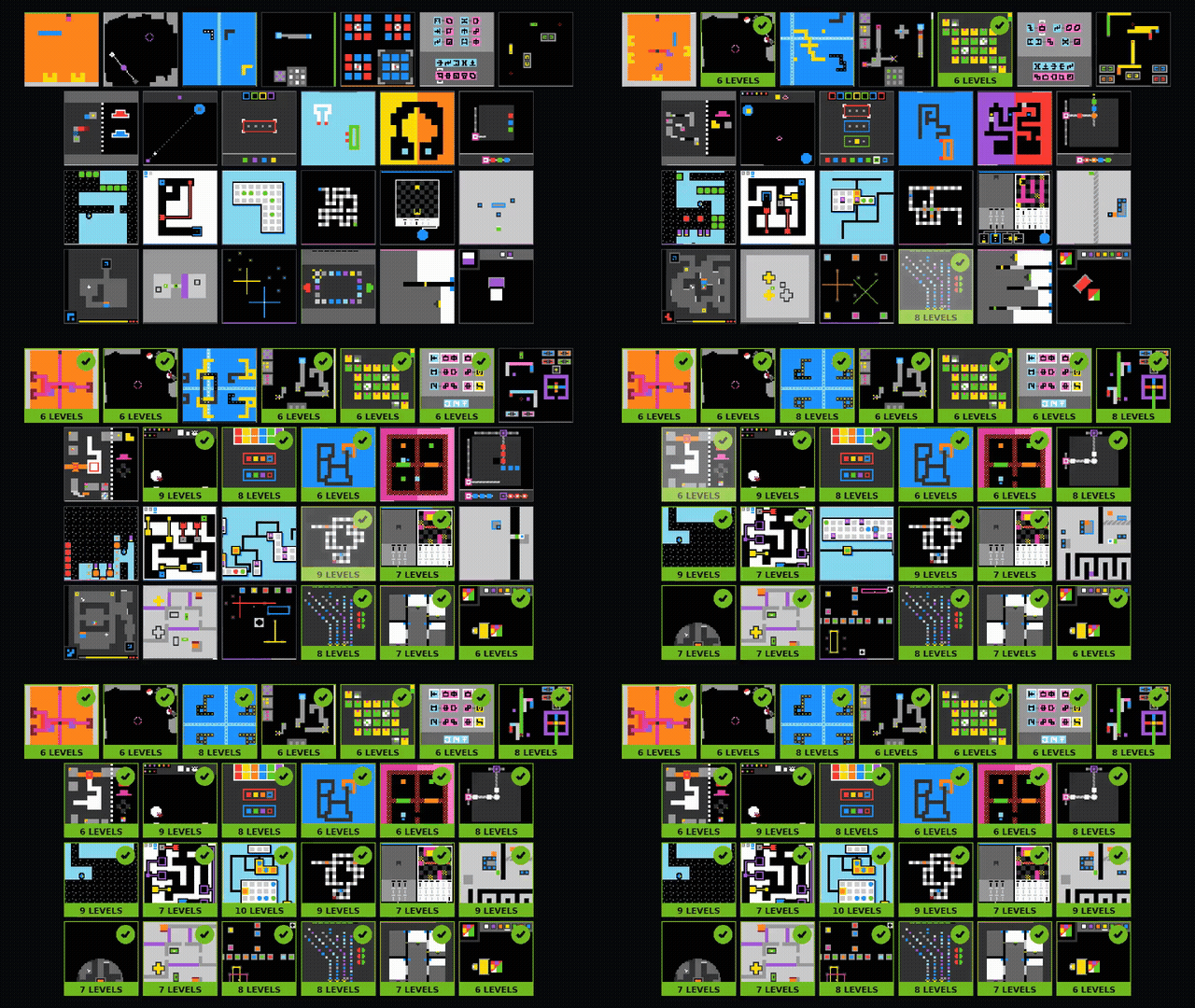
Source: NVIDIA's official announcement, August 21, 2026.
The Numbers
- AVO (Claude Opus 5): 100.00 RHAE across the full 25-environment ARC-AGI-3 public set — all 183 levels completed, in 6,624 total environment actions.
- VISTA, for comparison: 7,542 environment actions with Claude Opus 5 to complete the same 183 public-set levels — AVO used about 12% fewer actions. NVIDIA is explicit this is not a controlled ablation: the two systems differ in agent backend, observation representation, memory, and context management, among other things. The memory system may matter for the efficiency gap, but this comparison doesn't isolate its individual contribution.
- ARC Prize separately reports roughly 30% for Claude Opus 5 alone (High reasoning effort, no harness) on the public set — the bare model without AVO's scaffolding. NVIDIA is explicit that this is not a controlled measurement of "AVO's contribution" either: different reasoning-effort setting, an entirely different agent system and evaluation setup. Read it as "model-level eval alone doesn't characterize a complete agent system's performance," not as "AVO improved Opus 5 from 30% to 100%" — that framing overstates what NVIDIA measured.
A Smaller, Preliminary Test With GPT-5.6 Sol
NVIDIA also paired AVO with GPT-5.6 Sol on a subset of games — not the full public set. In these limited runs, Sol reached matched levels faster in wall-clock time in several cases, while Opus used fewer environment actions in matched-level comparisons. NVIDIA labels these results preliminary and says a broader, systematic comparison is future work — a caveat worth remembering the next time a "Model A vs. Model B on Benchmark X" chart circulates without one.
What This Doesn't Prove
Three caveats matter here more than the headline number, and NVIDIA states all three itself.
It's the public set, not the hidden exam. ARC-AGI-3 splits into public, semi-private, and fully private sets specifically so a model can't overfit to the exact tasks it's scored on. NVIDIA's 100.00 RHAE is on the 25-environment public set with an official scorecard — not the semi-private or private competition sets. A reply on NVIDIA's announcement thread on X made this point directly: "I would not file this as solved AGI... if you post 100 like it is the hidden exam, you skipped the split." That's a legitimate, correct read of the benchmark's design, not fringe skepticism — see the official announcement thread for the full exchange.
None of the headline comparisons are controlled experiments. Both the AVO-vs-VISTA action-count comparison and the AVO-vs-bare-Opus-5 comparison mix multiple variables at once — different agent backends, different observation formats, different memory systems, different reasoning-effort settings. NVIDIA's own writeup flags this twice. Treat the ~12% efficiency gap and the 30%-to-100% gap as illustrative, not as an ablation isolating what AVO's harness specifically contributes.
Preliminary means preliminary. The GPT-5.6 Sol comparison covers a subset of games, not the full evaluation, and NVIDIA labels the finding preliminary pending a systematic follow-up.
The thesis NVIDIA actually draws is narrower and more defensible than "100% on ARC-AGI-3": the same agent architecture — memory, supervisor, and an inspect/plan/implement/evaluate loop — transferred from a highly specialized domain (GPU kernels, with feedback from compilers and profilers) to a completely different one (interactive game reasoning, with feedback from environment transitions), with only the task interface and tools swapped. As NVIDIA puts it: "long-horizon capability is a property of the full system" — model capability matters, but memory, tools, feedback, and recovery determine whether that capability converts into sustained autonomous progress. "The model matters, but the model is not the entire agent."
That's the same lesson explainx.ai drew from Pathway's BDH-CQ efficiency claims — a real result narrower than its headline — and from DeepSeek V4 Flash's verified ARC-AGI cost-per-task numbers: benchmark headlines compress a lot of methodology into one number, and the methodology is where the actual signal lives.
What People Are Asking
"Didn't Opus 5 already score 30% on ARC-AGI-3 in July?" Yes — ARC Prize verified Claude Opus 5 (High) at 30.2% on the public set in late July, without any custom harness. AVO's 100% is that same underlying model wrapped in NVIDIA's memory-plus-supervisor agent system. The two numbers measure different things — bare model vs. full agent system — and NVIDIA says explicitly the gap between them isn't a clean measurement of the harness's individual contribution.
"Is 100% even meaningful if it's just the public set?" It's meaningful as an efficiency and architecture-transfer result, not as evidence the benchmark is beaten outright. ARC Prize's semi-private and private sets exist precisely to catch agents that look perfect on the public data and regress on unseen tasks — the split a commenter flagged on NVIDIA's own thread.
"Why does a GPU-kernel optimization agent transfer to a video-game-like benchmark at all?" Because, per NVIDIA's account, almost nothing about the core loop changed. Kernel optimization and interactive game-reasoning both reduce to the same shape: inspect available context, form a hypothesis, act, get feedback (compiler/profiler output in one case, environment state transitions in the other), and revise. The memory and supervisor mechanisms that kept the kernel search from stalling over 7 days appear to generalize to keeping a game-playing agent from stalling over hundreds of actions.
"How does the text-only 64x64 grid observation compare to VISTA's image-based approach?" NVIDIA doesn't run a controlled ablation between the two, but the action-count gap (6,624 vs. VISTA's 7,542) is at least consistent with a text representation being no worse — and NVIDIA flags memory as a plausible contributor to the difference, without isolating it.
Bottom Line
NVIDIA's AVO scoring 100.00 RHAE across all 183 ARC-AGI-3 public-set levels, in 6,624 actions, using an agent architecture originally built to evolve GPU kernels on DGX B200s, is a real and interesting transfer-learning result for agent scaffolding. It is not evidence that ARC-AGI-3 is solved, that AVO alone improved Opus 5 from 30% to 100%, or that the VISTA comparison is a controlled experiment — NVIDIA states each of those caveats itself. The genuinely durable claim is the architectural one: memory, a supervisor, and an iterative inspect-plan-implement-evaluate loop transferred across two unrelated domains with only the task interface swapped, which is exactly the kind of system-level result that matters more for builders than any single leaderboard number.
Related Reading
- Opus 5 Hits 30.2% on ARC-AGI-3 — What the Jump Means
- OpenAI ARC-AGI-3: Retained Reasoning + Compaction Tripled Scores
- DeepSeek V4 Flash 0731 Scores 89% on ARC-AGI at $0.02/Task
- Pathway's 150M BDH-CQ Model: 11x Cheaper Reasoning Than GPT-5.6
- Codex as a Platform: OpenAI Opens Up Its Agent Harness to Builders
- What Is an Agent Harness? The Scaffolding Layer Explained
- AI Benchmarks in 2026: The Complete Guide
- Qwen 3.7-Max: The Agent Frontier and Long-Horizon Autonomy
- Official sources: AVO paper (arXiv:2603.24517), ARC-AGI-3 benchmark, NVIDIA's developer blog, August 21, 2026, and NVIDIA's announcement thread on X
Figures, quotes, and scores in this post reflect NVIDIA's own developer blog post and announcement thread as published on August 21, 2026. RHAE scores and action counts are as reported by NVIDIA and ARC Prize at time of publication — check arcprize.org and NVIDIA's developer blog for any subsequent updates or verification.