



Nvidia has released Nemotron 3.5 Super VL, an open multimodal model that folds reasoning, tool use and text, image, document and video understanding into one checkpoint. It is a 120B-parameter mixture-of-experts (MoE) model that activates 12B parameters per token, and Nvidia pitches it at "always-on" enterprise agents. The details come from Nvidia's technical blog post, published October 15, 2026, and the NeMo Megatron Bridge documentation for the model.
It follows the RTX Spark launch software wave we covered earlier this week, including Nemotron 3.5 Bolt and PAIR 1.0, and it is positioned inside Nvidia's model line-up: Nemotron 3.5 Lightning for high-volume text, Nemotron 3 Ultra for planning and orchestration, and Super VL for specialised multistep work that needs vision.
TL;DR
| Question | Answer (source: Nvidia unless noted) |
|---|---|
| Size | 120B total, 12B active per token (MoE) |
| Inputs | Text, images, documents, video |
| Built for | Coding, web research, document intelligence, cybersecurity, video understanding |
| Released | Base, post-trained and NVFP4-quantized checkpoints, recipes, data and RL environments |
| Speed claim | Up to 5x throughput vs. other open models of its size on a single GPU |
| Local | Optimized for DGX Spark |
| Customisation | NVIDIA NeMo: SFT, LoRA, RL |
| Where | Hugging Face, ModelScope, OpenRouter, NVIDIA NIM |
Why one model for text and vision?
Agents rarely stay in one modality. A support agent reads a policy, then a receipt photo. A research agent reads a page, then a chart. Nvidia's argument is that teams should not deploy a text model plus a separate vision-language model and pass context between them. Super VL combines both so a single model can interpret a chart, connect it to a table elsewhere in a document and summarise both.
Its visual training covers charts, tables, OCR, multipage documents and video. A two-stage supervised fine-tuning pipeline trains the language and vision components, mixing visual evidence with reasoning, chat, safety, long-context data and agent trajectories.
What Nvidia reports on quality
- CharXiv (chart reasoning): 80.8%, against 63% for Nemotron 3 Nano Omni; 84% with Python code interpretation.
- OCRBench v2: Nvidia says it is one of the top open models on the leaderboard.
- Agent evals: On Hermes Bench the model scores 63.44% versus 56.33% for Nemotron 3 Ultra; on LangChain behavioural evals 87.05% versus 84.3%.
- Coding: Nvidia says it outperforms Nemotron 3 Super on SWE-bench and Terminal-Bench across multiple evaluation setups.
- Indic languages: Continued pretraining added 10B Indic tokens. Nvidia is releasing the full dataset of about 2.8T tokens across 22 Indian languages, developed with IIT Madras and its AI4Bharat lab, and shows leading accuracy over Gemma-4-31B-it and Sarvam-105B on five Indic benchmarks.
All of these are Nvidia's numbers. The agent evaluations span harnesses including Hermes, LangChain, OpenClaw, OpenCode, Pi, Codex and Claude, but independent replication was not available at publication. Note that the two comparisons against Nemotron 3 Ultra are against Nvidia's own bigger model, not a rival lab's.
Speed: the headline claim
Nvidia says that on a single GPU the model delivers up to 5x higher throughput for agentic tasks than other open models in its size category, and over 600 tokens per second on Artificial Analysis Intelligence Index agentic tasks on the Baseten endpoint.
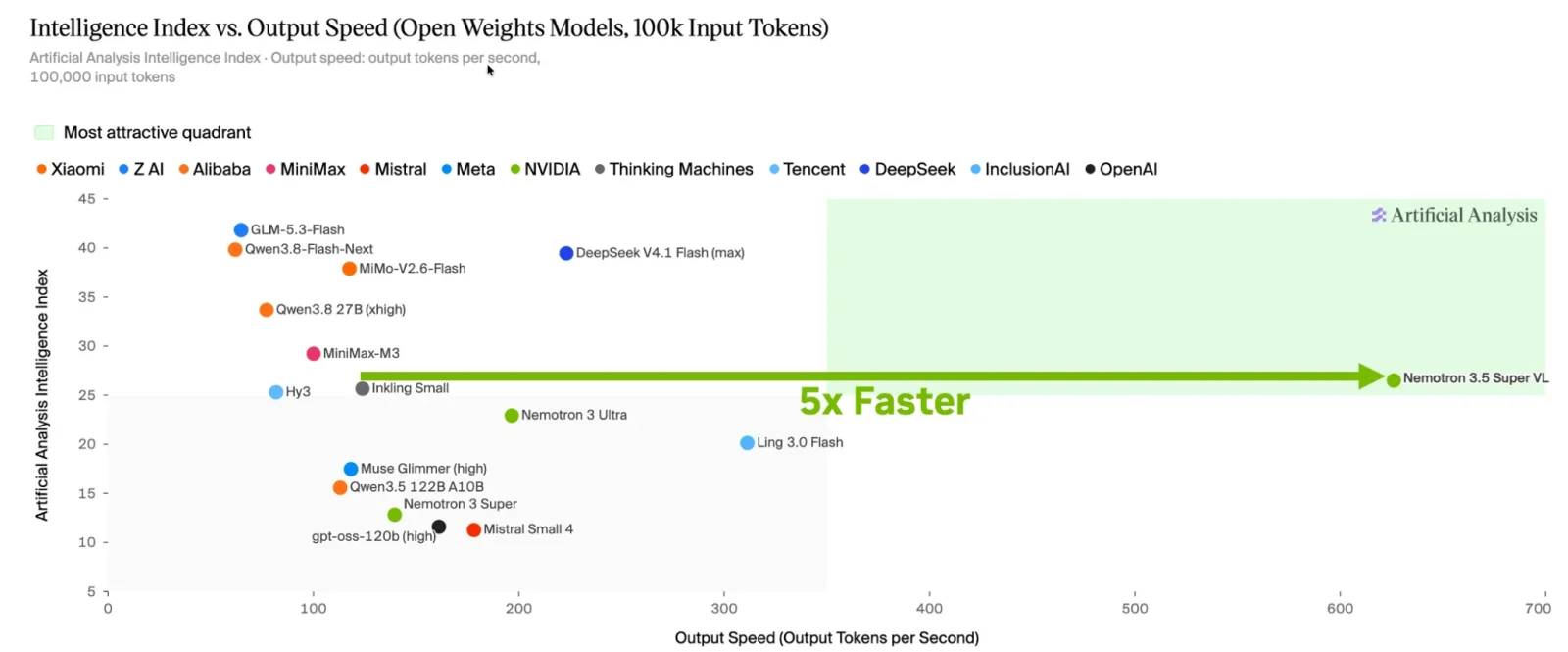 Nemotron 3.5 Super VL output speed versus Artificial Analysis Intelligence Index for open-weight models
Image: NVIDIA
Nemotron 3.5 Super VL output speed versus Artificial Analysis Intelligence Index for open-weight models
Image: NVIDIA
Nvidia also reports 4x faster task completion on 10,000 coding tasks on B200 GPUs, and says an independent evaluation by EXO Labs placed the model on the accuracy versus task-completion-time Pareto frontier on a DGX Spark with 128GB.
Under the hood: how it gets fast
The model was distilled from Nemotron 3 Ultra. Nvidia credits Ultra's coding ability and a "SkewReverse" distillation loss for better coding accuracy, and describes multi-teacher on-policy distillation (MOPD), where specialised teachers score the model's own responses for video reasoning, vision tool use and alignment. Inference uses several techniques:
- LiLiCorr speculative decoding. A lightweight network scores a whole draft of tokens jointly, capturing dependencies that independent token predictions miss. On DGX Spark it is the recommended drafter, with up to 2.3x faster token generation than decoding without speculation.
- NVFP4 with quantization-aware distillation. 4-bit weights and activations on Blackwell; the same checkpoint runs on other hardware with 4-bit weights and 16-bit activations. Training the quantized model to match the BF16 original closes the accuracy gap and adds no inference overhead.
- Multi-token prediction. An internal drafter proposes several tokens that the main model verifies in one pass.
- Context reuse. Agents resend system prompts, tool definitions and history every turn. Prefix caching preserves both attention caches and Mamba recurrent states, so the hybrid architecture does not recompute shared inputs.
On the serving side, Nvidia says Dynamo with KV-aware routing and cache offload serves up to 8x as many users and cuts first-token latency by 85% on 16 B200 GPUs at 50 tokens per second per user. For comparison with other open inference engines built for agent loops, see TokenSpeed.
Partner results: read them carefully
Nvidia lists organisations that post-trained the model for narrow jobs:
| Partner | Task | Reported result |
|---|---|---|
| Scale AI | Vendor credit processing for Skydance | Inference cost "will decrease" 40x, latency 5x |
| Ramp | Receipt images to structured JSON | Expects up to 50% higher throughput, 10x lower latency |
| AI21 | Threat intelligence for Alice | 40% accuracy improvement |
Two of these are expectations, not measured production results, and all come from Nvidia's post. They do show the intended pattern: take a general open model, post-train on your own data, and beat a frontier model on one workflow at much lower cost. We have seen the same logic in Nvidia's NeMo Gym chip-design agent, where reinforcement learning in an environment lifted a task from 55% to 95%.
What is in the release
Nvidia says the release includes base, post-trained and NVFP4-quantized checkpoints with training recipes, data and RL environments. Alongside it come open datasets on Hugging Face: agentic tool-use and conversation data, finance reasoning and tool-calling sets, instruction-following and chat data, long-context transduction and translation data, fairness data, and 45 vision-language datasets. Tools named for customisation are NeMo AutoModel (SFT and LoRA), NeMo RL, NeMo Gym and NeMo Data Designer, plus a usage cookbook on GitHub. The model was built with Nemotron Coalition organisations; Nvidia credits Perplexity datasets for mid-training and Prime Intellect environments for building better teacher models.
The partner ecosystem is wide: inference runtimes including vLLM, SGLang, Ollama, LM Studio and Unsloth; agent harnesses including OpenClaw, OpenCode, OpenHands, Cline, LangChain and Hermes Agent; and cloud platforms including Amazon SageMaker JumpStart, Microsoft Foundry and Oracle. If you use the Hermes harness, see our notes on Hermes Agent v0.22.0 and local models.
How to try it
- Hosted: use OpenRouter or a hosted inference provider from Nvidia's list to test quality before buying hardware.
- Local: the model is optimized for DGX Spark; NeMo's Megatron Bridge docs describe converting the 120B-A12B checkpoint (eight GPUs in BF16 for the verified import path). For Windows-side local AI, compare Llama Windows on RTX Spark.
- Customise: start with LoRA on a few thousand examples from your own workflow, then add RL with NeMo Gym if you can write a verifier.
- Serve: NVIDIA NIM packages optimised engines and standard APIs; Dynamo adds routing for multi-GPU setups.
Always run your own evaluation: one chart score and one harness score do not predict your documents.
Which Nemotron should you pick?
Nvidia describes Nemotron 3.5 as a system of models rather than a single flagship, and the choice depends on the job. Nemotron 3.5 Lightning handles high-volume text tasks where latency and cost dominate, such as classification, routing and extraction from plain text. Nemotron 3 Ultra is the model Nvidia points to for complex planning and orchestration, and it is also the teacher from which Super VL was distilled. Super VL sits in the middle: the specialised worker that reads documents, charts and video, calls tools and finishes multistep tasks.
In practice that suggests a layered design. Let a planner decide what to do, let Super VL execute the document and screen-heavy steps, and let a small text model clean up outputs at volume. The benefit is that each tier can be post-trained on your data separately, and you only pay 12B-active-parameter inference where vision is actually needed.
Limits and open questions
- Speed and cost numbers are Nvidia's and partners', not independent.
- A 120B model, even with 12B active, needs large memory for weights; "single GPU" claims depend on quantization and the GPU.
- The licence terms should be read on the model card.
- Comparisons name "other open models in its size category" without a full public table in the post.
- Video understanding and cybersecurity use cases are listed as capabilities, but the post gives no benchmark for them in the text we read.
What this means for what you build
If you are building document or screen-reading agents, Super VL is a credible open option that avoids a two-model pipeline, and the released datasets and recipes lower the cost of specialising it. If you only need text, the smaller Nemotron 3.5 Lightning will be cheaper. If you need the best raw reasoning, a frontier API model still sits above this tier; the value here is cost, control and the ability to run on your own hardware.
Related reading
-
Nemotron 3.5 Rerank 8B: open multimodal reranker for vision RAG
-
AI21 post-trains Nemotron 3.5 Super VL for Deel, Gong and Alice: claimed vs verified
-
RTX Spark launch software: Nemotron 3.5 Bolt, PAIR 1.0 and Llama Windows
Details are accurate as of October 15, 2026, based on Nvidia's technical blog and NeMo documentation; performance figures are vendor-reported.