




Mistral has released Timestral, its first family of time-series foundation models. The largest model has just 209M parameters, and Mistral says it ranks first among pretrained, zero-shot models on three public forecasting benchmarks (GIFT-Eval, TIME and fev-bench) while running on a plain CPU. The announcement is on Mistral's news page and the model is listed in the Mistral docs as a public preview under a Modified MIT licence.
This is a notable change of lane for a lab known for chat and coding models such as Mistral Large 4. Time series (sensor telemetry, observability metrics, energy load, demand) is one of the most common data types in companies, and it rarely gets the foundation-model treatment that text does.
TL;DR: what Timestral is
| Question | Answer (source: Mistral) |
|---|---|
| What is it? | Time-series foundation model family for probabilistic, multivariate forecasting |
| Sizes | 5M, 28M, 123M and 209M parameters |
| Context length | 32,768 time steps |
| Output | Probabilistic forecasts, 21 quantiles |
| Inputs | Multivariate targets, past-only and known-future covariates, categorical covariates |
| Hardware | CPU is enough; no GPU needed at inference |
| Licence | Modified MIT |
| Deployment | On-prem, VPC or air-gapped; fine-tuning through Mistral Forge |
| Status | Public preview; technical report to follow |
Why a foundation model for time series?
Classical tools such as ARIMA and linear regression are fitted to a single series and learn only from that series' history. Deep models such as PatchTST can learn nonlinear patterns across related series, but they are usually trained from scratch on each dataset, so nothing carries over to a new domain.
A time-series foundation model applies the pre-training idea instead. It is trained on a large and diverse corpus, learns patterns that transfer, and forecasts data it has never seen. That matters most where history is short or scarce, such as a newly installed machine or a new product line.
The benchmark claims
Mistral evaluated Timestral on GIFT-Eval, TIME and fev-bench. Among pretrained, zero-shot models, it says the 209M model ranks first across all five metrics, from a single checkpoint without ensembling. It says this is achieved with about two-thirds of the parameters of the previous state of the art.
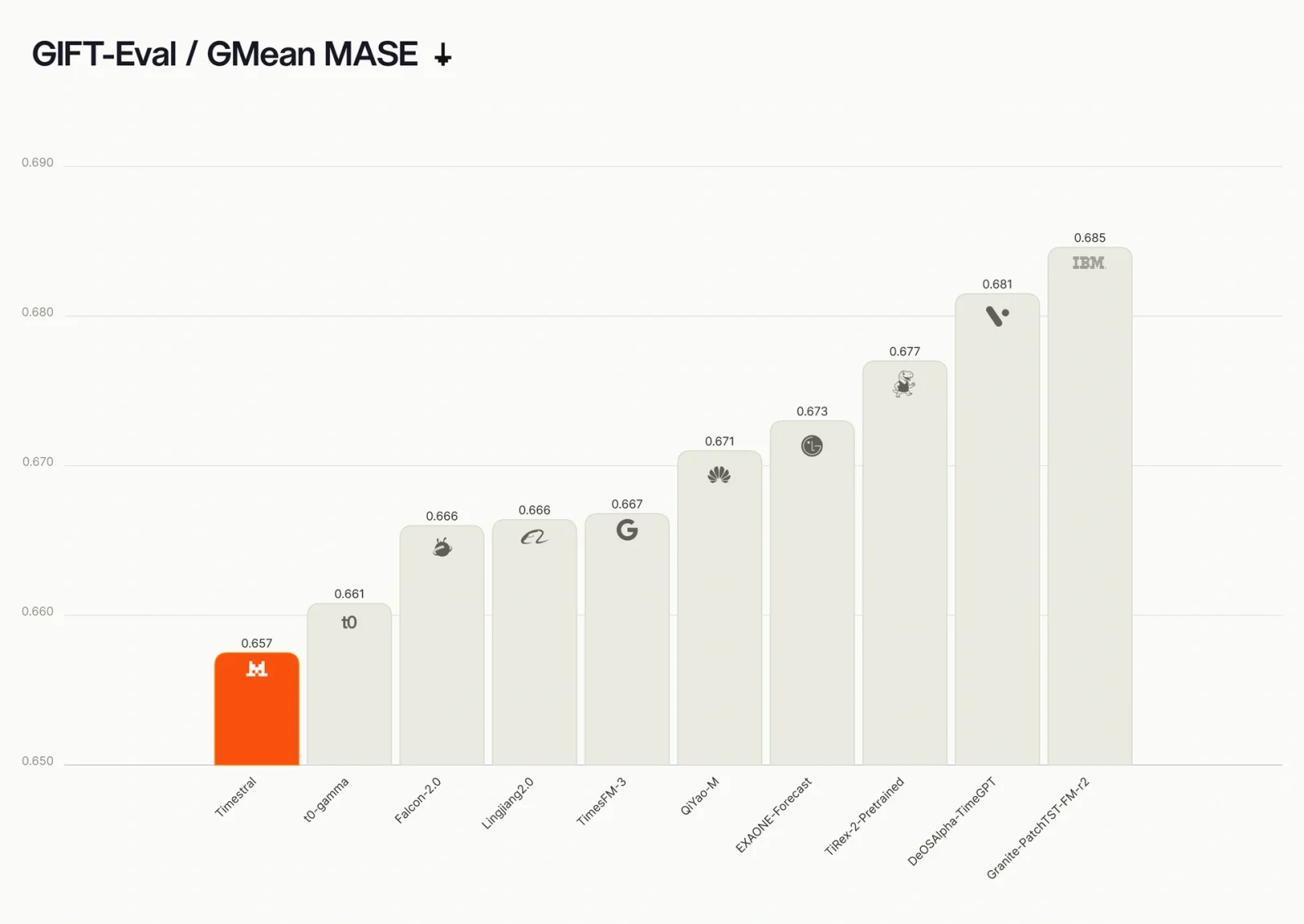 GIFT-Eval GMean MASE leaderboard where Timestral ranks first among zero-shot forecasting models
Image: Mistral
GIFT-Eval GMean MASE leaderboard where Timestral ranks first among zero-shot forecasting models
Image: Mistral
The figure above is Mistral's GIFT-Eval chart (top ten of 83 comparable pretrained and zero-shot entries, lower is better). Mistral's other charts cover TIME (35 leaderboard entries) and fev-bench (37 entries). Results have been submitted to the GIFT-Eval and TIME leaderboards.
Treat this as claimed, not independently verified. Mistral says a technical report with full results will follow, and benchmark rankings on public leaderboards move as new entries arrive. The fair test is your own data, which we cover below.
Four sizes on the accuracy-versus-size frontier
Mistral says all four models share one architecture and training recipe and each sits on the Pareto front of accuracy against model size, meaning no public model of the same size forecasts better. Its specific comparisons:
- The 28M model beats Chronos-2, which is about four times larger, on GIFT-Eval and TIME.
- The 209M model beats TimesFM-3 and Falcon-2.0 with fewer parameters.
- The 123M model comes within 0.2% of the 209M score at three quarters of its latency.
- The 28M model is five times faster than the 209M model.
 Timestral time series foundation model accuracy versus model size on forecasting benchmarks
Image: Mistral
Timestral time series foundation model accuracy versus model size on forecasting benchmarks
Image: Mistral
CPU latency: the practical headline
Timestral does not need a GPU at inference. On a standard server CPU with 8 threads, forecasting one day ahead from three weeks of 15-minute history takes 10 ms with the 5M model and 140 ms with the 209M model. That is a workload profile that fits inside an existing monitoring pipeline, a cron job or an edge box, without reserving accelerators. It echoes a wider trend toward tiny models that run anywhere, such as the 1M-parameter Indra OCR model on CPU and Tether's 250M on-device speech model.
What can it actually model?
Mistral's example is an industrial plant with thousands of sensors. It lists four capabilities:
- Multivariate forecasting. A pump's vibration, temperature and pressure move together; Timestral models related series jointly instead of one at a time.
- Probabilistic output. It predicts a full set of 21 quantiles, so teams can see how wide the uncertainty is, set alert thresholds that reflect it, and plan maintenance around risk rather than a single number.
- Categorical covariates. Day of week or machine state (running, idle, maintenance) enter as categories rather than as fake numbers with an order they do not have.
- Known-future covariates. Production schedules, planned shutdowns and weather forecasts can be fed in so a scheduled load increase is expected rather than flagged as a surprise.
How it was built
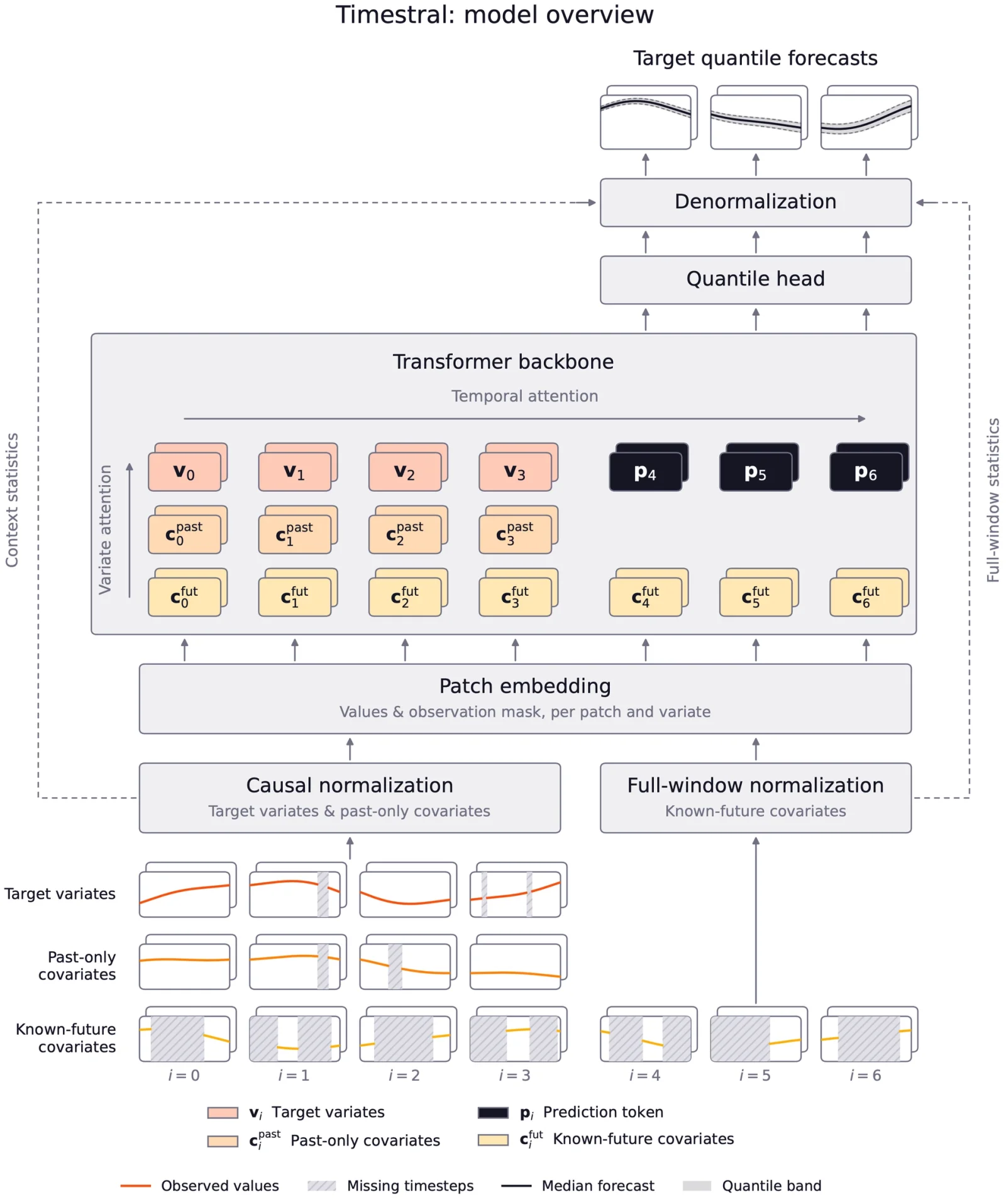
Mistral says the technical report will describe the ideas in detail, but the announcement names four:
- Decoupled Horizon Forecasting (DHF). Causal decoders trained with contiguous patch masking, as in Toto 2.0 and TimesFM-3, mask the values to be forecast, so they look like missing data and are lost as context for later forecasts. DHF keeps the full history in the sequence and uses learned forecast tokens that read the history before them. Every observed value is both target and context, and true gaps stay flagged as missing.
- Covariate-aware attention. Each input series gets a role: target, past-only covariate or known-future covariate. Known-future covariates are visible across the whole window while targets stay causal, and information flows only from covariates to targets, so a holiday calendar can help without leaking a target's own future.
- Synthetic-first data. Most training data is synthetic: univariate processes with trends, seasonality and varied noise, combined into multivariate series with nonlinear dependencies.
- Two-stage training. Pre-training on purely synthetic data with context 8,192, then post-training on a mix of real and synthetic data with a context four times longer. The loss is a pinball loss over 21 quantiles, a discrete approximation of CRPS.
The synthetic-first choice also helps with a common evaluation worry: leakage. If the model was pre-trained mostly on generated data, it is less likely to have seen your backtest set. Mistral stresses that, with Forge, you control the training mix so that nothing you backtest was seen during pre-training.
From model to system: pairing with agents
Mistral pitches Timestral as a numerical component that can sit in a monitoring pipeline or beside language models. In its plant example, Timestral runs continuously on sensor streams and detects anomalies. An agent then embeds the signals, compares them to past failures, spawns sub-agents to run a root-cause analysis over maintenance records, shift logs and manuals, and drafts a diagnosis. The plant manager receives a diagnosis and plan instead of a bare alert.
This is a vendor scenario, not a measured result, but it is a useful pattern: let a small specialised model do the numbers and a language model do the narrative. For more on building such loops, see our guide to always-on persistent agent architecture.
Fine-tuning and adaptation
Public benchmarks measure general performance, while production data drifts as markets change regime or equipment degrades. Mistral says Timestral is available through Mistral Forge, the training pipeline it uses for its language models, supporting zero-shot inference, architectural extensions such as domain-specific covariates, fine-tuning on proprietary data, and control of the training data mix. The full pipeline can be deployed on customers' hardware, including air-gapped environments.
How to try it
Mistral says it published a GitHub repository to run Timestral on your own data, and the docs list downloadable weights under Modified MIT. At publication time we could not open the repository page we tried (github.com/mistralai/timestral returned a 404 for us), so start from the links on the announcement page and the model docs rather than guessing URLs.
A sensible evaluation plan:
- Pick 5 to 20 series where you already have a baseline (seasonal naive, ARIMA or a tuned gradient-boosting model).
- Backtest with a rolling origin, not a single split.
- Score with both a point metric (MASE) and a probabilistic metric (CRPS or weighted quantile loss).
- Compare the 28M and 209M sizes; the small one may be enough.
- Add known-future covariates only after the covariate-free run, to see what they buy you.
Limits and open questions
- The technical report is not out, so architecture claims cannot yet be checked in detail.
- The leaderboard ranking is Mistral's reading of submitted results; rankings change.
- The licence is "Modified MIT", not plain MIT. Read the modifications before shipping it in a product.
- The docs label the model a public preview.
- Benchmarks such as GIFT-Eval average over many datasets; your domain may be an outlier.
What this means for what you build
If you run monitoring, capacity planning or demand forecasting, Timestral gives you a zero-shot baseline that runs on hardware you already have, with calibrated quantiles rather than a single guess. For many teams the realistic path is to run the 28M or 123M size as a baseline next to the existing model and keep whichever wins on your backtest. For agent builders, a CPU-cheap forecaster is a tool call that returns numbers with uncertainty, which is a better input to an LLM than raw CSV rows.
It also continues Mistral's push into specialised, deployable models alongside the frontier work, and it lands in the same week that Nvidia pushed open agent models; see Nvidia's Nemotron 3.5 Super VL. For other forecasting-style science models released as open code, see Microsoft's probabilistic bias correction for 2-to-6-week weather and Ai2's HIRO ACE v2 extreme weather emulator.
Related reading
- CERN and Mistral plan a Large Physics Model
- Mistral Large 4 open-weights preview
- Microsoft PBC open-source weather bias correction
- HIRO ACE v2 extreme weather emulator
- Indra OCR: 1M parameters on CPU
- Always-on persistent AI agent architecture
- Tether on-device speech recognition
Details are accurate as of October 15, 2026, from Mistral's announcement and docs; benchmark results are Mistral's own and the technical report was still pending.