



Google announced Video Remix in Google Photos on July 8, 2026 — a template-driven tool that uses Gemini Omni to turn ordinary clips into stylized share bait in a few taps. Pick a video, choose a prompt like "Relight my video with a morning glow" or "Paint my video in dreamy watercolor," wait a minute or two, and Google generates a new version with cinematic lighting, swapped backgrounds, or full artistic treatments.
The launch completes a year-long arc: Google shipped Remix for still images in Photos in 2025; spotted Video Remix in app strings in June 2026; and now ships consumer Omni video editing the same month Gemini Omni Flash landed for developers. Google's X post crossed 116K views within hours — with equal parts hype ("game-changer") and frustration ("again not in Germany").
This post covers what Video Remix actually does, who gets it, limits and privacy questions from the rollout thread, and how it fits next to Immich, Meta Muse Video, and the broader Gemini Omni stack.
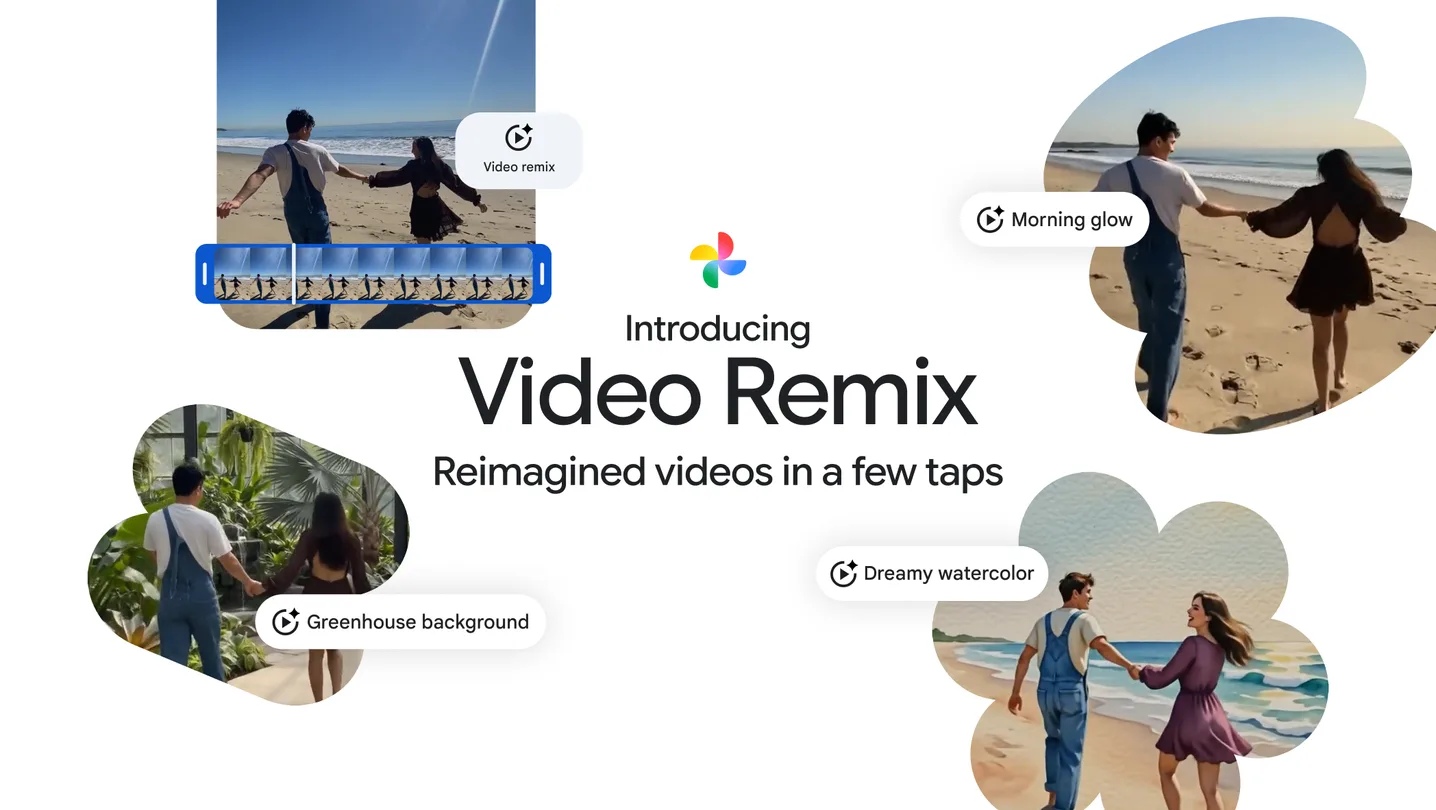 Google Photos Video Remix powered by Gemini Omni
TL;DR — what people are asking
| Question | Answer |
|---|---|
| Where is it? | Create tab in Google Photos → Video Remix |
| Who gets it? | Google AI Plus, Pro, Ultra — not free tier at launch |
| Countries (14)? | US, India, Japan, Brazil, Mexico, + 9 others — no Germany/UK/EU bulk |
| Max clip length? | 10 seconds — trim longer videos first |
| Model? | Gemini Omni — "create anything from any input" consumer path |
| Effect types? | Relighting, background swap, watercolor, sketchbook, oil painting |
| Speed? | ~1–2 minutes per remix (reports vary) |
| vs image Remix? | Same Create hub; video extends last year's still-image Remix |
| Privacy? | Clips processed on Google cloud — same trust model as Photos AI features |
What Video Remix does
Google's pitch is zero professional editing skills:
"Creating beautiful video clips shouldn't require professional skills or hours of editing."
From the official blog post:
- Cinematic relighting — brighten dark clips ("morning glow")
- Background swap — plain walls → greenhouses, stylized environments
- Artistic treatments — watercolor, raw sketchbook, oil painting
- Template library — inspiration prompts so you do not write prompts from scratch
Video Remix sits in the Create tab hub alongside:
| Create tool | Input | Output |
|---|---|---|
| Remix (images) | Still photo | Stylized still (2025) |
| Video Remix | ≤10s clip | Stylized video (July 2026) |
| Photo to video | Still(s) | Motion clip |
| Collages | Multiple photos | Grid layout |
This is Google's consumer answer to "TikTok filters, but multimodal" — social replies asked exactly that. The difference is full generative re-render of footage, not a LUT overlay.
Gemini Omni — why this model matters
Gemini Omni is Google's unified multimodal line — text, image, audio, and video in one stack. Early Gemini app leaks in May 2026 showed remix-in-chat before I/O; Omni Flash (June 30) opened API and AI Studio access for developers with conversational editing ("slow down the second half").
Video Remix is the opposite interface:
| Surface | User | Control |
|---|---|---|
| Omni Flash API | Developers | Free-form prompts, pipelines, products |
| Video Remix | Subscribers | Curated templates, one-tap transforms |
| NotebookLM Short Video | Pro/Ultra | Research → 60s vertical explainer |
Same model family, different UX contract. Photos users never see "Gemini Omni" in settings — they see templates. That is how Google ships AI to a billion users without exposing token economics.
For builder context: Runway Aleph vs Gemini Omni compared cinematic fidelity; Video Remix optimizes memories → shareable clip, not film production.
Availability — who is angry and why
Subscription: Google AI Plus, Pro, and Ultra only at launch. In-app copy suggests free-tier expansion later, but Google has not committed dates.
Countries (14 at launch):
Argentina, Bangladesh, Brazil, Colombia, Egypt, India, Indonesia, Japan, Mexico, Pakistan, Philippines, South Korea, Turkey, United States
Notably absent from day one: Germany, Canada, UK, Australia, most of EU — recurring pattern for Google Photos AI (Ask Photos rollouts followed similar geofencing). X commenters in Germany flagged paying AI Pro without access — a trust issue for Google's subscription stack.
Texas / US edge cases: No Texas-specific block announced; privacy-conscious users still ask whether remix processing adds new law-enforcement-adjacent exposure on top of existing Photos cloud storage — same debate as Immich vs Google Photos migration threads.
Limits and quality — what X caught early
10-second cap
Clips must be ≤10 seconds or trimmed first. That rules out travel vlogs, kid birthday parties, and most phone screen recordings without pre-cut. Good for Instagram Stories energy; bad for archival remix.
Generation latency
Reports cite 1–2+ minutes per remix — not instant like filters. You are paying inference cost in wait time.
Consistency and artifacts
Top constructive X question: "How well does it handle longer clips and keep people/objects consistent?" — Google sidesteps with the 10s cap. Demo footage and replies flagged body deformation when subjects turn — familiar generative video failure mode. One reply joked the preview showed the bug on purpose.
explainx.ai read: Use Video Remix for aesthetic social posts, not evidence, insurance claims, or news. Stylization destroys pixel fidelity by design.
Data processing
Remix sends video to Google's models. If you already upload to Google Photos, this is incremental AI processing — not a new upload channel. If you left Google over privacy and E2EE debates, Video Remix is another reason to stay on Immich — which has no Omni equivalent today.
How to use Video Remix (when you have access)
- Open Google Photos on a supported account and region
- Confirm Google AI Plus / Pro / Ultra subscription
- Go to Create tab
- Select Video Remix
- Pick a clip (≤10 seconds)
- Choose a template or inspiration prompt (relight, background, watercolor, etc.)
- Wait for generation → save or share
No API key. No AI Studio. Templates do the prompting — aligned with Google's low-friction consumer AI strategy vs X's iOS video editor for creators who edit in-app.
Competitive landscape — July 2026
| Product | Angle | Who |
|---|---|---|
| Google Photos Video Remix | Personal library → stylized clip | Subscribers, 14 countries |
| Gemini Omni Flash API | Build your own video products | Developers |
| Meta Muse Video | Agentic generation in Meta apps | Instagram/WhatsApp path |
| Runway / Seedance / Kling | Cinematic generation | Pros and creators |
| X iOS video editor | Captions, green screen, trim | Social posters |
| Immich 3.0 | Self-hosted backup, no generative remix | Privacy-first |
Google's moat is your existing camera roll — zero export friction. Competitors need you to bring footage; Photos already has a decade of memories hostage-compatible with One/Google account lock-in.
What builders should watch
Product teams
- Template UX beats raw prompts for mass adoption — Omni Flash power hidden behind "Paint my video in dreamy watercolor"
- 10s cap is a product choice (cost + quality), not a model hard limit — may rise
Developers
- Consumer feature validates Omni video editing demand — API users can prototype remix-like flows with Omni Flash conversational edits
- Safety filters on Omni (no real-person likeness generation in API) may differ from Photos remix on your own face in your own library — expect policy nuance
Privacy / enterprise
- Another Photos AI feature = another DPA and subprocessors line item for EU customers waiting on availability anyway
Related on explainx.ai
- Gemini Omni 1.1 Flash — 40s extensions, 4K upscale, $0.03/s drafts — August 27, 2026 update to the developer Omni model
- Gemini free 10 Omni videos — until Aug 4, 2026 — Tools → Create video promo for free-tier users
- Gemini Omni Flash — developer video generation API
- Gemini Omni — early app leaks and I/O context
- Runway Aleph 2 vs Gemini Omni
- Meta Muse Image and Muse Video
- Immich — self-hosted Google Photos alternative
- Self-host photos with Immich 3 — privacy and cost
- X iOS video editor — captions and green screen
- NotebookLM Short Video Overviews
Official: Google — Video Remix blog · Google on X — announcement
Availability, countries, and subscription tiers reflect Google's July 8, 2026 announcement — verify in-app before relying on access. Feature set may expand to additional regions and tiers.