



A 303-point Hacker News thread (July 8, 2026) resurfaced Kokoro-82M — the lightweight TTS model that makes GPU-poor developers feel less left behind. The anchor article: Local, CPU-Friendly, High-Quality TTS with Kokoro by Ariya Hidayat (March 2026), which walks through Kokoro-FastAPI, OpenAI-compatible endpoints, and real CPU timings.
The pitch is simple: realistic speech without sending text to a cloud API, on hardware you already own — including a 12-year-old Intel i7 or Apple M2 with the GPU reserved for LLM inference.
TL;DR — Kokoro at a glance
| Aspect | Details |
|---|---|
| Model | Kokoro-82M — ~82M parameters |
| Hardware | CPU-first — no NVIDIA required |
| Voices | ~50 presets — see VOICES.md |
| Languages | English-strong; Mandarin, Hindi, others supported |
| Fastest setup | ghcr.io/remsky/kokoro-fastapi-cpu container (~5 GB with bundled weights) |
| API | OpenAI speech-compatible at /v1 |
| Web UI | localhost:8880/web |
| Known weakness | Single-word / homograph pronunciation — community workarounds exist |
| HN sentiment | Accessibility, Home Assistant, article-to-podcast, browser games — with honest limits |
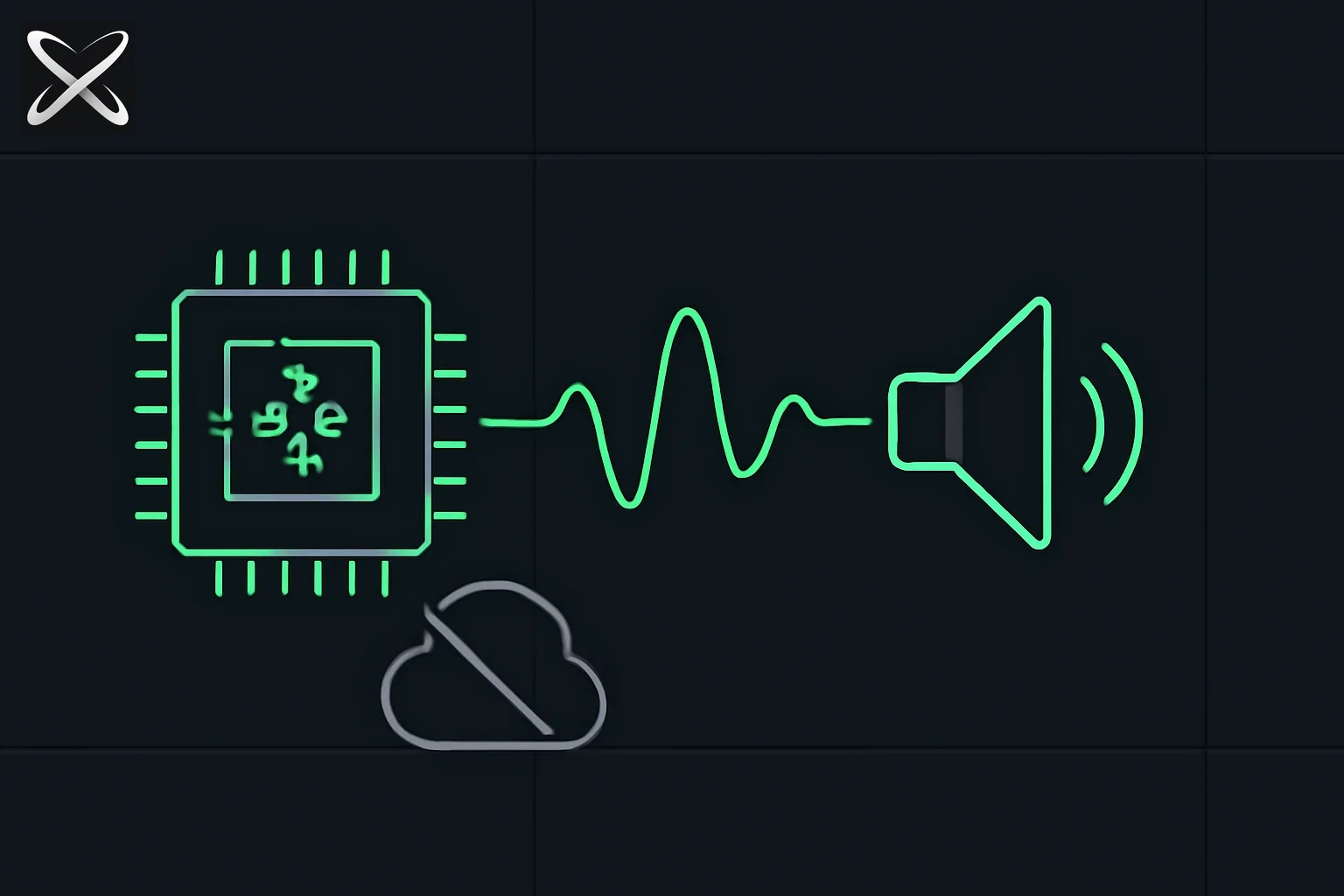 Kokoro local CPU text-to-speech explained — a CPU chip emitting a sound waveform directly to a speaker with the cloud crossed out
Quick start — Kokoro-FastAPI on CPU
From Ariya's guide and the remsky/kokoro-fastapi project:
podman run -p 8880:8880 ghcr.io/remsky/kokoro-fastapi-cpu
# or: docker run -p 8880:8880 ghcr.io/remsky/kokoro-fastapi-cpu
Open http://localhost:8880/web to type text and hear output immediately.
Point any OpenAI speech client at the local base URL:
export TTS_API_BASE_URL=http://127.0.0.1:8880/v1
export TTS_VOICE="am_eric"
Sample scripts: github.com/remotebrowser/speak (speak.js / speak.py) — output saves as MP3; plays back if SoX is installed.
Voice selection: set TTS_VOICE to any ID from the official voice list (e.g. am_eric, bf_emma).
CPU benchmark snapshot (Ariya, March 2026)
Test paragraph (Jupiter gas-giant blurb), am_eric voice, best of 3 runs:
| CPU | Generation time |
|---|---|
| AMD Ryzen 7 8745HS | 1.5 s |
| Apple M2 Pro | 4.5 s |
| Intel Core i7-4770K (2014) | 4.7 s |
Takeaway from the article: if a 12-year-old desktop CPU is acceptable, Kokoro is viable on commodity hardware — not just Apple Silicon or latest Ryzen.
HN commenters note iGPU acceleration (M2 ANE ports, Kokoro-CoreML, ONNX int8) can beat raw CPU numbers further; tts-bench scores show Kokoro still competitive ~1.5 years post-release.
What HN builders are actually doing
Patterns from the July 8, 2026 thread (69 comments, 1.2M views):
| Use case | How Kokoro fits |
|---|---|
| Accessibility product | IPA pronunciation guides for homographs; GPU-free deployment |
| Article → podcast RSS | Scrape/clean URLs → Kokoro TTS → Apple Podcasts morning drive |
| Home Assistant + Sonos | Wyoming protocol wrapper; event-triggered announcements |
| Browser game (WASM) | ~85 MB WASM or ~300 MB WebGPU build — "legitimately super good" per dev |
| Chrome read-aloud extension | Sentence-level highlighting while Kokoro reads selected text |
| Intercom / door system | Natural local voice without cloud latency |
| ePub audiobooks | Community epub → audio pipelines; occasional mispronunciation (e.g. "Malay") |
| Hermes agent pipeline | Link-to-podcast RSS automation — swapped Edge-TTS for Kokoro same day |
MCP route: kokoro-tts-mcp for agent tool integration.
In-browser: StreamingKokoroJS — 100% client-side (HN mixed reports on reliability).
The single-word problem (and the fix)
The most upvoted practical comment on HN: Kokoro stumbles on isolated words — saying "six" may produce something like "ah-six-ah".
Workaround (accessibility product builder):
- Wrap the word:
"The word is: six" - Generate full sentence
- Use Kokoro's per-word timestamps to crop just the target word in Python
Intonation is flatter, but reliable. Maintainers on Discord blame small parameter count; HN notes ElevenLabs can fail similarly on edge cases.
Homograph trick (chess example): say "Knight to f3" to Wispr/Google when "Knight" alone maps to "night" — same pattern across STT/TTS stacks.
Alternatives the thread named
| Model / tool | HN note |
|---|---|
| pocket-tts | "Much better" with ripped voices; ONNX int8 ~5x realtime on CPU per some users |
| Qwen3-TTS | Strong local voice cloning |
| F5-TTS | Close to ElevenLabs quality per one reply |
| Piper | macOS Claude Code notification announcer |
| Speaches | OpenAI-compatible; download weights on demand; bundles Whisper STT |
| Kokoro + RVC | Post-process for last ~2% nuance (podcast use cases) |
| NeuML kokoro-base-onnx | ONNX pipeline + permissive tokenizer |
For STT (opposite direction), HN pairs Parakeet + Senko diarization — not Kokoro's lane. See our Miso One real-time TTS guide for latency-first voice agents.
Local LLM + Kokoro stack
Ariya's closing line is the product pattern:
When combined with a local LLM, a speech synthesis system like this allows you to enjoy listening to LLM answers instead of reading them!
That mirrors Gemma 4 on-device duck demos (Parakeet STT → Gemma → Kokoro TTS) and the broader CPU-LLM movement — privacy, no metered speech API, offline air-gapped setups.
Pairing tips:
- Reserve GPU for LLM; let Kokoro own a CPU core
- Chunk long articles — some M2 Pro users report crashes on big paragraphs (HN: hard pass for that setup; chunking usually fixes)
- For NotebookLM-style audio digests, see Open Notebook (lfnovo/open-notebook) mentioned in-thread
Honest limits
- Not a new Kokoro version — July HN excitement was a guide resurfacing, not a v2 launch (common thread disappointment).
- Single-word / homograph weakness is real — plan sentence-wrapper + timestamp crop for glossary apps.
- Container image is ~5 GB — weights pre-bundled; Speaches is leaner on disk but needs explicit weight downloads.
- Male voices — several HN commenters find female presets stronger (possible training-data bias — anecdotal).
- SSML / inflection docs — limited vs cloud vendors; asterisk emphasis works for basic stress.
- M2 crashes on long paste — at least one report; test chunk sizes in production.
How should you test a local speech pipeline?
Prepare a short listening set before comparing voices. Include a plain sentence, a proper name, an abbreviation, a date, and a paragraph with punctuation that changes the intended rhythm. Keep the text fixed across runs. A pleasant sample chosen after hearing the result can hide weaknesses that your actual application will encounter.
For an article reader, test sentence boundaries and pauses between sections. For an accessibility tool, check the words users most need to distinguish. A voice that sounds natural on a paragraph may still pronounce an identifier or a short command ambiguously. Record these cases so future changes can be compared with the same inputs.
Measure the whole pipeline on the hardware you plan to use. Separate model loading from repeated synthesis, and include text preparation and audio playback where they affect the experience. A warm model in a benchmark script does not describe startup time for an application launched only occasionally.
What makes chunking reliable for long documents?
Split at meaningful sentence or paragraph boundaries and preserve the original order. Arbitrary character slices can break words, punctuation, and prosody. Keep a mapping from each chunk to its source position so playback can resume after an interruption without guessing which text was already spoken.
Handle a failed chunk explicitly. Retrying the entire document can waste work and duplicate audio already delivered to the listener. Save completed chunks and retry only the missing part when the failure is recoverable. If the text is unsupported or malformed, surface that condition rather than repeating synthesis indefinitely.
Test the joins by listening. Separate chunks may have different loudness or an unnatural pause even when each file sounds acceptable on its own. The Kokoro project is the starting point for supported usage; chunk boundaries and playback behavior are decisions your application must still make.
Does local synthesis mean the whole application is offline?
Inspect every stage. The speech model may run locally while the article fetcher, language model, or telemetry sends requests elsewhere. An offline claim should describe which inputs stay on the machine and which components need an initial download or an ongoing network connection.
For sensitive material, test with a harmless sample and inspect the configured endpoints before processing real documents. Keep logs from retaining the full text unless that is an intentional requirement. Local deployment gives you control over the pipeline, but that control is useful only when the surrounding application respects the same boundary.
Start with one modest use case, such as reading a saved public article, and keep its failure path visible. Add a live agent conversation only after you understand buffering, interruption, and what happens when synthesis falls behind incoming text.
Related on explainx.ai
- VoiceStudio — 16-engine local voice studio with the same OpenAI-compatible endpoint pattern — cloning and dubbing, not just Kokoro-style TTS
- Nari Labs pushes Qwen3-TTS to sub-50ms TTFA on GPU — the GPU-serving counterpart to Kokoro's CPU-only story, at $2/1M characters
- Miso One — 110ms real-time TTS — when latency beats Kokoro's quality-per-byte
- Gemma 4 duck — on-device STT/TTS stack — Kokoro in a full edge pipeline
- Running SOTA LLMs locally — pair speech with local inference
- Closed-source vs local open alternatives — TTS fits the sovereignty story
- Claude for Open Source — free Max 20x — cloud coding grants; Kokoro for offline voice
Official & community sources
- Kokoro-82M — Hugging Face
- Local CPU-Friendly TTS with Kokoro — Ariya Hidayat
- Kokoro-FastAPI — GitHub
- HN discussion — July 8, 2026 (search "Kokoro TTS Ariya")
- tts-bench comparison
Setup commands, voice IDs, and benchmark numbers follow Ariya Hidayat's March 2026 article and the July 8, 2026 HN thread. Container tags and voice lists may change — verify on Hugging Face and the Kokoro-FastAPI repo before production deploys.