




Hugging Face published token pooling-aware training on November 11, 2026 — a recipe to shrink multi-vector retrieval indexes (ColBERT-style MaxSim) without accepting the quality cliff that naive merging causes. Author Tom Aarsen ships Sentence Transformers APIs, training scripts, and Hub checkpoints so you can fine-tune ModernBERT-base to survive ~4× fewer document vectors while holding 97.8% of unpooled NanoBEIR nDCG@10 on the reported run.
If you read Perplexity pplx-embed-v2-late for multimodal multi-vectors, this post is the compression half — how to pay less RAM and disk per corpus.
TL;DR
| Piece | Detail |
|---|---|
| Core idea | Train on both full and pooled document embeddings each step |
| Pooling algo | Ward hierarchical clustering via HierarchicalTokenPooling |
| Default budget | pool_factor=4 ≈ quarter of doc token vectors |
| Reported NanoBEIR | 49.03 → 51.23 nDCG@10 (pooled aware) vs 49.03 baseline pooled |
| Retention @ factor 4 | 97.8% pooled vs unpooled (aware) vs 94.6% (baseline) |
| Checkpoints | tomaarsen/mve-ModernBERT-base-token-pooling + baseline twin |
| Code | examples/multi_vector_encoder/training/token_pooling/ in Sentence Transformers |
Why multi-vector search explodes
Single-vector embedders compress a document to one point. ColBERT keeps one vector per token, so MaxSim can match different query terms to different passages:
MaxSim scores each query token against the best-matching document token, then sums those matches — the standard ColBERT late-interaction recipe.
The HF blog walks through storage math: even with 4-bit residuals, 200 vectors × 128 dims per document is 12.8 KB — 12.8 GB per million docs. Pooling to 50 vectors drops that to 3.2 GB at the same width.
Many token vectors are redundant; merging similar ones should be safe — unless the encoder never learned to keep distinctions after merge.
HierarchicalTokenPooling mechanics
HierarchicalTokenPooling (Sentence Transformers) repeatedly merges Ward clusters — picking the pair that least increases within-group variance — until the budget is met.
Controls:
| Setting | Meaning |
|---|---|
pool_factor=4 | ~25% of original doc vectors (length-aware) |
max_tokens=16 | Hard cap per document |
distance_threshold=… | Adaptive merges; calibrate with calibrate_distance_threshold |
By default the first token is protected and pooling applies to documents only, leaving queries dense — standard ColBERT asymmetry.
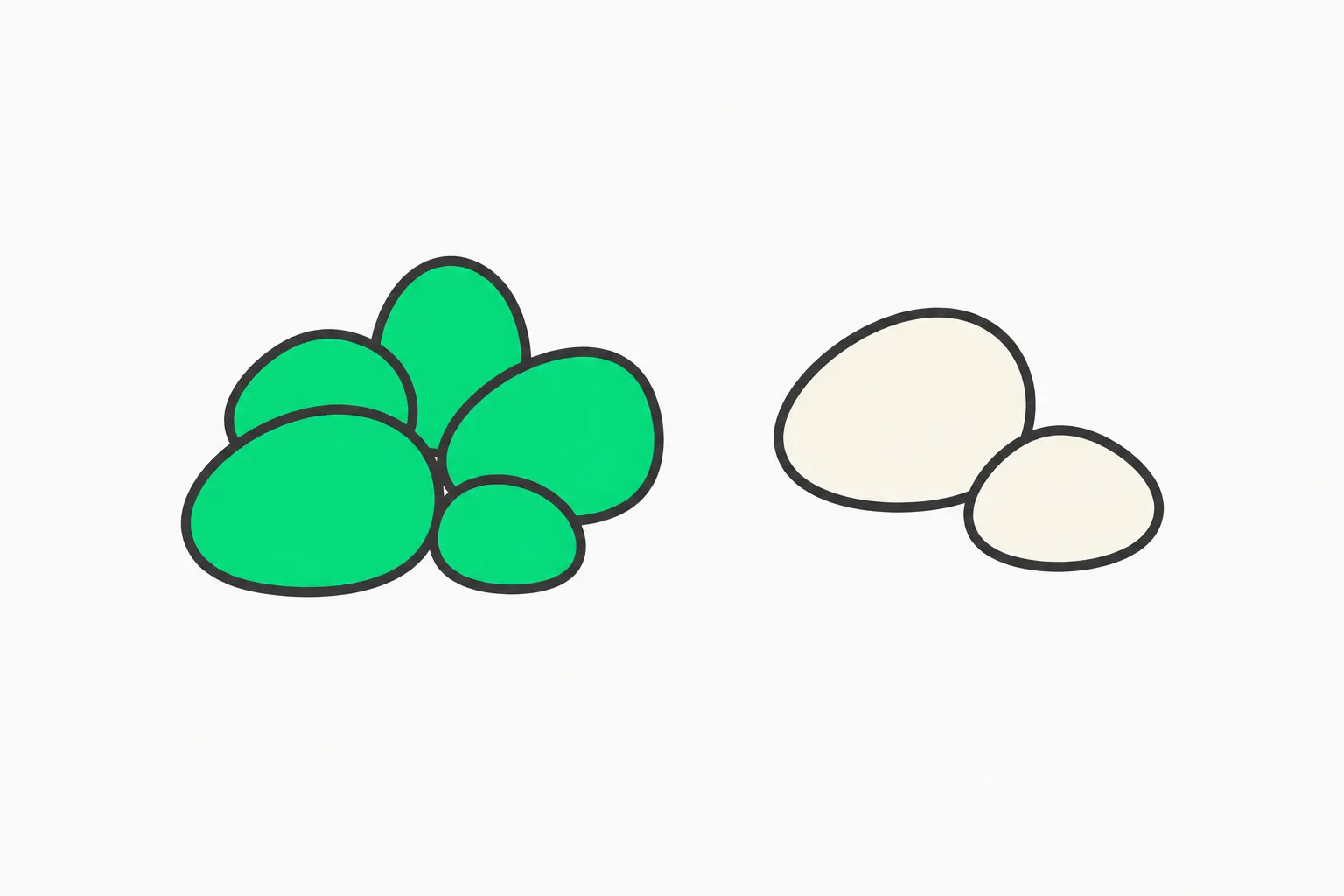 Pebbles clustered beside distant outliers, showing how Ward token pooling merges similar document embeddings
Pooling-aware loss (the actual contribution)
Prior work (Learn to Pool, LightOn pooling regularization) showed targeted fine-tuning helps. Aarsen's recipe is straightforward:
The training objective averages unpooled and pooled retrieval losses with equal weight.
Each batch updates the encoder with full and pooled document representations. Ward assignments are discrete; training uses a straight-through estimator so gradients flow from pooled vectors back to member tokens.
Snippet from the blog's training stack:
from sentence_transformers import MultiVectorEncoder
from sentence_transformers.multi_vector_encoder.losses import (
    CachedMultiVectorMultipleNegativesRankingLoss,
    MultiVectorTokenPoolingLoss,
)
from sentence_transformers.multi_vector_encoder.modules import HierarchicalTokenPooling

model = MultiVectorEncoder("answerdotai/ModernBERT-base", similarity_fn_name="maxsim")
pooling = HierarchicalTokenPooling(pool_factor=4)
base_loss = CachedMultiVectorMultipleNegativesRankingLoss(model, mini_batch_size=64)
loss = MultiVectorTokenPoolingLoss(
    model, base_loss, token_poolings=[None, pooling], weights=[0.5, 0.5],
)
CachedMultiVectorMultipleNegativesRankingLoss keeps large in-batch negatives with gradient caching — important when doc tensors are wide.
Released artifacts you can run today
| Artifact | URL |
|---|---|
| Blog + formulas | huggingface.co/blog/token-pooling |
| Pooling-aware weights | tomaarsen/mve-ModernBERT-base-token-pooling |
| Baseline (no pooling loss) | tomaarsen/mve-ModernBERT-base-token-pooling-baseline |
| Training script | training_cached_contrastive.py in Sentence Transformers examples |
| HF Jobs one-liner | hf jobs uv run --flavor a10g-small … in the post |
Inference example from the blog:
document_embeddings = model.encode_document(documents, token_pooling=pooling)
Mars-in-paragraph demo keeps correct ranking with 16 pooled doc vectors vs 58 unpooled, with slightly lower raw MaxSim scores — acceptable if ranking stable.
NanoBEIR numbers (vendor-reported)
Both models trained one epoch on 120k MS MARCO triplets, shared seed 42, 128-dim token projection. Only the loss differed.
At pool_factor=4 (mean 48.68 vectors/doc):
| Model | Mean nDCG@10 (%) | Retention vs own unpooled |
|---|---|---|
| Baseline pooled | 49.03 | 94.6% |
| Pooling-aware pooled | 51.23 | 97.8% |
| Pooling-aware unpooled | 52.39 | — |
Gains also show on fixed caps and calibrated adaptive thresholds — settings not seen during training, which suggests the encoder learns merge-robust geometry, not a single factor hack.
 A green lens over grouped shapes in a drawer, illustrating vector indexes after pooling shrinks storage
Kernels and production stack
Optional use_kernels=True on CUDA enables:
- MaxSim without full token similarity materialization
- Ward clustering on GPU (30–150× faster than SciPy in cited microbenchmarks)
For deployment, the blog's compression ladder:
- Residual quantization (e.g. Fast-PLAID 2–4 bit)
- Token pooling (+ pooling-aware fine-tune)
- Matryoshka width truncation (+ Matryoshka loss)
You can combine MultiVectorMatryoshkaLoss inside MultiVectorTokenPoolingLoss when both width and token count must fall.
How this connects to explainx.ai RAG coverage
| Topic | Post |
|---|---|
| Multi-vector late interaction | pplx-embed-v2-late guide |
| Agent memory with evidence | WikiTrace KAIST memory |
| Bedrock tokenomics | Amazon Bedrock data lake finops |
| HF marketplace billing | HF Hub on Google Cloud Marketplace |
| Decision models API | HF Decision Models SystemOne |
Teams running ColBERT + PLAID on private corpora should benchmark pool_factor sweeps on their domain — NanoBEIR is English retrieval, not your ticket archive.
What people are asking on multi-vector RAG teams
"Can I pool queries too?" The default protects the first document token and leaves queries dense. Asymmetric pooling on queries changes MaxSim asymmetry; the blog does not recommend it without ablations.
"Will this work on my ColBERT checkpoint?" Pooling at inference always helps storage; quality retention jumps when you fine-tune with MultiVectorTokenPoolingLoss. Expect to run at least one epoch on domain triplets, not only MS MARCO.
"How do I pick pool_factor in production?" Sweep factors 2–6 on a held-out legal/HR/medical slice if your corpus is not English web search. NanoBEIR is a sanity check, not a contract.
"Does pooling interact with rerankers?" Yes — first-stage recall changes which documents rerankers even see. Re-tune cross-encoder thresholds after index compression.
"What about multilingual ColBERT?" The released checkpoints are English ModernBERT. Multilingual pooling-aware training is an open question for teams with labeled cross-lingual pairs.
Paper lineage and what Hugging Face added
The blog cites three research threads:
- Stefan Josef — Learn to Pool for lightweight fine-tuning under flexible compression.
- LightOn — token pooling paper on footprint reduction with minimal performance impact.
- Antoine Chaffin — pooling regularization after training to enhance merge survivability.
Aarsen's contribution is operational: wire those ideas into Sentence Transformers 3.x multi-vector APIs, document Ward clustering defaults, release reproducible Hub checkpoints, and show HF Jobs commands so teams without local GPUs can replicate. That matters because many startups stalled on multi-vector search after ColBERT v2 READMEs — the bottleneck was index TB, not F1 on a leaderboard.
Extended NanoBEIR interpretation guide
When you run the evaluation script bundled with the post, focus on retention rather than absolute nDCG:
| Scenario | What to inspect |
|---|---|
| Aggressive mobile index | max_tokens=8 row — pooling-aware gain +3.48 points there |
| Corporate wiki scale | pool_factor=4 — ~75% vector reduction at 97.8% retention |
| Heterogeneous doc lengths | distance_threshold calibrated rows — averages hide short-doc starvation |
If your deployment caps vectors at 16 but docs are short memos, adaptive thresholds may undershoot the cap — the blog warns short documents pull averages below configured maxima.
Limitations
- ModernBERT + MS MARCO only in the released run — legal and medical corpora may behave differently
- Ward clustering CPU/GPU cost still hits indexing time if kernels unavailable
- Straight-through estimators can be unstable at extreme
pool_factor - Not a replacement for rerankers — pooling hits first-stage recall
Index math worked example
Take a 1M-document corpus with 200 token vectors per document at 128 dimensions and 4-bit residuals (Fast-PLAID style):
- Unpooled storage ≈ 12.8 GB quantized residuals (per blog arithmetic).
- After
pool_factor=4(≈50 vectors/doc) → 3.2 GB. - Pooling-aware fine-tuning aims to keep nDCG within ~2 points of unpooled on NanoBEIR while achieving that shrink.
At 10M documents, the same math crosses 128 GB unpooled versus 32 GB pooled — the difference between single-node RAM feasibility and mandatory sharding. Your finance team cares about the pooled column even if researchers only read nDCG.
Add Matryoshka width 64 on top and you compound savings, but each compression stage needs ablation — the blog's combined-loss recipe is the starting point, not the finish line.
Integration with retrieval stacks
Fast-PLAID (cited in the post) remains the practical serving layer for many ColBERT deployments. After pooling:
- Rebuild PLAID indexes from pooled
encode_documentoutputs. - Revisit probe counts — fewer vectors can reduce probe overhead but change latency variance.
- Log query latency p99 separately from nDCG; aggressive pooling can increase variance when rare tokens lose dedicated vectors.
If you serve through OpenSearch / Vespa / custom FAISS, confirm your engine supports variable-length multi-vector docs; some assume fixed token counts.
For Bedrock-centric teams, compare against Amazon embedding economics before assuming self-hosted ColBERT still wins on TCO at your scale.
Training yourself: commands
From a Sentence Transformers checkout:
uv run examples/multi_vector_encoder/training/token_pooling/training_cached_contrastive.py --baseline
uv run examples/multi_vector_encoder/training/token_pooling/training_cached_contrastive.py
Cloud:
hf jobs uv run --flavor a10g-small --timeout 4h --secrets HF_TOKEN -- \
  https://raw.githubusercontent.com/huggingface/sentence-transformers/main/examples/multi_vector_encoder/training/token_pooling/training_cached_contrastive.py
Evaluate with the blog's NanoBEIR script across caps 4–64 and factors 2–6 before picking a production budget.
Monitoring after deployment
Once pooled indexes ship, watch four metrics weekly:
- Headline nDCG or MRR on a frozen golden query set — catches slow drift as encoders get hot-swapped.
- p95 query latency — pooling should shrink index size, not inflate CPU clustering work per query (queries stay dense).
- Fraction of docs hitting max_tokens caps — indicates whether
pool_factoris too aggressive for long PDFs. - Human spot checks on top queries where scores drop after pooling — often signal entity-level token merges that confused rare proper nouns.
Rollback strategy: keep an unpooled index snapshot for seven days after cutover so you can diff failures without re-embedding the entire corpus.
Related on explainx.ai
- Perplexity pplx-embed-v2-late multimodal embeddings
- Hugging Face Hub marketplace billing
- Amazon Bedrock tokenomics data lake
- WikiTrace evidence-linked agent memory
- Deletion tuning post-training research
- What is MCP for tool routing
Benchmarks and checkpoint names match the Hugging Face blog as of November 11, 2026.