



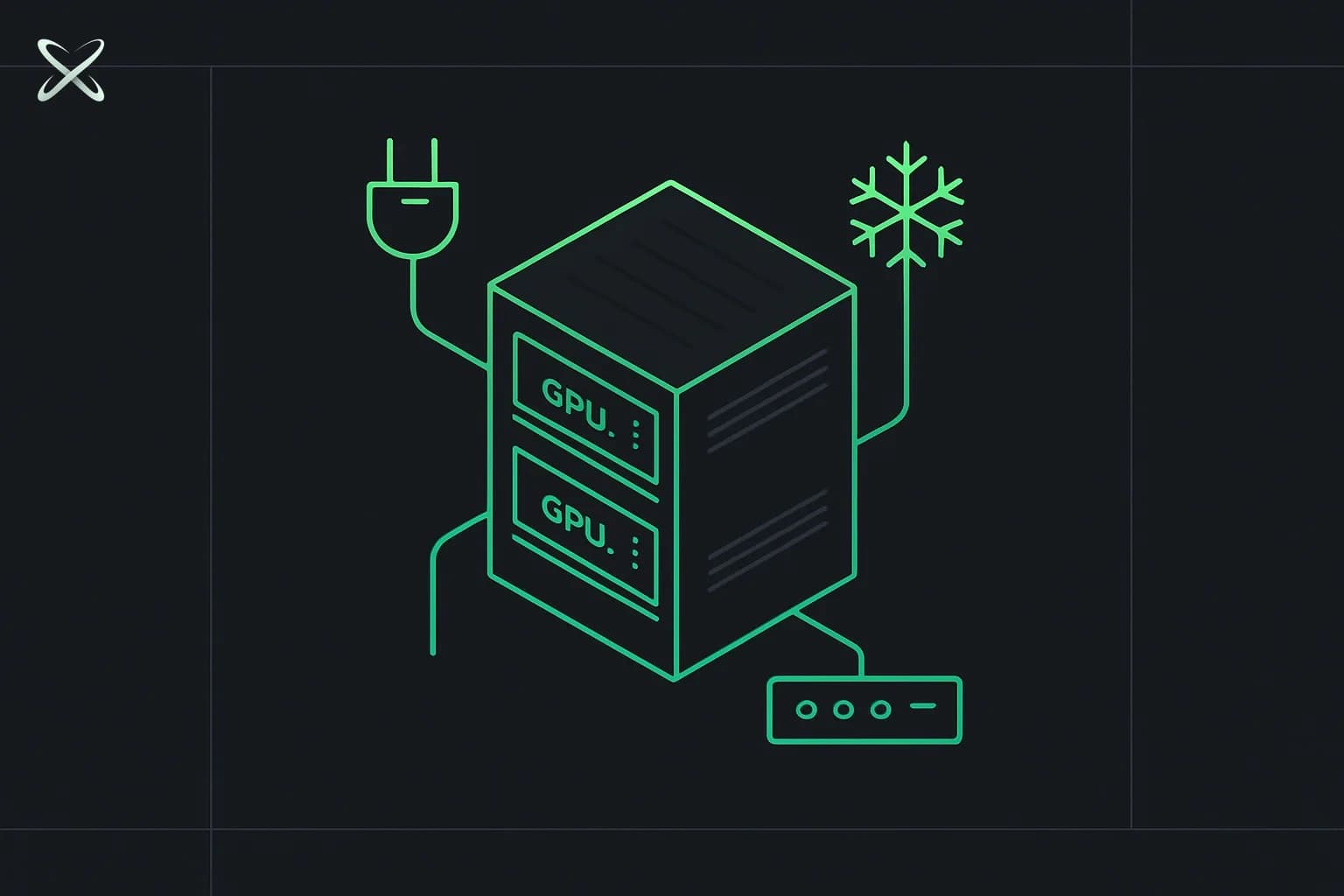
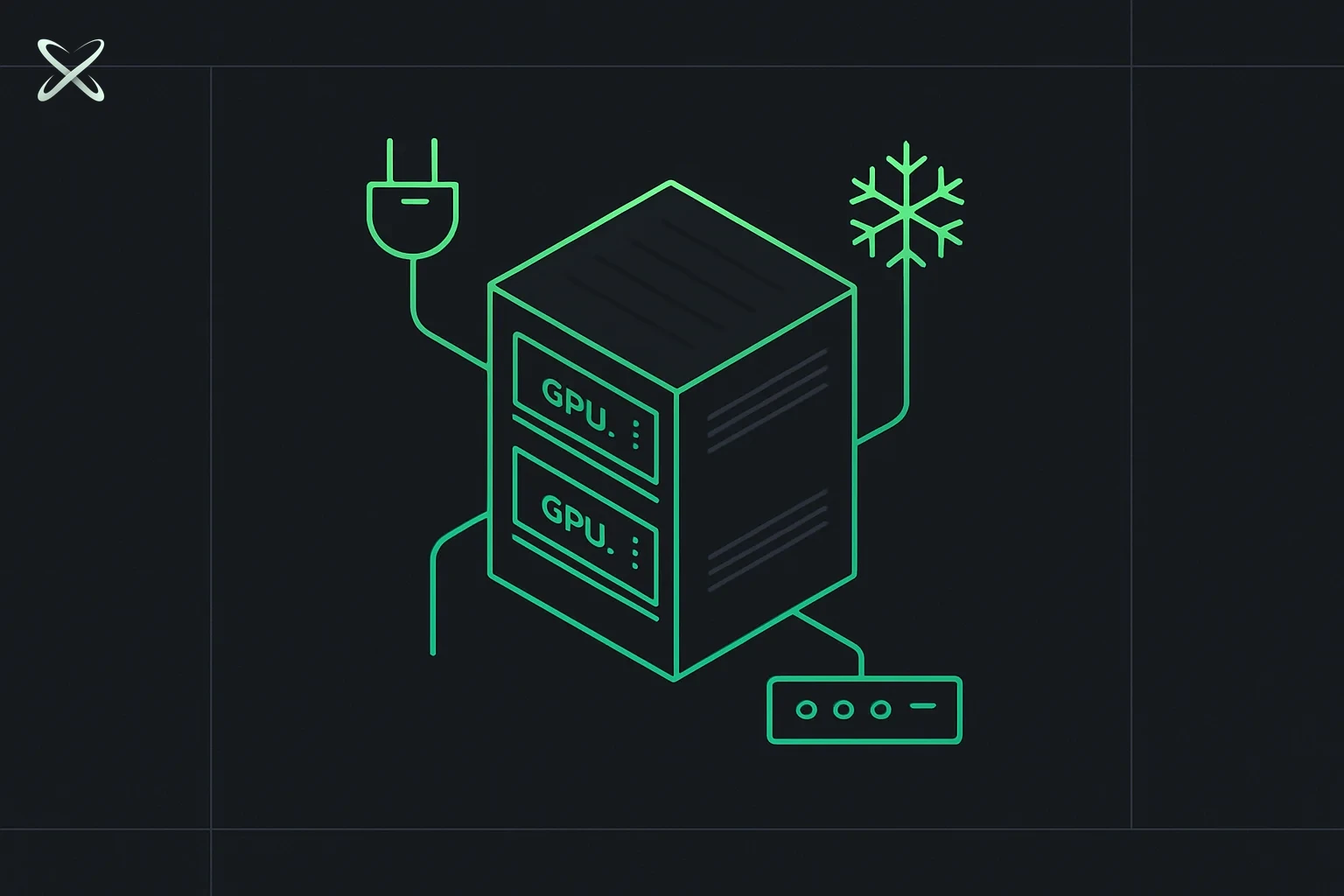
 Diagram of a small data center build path: define workload, choose colocation, size power and cooling, deploy GPU servers
"Data center" in 2026 headlines usually means a hyperscaler's multi-billion-dollar, gigawatt-scale campus — the kind we've covered in the AI data-center backlash map and hyperscaler nuclear deals. That is not what most people asking "how do I start a small data center" actually mean or need.
A realistic small-scale start in 2026 is 1-2 GPU servers in a colocation facility, not a self-built campus. This guide walks through the real process: colocation versus building your own, sizing power and cooling correctly, choosing GPU server specs, permits, networking, and what it actually costs at small scale — with sourced 2026 numbers throughout.
Quick answer: the six-step process
| Step | What you do | Why it matters |
|---|---|---|
| 1. Define the workload | Training vs. inference, expected utilization | Drives every downstream sizing decision |
| 2. Choose colocation vs. owned | Colocation for almost all small operators | Avoids multi-million-dollar shell/power capital cost |
| 3. Size GPU servers | 1-2 servers (8-GPU each) to start | Measure real utilization before scaling |
| 4. Plan power and cooling | 15-30 kW/rack minimum for AI workloads | Undersizing power is the most common early failure |
| 5. Design networking and storage | InfiniBand or high-speed Ethernet, NVMe storage | Bottlenecks here waste GPU cycles you're paying for |
| 6. Install stack, test, monitor | Software stack, load test, then scale | Scale rack by rack against measured demand |
Step 1: Define your actual workload first
Before pricing anything, decide what you're actually running. Training workloads want the largest, most tightly networked GPU clusters you can afford, run in bursts. Inference workloads want steady, right-sized capacity that matches real request volume — over-provisioning for inference is pure waste, since idle GPUs still draw most of their power.
Most small operators starting in 2026 are running inference or fine-tuning, not frontier pretraining — which changes every other decision in this guide toward "start small, measure, scale."
Step 2: Colocation vs. building your own
For a small operator, colocation wins almost every time, and the economics explain why:
| Colocation | Build your own | |
|---|---|---|
| Upfront capital | Servers + networking only (~$1M for a 16-GPU start) | $15-20M/MW for shell and power alone; $30-40M/MW all-in with liquid cooling |
| Time to deploy | Weeks, once space is secured | 6-18 months even with power already secured |
| Minimum viable scale | Single rack (though only ~25-30% of Tier I operators allow true single-rack high-density without forcing 3-10 rack minimums) | Realistically needs committed load in the multi-MW range to amortize |
| Who it's for | First-time and small operators | Operators with committed, sustained multi-megawatt load |
Cloud GPU rental runs $2-4 per GPU-hour. Colocated hardware you own, amortized over three years, runs roughly $0.50-1.00 per effective GPU-hour — a 60-75% saving for sustained workloads, which is the real financial case for going the colocation-plus-owned-hardware route instead of just renting cloud GPUs indefinitely.
Step 3: Size your GPU servers
An 8-GPU server on B200/B300-generation hardware runs $250,000-$400,000 as of early 2026. Start with 1-2 servers — that's a 16-GPU deployment at roughly $1 million all-in including networking and supporting infrastructure. Resist the urge to overbuild before you have real utilization numbers; scaling rack by rack against measured demand is cheaper than guessing wrong at scale.
For context on the far end of this spectrum: a 576-GPU neocloud-scale cluster (72 servers, full InfiniBand) runs approximately $36 million — useful mainly to show how much room there is between "small operator" and "neocloud," and why most people asking this question should be planning for the former.
Step 4: Power and cooling — the step people underbudget
This is where small operators most often get the plan wrong. A standard enterprise rack (non-GPU) draws 5-10 kW. An AI/GPU rack in 2026 needs a minimum of 15-30 kW as a baseline — and a single NVIDIA GB200 NVL72 rack draws 120-140 kW, which requires liquid cooling, not standard air cooling.
Commercial electricity averaged 14.12¢/kWh as of May 2026, up 5.4% year over year. At the small end (a couple of 15-30 kW racks), that's a real, recurring line item — not a rounding error — and it compounds with colocation power pricing (see the cost breakdown below).
Practical rule: if you're not planning liquid cooling, don't plan for GB200-class racks. Size your GPU choice to the cooling infrastructure you're actually deploying, not the other way around.
Step 5: Networking and storage
GPU compute is only as fast as the network and storage feeding it. For multi-GPU training workloads, InfiniBand is still the standard for low-latency inter-GPU communication; for inference-heavy or smaller deployments, high-speed Ethernet (100/200 GbE) is often sufficient and considerably cheaper. Pair it with NVMe storage — spinning disk or even SATA SSD will bottleneck a modern GPU server badly enough that you're paying for idle compute.
Budget for the "invisible" line items too: UPS, redundant networking, rack hardware, monitoring stack, and spare drives. These don't show up in a GPU-price headline but they're what keeps a small deployment from going down the first time a single component fails.
Step 6: Install, test, and monitor before you scale
Once hardware is racked: install your AI software stack, run load tests against realistic workloads (not synthetic benchmarks alone), and instrument monitoring from day one — power draw, GPU utilization, thermal headroom, network throughput. Only scale to additional racks once you have real utilization data justifying it. Overbuilding on projected rather than measured demand is the single most common way small operators waste capital in year one.
What it actually costs: small-scale cost summary
| Item | Cost range (2026) |
|---|---|
| 16-GPU deployment (2x 8-GPU servers + networking) | ~$1,000,000 |
| Single 8-GPU server (B200/B300 gen) | $250,000-$400,000 |
| Colocation power (per kW/month) | $150-250 |
| Colocation rack + cross-connects (per rack/month) | $1,200-$3,500 |
| Commercial electricity | 14.12¢/kWh (national average, May 2026) |
| Cloud GPU rental (for comparison) | $2-4/GPU-hour |
| Owned + colocated, amortized (for comparison) | $0.50-1.00/effective GPU-hour |
Hidden costs — cross-connects, remote hands, power overage fees — typically add 8-15% on top of the headline colocation rate. Budget for that upfront rather than discovering it on your first invoice.
Permits — what to expect, even at small scale
If you're using colocation, most permitting is inherited from your provider's existing facility. If you're deploying any physical infrastructure yourself — even a small server closet with backup power — expect to potentially need siting and construction permits, building code compliance, and air quality/emissions permits if you install a backup generator. Requirements vary significantly by state and municipality; confirm with local authorities and legal counsel before committing capital, not after.
What people are asking
Can I really start with just one or two servers? Yes — this is the recommended path, not a compromise. Define the workload, deploy 1-2 servers, measure real utilization, then scale rack by rack.
Should I buy GPUs or rent cloud GPU-hours? For sustained, predictable workloads, owning and colocating is 60-75% cheaper per effective GPU-hour once amortized over three years. For bursty or experimental workloads, cloud rental avoids the capital commitment — most operators do both, renting for spikes and owning for baseline load.
How is this different from starting a neocloud? A neocloud resells compute at scale — the smallest viable deployment is roughly a 576-GPU cluster at ~$36 million. This guide covers a much smaller, typically single-tenant deployment for your own workload, which is what most people asking "how do I start a small data center" actually need.
Update — September 1, 2026: Paradigm's GPU World story contest asks writers to imagine ~8 billion personal B300-class GPUs by 2040 — the same power-and-cooling math this guide covers at 16-GPU scale, extrapolated to planetary per-capita compute.
Compare ownership costs using productive hours
Build an illustrative cost sheet with hardware, facility charges, support, networking, financing assumptions, and expected replacement value. Divide by the hours the workload can actually use, rather than the number of hours in a year. An idle or unavailable server still has ownership costs.
Use current written quotes and your measured demand for the decision. Compare bursty and steady demand separately, and include downtime or maintenance in the scenario. The historical figures above are planning context, not a supplier offer or a guaranteed savings percentage.
Before expanding, identify who owns incidents and how failed hardware is replaced. Ask the provider what power, cooling, access, and remote support the agreement actually includes. A low rack price does not establish that the facility can support your selected equipment or restore your workload within the time your customers need.
Related reading
Update — September 1, 2026: If you're siting in California, the cost math changed — seven data center bills advanced in August 2026 covering fair-share utility costs, energy-use reporting, and a permanent Coachella ban on large AI facilities.
- GPU World: $100K contest for one GPU per person (Sep 2026)
- Perplexity Mac hybrid compute — local PII routing (Sep 2026) — Apple Silicon subtasks for sensitive agent steps without adding rack capacity
- Top 10 AI + Climate Tech Startups to Watch in 2026 — including Emerald AI, turning data-center load into a grid-flexible asset
- What is the real environmental impact of AI data centers? — water and power at national vs. local scale
- Hyperscaler nuclear deals for AI data centers — how the largest operators are solving the power problem
- Virginia's data-center power tax and AI pricing — how facility cost flows into cloud pricing
- The AI data-center backlash, mapped — community and grid pushback at the hyperscale end
- The model-selection energy math — workload-side efficiency once you're running your own hardware
Costs, power figures, and pricing reflect public reporting and market data as of August 2026 and change quickly — get current quotes from colocation providers and hardware vendors before committing capital.