



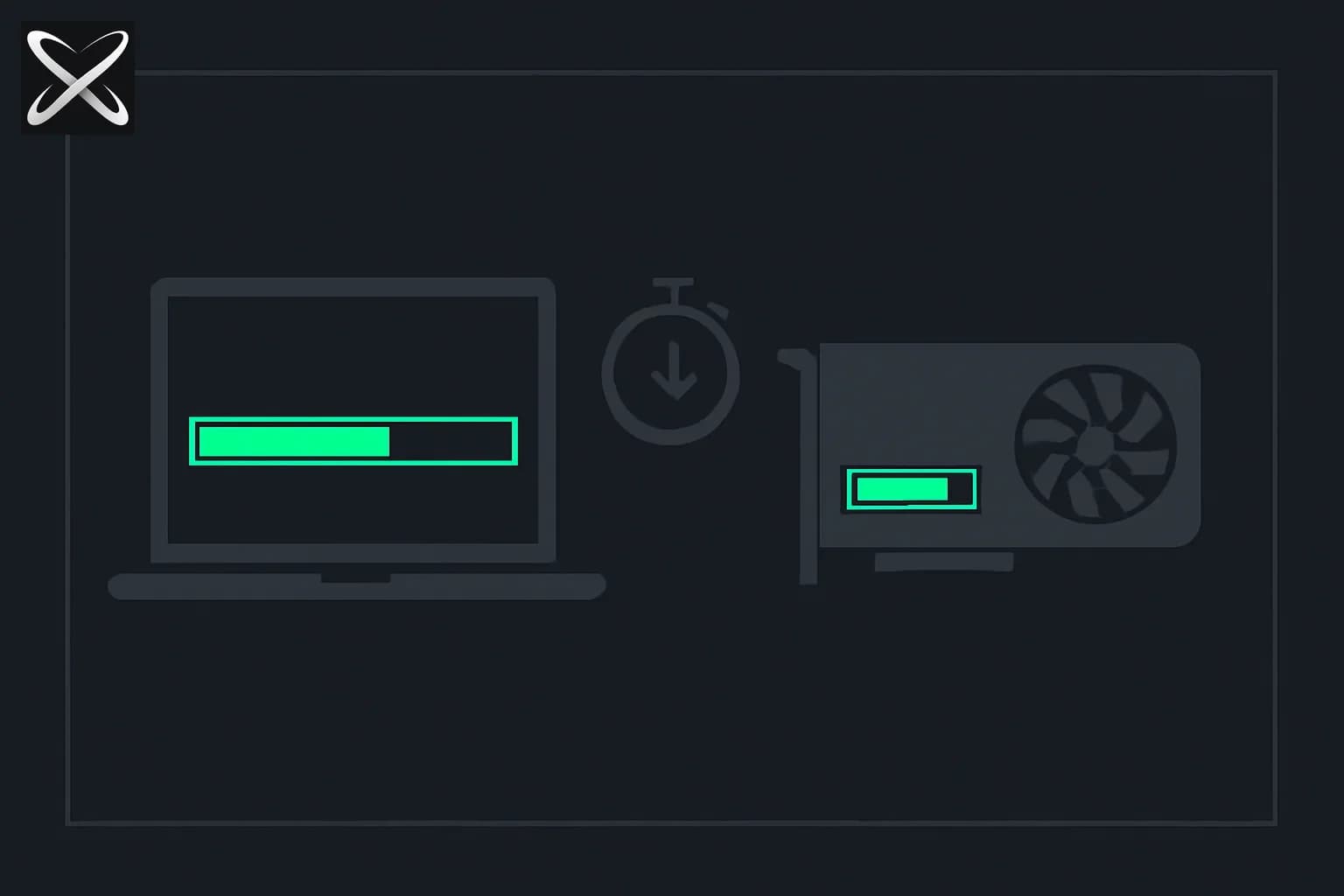
GPU World opened a $100,000 story contest on September 1, 2026, sponsored by Paradigm and Guardian Angel Intelligence. The prompt is deliberately narrow: frontier AI capability freezes at today's level — no singularity, no runaway superintelligence — but GPU supply keeps scaling until, by 2040, there may be the equivalent of one B300-class GPU per human, each running a frontier LLM 24/7/365.
The site opens with William Gibson's line: "The future is already here — it's just not evenly distributed." GPU World asks writers to imagine that distribution evened out — and to answer what breaks when it does.
TL;DR — what people are asking
| Question | Direct answer |
|---|---|
| What launched? | gpuworld.org — story contest, submissions open September 2026 |
| Total prizes? | $100,000 — $40K first, $20K second, $12K third, seven $4K finalist prizes |
| Judges? | Neal Stephenson, Gwern Branwen, Matt Huang (top 10 after pre-screening) |
| Deadline? | October 31, 2026, 11:59 PM PT |
| Word count? | 1,000–5,000 words, fiction or nonfiction, Markdown or PDF |
| License? | CC BY-NC or freer — winners republished on gpuworld.org, paradigm.xyz, gwern.net |
| LLM use? | Permitted but discouraged; disclosure requested |
| Core premise? | AI frozen Sep 1, 2026; ~8B GPUs by 2040; one B300-equivalent per person |
Why Paradigm is running a fiction contest about compute
Most 2026 AI discourse still assumes capability is the variable that changes everything — DeepMind's AGI-to-ASI pathways, superintelligence debates, benchmark horseraces. GPU World flips the frame: hold capability constant, let compute per capita go to parity.
That matches a thread explainx.ai has covered from the builder side all year — humanity is GPU-poor today. Only a few million datacenter-class GPUs capable of efficiently serving frontier models ship annually; billions of people have never had a sustained conversation with a top-tier model. Building a personal local AI system is still a hobbyist project for most; Perplexity's hybrid Mac routing and DGX Spark local demos are early product experiments in selective local inference, not universal access.
The contest premise says: ignore the next breakthrough. Assume September 2026 models — Fable-class, Sol-class — are as good as it gets. What changes when everyone can run one continuously?
The questions the prompt wants answered
gpuworld.org lists the scenarios explicitly:
- Surveillance: Does always-on personal frontier AI become an indefatigable panopticon — or a privacy tool when inference stays local?
- Education: Do infinitely patient tutors reshape schooling, or just widen the gap between motivated and unmotivated learners?
- Healthcare: World-class AI doctors and personalized medicine at home — or regulatory gridlock and liability nightmares?
- Social media: Does feed-ranking die when everyone has a private reasoning engine, or mutate into something worse?
- The developing world: The site calls this "oft-ignored." If GPUs distribute unevenly by 2040 the way smartphones did, the Gibson quote still applies — just on a different axis.
- Energy: The elephant in the room. A B300-class accelerator in a datacenter context draws hundreds of watts under load; 8 billion × ~500 W is four petawatts of nameplate demand if every unit ran flat out — orders of magnitude above today's global electricity generation. Any credible entry needs a grid story, not just a software story. explainx.ai's small data center guide covers how even 16 GPUs already forces power and cooling math most founders skip; scaling to planetary per-capita GPU is the same problem at civilization scale.
These are not abstract sci-fi set dressing. They are the same trade-offs local AI builders and agent harness engineers already navigate — privacy vs cloud, cost vs capability, who gets access first.
Submission mechanics — and the HN reaction
| Rule | Detail |
|---|---|
| Eligibility | Open to everyone; one entry per person |
| Genre | Fiction or nonfiction |
| Length | 1,000–5,000 words |
| Format | Markdown or PDF |
| Copyright | CC BY-NC or freer (must allow republishing) |
| AI use | Allowed but discouraged; disclose if used |
| Timeline | Submissions open August 2026; close Oct 31, 2026; winners announced December 2026 |
The contest hit Hacker News hard on launch day — 338 points on the front page — with a recurring technical complaint: the site is largely unreadable without JavaScript and web fonts. Crawlers, readers on slow connections, and the accessibility-minded crowd saw blank or broken layouts. For a writing contest whose output must be Markdown or PDF, that irony was not lost on commenters. If you are drafting an entry, treat the official text on gpuworld.org as canonical once it renders; do not rely on social-thread summaries alone.
On LLM use: organizers are explicit that unskillful LLM prose clusters when judges read ten finalists back-to-back. Disclosure is requested. For explainx.ai readers who build with AI daily, the interesting meta-question is whether a frozen-capability world still rewards human voice — the contest's answer is implicitly "yes, if you want $40K."
What builders should take from the premise — even if you do not enter
You do not need to write fiction to use GPU World as a design spec.
1. Compute parity is a product question, not just a policy one. Today's gap is not only "better models" — it is who can afford to run the current ones. NVIDIA's GB300 deployments and B300 server pricing show how concentrated frontier inference still is. A 2040 with personal B300-equivalents is a forcing function for on-device agents, local RAG, and hybrid routing — the architecture Perplexity shipped on Mac in September, not a hypothetical.
2. Frozen capability favors orchestration and memory, not raw IQ. If models stop getting smarter, the winners are harnesses, memory systems like Perplexity Brain, and tool use — exactly where agent builders already spend effort. Sample efficiency and inference-time compute (the line HRM/TRM and ARC-AGI cost benchmarks explore) matter more when the base model is fixed.
3. Energy is the constraint that kills naive utopias. Any "everyone gets a GPU" story that skips 500 W × 8B, cooling, rare earths, and grid buildout reads like 1990s "internet will be free" essays. The contest rewards writers who engage infrastructure honestly — the same honesty data center planners need at 16-GPU scale.
4. Paradigm's crypto-native lens is part of the subtext. Matt Huang judging a contest about evenly distributed compute is not accidental for a firm that has long framed blockchains as coordination layers for scarce resources. explainx.ai is not a crypto blog — but builders should notice the parallel: GPU World is asking what happens when a previously elite resource becomes a human right, which is the same structural question as open-weight models vs closed APIs, just with a 2040 deadline.
Should you enter?
Enter if you have a sharp take on education, health, surveillance, or the developing world under fixed AI capability — especially if you can make the energy and grid math feel lived-in, not bolted on. Skip if your only angle is "AGI wakes up" — that violates the premise. Read how to read AI benchmarks if you want grounding in what "frozen at September 2026" actually implies for model behavior.
One entry per person. October 31, 2026 deadline. CC BY-NC or freer. Winners get cash and publication on gpuworld.org, paradigm.xyz, and gwern.net.
Related on explainx.ai
- Build a personal local AI system — 2026 guide
- How to start a small data center — power and GPU math
- DeepMind's four AGI-to-ASI pathways — capability vs compute framing
- Perplexity Mac hybrid compute — selective local inference
- Perplexity portable Computer on DGX Spark
- NVIDIA revenue-share program — GB300 scale deployments
- Recursive reasoning — HRM, TRM, inference-time scaling
- Can governments ban AI models and tools?
Primary source: gpuworld.org · September 1, 2026 contest launch
Prize amounts, judges, submission rules, and premise text reflect gpuworld.org as of September 1, 2026. Energy estimates are order-of-magnitude illustrations for writers, not engineering forecasts — verify hardware TDP and grid statistics against primary sources before citing them in contest entries.