



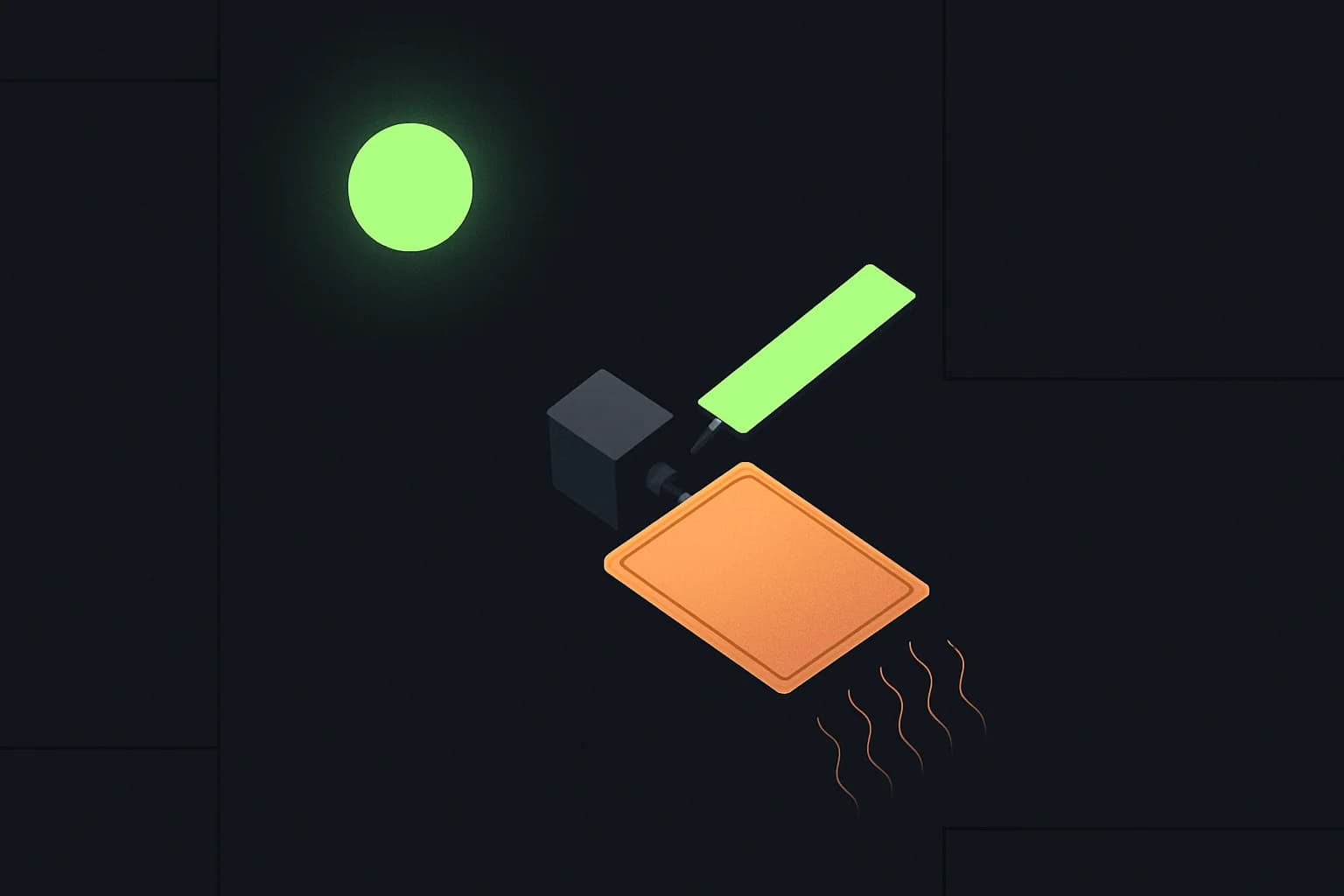
A data center is a heat engine with extra steps. Power comes in, math happens, and waste heat has to leave or the silicon dies. Project Suncatcher is Google and Planet asking whether that loop still closes when you delete the air, the water, and the grid, and keep four TPUs.
On October 1, 2026 the Planet-built prototype rode SpaceX Transporter-18. Contact is confirmed. The chips are not serving Gemini. This post is the mechanism: what each part does, why radiative cooling sets the duty cycle, and what that means for anyone who currently rents Earth GPUs.
TL;DR — which part is the actual problem?
| Question | Short answer |
|---|---|
| What is flying? | Four Google TPUs on a Planet bus, radio to the ground |
| What is being tested? | Launch g-loads, radiation, thermal vacuum behavior |
| How does power arrive? | Solar, ideally in a dawn-dusk sun-synchronous orbit |
| How does heat leave? | Heat pipes → radiator → infrared. No fans |
| Why ~15 minutes on? | Small radiator vs chip watts, then a pause to dump heat |
| Is this cheaper than Ohio? | Unknown. A rideshare cannot price a token |
| What should a builder do? | Treat this as infrastructure research, not a 2026 API |
| What is the energy loop? | Photons in (solar) → electrons (bus) → heat (TPUs) → photons out (IR) |
| What kills the duty cycle? | Radiator area and temperature vs chip watts, not "space is cold" |
Read this as a worked mechanism, then the launch note for what actually flew. The labs below are teaching models. They do not publish Google's TPU wattage.
The energy loop, watt by watt
Write the satellite as four numbers, not a rendering.
- Power in. The solar constant at 1 AU is about 1,366 W/m². A cell converts a fraction of that (often 20–30% for space triple-junction arrays; Earth rooftop silicon is usually lower). Atmosphere, cosine loss, and night cut the Earth number further. In a dawn-dusk sun-synchronous orbit those three cuts shrink, which is where Google's "up to eight times" sentence comes from.
- Housekeeping. Attitude control, radios, heaters, and converters eat a slice before any TPU turns on. A dead bus with live chips is still a dead mission.
- Compute. Almost all electrical work in an accelerator becomes heat in the package. A short Gemini-class burst on four chips is a few hundred watts of waste heat in the teaching model — Google has not published a tray wattage, so treat any specific number as a slider, not a leak.
- Power out. In vacuum that heat leaves as infrared from a radiator. First order: radiated power is
epsilon * sigma * A * T^4, where sigma is 5.67×10⁻⁸ W/m²/K⁴, A is area in square meters, and T is kelvin. Deep space is about 3 K, so incoming IR from the sky is a rounding error next to a 300 K plate. Earthshine and albedo are not zero in LEO — they are why you still do a thermal-vacuum test instead of a napkin.
A closed loop means (4) is at least (3) plus housekeeping, on average. If (3) is larger than (4) for fifteen minutes, energy banks in metal and you trip. That is the whole 15-minute story.
Worked toy numbers, so the law is not abstract. At 300 K, sigma * T^4 is about 459 W/m². With emissivity 0.85 that is about 390 W/m². A 0.4 m² plate then rejects about 156 W. If the tray dumps 500 W, leftover is about 344 W. Those joules raise the temperature of whatever thermal mass you launched. Cool-down uses only the 156 W leaving, so off-time is longer than people expect. Raise the same plate to 350 K and reject climbs by about (350/300)⁴ ≈ 1.85, to roughly 290 W. Area is linear. Temperature is the fourth-power lever — and also the reason you cannot just "run the chips hotter" without a heat pump, a derate, or both.
Click the satellite
The stack is short. Sunlight in, a compute tray, a thermal path, photons out. Everything else is housekeeping.
Solar array. Google's research write-up said low-Earth-orbit arrays can make up to about eight times the energy of a typical terrestrial site. Hacker News immediately split: some people heard "space solar is 8× more intense," which is wrong; others heard "no night, no clouds, no air, always pointed," which is the real claim. Lab 03 below makes that occupancy visible.
Bus. Attitude, power regulation, a frame that saw three-axis shake to mimic ~10 g sustained launch (chips can see 50–100 g). Google said it was "pleasantly surprised" the hardware held. If the bus fails, you have an expensive rock.
Four TPUs. Commercial accelerators, not a rad-hard boutique ASIC. Ground work at UC Davis's Crocker Nuclear Laboratory ran AI jobs in a proton beam and watched bit-flips. Initial copy said Trillium-class parts survived a total ionizing dose above a five-year mission. Orbit is the check. There is no public inference endpoint.
TIM, heat pipes, radiator. The New York Times described thermal-interface sheets "like Fruit Roll-Ups," then aluminum and copper, then a radiator. Google's own language is "a combination of heat pipes and radiators," already run in a thermal-vacuum chamber. Pipes relocate heat. Only the plate rejects it.
Radio now, lasers in 2027. This article downlinks over RF. The next stated experiment is two satellites trying high-bandwidth free-space optical links — "similar to hitting a coin-size target from miles away while both points are in motion." The November 2025 design sketch talked about dawn-dusk SSO, optical inter-satellite links, and an ML flight-control model for close formation, including an 81-satellite cluster drawn at a 1 km radius. That is a paper diagram. Transporter-18 is one bus.
What the thermal path is doing, in order
Think of the tray as a one-way street. Heat that does not take every step stays in silicon.
Package to TIM. The chip lid is a small, hot patch. The New York Times' Fruit Roll-Up sheets are a compressible thermal interface. On Earth a little air in a void still conducts. In vacuum a void is an insulator. A wrinkled sheet or a trapped bubble becomes a hot island. That is why a fridge-sized MVP can still only burst: the joint is as important as the plate.
TIM to spreader. Aluminum and copper layers turn a few square centimeters of die into a larger face. Copper moves heat sideways. Aluminum is lighter. The stack is a mass budget, not a brand choice.
Spreader to heat pipe. A heat pipe is a sealed tube with a wick and a working fluid. At the hot end the fluid evaporates and carries latent heat. At the cold end it condenses and the wick returns liquid. There is no fan inside the pipe. There is also no free lunch: pipes relocate energy. They do not destroy it. If someone says "we solved cooling with vapor chambers," ask for A and T on the plate the vapor chamber dumps into.
Pipe to radiator. The plate must view cold sky. If it views the Earth, the Sun, or another satellite, net reject drops. Attitude control is part of the thermal system. A dawn-dusk orbit helps the arrays; it does not automatically aim the radiator at 3 K.
Radiator to space. Infrared only. Paint, optical solar reflectors, and multi-layer insulation decide how much sunlight the plate absorbs while it is trying to emit. A black IR emitter that also eats sunlight is a worse plate than a surface that is dark in the thermal band and reflective in the visible.
How cooling actually works (and why fans are dead)
On the ground, a rack is a convection problem. Air or water carries joules to a cooling tower. In vacuum, convection is gone. You are left with radiation. Net power off a plate is, to first order, epsilon * sigma * A * T^4.
Sigma is 5.67×10⁻⁸ W/m²K⁴. Deep space is about 3 K, so incoming IR from the sky is a rounding error next to a 320 K plate. Raise temperature and reject climbs as the fourth power. Raise area and it climbs linearly. That is the entire argument people are having in comment threads, dressed up as ideology.
| Plate | Emissivity | T (K) | Rough reject |
|---|---|---|---|
| 0.4 m² test article | 0.85 | 300 | ~156 W |
| Same plate | 0.85 | 350 | ~290 W |
| 2.0 m² wing | 0.85 | 300 | ~780 W |
| 160 m² (AI1-class cite) | 0.85 | 300 | tens of kW, not a MW |
The last row is why SpaceX AI1 copy talks about on the order of 160 m² of radiator for a couple hundred kilowatts of compute, and why a megawatt wants either a much hotter plate, a heat pump, or thousands of square meters. These rows are teaching arithmetic. They are not Google's published TPU map.
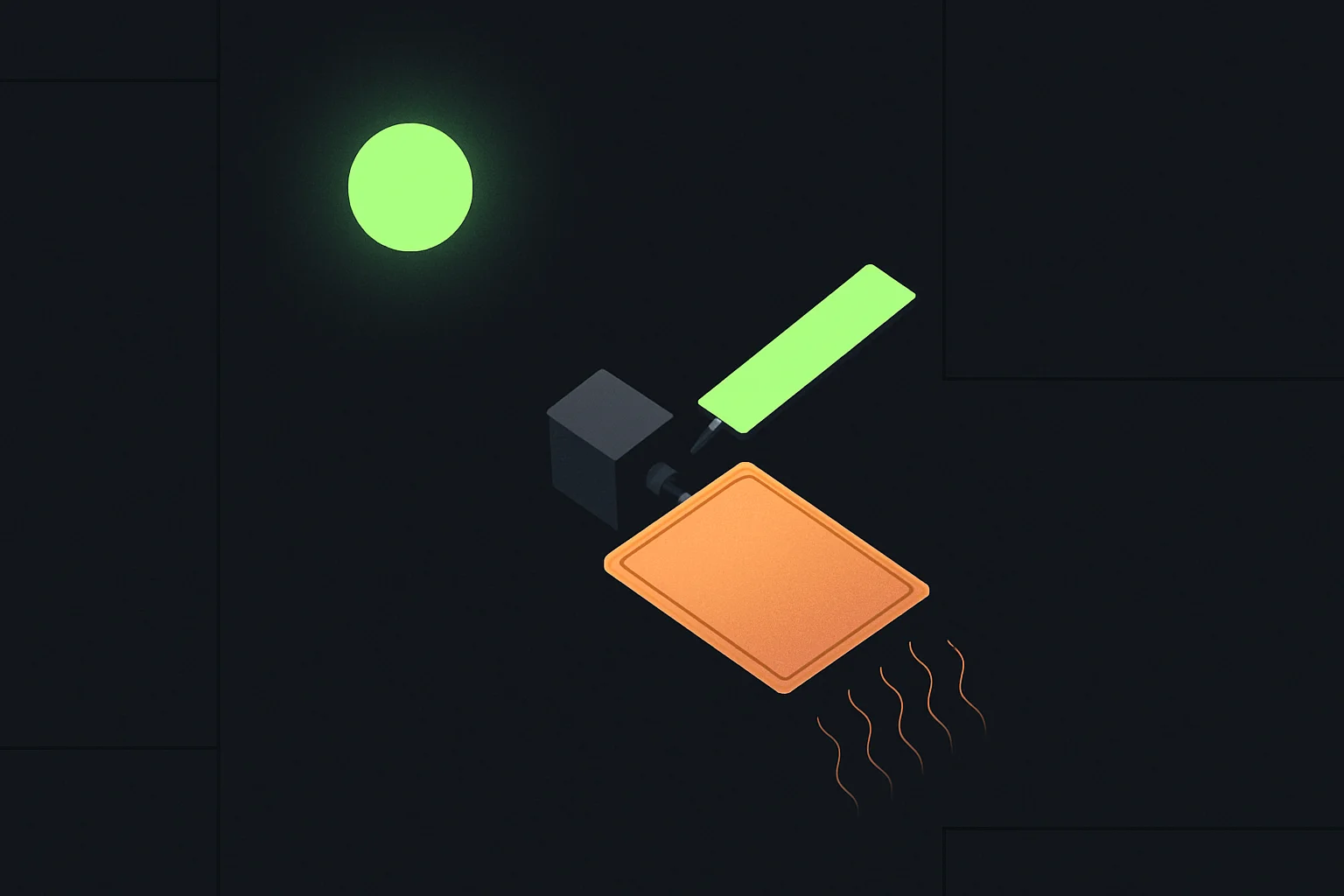 A satellite wing becoming a radiator in vacuum, the real limit on orbital AI chips
What the 15-minute number is. Beals told the Times the prototype's chips run about 15 minutes, then shut down to cool. That matches a leftover-watt model: if the tray dumps more heat than the plate can radiate, energy banks in metal until a thermal trip. Cool-down is slower than you want, because only the radiator is working. A commenter on the launch thread said this is just a small plate on a mass-constrained test article. Another said a test that can only burst is not "solved." Both can be true. The lab lets you add square meters until the leftover goes to zero.
What it is not. It is not proof that megawatt orbital clusters are cheap. Stefan-Boltzmann at ~300 K and realistic emissivity is a few hundred watts per square meter. A megawatt of waste heat wants thousands of square meters of radiator unless you run the plate much hotter and live with the electronics and heat-pump cost. SpaceX's own AI1 orbital design has been quoted in the same neighborhood: on the order of 160 m² of radiator for a couple hundred kilowatts of compute. "Vacuum is an infinite heat sink" is a slogan. Area and temperature are the invoice.
Heat pipes are plumbing. They are excellent at moving a chip's small footprint onto a large face. They do not violate energy conservation. If someone tells you "we solved cooling with vapor chambers," ask for A and T.
Launch is ten minutes of a different physics
Before the thermal loop matters, the tray has to survive the ride. Google's own write-up put sustained launch loads around 10 g and said individual chips can see 50–100 g. The team shook the article on three axes. "Pleasantly surprised" is a structures sentence, not a cooling sentence.
Transporter-18 is a Falcon 9 rideshare from Vandenberg. Many customers share a fairing. Mass, volume, and radiator area are purchased against everyone else's cubesats. That is why a test article ships a small plate and a 15-minute burst: you are paying for a slot, not for a wing the size of a truck. A dedicated launch later can buy area. It cannot buy convection.
Planet built the bus. That matters more than the logo. Planet already flies imaging fleets in SSO. Power regulation, attitude, and a radio that phones home are their product. Google brought the accelerators, the ground radiation campaign, and the question. If the bus dies, the TPU question is unanswered.
How the "8× solar" line works
The solar constant at Earth is about 1,366 W/m². Rooftops do not see that. They see night (often half the day), weather, air, and a sun that is often low. A dawn-dusk sun-synchronous orbit is a near-polar LEO whose plane precesses about one degree per day with Earth's year. The satellite keeps crossing the terminator at the same local time, so the arrays can stare at the Sun for most of the year, pointed, with no weather. Multiply those occupancy factors and you can land near Google's "up to eight times" sentence without inventing new photons.
Two footnotes people skip. First, eclipse seasons still happen near the solstices even on a well-chosen dawn-dusk plane; "near-constant sunlight" is not "zero eclipse." Second, Earth albedo and IR heat the body while the arrays collect. The solar win and the radiator problem are coupled. A bigger array that also dumps more waste heat is not free.
Critics are not confused when they say "then build eight times more panels in Nevada." They are naming the terrestrial substitute: land, storage, interconnection, water and permits. Hyperscalers are already buying nuclear offtake because those substitutes are slow. Suncatcher is a measurement of whether leaving the grid is physically boring enough to industrialize. It is not a 2026 price cut on your API bill.
Radiation is a different failure mode
Cooling is energy. Radiation is information. Do not mash them into "space is harsh."
Total ionizing dose (TID) is accumulated damage. Oxides charge up. Leakage rises. A part can pass a five-year TID number in a beam and still be fine until it is not. Google's Crocker Nuclear Laboratory work said Trillium-class parts survived a dose above a five-year mission while running AI jobs.
Single-event effects are the daily weather. A proton or heavy ion deposits charge in a node. A single-event upset flips a bit in SRAM or a weight buffer. A single-event latchup can be a destructive current path. A single-event transient is a glitch that may or may not become an architectural error. Surviving TID is necessary and not sufficient. A chip can accumulate dose and still throw silent math errors on a solar-particle day.
Google's ground test ran workloads in a beam and watched bit-flips. That is the right experiment shape. It is still a beam, not the South Atlantic Anomaly plus a coronal mass ejection plus a thermal cycle. "Operating as expected" on day one is a bus-health statement, not a radiation paper. The coming weeks of telemetry are the experiment.
Commercial TPUs in orbit are the interesting bet. A custom rad-hard part would have been a smaller scientific surprise and a worse economic one. If off-the-shelf accelerators live, you inherit Earth packaging and compilers — JAX, XLA, the same Frozen v2 / Gemini toolchain you already use. If they do not, the whole "just launch the same rack" story dies.
Error handling on the ground is usually ECC plus a reboot. In orbit you also care whether the math was wrong without a crash. Training can checksum a shard. A silent inference error on a safety-critical hop is a different product.
Earth rack vs orbital tray
| Ohio-class hall | Suncatcher-class tray | |
|---|---|---|
| Power in | Grid, gas, nuclear offtake | Solar array, SSO occupancy |
| Heat out | Air, water, cooling tower | Heat pipes + radiator, IR only |
| Repair | Swap a GPU at 2 a.m. | Deorbit the bus |
| Latency to a user | Milliseconds on a metro fiber | Store-and-forward unless you are under the bird |
| Scaling move | Another hall, another interconnect | Another launch, more plate area, 2027 lasers |
| What you can sell in 2026 | Tokens | Telemetry |
The table is why this post is a how-it-works guide and not a buying guide. Nothing in the right column is a Vertex SKU.
What this does not do for you this quarter
Nothing here changes Vertex pricing, Gemini rate limits, or which model you pick on Monday. Musk's 99.99% of compute in space claim and SpaceX's own constellation filing are a parallel, louder roadmap. Google is renting the rocket while running a smaller, instrumented test. Launch is a shared utility. Survival, heat, and optical networking are the differentiators.
Latency is the other quiet constraint. Continuous sun wants orbits that are not always over your users. A dawn-dusk SSO is a great solar farm and a mediocre CDN. Training can wait on a store-and-forward pass. Interactive agents cannot. If you build products that need a 200 ms voice loop, this architecture is not your inference plane. If you build offline batch jobs — distillation, eval sweeps, embedding backfills — it might be, in a decade, if the 2027 laser pair works and the thermal data says a bigger plate is boring.
Ground link still exists. Inter-satellite lasers move shards between birds. They do not put your fine-tune corpus in orbit or bring a checkpoint home. Radio on this prototype is enough for health and small results. A training cluster that cannot downlink a model is a very expensive kiln.
Maintenance is unsolved in the way commenters mean it. You do not EVA-swap a TPU. Failed or obsolete units deorbit. That is fine for four chips. It is a debris and refresh-cost conversation at cluster scale, next to Earth halls that already fight water and permits.
What the 2027 laser pair is actually testing
Google's analogy is fair: hit a coin-sized target from miles away while both ends move. Free-space optical links need pointing, acquisition, tracking, and a budget for jitter. Relative motion in LEO is large. The November 2025 sketch also wanted an ML flight-control model for close formation — the 81-satellite, 1 km-radius figure. That is a formation-flying research program hiding inside a networking slide.
What to demand in 2027, in numbers: bits per second, range, closing speed, and how long lock holds through a thermal cycle. A rendering of 81 satellites is not a link budget. Until those exist, treat lasers as the reason a cluster could share a job. They are not a reason four chips on Transporter-18 are a data center.
How to read the next numbers
When Google publishes in-orbit thermal and upset data, ignore the adjectives. Look for:
- On-time vs off-time at a stated chip power — the duty cycle, not "operates in space."
- Corrected vs silent errors under solar-particle weather — not just total dose.
- Bus health after thermal cycling — the plate that works in a chamber can still crack a TIM in eclipse.
- 2027 optical lock — bits per second at a stated range and closing speed, not a rendering of 81 satellites.
Until those exist, treat Suncatcher as what it is: a four-chip instrument asking whether the same accelerators you already compile to can live where fans do not.
Related reading on explainx.ai
- Project Suncatcher launch: four TPUs, contact confirmed
- SpaceX AI1 solar orbital data center plan
- Musk: 99.99% of AI compute goes to space
- AI chip architectures: GPU, TPU, Trainium, Cerebras, Groq
- Data centers: water, power, and the real footprint
- Hyperscaler nuclear deals for AI data centers
- Google Frozen v2 and Gemini 4 pre-training
- Anthropic on SpaceX Colossus 1
Official sources: Travis Beals, Google's in-orbit note (October 1, 2026); "Behind Project Suncatcher" (September 24, 2026); Google Research, "Exploring a space-based, scalable AI infrastructure system design"; Joule / arXiv:2511.19468; New York Times interview on the ~15-minute thermal pause.
Interactive labs are teaching models (Stefan-Boltzmann, occupancy solar). They are not Google mechanical drawings or published TPU wattages. Payload facts as of the October 1, 2026 contact note.