



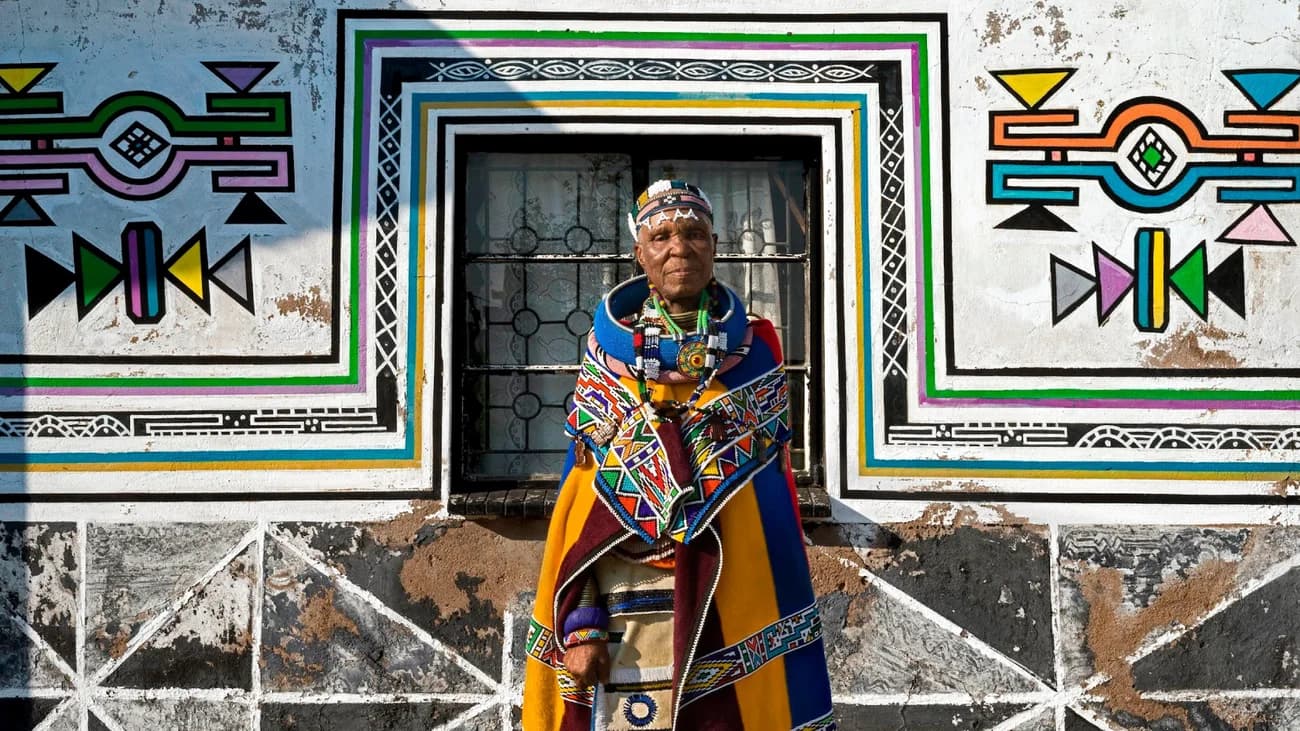
Google Arts and Culture opened a full online retrospective of Dr Esther Mahlangu on November 11, 2026, the Ndebele artist's 91st birthday. The announcement on Google's blog is not a generic culture plug. It documents a deliberate archive strategy: when paper records stop before 1980, the team used synthetic memories, still images, and Veo video to visualize decades Mahlangu could narrate but museums could not show.
For builders, the post is a case study in how a top lab couples generative video to consent, oral history, and institutional curation — a different bar than dropping a model demo on social media.
TL;DR
| Question | Answer |
|---|---|
| Launch date | November 11, 2026 |
| Scale | More than 45 exhibitions and stories on Google Arts |
| Archive gap | Little documented material before 1980 |
| AI role | Recreate childhood memories from her stories; Veo animates stills |
| Method partners | Google DeepMind, Arts and Culture Lab, Domestic Data Streamers synthetic memories workflow |
| Museum partners | Art of Contemporary Africa, Iziko, British Museum, Jean Pigozzi Collection, NMWA, Serpentine, and others |
| Entry URL | goo.gle/esther-mahlangu |
| Disclosure | Google states AI filled missing history guided by Mahlangu's own accounts |
What was missing from the archive
Dr Nontobeko Ntombela, who curated the retrospective with Mahlangu's family, writes that her research gathered murals, intimate works, and rare materials, yet nothing survived from before 1980. That hole blocked a truthful timeline from her start as a painter at age ten through her first widely documented works.
Without fabrication, a digital retrospective would skip the origin story entirely. Google's response was not to invent anonymous stock scenes. The blog says they collaborated with Mahlangu in workshops, used her retold memories as source text, and followed the synthetic memories methodology with studio Domestic Data Streamers.
The same pattern shows up elsewhere in Google's consumer products — Dreambeans animates illustrated stories with Veo for a mass audience. Here, the stakeholder is the artist, the claims are personal, and partner museums attach reputations to each gallery page.
 Google Veo temporal storytelling for reconstructed cultural memory scenes
How Google describes the production pipeline
Google's post breaks the pipeline into steps readers can audit:
- Oral history and interviews with Mahlangu, including details such as discovering painting talent at ten using feathers instead of a brush.
- Still image generation from those memories, informed by archival references where they exist.
- Veo video to animate those stills into short scenes of early life.
- Publication inside the Google Arts exhibition structure with museum co-branding.
DeepMind and the Google Arts and Culture Lab supplied technical execution; Domestic Data Streamers contributed the synthetic memories framework. The blog emphasizes that AI visuals were guided at every step by respect for personal memory and historical accuracy, language institutions increasingly demand when generative media enters education and heritage sites.
That wording matters legally and editorially. A national archive cannot treat model output as documentary footage without labeling. Google's post labels the AI layer explicitly and anchors it to Mahlangu's voice.
What visitors get online
Beyond the reconstructed early years, the retrospective bundles standard Arts and Culture features at institutional scale:
- More than 45 exhibitions co-curated with partners across Africa, Europe, and the US.
- Large-scale murals, intimate pieces, and street-view style presentation where applicable.
- Stories covering how Mahlangu became known globally through commissions and collections.
Partners named in the announcement include Art of Contemporary Africa, Iziko Museums of South Africa, the British Museum, the Jean Pigozzi Collection, the National Museum of Women in the Arts, and Serpentine.
The hub lives at goo.gle/esther-mahlangu. That short link is Google's canonical entry point for the collection.
First-party visuals and official video
Google's announcement page includes curatorial photography and carousel artwork from the exhibition. The project also ships video on Google's YouTube presence.
For teams evaluating Veo in production, the Mahlangu workflow is closer to illustrated documentary than to one-shot text-to-video memes. Stills act as an intermediate asset with human review before motion. That two-step pattern shows up in professional pipelines discussed around Veo cost and quality tiers and enterprise generative video benchmarks, even though those posts cover different markets.
Ethics and labeling: what builders should copy
Heritage AI fails when labs optimize for share count alone. Google's post at least documents structural safeguards readers can replicate:
| Practice | Why it matters |
|---|---|
| Subject workshops | Mahlangu could correct or extend scenes during creation |
| Named curator authorship | Ntombela's essay sets scholarly framing |
| Museum co-signatures | Partner logos signal institutional review, not solo tech demo |
| Explicit AI disclosure | Blog states AI recreated undocumented memories |
| Separation of fact tiers | Documented works versus reconstructed childhood scenes |
None of that removes deepfake risk if someone clips a Veo scene without context. It does give editors a template: provenance table in the UI, separate rails for archive scans versus synthetic reconstructions, and contracts with living subjects.
 Curatorial review separating documented artifacts from AI-reconstructed memory scenes
Researchers weighing multimodal tools should compare this launch with purely automated multimodal knowledge agents or science animations from Gemini demos. Mahlangu sits in the regulated emotional space of identity, not generic benchmark clips.
What people are asking
Is AI replacing the artist's hand? The retrospective foregrounds Mahlangu's physical murals and collections. AI scenes target a timeline gap, not her contemporary studio practice.
Can other communities use the same pipeline? Technically, yes — synthetic stills plus Veo is reproducible. Legally and culturally, each community needs consent architecture, language rights, and curators who already hold trust.
How does this relate to Google policy fights? Unrelated product threads such as Gemini Healthcare skills share the same corporate AI stack but different compliance envelopes. Heritage work stresses narrative accuracy; healthcare stresses PHI.
Will search engines treat synthetic scenes as facts? That is an open GEO problem. Publishers should markup synthetic segments in captions and JSON-LD where platforms allow, and keep textual narration sourced to interviews.
Technical takeaway for generative video teams
Three implementation lessons sit beneath the press language:
- Treat memory as structured data. Workshops produced discrete story units before any pixels rendered.
- Still-to-video beats raw prompt-to-video when subjects can reject frames early.
- Distribute through an archival CMS (Arts and Culture exhibitions) rather than a single MP4 on a blog — museums need pagination, rights metadata, and partner-specific galleries.
If you ship Veo or competitor models into education, copy the exhibition pattern before you copy the model weights.
A builder checklist for heritage-style Veo pipelines
Teams outside Google can still copy the process contract even when they lack Arts and Culture distribution. Treat the following as a minimum viable governance stack before you animate anyone's biography.
| Stage | Owner | Output artifact |
|---|---|---|
| Intake | Living subject or estate | Signed scope: which decades, which stories, which exclusions |
| Story unit drafting | Oral historian | Timestamped transcripts with scene IDs |
| Visual brief | Curator | Wardrobe, architecture, and palette references tied to each scene ID |
| Still generation | ML engineer | Frame folder with version hash per scene |
| Subject review | Subject or estate rep | Approve or reject stills before motion |
| Motion | Video team | Veo passes per approved still, no batch blind render |
| Labeling | Editor | On-page badge: "reconstruction from oral history" versus scanned artifact |
| Publication | Web or CMS | Separate URLs for documentary scans versus synthetic scenes |
Skipping the still-review gate is how projects end up in litigation folders. Mahlangu's workflow implicitly includes that gate because workshops continued while images were produced and because museums co-published the results.
Engineering teams should also plan compression and CDN cost. Forty-five exhibitions with embedded video multiply egress. Google's stack absorbs that; a regional archive on a small VPS does not. Budget for WebM or HLS renditions and lazy loading per gallery, not autoplay on the landing page.
How this differs from pure generative demos
Consumer Veo clips optimized for virality optimize for single-shot surprise. Heritage work optimizes for cumulative trust across dozens of pages.
| Dimension | Viral Veo clip | Mahlangu retrospective |
|---|---|---|
| Primary asset | One prompt | Curated transcript corpus |
| Error handling | Delete and repost | Curator revision cycles |
| Rights | Platform ToS | Museum partner agreements |
| Audience | Scrollers | Educators, diaspora communities, press |
| Success metric | Views | Archival completeness and subject approval |
That distinction matters when executives ask engineers to "just Veo it" for a brand anniversary. The Mahlangu announcement is the counterexample: multi-month collaboration, named authorship, and synthetic segments fenced inside a larger evidence-based exhibition.
Implications for search and education products
School districts already debate whether AI overviews can cite synthetic media. A Google-operated heritage site sets precedent: synthetic scenes sit beside scanned collections with prose disclosure in the launch blog.
If you build RAG over cultural content, tag synthetic scene IDs in your vector metadata so agents do not quote them as primary sources. A tutor bot that confuses reconstruction with documentary photograph is an ethics incident waiting for a school board meeting.
Similarly, dataset builders scraping Arts and Culture should read partner restrictions. Co-branded galleries often carry no-training or attribution-required terms that do not apply to random blog crawl data.
What is not in the announcement
Google's post does not publish model version strings for Veo, per-scene generation counts, or human-hours spent in review. It does not compare reconstruction accuracy to ground-truth photos because ground truth does not exist for the targeted years.
Treat absent numbers as unknown, not as hidden failure. The value proposition here is narrative completeness with consent, not photoreal fidelity scores.
Related reading
- Google Dreambeans and Veo in consumer stories
- Grok Imagine vs Veo pricing context
- Google multimodal knowledge agent benchmark
- Gemini 4 Argon demo patterns
- Google Gemini Healthcare preview skills
Sources: Google blog: Esther Mahlangu retrospective · Google Arts exhibition entry
Exhibition titles, partner list, and AI methodology quotes reflect Google's November 11, 2026 announcement; on-site copy may expand as galleries update.