



Google Cloud launched Gemini for healthcare in U.S. preview on November 10, 2026, pitching it as a governed orchestration layer across EHRs, claims systems and plan documents — not a general chat model with a stethoscope emoji.
CEO Thomas Kurian frames the problem as fragmented data: clinicians spend nearly 28 hours per week reconciling records, per Google’s post, while patients wait on coverage answers. The product extends the Gemini agent introduced at Gemini at Work: employees delegate an objective, the agent plans steps, retains org context, and routes across models inside existing tools.
TL;DR for builders and clinical ops
| Question | Answer | Source |
|---|---|---|
| What is it? | Industry-specific Gemini agent for payers and providers | Google Cloud blog |
| Availability | U.S. preview from Nov 10, 2026 | Same |
| Core idea | Multi-step workflows with human oversight, not single-shot Q&A | Same |
| EHR access | Epic and Oracle Health connectors, read-only, no write-back | Same |
| HIPAA | Built to support HIPAA compliance with audit logging and citations | Same |
| Training on PHI? | Google says customer data is not used to train Google foundation models | Same |
Four components Google ships
Google groups the platform into four parts:
- Skills for healthcare work — Reusable instructions authored by domain experts (records synthesis, pre-visit prep, coverage review, benefit determination).
- Connectors — Live queries into EHR, claims, care management and admin systems under existing RBAC.
- Partner ecosystem — SI and digital-health partners extend connectors without lock-in, Google claims.
- Governed runtime — Identity administration, audit logs, citations, and model choice (frontier vs efficient models under one policy).
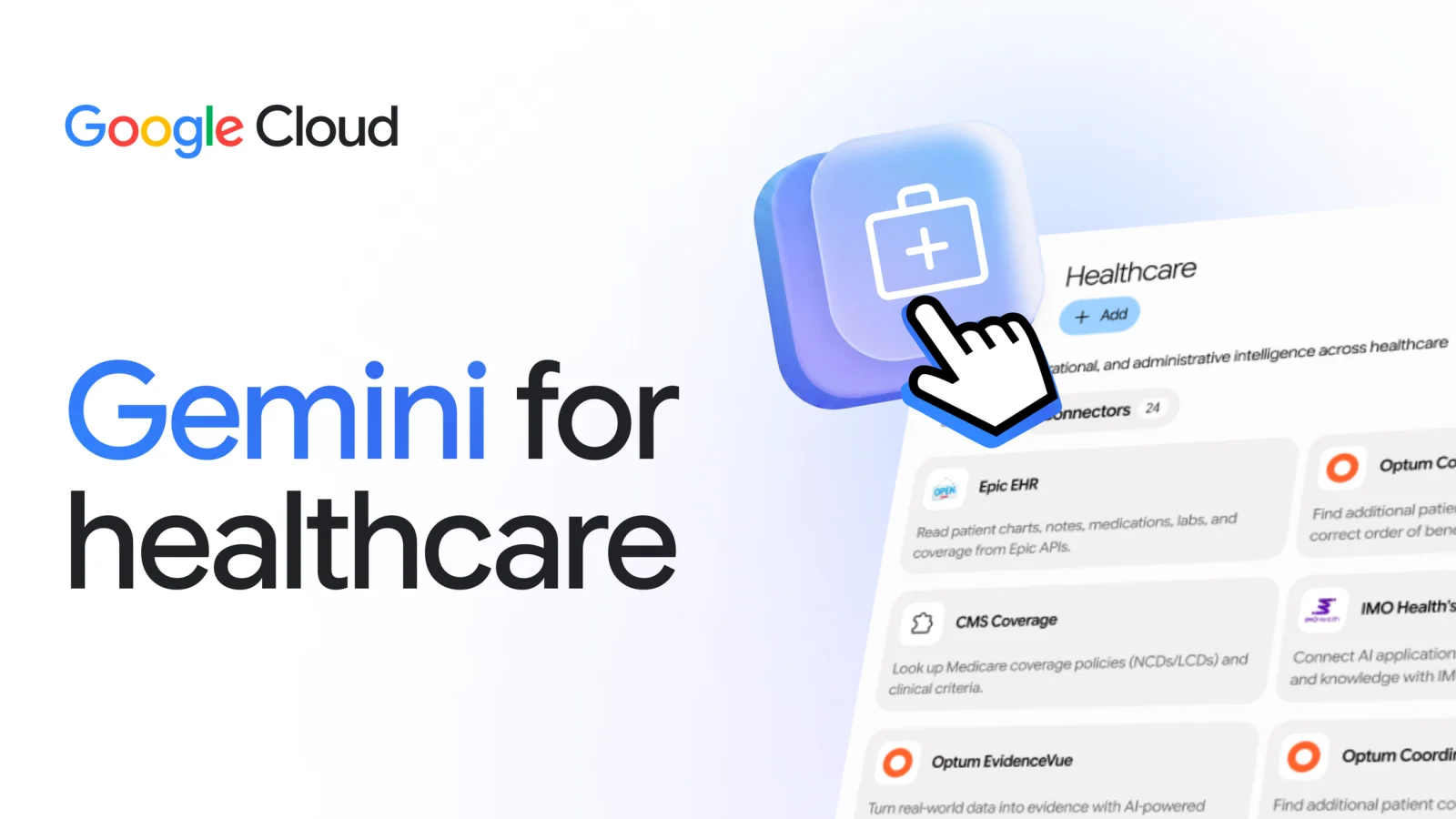 Gemini for healthcare four components diagram showing skills connectors ecosystem and governance
Image: Google Cloud
Skills: what “orchestration” means in practice
Google lists concrete workflows:
At the point of care
- Longitudinal timeline from fragmented sources (active vs resolved problems, allergies, med discrepancies).
- Pre-appointment chart prep with interval events, meds, outstanding labs or consents.
- Prior authorization and appeals packets aligned to payer policy with gap flags pre-submission.
At the point of coverage
- Payer review acceleration against medical policy with traceable citations.
- Benefits and liability breakdowns from plan booklets, including Medicare Advantage criteria when stricter.
Each skill is meant to finish in audit-ready artifacts (packets, letters, summaries), not only chat prose.
Connector catalog: what is actually wired
Google’s post reads like a marketplace map. Highlights builders should know:
Clinical and identity
- Epic EHR — Read-only conditions, meds, labs, notes (no write-back).
- Oracle Health EHR — Same read-only posture.
- InterSystems FHIR MCP Server — FHIR repository management.
- Verato — Patient identity resolution across sources.
- Keragon — Claims connectivity to 400+ healthcare apps via one MCP integration.
Payer, eligibility and pharmacy economics
- Optum coordination-of-benefits and network eligibility (limited release with Gemini for healthcare).
- TriZetto — Eligibility across Medicare, Medicaid and commercial lines.
- GoodRx — Prescription pricing inside workflows.
- Infinitus Relay — Automated payer phone calls for auth and benefits.
Terminology and evidence
- IMO Health — Terminology normalization and knowledge graphs.
- ICD-10 and RxNorm lookups.
- CMS Coverage — NCD/LCD grounding.
- BMJ Digital Health — Structured guidelines with citations.
- Optum EvidenceVue — Real-world evidence workflows.
Ops and productivity
- Salesforce Health Cloud and Agentforce in governed flows.
- Suki ambient documentation.
- UiPath and Synthpop Careflow for referral-to-order automation.
- Microsoft 365 and Google Workspace for packet delivery into Word, Gmail, Drive.
Security
- Cyera Dataport for PHI context in compliance reporting.
This list matters because health IT projects live or die on connectors, not model IQ. A mediocre model with stable Epic read paths beats a frontier model that hallucinates because it never saw the chart.
Launch voices: what customers said on the record
Google quotes executives from launch partners:
- HCA Healthcare — Michael J. Schlosser, MD, on synthesizing patient history across EHRs and care settings.
- Northwell Health — Dr. John D'Angelo on reducing administrative burden so caregivers focus on patients.
- Optum Insight — CEO Sandeep Dadlani on connecting payer and provider workflows.
- BCBS Massachusetts — CIO Prem Somasundaram on an agentic-AI roadmap atop Gemini for healthcare.
- ASCO — CEO Clifford Hudis on oncology guideline access at the point of care.
These are forward-looking statements, not audited outcome metrics. Treat them as design partners, not effectiveness proofs.
How Gemini for healthcare compares to ChatGPT for Healthcare
explainx.ai covered ChatGPT for Healthcare’s Epic integration in September 2026. The contrast:
| Dimension | ChatGPT for Healthcare (OpenAI) | Gemini for healthcare (Google) |
|---|---|---|
| Primary user | Clinician in chat or embedded Epic UI | Cross-functional clinical + admin + payer teams |
| Data motion | Read-only Epic + public clinical datasets plugin | Many governed connectors across clinical and payer stacks |
| Workflow depth | Strong on Q&A and synthesis | Emphasizes finished packets and multi-step skills |
| Cloud home | OpenAI platform | Google Cloud HIPAA-oriented stack |
| Partner model | Named health system pilots | Long SI list (Accenture, Deloitte, TCS, etc.) |
Neither replaces the legal record; both depend on authorization, logging and human sign-off for high-risk actions.
Governance claims developers should verify
Google repeats enterprise promises relevant to security reviews:
- Agents run with distinct identities inheriting user RBAC.
- End-to-end audit logging and verifiable citations on outputs.
- Model routing — heavy reasoning for clinical tasks, cheaper models for high-volume admin.
Your security team should ask:
- Which connectors are enabled in your tenant vs marketing slides?
- Where do prompts and completions reside regionally?
- How are sub-agents segmented under need-to-know rules?
- What is the break-glass path when the agent mis-assembles an auth packet?
For agent patterns outside healthcare, see AWS Bedrock AgentCore layers and semantic caching for cost.
YouTube demos Google published
Google’s healthcare post embeds official walkthrough videos. The Cloud blog lists YouTube IDs uqmXoKOs_o0 and VIBvNUWB-NQ on the announcement page. If you evaluate the preview, watch whether demos use synthetic patients only.
Who can get access?
Preview implies contractual onboarding, likely through Google Cloud sales and implementation partners (66degrees, Accenture, Deloitte, Wipro, and others named in the post). Individual developers should not expect a toggle in the consumer Gemini app.
Health systems already on Vertex AI and Google Workspace have the shortest path. Plans heavy on Microsoft 365 still get explicit connector mention — expect hybrid architectures.
Risks and open questions
- Preview quality — Skills may misread policy edge cases; appeals drafts need clinician review.
- Connector overlap — Not every listed vendor may be live in your region on day one.
- Regulatory fragmentation — U.S. preview does not imply EU GDPR adequacy without separate review.
- Labor impact — Google sells admin time saved; unions and nursing groups will scrutinize workload shifts, as with other enterprise AI rollouts we covered in workforce automation stories.
 Stethoscope and heart icon for Gemini healthcare agent clinical workflows
What people are asking about Gemini for healthcare
Is this Gemini Enterprise with a skin? Partially. Google positions it as an industry solution atop the same Gemini agent runtime from Gemini at Work, but skills and connectors are healthcare-specific. You still need the governed enterprise shell — identity, audit, model routing — not only a prompt pack.
Will it dispute claims automatically? Google describes appeals drafting when documentation supports it. That is not autonomous filing. Compliance officers should require human sign-off on every outbound payer packet until error rates are measured on your data.
How does Keragon’s 400-app MCP claim fit? It signals Google wants partner-built pipes instead of Google owning every EHR adapter. Your SI partner list (Accenture, Deloitte, TCS, etc.) is the practical onboarding path.
Does Optum using Gemini while also selling claims software create tension? Possibly. Multi-sided platforms must show firewalled tenants and transparent routing when the same corporate family sells both payer tools and provider agents. Ask for architecture diagrams in procurement.
Model routing and cost governance
Google explicitly markets pairing frontier models with cheaper ones under one policy. For high-volume eligibility checks, that can cut spend versus running every call on the largest Gemini tier. For pre-surgical synthesis, you may want the heavier model end to end.
Document:
- Which skill invokes which model class
- Token logging per workflow step
- Fallback when the reasoning model times out (does the skill fail closed or downgrade?)
Teams already optimizing harness cost should cross-read multimodal token budgeting and semantic caching.
Implementation timeline expectations
Preview status means no guaranteed GA date. Health systems should plan six-to-twelve month integration pilots:
- Connector proof on a non-production Epic sandbox with synthetic patients.
- Skill tuning with medical staff rewriting policy snippets, not only IT prompts.
- Revenue-cycle shadow mode comparing human-assembled auth packets to agent drafts.
- Incident runbooks tying into Australia-style reporting norms even if your facility is U.S.-only — buyers increasingly ask for parity.
Practical checklist for IT and clinical informatics
- Map your top five workflows (prior auth, referral intake, benefits calls) against Google’s skill list.
- Audit Epic/OCI RBAC — read-only connectors still expose PHI broadly if roles are sloppy.
- Run parallel human review for 30 days on any auto-generated auth or appeal packet.
- Log citation coverage — if the agent cannot trace a policy sentence, block send.
- Compare total cost vs status quo BPO — model routing only helps if call volume actually drops.
Related reading
- ChatGPT for Healthcare Epic integration
- Gemini at Work agent launch context
- Healthcare public data and evidence benchmarks
- AWS AgentCore seven-layer agent stack
- Semantic caching for LLM cost control
- Australia mandatory AI incident reporting
- Agent safety monitoring patterns
- OpenAI caregiver skills jam
Product capabilities and partner lists are accurate as of November 10, 2026, per Google Cloud’s announcement.