



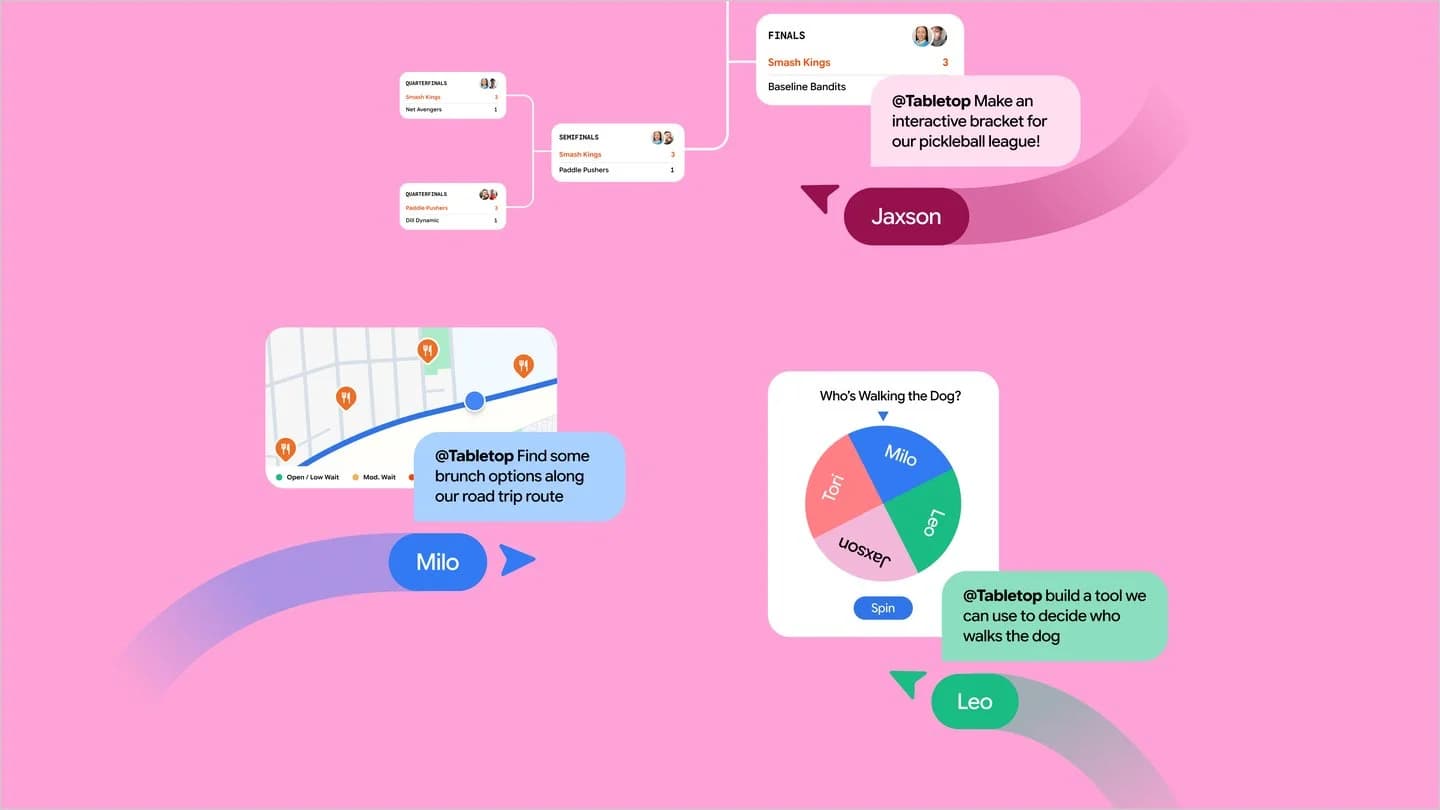
Google Labs opened a waitlist for Tabletop on November 11, 2026—a shared canvas where groups prompt @tabletop to spin up itineraries, polls, expense splitters, and brackets, then co-edit live through an invite link. Roman Nurik, design and engineering lead for Google Labs, framed it for trips, rec leagues, and potlucks where one chat thread is not enough structure.
For builders, Tabletop is a product pattern: multi-user artifact + @-mention model + templates, not another single-user chatbot.
TL;DR
| Field | Detail |
|---|---|
| Announced | November 11, 2026 on Google’s blog |
| Core loop | Add assets → prompt @tabletop → share link → real-time co-use |
| Templates | Trip boards, dinner polls, expense splits, tournament brackets |
| Availability | U.S. waitlist, 18+, labs.google/tabletop |
| Labs context | Same week as Gemini healthcare preview and Adobe partnership news |
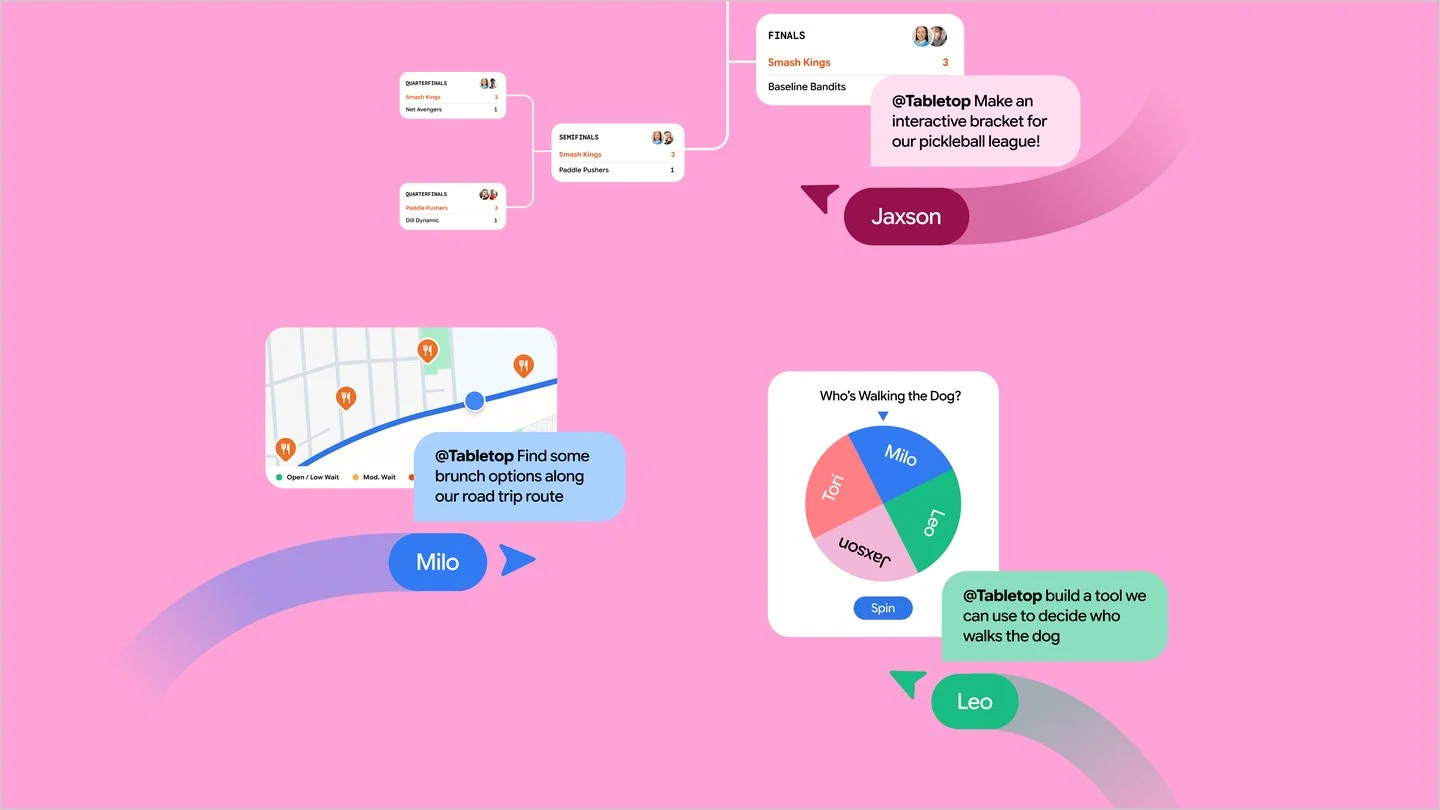 Google Labs Tabletop collaborative planning board for group itineraries and polls
Image: Google Labs
What Tabletop tries to solve
Group planning fails when one person owns a doc and everyone else only reacts in chat. Tabletop pushes structured interactives everyone can touch—closer to ChatGPT collaborative sites editing than to a lone Gemini thread.
Google’s post emphasizes starter templates so non-prompters are not blocked. That matters for mixed-skill groups—the same reason Meta Muse Spaces pitches in-app mini-apps.
Connection to multi-user agent research
Tabletop is human-first, but it previews shared state problems Anthropic’s Worse Together study measured with agents: one shared cart, many editors, race to commit. If Google later attaches per-user agents to Tabletop boards, read that paper before shipping.
How Tabletop differs from “Tabletop exercises” in policy posts
Headline collision is annoying: explainx.ai’s G7 finance tabletop exercises mean cyber drills, not this product. Search “Google Tabletop” with Labs or Roman Nurik to avoid mixing them.
What is not announced
Google’s post does not specify:
- Model version behind
@tabletop - Export formats or API access
- Enterprise Workspace admin controls
- International rollout dates
Treat specs as waitlist marketing until Labs publishes docs.
UX patterns to steal (even without API access)
 Household planning tray with calendar and shared checklist items
| Pattern | Why it matters for agents |
|---|---|
| Template-first entry | Reduces blank-page failures for casual users |
| Invite link = permissions | Mirrors MCP OAuth scopes in consumer UI |
| @-mention inside artifact | Keeps prompts in context of the board |
| Parallel editing | Needs conflict rules—lesson from Worse Together |
Competitive landscape
| Product | Shape |
|---|---|
| Tabletop | Shared interactives + @tabletop generation |
| ChatGPT Sites | Team-published sites with Codex editing |
| Muse Spaces | In-app specialized models |
| CC Family agent | Household shared vs personal memory |
Google is iterating several group-AI shells; Tabletop is the planning-board bet.
Signing up and expectations
Join the waitlist at labs.google/tabletop if you are U.S.-based and 18+. Labs experiments sunset or pivot often—do not plan curriculum around Tabletop until it exits waitlist.
Related reading
- Anthropic Worse Together: shared resources
- ChatGPT Sites team editing
- Google CC Family shared memory
- Gemini healthcare preview
- Gemini widgets and custom UI
- What are agent skills
Source: Google Labs Tabletop announcement, November 11, 2026.
Roman Nurik and the Labs product bar
Nurik’s name signals material design-era craft applied to AI surfaces. Tabletop is not a Gemini model release—it is a UX shell Labs can iterate weekly. Compare to Gemini Intelligence widget flows, which also use prompted generation inside a host UI.
Waitlist expectations for educators
If you teach collaborative AI, Tabletop is a live case study once approved:
- How do templates reduce prompt variance across students?
- What conflict resolution appears when two editors change the same poll?
- Does @-tabletop leak prompts to other users’ sessions?
Document answers in your syllabus; Labs products rarely ship admin logs.
Privacy and data retention (unknowns)
The announcement does not list retention, training use, or Workspace admin controls. Until Google publishes a Labs privacy addendum, treat uploads as consumer-grade—no confidential roadmaps.
Integration futures watchers should track
| Signal | If it ships, builders should… |
|---|---|
| Export to Google Docs | Build importers, not duplicate editors |
| Calendar write API | Wire Tabletop → Meet invites carefully |
| Third-party MCP | Re-read OAuth scopes |
None of those appear in the November 11 post—speculation only.
Tabletop vs NotebookLM sharing
NotebookLM rewards single-researcher synthesis; Tabletop rewards parallel editing on structured widgets. They solve different coordination failures—do not merge them in procurement RFPs.
Accessibility and mobile
Labs posts rarely detail screen reader behavior on launch day. If you demo Tabletop in a classroom, verify keyboard navigation before assigning graded work.
Cost model
Waitlist products are usually free during experiments. Watch for Workspace bundling later—similar to Gemini in Workspace pricing arcs.
Builder takeaway
Even without API access, copy the pattern: shared artifact URL + mentionable model + template gallery. That is how consumer AI escapes single-player chat—and where Worse Together warns you to add commit gates.
Use-case walkthroughs from the announcement
Family trip planning: The blog pitches interactive itineraries—not static PDFs. Each member can adjust legs while @tabletop regenerates sections. That is closer to Google’s CC Family agent memory model than to a single Gemini chat, because state lives in the board.
Rec league brackets: Tournament templates turn unstructured chat votes into visible seeds. Operators care about audit trails when disputes arise—Labs does not yet say whether edit history exports.
Potluck polls: Dinner polls and expense splitters target the messiest group-chat use cases. Products win here when minority dietary constraints survive majority edits—test whether Tabletop preserves per-person flags or only aggregate totals.
Enterprise analogues
Corporations may never use consumer Tabletop, but they already need shared planning boards with AI assists. Map Tabletop patterns to ChatGPT Business Agents hubs where verified brands want co-editing without leaking prompts.
Failure modes to watch after waitlist
| Risk | Mitigation idea |
|---|---|
| One user prompts harmful content into shared view | Host moderation + report |
| Race on last bracket slot | Optimistic locking UI |
| Model hallucinates venue availability | Link-out verification step |
Google has not documented mitigations; this is a preview risk list for early testers.
Labs sunsetting history
Google Labs experiments sometimes merge into Workspace, shut down, or rebrand. Do not build customer contracts on Tabletop URLs until a GA blog ships on workspace.google.com or similar.
Educator assignment idea
Assign students to replicate one template manually in Figma or Sheets, then compare friction to Tabletop once admitted. The reflection essay should cite coordination cost, not model IQ.
Why Google leads with “add your links and files”
Grounding in user-supplied assets reduces pure hallucination on venue names. It also mirrors enterprise RAG patterns in Vertex Gemini healthcare preview—context before generation.
Related enterprise Adobe angle the same week
Google’s Tabletop post sits beside Adobe and Disney enterprise creative news. Tabletop is consumer coordination; Firefly Foundry is rights-managed generation. Both push AI into shared artifacts, different compliance tiers.
Prompting @tabletop responsibly
Because generation is mention-triggered, groups should agree on who may prompt and what sources are allowed. A malicious invite link plus one @tabletop call could surface inappropriate itineraries in a family board—similar moderation concerns as Reddit AI shopping hubs, but private to the link holders.
International users
Non-U.S. readers cannot join the waitlist today. Track Google blog keyword “Tabletop” for regional expansion; until then, compare Singapore AI landscape planning tools your team already uses.
What success would look like in six months
If Tabletop graduates from Labs, expect Workspace attachment rumors and Meet integration. None are confirmed—use this section as a scorecard when you revisit the product in mid-2027.
Template gallery as product moat
Starter templates reduce cold start for casual users. Builders copying the pattern should ship three curated templates on day one of any group-AI MVP—trip, budget split, and vote—before opening free-form prompting.
Ops checklist for early Tabletop testers
| Step | Why |
|---|---|
| Create a dedicated Google account for tests | Limits blast radius if a board link leaks |
| Agree on one prompter per board | Reduces conflicting @tabletop instructions |
| Screenshot final boards before sunsetting | Labs may delete experiments without export |
| Compare output to manual baseline | Proves time saved versus hallucination risk |
Links to adjacent Google agent launches
Tabletop is not Gemini Robotics or DeepMind AlphaGenome APIs—keep planning docs separate so stakeholders do not assume robotics or science APIs ship inside Tabletop boards.
When to skip Tabletop coverage in your org
Skip internal pilots if you need SOC2 audit trails today. Wait for enterprise terms or stay with Workspace Duet-era patterns you can contract.
Summary for product managers
Tabletop validates demand for multiplayer AI UI without shipping another chat window. Measure success by time-to-decision in a group, not tokens generated. If your roadmap only tracks single-user copilots, use Tabletop as evidence that shared boards deserve a squad in 2027 planning.
Summary for developers
Until APIs arrive, study the @-mention interaction model and template bootstrap flow. Those two mechanics will reappear in enterprise group agents whether or not Tabletop survives Labs. File issues on the Labs feedback channel when boards lose sync—that signal shapes what ships next.
Availability and features may change under Google Labs policies. This article reflects the launch post only.