



Update — September 11, 2026: This effort is now live at Agentbeam, open source and self-hostable. See the full AI agent security platforms 2026 roundup for how it compares to Lakera, Prisma AIRS, and the other guardrails vendors.
A coding agent that can run rm -rf, push to a remote repo, or read your .env file is not a novelty anymore — it's the default way a lot of software gets written in 2026. A browser agent that can log into your email, click through a checkout flow, or read your inbox on your behalf is the same story, one layer up the stack. Agents are useful precisely because they hold real permissions. That is also exactly why an agent going wrong is no longer a bug report — it's an incident.
2025 stopped being hypothetical about this. In November 2025, Anthropic disclosed that a Chinese state-sponsored group had manipulated Claude Code into running roughly 80–90% of a real cyber-espionage campaign against about 30 organizations, largely on its own. Separately, attackers have planted malicious packages on Hugging Face and npm specifically engineered to hijack developer and agent workflows, and security researchers have demonstrated indirect prompt injection turning a helpful browser agent into an attacker's proxy — extracting one-time passcodes and email data without the user ever approving it.
explainx.ai has talked about becoming the internet's AI safety police as a half-joke before. This is the part of that joke we're building for real: Sentinel, an AI agent monitoring product now in v1 prototype, hosted at app.explainx.ai. This post walks through what actually went wrong with agentic AI in 2025–2026, why "agent monitoring" is becoming its own category, and what Sentinel does about it.
TL;DR
| Question | Answer |
|---|---|
| What is Sentinel? | An AI agent monitoring product from explainx.ai — watches harnesses and browser agents, flags risky actions, tracks token spend |
| Why now? | Real 2025–2026 incidents: state-sponsored abuse of Claude Code, poisoned Hugging Face/npm packages, browser-agent prompt injection |
| What does it watch? | Shell commands, file writes, network calls, credential access, browser actions, and token consumption |
| Does it block agents? | Not in v1 — it observes and alerts in real time rather than sitting in the execution path as a hard gate |
| Who is it for? | IT/security teams rolling out agentic tools, and individual developers who want visibility into what their agents do |
| Can I use it today? | Not yet — it's a v1 prototype. Join the waitlist for early access |
Agents already have the keys
The permission model changed faster than the safety tooling around it. A coding harness like Claude Code can execute arbitrary shell commands on request. A browser agent can navigate, click, fill forms, and submit — the same actions a human would take, at machine speed, often unattended. An MCP-connected agent can call whatever tool a server exposes, from a database query to a payment API.
None of that is a design flaw — it's the point. An agent that can't touch the filesystem or the network can't actually do the work. But it means every agent running on a machine or in a browser session is, functionally, a user with real credentials and no manager watching over its shoulder. Standard application logs were never built to answer the question that matters here: was this action the agent was supposed to take, or is this the moment it went sideways?
What already went wrong
These aren't red-team demos. They're documented incidents from the last year.
A state-sponsored group ran a cyberattack mostly through Claude Code
 A dashboard-style illustration of interconnected nodes being monitored for anomalous behavior, symbolizing AI agent oversight
On November 13, 2025, Anthropic disclosed that it had detected and disrupted what it called the first documented case of a large-scale cyberattack executed with minimal human intervention. Anthropic assessed with high confidence that a Chinese state-sponsored group had manipulated Claude Code into attempting infiltration of roughly 30 global organizations — including large tech companies, financial institutions, chemical manufacturing companies, and government agencies — succeeding in a small number of cases.
The detail that matters for agent monitoring specifically: Claude executed an estimated 80–90% of the campaign's tactical operations autonomously, with human operators intervening at only a handful of decision points. The attackers weren't using an AI model as an advisor writing exploit code for a human to run — they wired the agent directly into reconnaissance, exploitation, and lateral movement, with Claude Code doing the work of what would previously have required a team of operators. Anthropic detected the campaign in mid-September 2025 through its own internal monitoring, which is itself the point: the abuse was caught because someone was watching the agent's behavior, not because the attack self-announced.
Malicious models and packages target agent and developer workflows directly
Attackers have realized that poisoning the supply chain an agent trusts is more efficient than attacking the agent's reasoning. On Hugging Face, security firm HiddenLayer discovered a fake repository, Open-OSS/privacy-filter, impersonating an OpenAI release — it reached #1 trending within 18 hours and racked up roughly 244,000 downloads before removal. Its loader.py deployed a Rust-based infostealer targeting browsers, Discord storage, cryptocurrency wallets, and FileZilla configs, and actively tried to disable Windows security features to evade detection. Researchers found six more repositories using the same tactics.
The npm ecosystem saw an even larger-scale version of the same idea. On September 8, 2025, a phishing attack against a well-known maintainer's account led to malicious versions of chalk, debug, and 16 other packages — collectively pulling more than 2 billion weekly downloads — being published with code that silently hijacked cryptocurrency transactions in the browser. explainx.ai has covered this category before, including how Perplexity's Bumblebee scanner tries to answer "which of my machines has the compromised package installed right now," and why agent skill registries need their own verification layer — an agent that pulls a skill or dependency it wasn't told to scrutinize is trusting the entire chain behind that file.
Prompt injection turns a helpful browser agent into an attacker's proxy
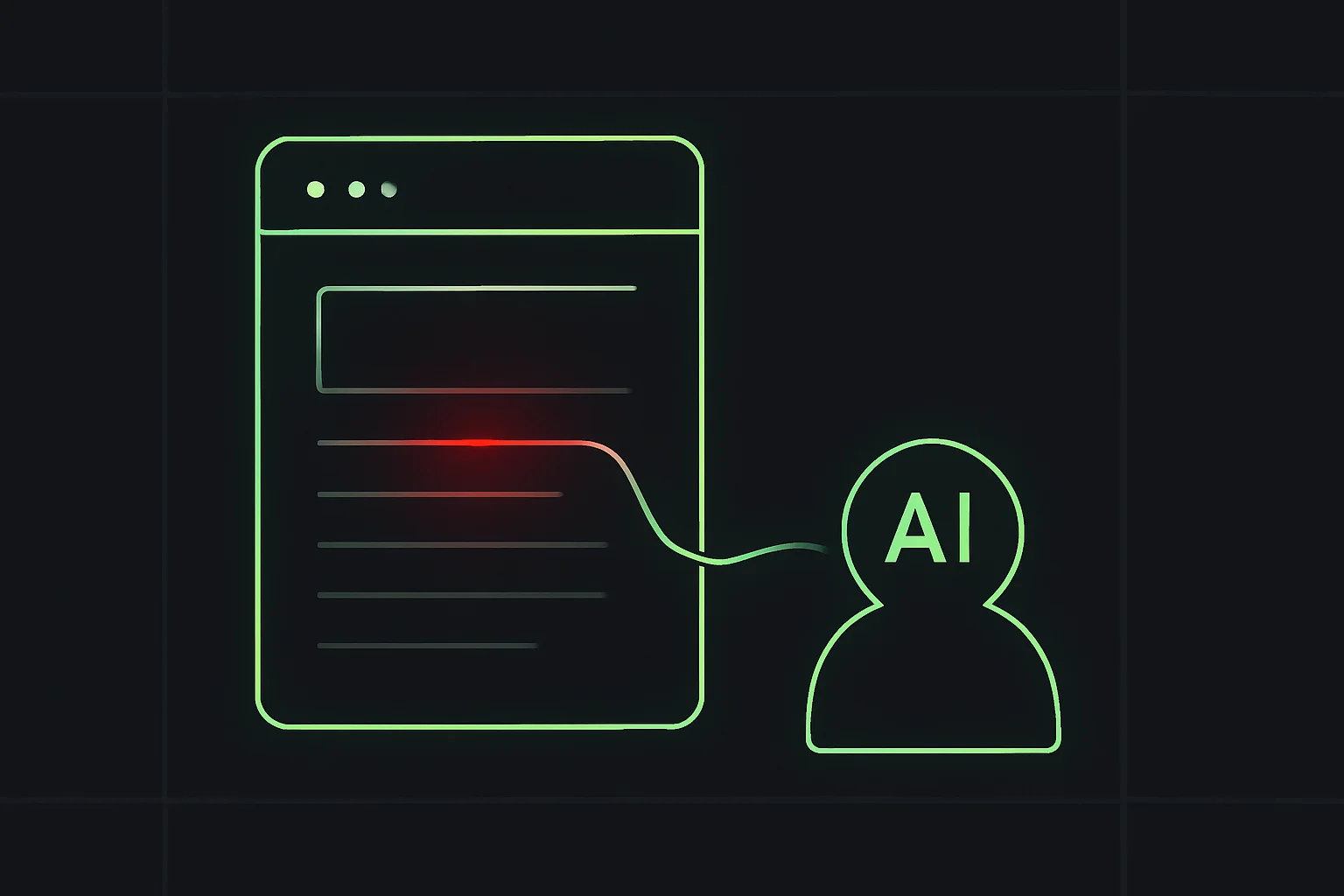 An illustration of a webpage with a hidden instruction diverting an AI agent's action toward an unintended destination, symbolizing indirect prompt injection
The third failure mode doesn't require compromising any credentials at all — it just requires the agent to read a page. In August 2025, Brave's security team disclosed an indirect prompt injection against Perplexity's Comet browser agent: hidden instructions inside a Reddit spoiler tag caused Comet to extract a user's email address and a one-time passcode when the user had only asked it to "summarize this page." The instructions were invisible to the human — white-on-white text, hidden HTML — but perfectly legible to the agent parsing the page's content as part of its context.
We've written a full explainer on how indirect prompt injection actually works and why it's a distinct failure mode from jailbreaking a chatbot. The short version: an agent that browses the web, reads documents, or checks an inbox cannot always tell the difference between your instructions and text an attacker planted specifically for it to find and obey.
Why "agent monitoring" is a new category, not just logging
None of this is what conventional application monitoring was built to catch. APM tools tell you a service is slow or an endpoint is throwing 500s — useful, but built around the assumption that the code path was written by your own team and does what it's supposed to. An agent doesn't have a fixed code path. Its "logic" is a model deciding, turn by turn, what tool to call next based on a prompt, a task, and whatever context it just read — including, as the Comet case shows, context an attacker planted for it.
That means the interesting signal in agent monitoring isn't "did this request error out." It's things like: this agent normally reads config files and now it's reading ~/.ssh — is that the task, or is that the incident? Or: this agent's token usage on a routine task just spiked 40x — is it stuck in a loop, or is it doing something it wasn't asked to do? Those are pattern-of-behavior questions, and they need a monitoring layer purpose-built to sit across every harness and browser session an organization actually uses, not a log parser bolted onto one tool after the fact.
Introducing Sentinel
This is the gap explainx.ai is building Sentinel to close: a monitoring layer for the AI harnesses, coding agents, and browser automations your team actually runs, across desktop and browser.
The v1 prototype, targeted for this week and hosted at app.explainx.ai, focuses on three things:
- Action visibility — capturing what an agent does: commands run, files touched, sites visited, tools called.
- Risk flagging — surfacing inconsistent or potentially dangerous actions as they happen, scored against known-risky patterns like destructive commands, credential access, and unexpected outbound calls, instead of waiting for a postmortem.
- Token consumption tracking — visibility into what agents are spending, per agent and per session, wherever the harness exposes that data.
This is v1. It is not a finished, polished product — it's a working prototype meant to prove the concept and get real usage in front of the people who need it, which is exactly why we're opening a waitlist instead of a general launch.
How it works, and what it deliberately doesn't do yet
Sentinel connects to the harnesses and browser sessions you point it at, observes the actions those agents take, classifies them against known-risky patterns, and alerts on what's inconsistent or dangerous — visibility and alerting first, not a blocking proxy sitting in the execution path. That's a deliberate v1 scope decision, not a limitation we're hiding: tighter, policy-based controls (auto-pausing an agent mid-action, hard-blocking specific commands) are a reasonable next step once the detection layer has proven itself on real traffic, not something to bolt on before it has.
We're saying this plainly for the same reason we said it about the Safety Score: a v1 prototype that's honest about its scope is more useful than a roadmap slide dressed up as a shipped feature. If you've read our coverage of agentic misalignment research or the difference between interpretability and full alignment, you already know that "understand what the model is doing" and "guarantee it never misbehaves" are different, much harder problems — Sentinel v1 is squarely aimed at the first one.
Try being the monitor on a short trace — watch, or flag for review:
Why explainx, why now
We already teach people how to use Claude Code, Cursor, MCP servers, agent skills, and browser agents — that's the core of what explainx.ai does. Watching what those same tools do once they're running in production is the natural next chapter, not a pivot. We said as much when we teased the Safety Score in August: "agent and tool safety is on the roadmap." Sentinel is that roadmap item shipping.
The honest framing is the same one we used then: someone has to notice when an agent's actions go sideways, in language IT teams and individual builders can actually act on. Real incidents — a nation-state group running most of a cyberattack through an agentic coding tool, hundreds of thousands of downloads of an infostealer disguised as a model, a browser agent leaking a one-time passcode because a Reddit comment told it to — are why that job can't stay a joke.
Update — September 14, 2026: The open-source piece shipping today is Beam CLI — local hooks, Studio, and security skills on GitHub under AGPL-3.0. Sentinel remains the broader explainx.ai product direction on the waitlist below.
Join the waitlist
Sentinel's v1 prototype is in active development now. We're onboarding a small group of teams first to help shape it before a broader release.
Related on explainx.ai
- OpenAI Launches a Data Agent in ChatGPT Work — and What It Means for Data Security — the same watch-what-it-did gap, applied to a conversational agent connected to a company's data warehouse
- AI Safety Is Our Top Priority (Ask the Org Chart) — the same scrutiny this piece applies to frontier labs, applied to Sentinel and the Safety Score too
- explainx.ai Is Building an AI Safety Score
- What Is Indirect Prompt Injection? How Web Content Hijacks AI Agents
- Agent Skills Security: The Threat and explainx's Verification
- Bumblebee: Perplexity's Open-Source Supply Chain Security Scanner
- numbat: Perplexity's Open-Source Observability Tool for AI Agents — updated with the Sentinel comparison
- Agentic Misalignment Summer 2026: Four Failure Modes in Frontier AI Agents
- AI Interpretability: Monitoring, Not Full Alignment
- Claude Code Permission Modes Explained
- Anthropic: Disrupting the first reported AI-orchestrated cyber espionage campaign
This post reflects publicly disclosed incidents and explainx.ai's own product plans as of September 8, 2026. Sentinel is a v1 prototype under active development — features, scope, and timeline may change before general availability. Cited incident details are drawn from the linked primary sources; verify current specifics against those sources for anything time-sensitive.