



Google Research published a November 23, 2026 blog post on DeepCrossAttention (DCA), an architecture that replaces fixed residual sums with learnable, per-token routing across earlier layers. The work was presented at ICML 2025 in the paper DeepCrossAttention: Supercharging Transformer Residual Connections. Google reports matching standard transformer quality with up to three times faster training, up to five times fewer steps to the same perplexity on large corpora, and up to 29% fewer layers for an LM1B target—while adding under 0.2% extra parameters.
TL;DR: what changed versus a standard transformer
| Topic | Standard residual | DeepCrossAttention (per Google) |
|---|---|---|
| Combine with prior layers | Fixed addition | Learned weights per token |
| Cross-depth interaction | Implicit via sum | Depth-wise cross-attention (Q/K/V split across layers) |
| Parameter overhead | None | Under 0.2% of model size |
| Pretrained retrofit | N/A | Initializes like standard residuals; Google reports 0.19 LM1B perplexity drop after brief continued training |
| Named adopters in Google's post | N/A | Moonshot attention residuals; Thinking Machines Inkling 2 |
Why residual connections hit a wall in deep transformers
Transformers scale depth because self-attention mixes tokens along the sequence axis, while residual connections carry a shortcut along depth. That shortcut fixed vanishing gradients in early deep networks, but Google's post argues the shortcut has a cost: every prior layer enters the sum with equal implicit weight, so fine-grained features from shallow blocks get averaged away in very deep stacks.
That matters for builders training long-context or high-depth models on custom silicon: you may pay for dozens of layers that mostly recompute what layer 6 already encoded. Google's framing matches a wider 2026 thread—depth is representational memory, not only FLOPs.
How DeepCrossAttention works
Google describes two mechanisms:
- Dynamic layer routing — each token gets mixing weights from a static learnable base plus an input-dependent projection, so the block can shift between sequential and parallel processing depending on context.
- Depth-wise cross-attention — attention runs across layers, not across sequence positions: each token queries a weighted mix of all prior layer embeddings for that token.
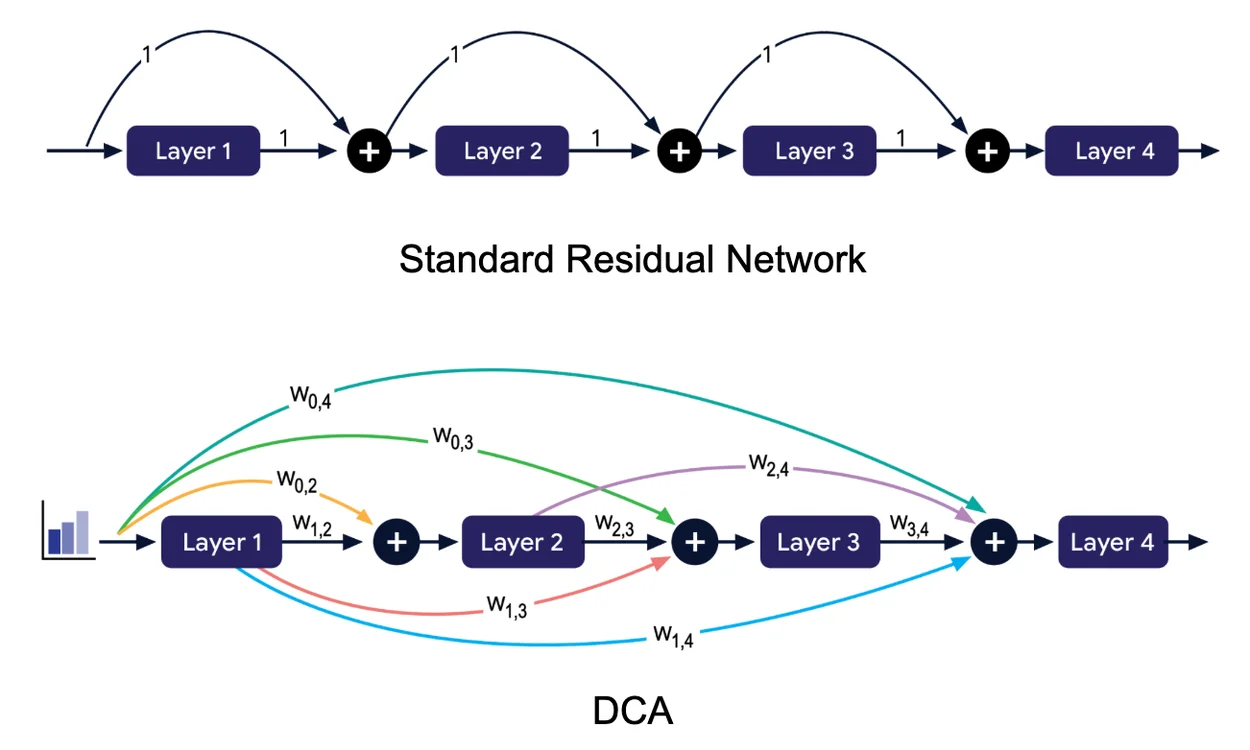 Standard transformer residual connections vs DeepCrossAttention dynamic routing for transformer training
Image: Google Research
Comparison with related 2026 research directions
Google's November post situates DCA inside a cluster of dynamic residual designs:
- Moonshot AI attention residuals — softmax over prior depths with block variants for memory.
- Hyper-connections — parallel residual channels with mixing matrices; Google cites training instability at scale unless constrained.
- Manifold-constrained hyper-connections — Sinkhorn-Knopp stochastic matrices to stabilize signal propagation.
If you follow Hugging Face's MoE training handbook for routing intuition, DCA is the same idea applied to depth instead of expert indices: pick who to read, don't average everyone.
Benchmark numbers Google published
Google's blog and the arXiv paper emphasize language modeling perplexity on LM1B and C4:
- Lower perplexity than standard transformers at the same training budget versus baselines named in the post (LAUREL-PA, 1x1-DenseFormer, Hyper-Connections).
- Same quality up to 3x faster and up to 5x fewer steps to match a standard transformer on those corpora.
- To hit perplexity under 14 on LM1B, Google reports a fixed-width standard transformer needed 42 layers, while DCA reached lower perplexity with 30 layers—about 29% less depth.
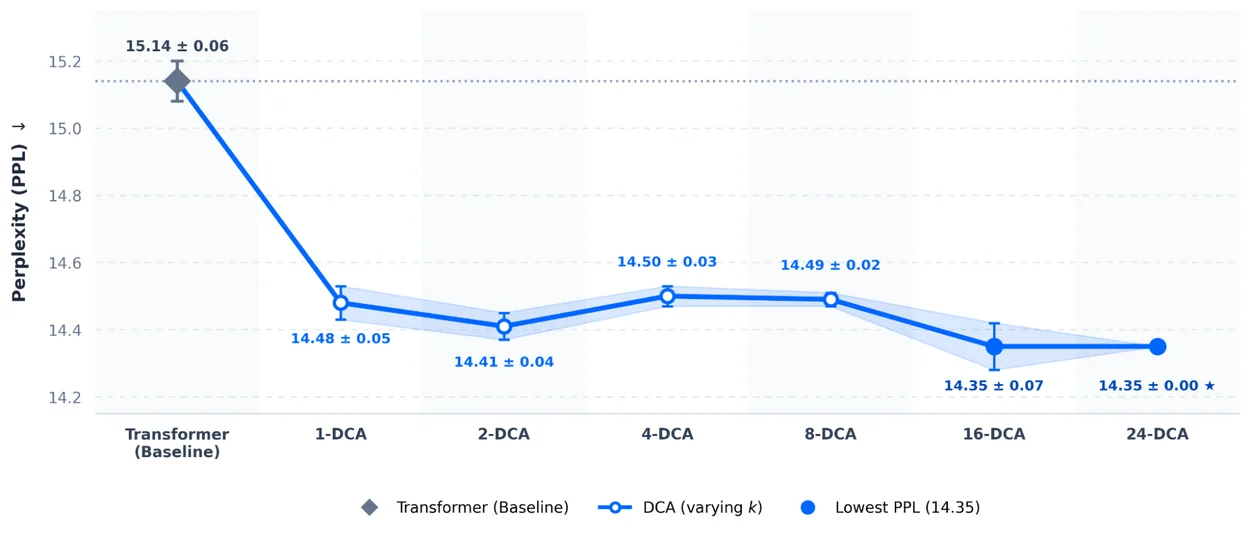 DeepCrossAttention perplexity improves as connection history k increases on LM1B
Image: Google Research
Scaling connection history k
Google also charts how varying the number of preceding layers (k) DCA can attend to affects perplexity, with 16-DCA and 24-DCA configurations landing best in their sweep. Practically, k is a memory–quality knob: more history means richer routing but higher bandwidth because prior representations stay unmerged.
Retrofitting pretrained transformers
One builder-facing detail in Google's post is initialization: DCA can start identical to standard residuals, so you are not forced into train-from-scratch only to test the idea.
Google reports that retrofitting DCA onto a pretrained transformer and continuing training briefly cut LM1B perplexity by 0.19, versus 0.02 for continued standard fine-tuning in the same setup. That is a small absolute delta on a benchmark metric, but it supports the claim that routing modules can learn after the base model exists—similar in spirit to post-training adaptation layers work elsewhere in 2026.
If you want to use this at work, not just read about it, this is the fastest path.
What this does not solve
Google is explicit that DCA is not free compute:
- Memory bandwidth rises because multiple prior layer tensors stay available for routing.
- Image classification experiments are mentioned, but the headline claims are LM1B/C4-centric—do not assume vision transformers get the same multipliers without your own sweep.
- The post is research communication, not a Gemini release note. Pair it with Gemini agent research for product moves, not architecture moves.
How to try DeepCrossAttention
Google does not ship a one-click Hugging Face module in the November 23 post. A practical path for builders today:
- Read arXiv:2502.06785 for layer definitions,
klimits, and initialization. - Reproduce LM1B/C4 slices before touching a frontier-scale run—DCA's value proposition is training efficiency, which only shows up with honest step budgets.
- Compare against your baseline residual, not against published leaderboard snapshots from unrelated open-model releases.
- Watch third-party stacks that already cite DCA—Inkling 2 and attention residuals named in Google's post are signals for library support landing outside Google first.
If you train on Google TPU paths or Amazon Trainium stacks, profile bandwidth: DCA's 0.2% parameter story can still hurt step time if KV-style depth caches are not fused.
Theory hook: when DCA should beat plain residuals
The arXiv paper includes a theoretical section Google summarizes on the blog: DCA improves the accuracy–size trade-off when the ratio of collective layer ranks to ambient dimension falls below a critical threshold. Builders do not need the proof to ship experiments, but it explains why DCA is not always a free win on tiny widths—if rank collapses, routing has nothing useful to select.
In practice, treat that as a hyperparameter guardrail: on small student models or distillation targets, run a width sweep before blaming implementation bugs. On frontier-width stacks—the ones burning megawatt training clusters—the rank assumption is more plausible, which is where 29% depth reduction headlines actually matter for capex.
Image and vision experiments (secondary in the release)
Google's November post mentions image classification as another evaluation axis, but the figures and tables center on LM1B/C4 language modeling. Vision builders should not port LM1B multipliers to ViT training without re-running ablations—residual dilation behaves differently when patch embeddings mix spatial and channel structure.
Dynamic residual routing and the 2026 architecture menu
2026 model teams increasingly treat depth as another routing problem, not a fixed ladder:
- Sparse upcycling and MoE route tokens to experts.
- DCA routes tokens to prior depths.
- Multi-branch transformers route information across branch KV.
For education teams, the through-line is stop assuming addition is neutral—how layers combine is now trainable structure, not compiler trivia.
Operational checklist before you change production stacks
| Step | Why |
|---|---|
| Profile bandwidth per step | DCA keeps prior layer tensors alive longer |
Match k to your depth budget | Google's sweeps show diminishing returns after mid-teens connections on LM1B |
| Log perplexity per 1k steps | Google's claim is time-to-quality, not final quality at infinite budget |
| Keep a standard-residual control | Initialization can mimic classic residuals—you need an A/B to see routing learn |
| Document tokenizer and data mix | LM1B/C4 numbers do not transfer to code or multimodal corpora without work |
Teams using inference optimization skills for deployment should note: training-time routing does not automatically become serving-time routing unless you export the same block definitions into your inference engine.
Related reading
- Language models that rewrite their own weights — another 2026 take on where adaptation lives in the stack.
- Hugging Face transformer integration contracts — when small harness bugs distort published benchmark tables.
- DeepMind Gemini agents and formal methods — Google Research product lane versus architecture lane.
- Weight-space programming without standard transformers — when teams leave transformer residuals entirely.
- AI chip architecture guide — bandwidth often caps depth tricks before FLOPs do.
Questions teams ask after the Google blog
Should I wait for a Hugging Face reference implementation? Not necessarily. The paper PDF is the source of truth for block definitions. Early adopters often port one decoder layer into an internal fork and measure step time before full-model swaps.
Does DCA help RL or SFT more? Google reports focus on pretraining-style language modeling. Alignment passes with small learning rates may see smaller gains because routing modules have less time to move. Treat SFT/DPO as a separate ablation.
How does this interact with FlashAttention? Depth-wise reads add memory traffic orthogonal to sequence attention kernels. If attention is already bandwidth-bound, DCA can hurt unless fused; profile before productionizing.
Architecture details and benchmark tables reflect Google's November 23, 2026 research post and arXiv:2502.06785 as published; check both for revisions.