



On September 1, 2026, Google's official @antigravity account introduced /boost — a new slash command in Antigravity 2.0 and the Antigravity CLI for tasks that need more than a single fast agent pass. The pitch is direct: for particularly complex work, Antigravity spends more tokens on deep reasoning, routes the job through a multi-agent orchestrator into a deep-reasoning pipeline, and wraps changes in an execution and verification loop before treating the task as done.
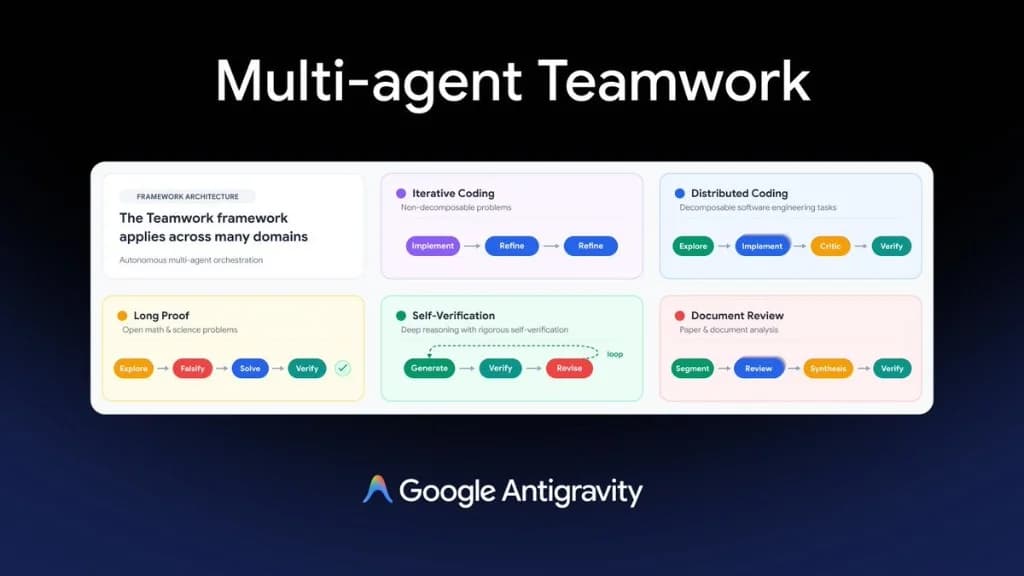
If you already track Antigravity's Teamwork multi-agent framework (/teamwork-preview) or the CLI subagent surface, /boost sits adjacent: not a multi-day research campaign, but a paid-plan deep lane for hard bugs, adversarial algorithm work, and root-cause hunts where verify-after-execute matters.
Official home: antigravity.google.
TL;DR
| Question | Answer |
|---|---|
What is /boost? | Slash command for complex tasks — more tokens, deep reasoning, multi-agent pipeline |
| Where? | Antigravity 2.0 desktop app and Antigravity CLI (agy) |
| Who gets it? | Pro and Ultra subscribers (per Google's Sep 1 announcement) |
| Mechanism | Orchestrator → deep-reasoning pipeline → execute → verify → loop |
| Best for? | Race conditions, flaky tests, algorithm edge cases, root-cause investigation |
| Overkill for? | Quick edits, syntax questions, single-file refactors — use normal mode or /btw |
| Registry | explainx.ai /slash-commands/antigravity-boost |
What Google announced
Per the September 1, 2026 @antigravity thread, /boost exists because some tasks fail when treated like everyday coding — intermittent failures hide behind timing, algorithm bugs only appear at boundary sizes, and production incidents span layers that a single shallow pass never stress-tests.
Google's stated design:
- Higher token budget — explicit spend on extended reasoning rather than optimizing for latency.
- Orchestrator routing — the main agent decides the task belongs in the deep-reasoning pipeline (as opposed to a fast path).
- Two pipeline modes — complex implementation (large, correctness-sensitive builds) and root-cause investigation (hypothesis → test → narrow).
- Execution and verification loop — changes run against tests, reproducers, or benchmarks; failures feed the next reasoning turn.
That loop structure mirrors what explainx.ai documents under loop engineering and agent harness DAG patterns: don't trust the first patch; verify, then iterate.
The multi-agent workflow (how it differs from one chat)
A normal Antigravity session can delegate to subagents via /agents, but /boost is a productized deep lane — Google pre-packages orchestration instead of leaving you to prompt "think harder."
At a high level:
User: /boost <hard task>
        │
        ▼
   Orchestrator (routes complexity)
        │
        ├──► Deep-reasoning pipeline
        │         ├── plan / decompose
        │         ├── implement or instrument
        │         └── adversarial critique
        │
        ▼
   Execute (run tests, repro, benchmark)
        │
        ▼
   Verify ──fail──► loop back to pipeline
        │
       pass
        │
        ▼
   Present result + evidence
Builders who do not use Antigravity can still steal the shape: route by difficulty, cap fast-path models for easy work, and require verification artifacts (test output, flame graphs, counterexamples) before merging agent diffs.
Four use cases Google highlighted
Google named concrete scenarios in the announcement thread. These are the ones worth treating as intentional /boost prompts, not generic "fix my code."
1. Tricky bug fixes — race conditions and intermittent tests
Flaky CI is the canonical misfit for fast agents: the failure is non-deterministic, stack traces lie, and a patch that "looks right" may only reduce failure rate. /boost's verification loop is aimed at repro → instrument → stress → fix → re-stress rather than one diff and hope.
Example prompt:
/boost Our checkout integration test fails ~3% of runs on CI only.
Find the race, add a deterministic repro, fix it, and prove 500 consecutive green runs.
2. Algorithmic optimization — adversarial boundary cases
When performance cliffs live at specific input sizes or degenerate graph shapes, shallow optimization often passes happy-path benchmarks and ships regressions. Google explicitly called out adversarial boundary cases and throughput stress-testing — the same mindset as fuzzing and property-based testing, but agent-orchestrated.
Example prompt:
/boost Optimize our sparse graph frontier queue. Stress-test n=1e6, m=1e7,
adversarial degree-1 chains, and compare against the baseline on p50/p99 latency.
3. Root-cause investigation across subsystems
Production incidents that touch auth, caching, and queue workers need hypothesis ranking and falsification, not the first plausible story. The deep-reasoning pipeline's investigation mode maps to SRE-style loops: gather signals, narrow blast radius, validate fix under load.
Example prompt:
/boost 502s spiked 40 minutes ago only in us-east. Trace request path,
correlate deploys and cache TTL changes, propose minimal fix with rollback plan.
4. Complex multi-step implementation with proof obligations
Large refactors — migration off a deprecated API, correctness-sensitive concurrency refactors, security-sensitive parsing — benefit when each step must pass verification before the orchestrator advances. This is implementation mode: bigger surface area than a bug hunt, same execute → verify discipline.
Example prompt:
/boost Migrate payment webhooks from v1 to v2 signatures module-by-module.
Each module must pass integration tests before continuing.
What people are asking
Is /boost the same as turning on "thinking" or a bigger model?
Not exactly. /boost is a workflow switch — orchestrator, pipeline selection, and verification loops — not merely /model to a larger Gemini tier. You can still hit quota limits; the command allocates more reasoning steps, not unlimited tokens.
How does this compare to /teamwork-preview?
| Surface | /boost | /teamwork-preview |
|---|---|---|
| Scope | Hard task in a session | Hours-to-days campaigns |
| Patterns | Deep reasoning + verify loops | Five named Teamwork patterns |
| Examples | Flaky tests, algo stress tests | Long proofs, distributed coding |
| Cost warning | Higher than normal; Pro/Ultra | Google: "uses a lot of tokens" |
Use Teamwork when the problem is decomposable research or engineering over days; use /boost when you have a bounded but nasty task that must finish with evidence, not a literature-scale campaign. See Teamwork coverage for pattern details.
Do I need Antigravity 2.0 or the CLI?
Google said both — the 2.0 desktop app and the CLI. If you live in agy already, /boost should appear in the same slash surface as /fast, /agents, and /planning. Full command reference: Antigravity CLI guide.
What about quota and cost?
Google has not published /boost-specific metering in the Sep 1 thread. Treat it like Teamwork and extended thinking tiers elsewhere: budget for 3–10× normal token burn on hard tasks, watch /usage, and do not /boost a typo fix.
Honest limitations
- Paid plans only — Pro and Ultra; not a free-tier convenience feature.
- No public benchmark — Google showed use-case categories, not pass@1 deltas vs normal mode.
- Verification quality depends on your tests — garbage reproducers produce confident wrong fixes; invest in CI and repro harnesses first.
- Not a replacement for human review on security, compliance, or production deploys — same bar as any agent harness.
Try it today
On a Pro or Ultra Antigravity session:
/boost <describe the hard task with repro, benchmark, or success criteria>
Quick lookups without tool loops: stay on /btw. Frontier multi-day work: consider /teamwork-preview. Middle ground — nasty, bounded, must be verified — /boost.
Registry entry with arguments and examples: /slash-commands/antigravity-boost.
Related on explainx.ai
- Antigravity /plan — dedicated planning mode (Sep 2026)
- Google Antigravity Teamwork: multi-agent framework for long-horizon work
- Antigravity CLI: sandbox, plugins, and slash commands reference
- What is an agent harness? Complete guide
- Loop engineering for coding agents
- Agent harness DAG: planner, worker, critic under budget pressure
- Google I/O 2026 recap — Antigravity 2.0 launch context
- Gemini managed agents get Files and Credentials APIs (Sept 18) — antigravity-preview-09-2026 brings this harness's tools into the Interactions API
- Gemini 3.7 Flash showcase across Antigravity and AI Studio
- Top 10 open and closed agent harnesses (2026)
Official: antigravity.google
Details on /boost availability, pipeline behavior, and plan entitlements reflect Google's September 1, 2026 announcement. Preview and paid features can change — confirm on antigravity.google before planning production workflows.