



Edge0 open-sourced Edge0-145B and Edge0-120B on November 12, 2026, calling Edge0-145B the first open 145-billion-parameter model aimed at personal-computer agents rather than datacenter-only serving. The announcement pairs weights on Hugging Face with edge0-infer and edge0-strata on GitHub, continuing a line that began with the 35B phone-scale release in September.
If you benchmark agents locally, this is a different design bet from InferSSD's SSD-streamed 800B path or Apple's four-Mac 800B RDMA demo: Edge0 trains a latent sparse MoE for one NVIDIA GPU with predictive expert loading, not full-weight RAM residency.
TL;DR
| Question | Answer (Nov 12–13, 2026) |
|---|---|
| Models | Edge0-145B and Edge0-120B open weights |
| License | Apache 2.0 stack on GitHub per repository header |
| Checkpoints | Edge0/Edge0-145B-q3k, Edge0/Edge0-145B-NVFP4, plus 120B variants |
| Engine | edge0-strata plus edge0-infer serve/chat |
| GPU requirement | CUDA 13, compute capability 7.5+, 16GB+ VRAM per GitHub v0.2.0 notes |
| Claimed memory | 29GB peak on compatible laptop in announcement |
| Claimed decode | 80+ tok/s decode, 1100+ tok/s prefill in announcement |
| Benchmark caveat | Most table rows are Edge0 internal evals |
What shipped in the stack
Edge0's November release is three artifacts, not a weights-only drop:
- Model folders on Hugging Face with
model.jsonmetadata for edge0-infer. - edge0-strata, a Strata fork that implements latent experts, SSD-tier vocabulary, and speculative paths described in the announcement.
- edge0-infer v0.2.0, packaging CLI
serve,chat, OpenAI-compatible local server, and desktop Edge0 Chat without bundling weights.
GitHub release notes dated November 11, 2026 (v0.2.0) state Windows x64 and arm64 packages, Anthropic Messages API on the local server, and explicit separation: 145B does not ship inside the zip; you download checkpoints separately.
That matches how serious local stacks should ship: engine first, multi-hundred-gigabyte folders second.
Architecture: why 145B can claim laptop memory
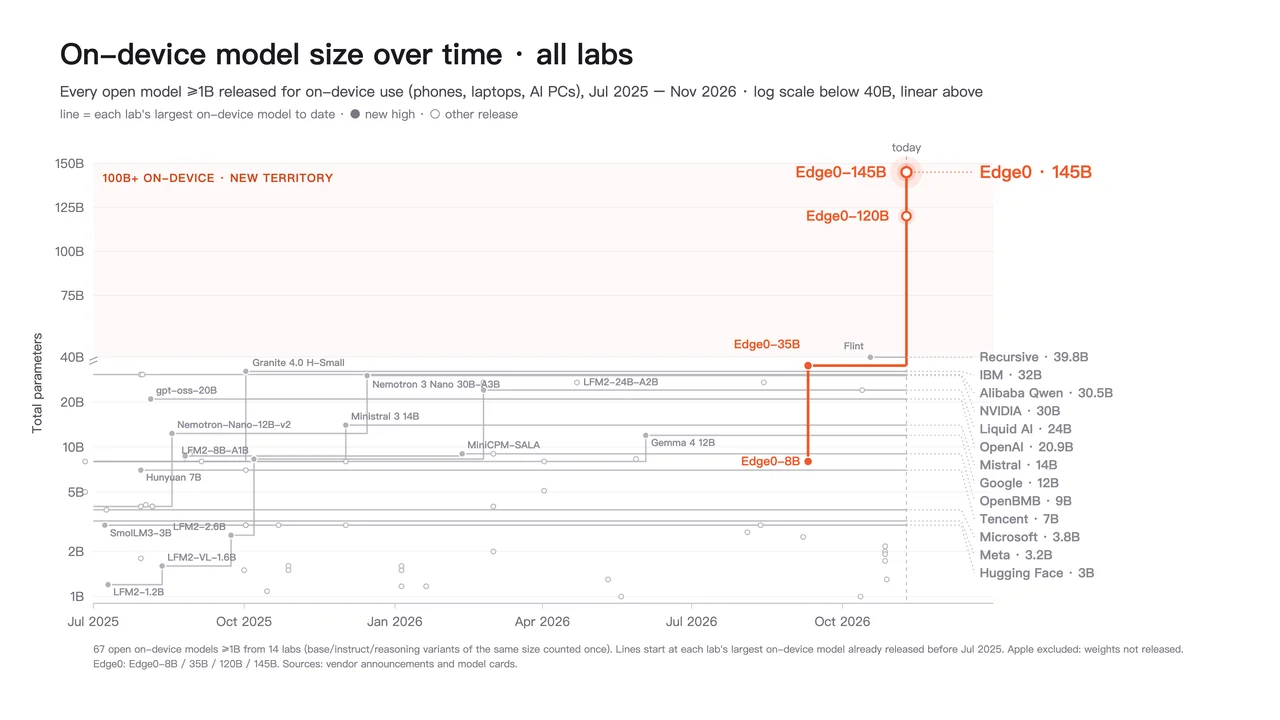 Edge0 chart of largest open on-device models by lab through November 2026
Image: Edge0
Edge0's post breaks the design into four layers — architecture, training, loading, scheduling — we summarize with their vocabulary:
Shared expert matrices. Groups of 64 experts share large matrices; only about 10B of 145B parameters activate per step in the announcement narrative.
Training for local execution. Models are trained in the on-device architecture, not compressed after a cloud training run — a distinction we also stressed for Janas disk-streaming MoE.
Three-tier loading. Hot experts in GPU memory, a ~40GB expert library in system RAM, ~48GB vocabulary data on SSD with on-demand reads.
CPU/GPU co-scheduling plus speculative decoding to hit the cited 80+ tok/s decode.
The approach rhymes with WiCi InferSSD expert streaming but targets 145B total rather than 800B-class checkpoints — different scale, similar memory-wall philosophy.
Coding and reasoning that rival frontier cloud models
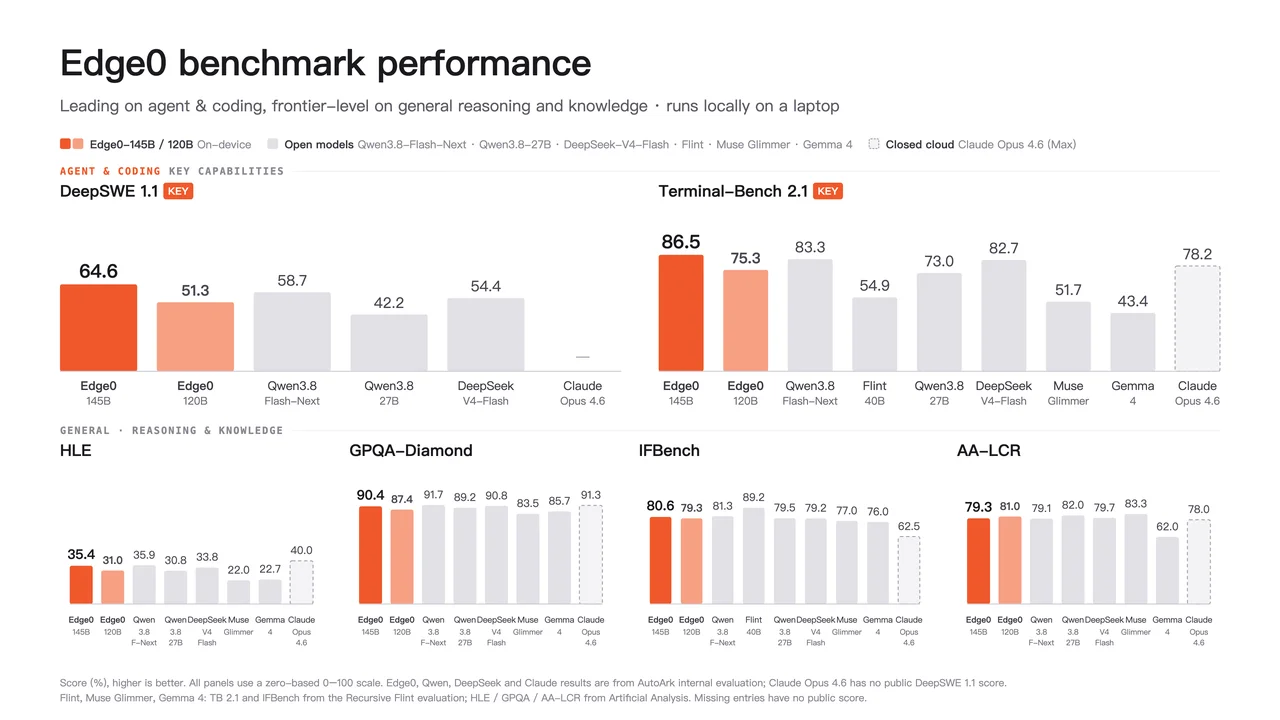
Edge0-145B is competitive with specific frontier cloud models across coding, reasoning, knowledge, and instruction following:
The announcement table highlights:
- DeepSWE 1.1: 64.6 versus Qwen3.8-Flash-Next 58.7
- Terminal-Bench 2.1: 86.52 versus Claude-Opus-4.6 (Max) 78.2 in Edge0's table
- GPQA-Diamond: 90.4 near DeepSeek-V4-Flash-0731 90.8
Read the footnotes: Claude lacks a public DeepSWE score in their table, and Flint/Muse/Gemma rows mix Recursive Flint and Artificial Analysis sources. This is useful for directional comparisons, not leaderboard certification.
Edge0 also claims 72.8 mean across six benchmarks at 29GB measured peak, versus ~70GB estimated for Qwen3.8-Flash-Next in 4-bit deployment — enabling 48GB laptops in theory, if your GPU partition matches their test rig.
 Edge0 benchmark mean score versus peak memory for laptop-class models
Image: Edge0
Hugging Face card: parameters you can verify
The Edge0-145B-q3k model card lists mechanical facts independent of marketing copy:
| Field | Value on card |
|---|---|
| Total parameters | 145B, 10.12B active per token |
| Layers | 48 hybrid attention |
| Experts | 512 per layer, 10 routed + 1 shared |
| Context | 256K, KV int8 with 32K resident |
| Q3_K size | 40.81 GiB on disk |
| NVFP4 size | 47.79 GiB |
Throughput on card: 121.2 tok/s agent decode and 3554.9 tok/s 16K prefill on RTX 5090 D 24GB — faster than the blog's generic 80+ tok/s line because the card names a specific agent decode profile.
Builders should treat test RAM budgets (16GB VRAM + 20GB host) as engineering limits from one profile, not a universal minimum.
How to run Edge0-145B today
From the Hugging Face quick start (paraphrased with paths intact):
git clone https://github.com/Edge0-AI/Edge0.git edge0
Build edge0-strata using EDGE0.md for Linux or Windows NVIDIA, then edge0-infer per edge0-infer/docs/getting-started.md. Download Edge0-145B-q3k or Edge0-145B-NVFP4 into its own folder.
build/cpu/bin/edge0-infer serve --model /path/to/Edge0-145B-q3k
Pass the leaf model folder, not the parent directory holding multiple checkpoints. On Windows, GitHub points to build\windows\bin\edge0-infer.exe.
OpenAI-compatible local server plus Messages API support (per v0.2.0 notes) means you can point harnesses that expect cloud APIs at localhost, similar to patterns in GPU task managers trending this week but with MoE-scale weights.
Platform matrix: who can run what
| Platform | Edge0-145B / 120B | Edge0-35B |
|---|---|---|
| Linux NVIDIA | edge0-strata | CPU native engine |
| Windows NVIDIA | edge0-strata | CPU or Vulkan |
| macOS Apple Silicon | Not in strata table | Metal |
If your team is Mac-only, this release is watchlist, not production — unless you remote into a Windows/Linux box. For Mac local agents, compare TensorFold Zig inference and the existing 35B path.
What developers are saying on Hacker News
A small thread (~21 points) asked practical questions rather than celebrating star counts:
- mortalapeman asked whether 145B is derived from Qwen3.8-Flash-Next, noting strong hands-on results with Strata on that family — consistent with GitHub's derivation line. Comment
- fesoliveira said third-party benchmarking would determine excitement, flagging healthy skepticism at the parameter count. Comment
- Zetaphor corrected terminology: open weights, not open source for the whole stack — fair when chat apps remain partially packaged. Comment
- SwellJoe praised Blender tool-use demos but doubted whether outputs are human-refinable — the same maturity question we raised for agentic video pipelines. Comment
No independent Terminal-Bench reproduction appeared in the first dozen comments we fetched.
Agent workflows the announcement emphasizes
Edge0's public demos lean on tool loops — Blender scenes, PCB edits, small games — not single-shot chat. That matters for harness design:
- Plan → code → execute → visually verify matches how Expo EAS simulator agents record UI work, but Edge0 claims the loop stays on-machine.
- 128K–256K context in the announcement supports multi-file repo edits without re-uploading zip archives to a cloud API.
- Offline core in the Edge0 App removes quota anxiety for travelers, similar to why teams experiment with Hugging Face Trellis 3D LoRA locally before paying hosted GPUs.
If your product only needs summarization, 145B local is probably overpowered. If you run SWE-bench style tasks, this release is aimed at you.
Licensing, derivation, and compliance
GitHub marks the Edge0 repository under Apache 2.0. Weights ship as separate folders on Hugging Face with their own cards. Because models are derived from Qwen3.8-Flash-Next, read upstream license stacking before redistributing merged checkpoints in a commercial appliance.
Export-control news — Tim Scott's Banking testimony requests and Singapore's Megaspeed probe — does not change open-weight downloadability today, but it can change who may host large MoE endpoints in regulated industries.
Honest limitations
Vendor benchmarks. Until Artificial Analysis or community harnesses publish runs, treat Terminal-Bench 86.52 as Edge0-reported.
Hardware lock-in for 145B. CUDA 13 plus recent NVIDIA GPUs excludes AMD, Intel Arc, and Apple for this tier today.
Disk and thermals. SSD vocabulary streaming and 120W typical power in the announcement mean laptop cooling profiles matter as much as VRAM spreadsheets.
Derivation lineage. Starting from Qwen3.8-Flash-Next may affect license stacking and fine-tune compatibility — read both Edge0 and upstream cards before merging adapters.
Not a cloud replacement for every task. Edge0's own closing section keeps cloud for very low-compute devices and fresh web search — same split we document for Bedrock agent ROI.
How Edge0-145B compares to neighbor releases
| Approach | Scale | Mechanism | explainx.ai pointer |
|---|---|---|---|
| Edge0-145B | 145B MoE | Latent experts + strata GPU | This post |
| Edge0-35B | 35B MoE | Phone/laptop preview | 35B guide |
| InferSSD | 763B–816B | SSD expert reads + llama.cpp | InferSSD post |
| Janas | Varies | Disk streaming engine | Janas MoE |
| Inkling 2 Small | 594B MoE | Datacenter NVFP4 | Inkling weights |
Pick 145B Edge0 when you want single-GPU agent loops with sub-50GB RAM stories. Pick InferSSD when you already downloaded DeepSeek-V4.1-Flash or Muse-Spark-Open GGUFs and accept 2–7 tok/s decode.
Repro checklist before you file a bug
Edge0's stack is new enough that misconfigured paths dominate early issue threads:
- Confirm
model.jsonmodel_namematches the folder you pass toserve. - Install CUDA Toolkit 13 on Windows if
edge0-stratafails device init — GitHub release notes are explicit. - Download NVFP4 only if you have spare disk; Q3_K is the documented default for the 5090 profile.
- Run
edge0-infer info(if available in your build) before blaming model quality. - Compare against cloud baselines with the same prompt file — apples-to-oranges prompts made Podqi shopping safety stats look worse until methodology aligned.
Related reading
- Edge0 35B on Apple Silicon
- InferSSD 800B on consumer hardware
- Janas streams MoE experts from disk
- GPUtaskman for local LLM jobs
- TensorFold Zig local inference API
- Colibrì GLM-5.2 in 25GB RAM
- SGLang consortium and production MoE serving
- What is AI distillation for builders
Weights paths, CUDA requirements, and benchmark tables reflect Edge0's announcement, Hugging Face model card, and GitHub v0.2.0 release notes as of November 13, 2026.