



Drax, Brookfield and Radiant announced on November 3, 2026 that they will develop AI data centre capacity at Drax Power Station in North Yorkshire. The first phase is up to 100MW, operational from Q1 2028. Later phases aim at 500MW between 2028 and 2031, and more after 2031. Brookfield says total investment could potentially exceed £20bn.
The numbers are large, but the conditions matter more. The first phase still needs planning, Government and grid approvals, and a tenant. Drax's own announcement says so.
TL;DR: what is firm and what is not
| Question | Answer |
|---|---|
| Who is involved? | Drax (site owner), Radiant (delivery), and the Brookfield-Qai AI infrastructure joint venture (backing) |
| First phase? | Up to 100MW, operational from Q1 2028 |
| Second phase? | Ambition of 500MW between 2028 and 2031 |
| After that? | Ambition for more capacity after 2031 |
| Money? | £2.5bn backing for phase one. Total could potentially exceed £20bn, per Brookfield's estimate |
| Approved? | No. Planning, regulatory and network approvals are pending |
| Tenant? | None named. Needed for phase one |
| Site? | 1,000 acres, 4GW grid access, 2.6GW of active dispatchable generation and cooling systems |
Who are the partners, and what does each bring?
Drax is the owner of one of the UK's best-known power stations. Its release says the site has supported the country for over 50 years. CEO Will Gardiner describes it as one of the few UK sites able to supply large-scale reliable power directly to data centre customers.
Radiant is described as Brookfield's UK-headquartered AI infrastructure platform and a vertically integrated AI infrastructure company. It delivers the project. Brookfield's Head of AI Infrastructure is Sikander Rashid, and Radiant's CEO is Mahdi Yahya.
The money comes from the Brookfield-Qai AI infrastructure joint venture. Qai is a technology company headquartered in Qatar, and its Chairman and Managing Director, Abdulla Al-Misnad, is named in the release. The Government's Minister for Science, Innovation and Investment links the deal to a growing UK-Qatar partnership.
What does the site offer for AI compute?
AI data centres need three things: power, cooling and network. Drax's release lists all three.
- Grid access of 4GW. That is the headline asset. Waiting for a grid connection is the main delay for UK data centres.
- 2.6GW of active dispatchable generation and cooling systems. The release groups these together and does not split them out.
- Fibre. The site is close to the UK fibre network.
- Land. 1,000 acres is enough for a campus rather than a single building.
This is why a retiring or converted power station is attractive. It already has a heavy grid connection, cooling water infrastructure and a planning history. We saw the opposite problem in October, when Microsoft pulled out of Nscale's Loughton datacentre over power supply. Power, not chips, decided that project.
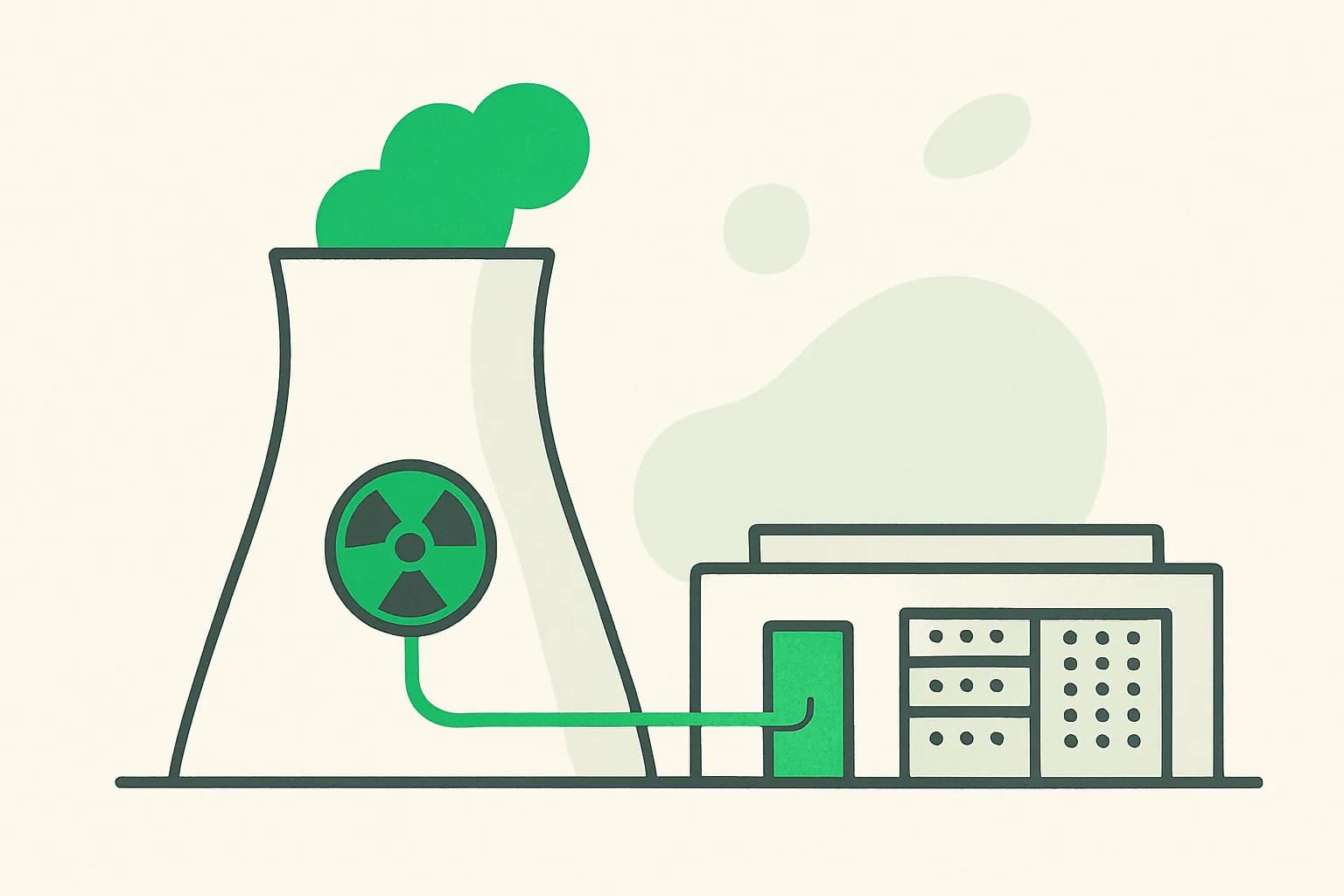
 Cooling tower linked to a data hall by a green power line, picturing the Drax data centre power and cooling story
Why do power stations keep turning into data centre sites?
Three reasons recur across the projects we track, and each applies at Selby.
First, the grid queue. A new large connection in the UK can take years to secure. A site that already holds a 4GW connection skips most of that wait, though Drax's release says approvals from the Government and the system operator are still required for phase one.
Second, heat and water. Large thermal plants were built with cooling systems, and the release counts 2.6GW of active dispatchable generation and cooling systems as part of the site. Whether those systems can be reused for an AI campus is a design question for the planning stage, and the release does not answer it.
Third, speed. Developers want AI capacity within two or three years, while greenfield builds with new substations take longer. That pressure explains why Q1 2028 is the stated target for the first 100MW.
The trade-off is that a power station also carries its own history: emissions, ownership questions, and a local workforce whose jobs depend on the plant. That is why both Drax and Brookfield stress jobs in their statements, and why the community benefits fund appears so early in the plan.
What is the history behind this plan?
This is not a new idea at Drax. In December 2025, trade press reported that Drax had set out plans for a 100MW data centre at its Selby site, positioned as support for rising AI demand (Data Centre Review). That report said no planning application had been filed and that the site "could be operational by 2027". The new plan moves that date to Q1 2028.
Later, Data Center Dynamics reported that the UK Government rejected a joint bid from North Yorkshire Council, the University of York and Drax for an AI Growth Zone at the site. Drax said at the time that it had never relied on that bid. We have not been able to open that article in full, so treat this summary as secondhand.
The November 3 announcement therefore is not a first. It is the point where a named delivery partner and a funding source join a plan that Drax had been developing alone.
What conditions does phase one still face?
Drax's release lists three conditions for the first phase.
- Timely progression of planning. A first-phase community consultation will launch shortly. Formal planning follows. Drax targets the start of the planning process in the coming months.
- Regulatory and network approvals. The release says approvals are required from Government and the system operator.
- A suitable tenant. No tenant is named.
The third condition is the most telling. A data centre needs a customer, such as a cloud provider or an AI lab, to commit capacity. Without one, a 100MW date of Q1 2028 is a target, not a schedule. Compare this with our report on the neocloud shakeout, where Gartner warned that many capacity providers may fail when demand does not match their supply.
The partners also say that, on an initial assessment, the project aligns with the Government's new Data Centre Covenant. Our post on the UK Budget and the Data Centre Covenant explains what that covenant is: priority grid connections in return for local investment, jobs and water protection, as reported by Reuters and City AM.
How big is £20bn, and should you trust the number?
Brookfield's estimate is that total investment "could potentially exceed" £20bn. The only committed-looking figure is £2.5bn of backing for phase one. The gap is large.
Think of it as three layers.
| Layer | Capacity | Money stated | Status |
|---|---|---|---|
| Phase 1 | Up to 100MW, from Q1 2028 | £2.5bn backing | Conditional |
| Phase 2 | Ambition of 500MW, 2028 to 2031 | Not stated separately | Ambition |
| Phase 3 | More after 2031 | Not stated separately | Ambition |
| Total | GW-scale | Could exceed £20bn | Estimate |
Ambition is not a contract. A reader should read the £20bn as the size of the dream if every phase goes ahead and every approval comes through. That is a useful scale marker, but not a forecast.
What about jobs, communities and local opposition?
The partners say they plan a voluntary community benefits fund, developed with local communities. It would be separate from, and additional to, planning obligations and Drax's existing community initiatives. Both Gardiner and Brookfield's Rashid say the project would protect or preserve hundreds of jobs. Brookfield also expects many direct and indirect jobs across the wider Yorkshire area.
Local sentiment is not part of the release, and we have not found reporting that measures it. Data centre projects elsewhere have met strong resistance over water and power. Our coverage of the Amazon Thane protests in India and Maine's data centre revolt shows how fast that can turn. The coming consultation is the first real test.
What does this mean for what you build or pay?
For most builders, nothing changes this year. No capacity exists yet, and no tenant is named. But there are three signals worth noting.
- UK compute is power-limited, not chip-limited. Sites with existing heavy grid connections now command partnerships worth billions.
- Sovereign and Gulf capital is moving in. Qai's involvement through Brookfield adds a Qatar link to UK AI infrastructure.
- Timelines slip. If you plan UK-hosted inference or training around 2028, treat Q1 2028 as an optimistic date and keep a second region ready.
If you buy cloud capacity in the UK, ask providers where their power comes from and what approvals are still open. For readers who run agents on rented compute, remember that capacity risk and security risk are separate. AgentBeam, the agent security platform from the explainx.ai team, covers the second.
What to watch next
- The first-phase community consultation, and its dates.
- A planning application, and whether it names the power sources.
- A named tenant. That would turn the plan into a project.
- Any statement from the Government and the system operator on grid approvals.
- Whether the AI Growth Zone question returns in another form.
Related reading
- Microsoft pulls out of Nscale's Loughton AI datacentre over power
- The neocloud shakeout: Gartner says 80% may vanish
- UK Budget: Data Centre Covenant and AI security funding
- Nvidia's £250 million UK agentic safety compute
- Musk says SpaceX closed $40B in GPU debt: claimed vs verified
- Amazon Thane data centre protests in India
- Drax's official announcement
Facts come from Drax's announcement of November 3, 2026 and the cited trade press. Plans may change as planning and approvals progress.