



A Shirt That Only Machines Can't See
On August 30, 2026, Polymarket reposted a one-line alert that sent the story back through the X feed: "JUST IN: German technologist develops a 'digital camouflage' shirt designed to make wearers effectively invisible to AI surveillance cameras." The framing is news-brief tight — it calls Simon Weckert a "technologist," skips the Berlin surveillance politics, and treats a months-old art project like a fresh product drop. The demo underneath is real anyway: a printed shirt that makes open-source person detectors draw green PERSON boxes on everyone in frame except the wearer.
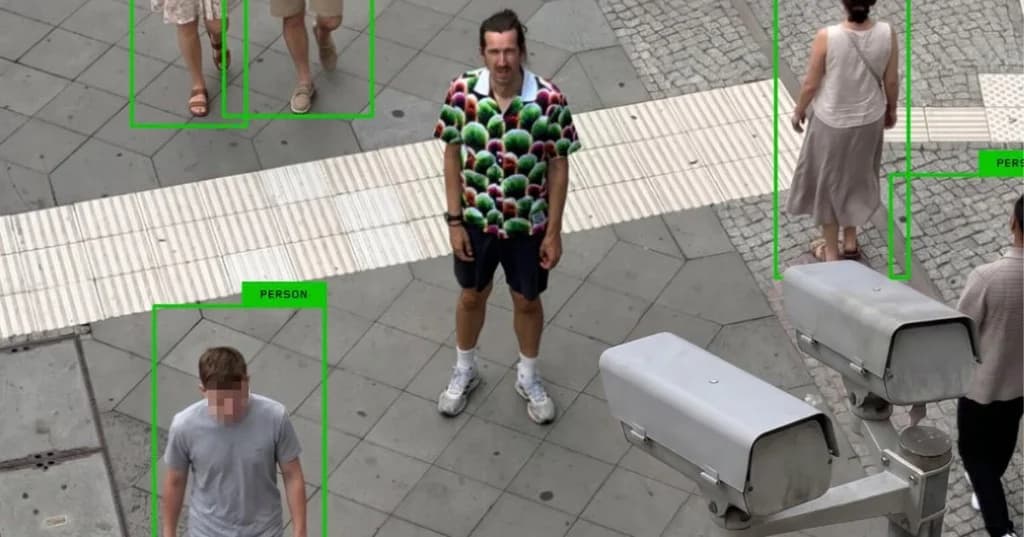
Weckert is a Berlin-based artist and researcher, not an anonymous lab inventor. In June 2026 he stood in front of a real, operational surveillance camera at Berlin's Kottbusser Tor — a site chosen deliberately for its history as a testbed for automated behavior-scanning cameras — wearing a shirt printed with a strange, glitchy pattern. To any person walking past, it was obviously a person wearing an unusual shirt. To the camera's object-detection model, there was no person there at all.
That's the entire trick, and it's a real one. The project, called Digital Camouflage, is not a costume or a hoodie-and-sunglasses privacy hack — it's an engineered adversarial pattern designed to push a person-detection model's internal representation of the wearer outside the boundary the model uses to say "human." The shirt is available for purchase, proceeds go toward digital civil rights organizations, and the whole thing is released under a CC-BY-NC-SA 4.0 license.
It's also a useful, concrete way to understand one of computer vision's most persistent and least explained weaknesses.
TL;DR
| Question | Answer |
|---|---|
| What does the shirt actually do? | Suppresses the "person" detection confidence score of an object-detection model wearing it, so no bounding box or label is drawn |
| Does it fool humans too? | No — it's fully visible as a shirt with a printed pattern to anyone looking at it directly |
| Is this new research? | No — it builds on published adversarial-patch and evasion-clothing research; the project's contribution is a wearable, publicly demonstrated product |
| Does it beat facial recognition? | Not directly — it targets the person-detection stage, the step that draws a box before any face or gait model runs |
| Can it be independently verified against real government systems? | No — those systems and their training data are not public, so claims about specific deployments can't be checked |
| Why does this matter for AI builders? | It's a live case study in adversarial robustness testing, a gap that benchmark accuracy alone does not catch |
| Who built it? | Simon Weckert — Berlin artist; project page documents YOLO demos at Kottbusser Tor |
| Is wearing this legal? | Depends on jurisdiction and intent — protest art is different from evading law enforcement; see legal section below |
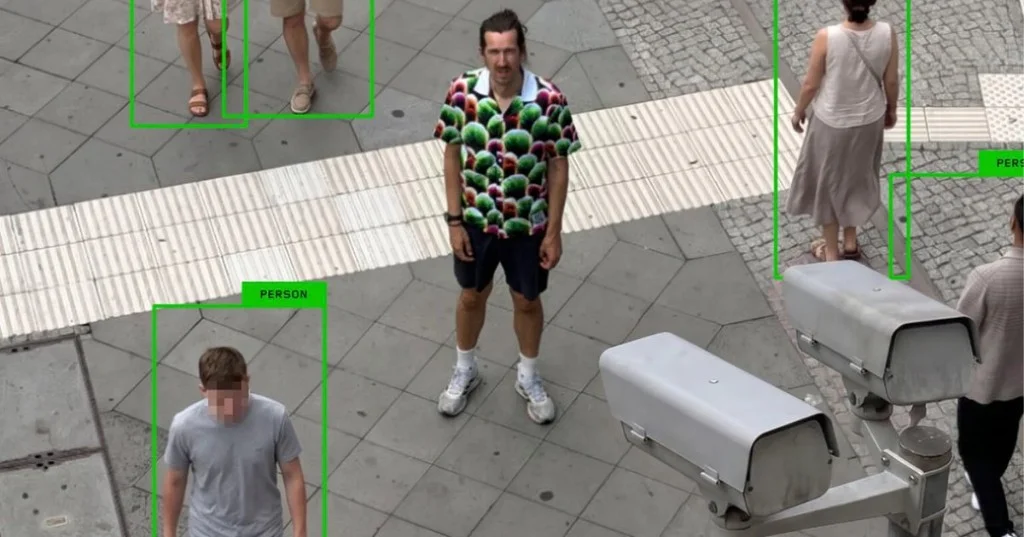 Surveillance-style object-detection overlay marking every pedestrian with a green PERSON bounding box except the wearer in Simon Weckert's Digital Camouflage patterned shirt
Demonstration frame: generic open-source YOLO person detection marks every passer-by — except the shirt wearer. Image from Simon Weckert's Digital Camouflage project documentation.
How Object Detectors "See" a Person
A model like YOLO, RF-DETR, or any modern detector doesn't perceive a person the way a human does. It takes in pixel values, runs them through learned convolutional or transformer layers, and produces a set of class probabilities and bounding-box coordinates for regions of the image. "Person" is not a concept the model understands — it's a region of high-dimensional space the model learned to associate with certain pixel patterns during training on labeled datasets like COCO.
That's the exploit surface. If pixel patterns, not conceptual understanding, drive the classification, then an engineered pixel pattern can push an image's internal representation away from the "person" region without changing what a human sees. This is the same underlying mechanism behind adversarial stickers that make a stop sign register as a speed-limit sign, or a few pixels of noise that flip an image classifier's answer from "panda" to "gibbon" with high confidence — a well-documented failure mode going back to Szegedy et al.'s original 2014 adversarial examples paper.
What makes Digital Camouflage harder than those lab demonstrations is that it has to survive the physical world: fabric folds, changing light, distance from the camera, and viewing angle all distort the printed pattern before it ever reaches the sensor. Academic work on physically realizable adversarial patches and evasion clothing — including research specifically targeting YOLOv2/v3 person detectors under real-world conditions — spent years solving exactly that robustness problem. Weckert's project applies that line of research to a wearable, sellable product and stages it against a real public camera instead of a controlled lab rig.
How the Pattern Was Engineered
Weckert did not sketch the print by eye. As he told Dezeen, the design ran in an adversarial loop against the detector itself: generate a candidate texture, show it to the model, measure how confidently it still labels a person, adjust, repeat — until confidence collapses. "You cannot design against machine perception by eye," he said; "only the machine can tell you what it fails to see."
The technical write-up on designboom names the generative method TC-EGA (Toroidal-Cropping-based Expandable Generative Attack): a tileable adversarial texture meant to cover the whole garment so folds and viewing angles do not create the segment-missing failure mode that defeats fixed printed patches. Weckert's own description of the mechanism — saturated color transitions firing strongly in early network layers while overlapping shapes break body-outline continuity — matches how convolutional detectors bind head-shoulder silhouettes and limb proportions into a single "person" hypothesis.
He validated the shirt against YOLO, the same family of open-source real-time detectors used in countless hobby rigs, security demos, and research benchmarks. His project page is explicit about scope: demonstrations use a generic detector; no claim is made about any specific government deployment — and that opacity is part of the critique.
Prior Art — This Line of Research Is Not New
Digital Camouflage packages a decade of adversarial-clothing research into a purchasable protest garment. The table below is the lineage a builder evaluating detectors should know.
| Prior work | Year / source | What it did | Limit vs. Digital Camouflage |
|---|---|---|---|
| AdvPatch on cardboard | Thys et al.; ECCV 2019 | Person holds a rigid board printed with an adversarial patch; ~18% physical success vs. YOLOv2 | Patch on cardboard — not wearable; fails on fabric deformation |
| Adversarial T-shirt | Xu et al.; arXiv:1910.11099 | Thin-plate-spline modeling of cloth deformation; ~57% physical ASR vs. YOLOv2 | Lab research artifact — not a public product staged at a live surveillance site |
| Adversarial texture (full garment) | Hu et al.; CVPR 2022 line | Full-body adversarial texture for person-detector evasion | Academic — Weckert cites this family on his project page |
| Cap_Studio knitwear | 2024–2025; tested on YOLO per Dezeen | Biometric-frustrating knit patterns without face cover | Different target — biometrics, not bounding-box suppression |
| IR "hacker hoodie" | Various maker projects | High-power IR LEDs blind camera sensors | Hardware jamming — illegal in many jurisdictions; fails against visible-light-only pipelines |
| HyperFace scarf | Hyphen-Labs | Overwhelms face detectors with false face-like patterns | Targets face classifiers, not whole-person detection |
The 2019 adversarial T-shirt paper is the closest academic anchor: it proved person detectors could be fooled through non-rigid deformation if you model fabric warping during training. Digital Camouflage's contribution is productization, full-garment tileable texture (TC-EGA), and political staging — Kottbusser Tor, proceeds to digital-rights orgs, CC-BY-NC-SA 4.0 release — not a new theoretical attack class.
Why Kottbusser Tor, Specifically
The staging location isn't incidental. Kottbusser Tor is a well-documented site for automated behavior-scanning surveillance in Berlin, and Weckert frames the project explicitly as civil resistance to the expansion of that kind of monitoring in cities including Berlin and Los Angeles. The pointed contrast in his own framing: government surveillance systems are deployed and operated without independent testing or public audit, while "the same class of technology is undone by a piece of fabric" that anyone can buy.
That framing lands squarely in a debate explainx.ai has covered before — Flock Safety's ALPR camera network across the US and the EU's mandatory driver-facing cameras both raise the same underlying question: what happens when a detection system is deployed at scale with no independent way to verify its accuracy or its failure modes, adversarial or otherwise? A shirt that defeats a person-detector in a public demo is a small, visible instance of a much larger accountability gap.
What This Isn't
It's worth being precise about the limits, because the project's own framing is honest about them and the claims are easy to overstate.
It's not a universal invisibility cloak. The pattern targets the person-detection stage — the step that decides "there is a human-shaped object here" and draws a bounding box. Facial recognition, gait analysis, and other downstream identification models are separate systems that may run independently of a person detector, or not run at all if no box was ever drawn to hand off to them. Defeating detection is a meaningful evasion; it is not the same as defeating every layer of a surveillance stack.
It's not verifiably effective against any specific deployed system. Weckert's own project notes acknowledge this directly: the technology's effectiveness against particular government cameras "cannot be independently verified," because those systems' architectures, training data, and confidence thresholds are not public. What's demonstrated is effectiveness against the class of person-detection models the pattern was engineered against — a meaningful proof of concept, not a guaranteed universal bypass.
It's not permanent. Adversarial robustness is not a fixed property. A model retrained on examples that include adversarial patches — a standard defensive technique called adversarial training — can partially close the specific gap a given pattern exploits, which is why this remains an active arms race between attack and defense research rather than a one-time fix.
Legal, Ethical, and Deployment Angles
Weckert's own framing is protest art, not a stealth product. The shirt ships with a CC-BY-NC-SA 4.0 license; a share of proceeds goes to organizations fighting surveillance expansion. The project page states plainly it is not a tool for evading the police and not a promise of anonymity.
That distinction matters legally. In Germany, Berlin's Kottbusser Tor pilot is a behavior-scanning deployment — software sorting gestures into "normal" and "suspicious" — and the system vendor has been kept non-public, which means independent red-teaming like Weckert's demo is one of the few public checks available. Wearing adversarial clothing in a public square as political speech sits in a different bucket from using the same pattern to defeat access control, evade court-ordered monitoring, or interfere with safety systems.
For US readers, the parallel is Flock Safety's ALPR mesh: networked cameras logging every vehicle without a warrant, with dozens of communities voting to cancel contracts in 2026. Person-detection pipelines on street cameras follow the same accountability gap — high benchmark scores, opaque training data, no public adversarial test regime.
Ethically, the shirt forces a question explainx.ai has raised in smart-glasses misuse coverage: when surveillance is asymmetric — institutions see you, you cannot see or audit their models — individual countermeasures look like privacy tools and perform like arms-race toys. A printed pattern that beats YOLO today may fail tomorrow against a retrained detector or a different architecture (transformer backbones, multi-model fusion, thermal/IR fusion). Treating a shirt as reliable cover is a category error; treating it as evidence that detector deployments need adversarial evaluation before go-live is not.
Why This Matters Beyond Art and Protest
For anyone building or evaluating computer-vision systems, Digital Camouflage is a useful public demonstration of a category of failure that too often stays confined to academic benchmarks: the gap between reported accuracy on a clean test set and reliability against inputs specifically engineered to defeat the model. A person-detector that reports 95%+ mAP on COCO can still be reduced to near-zero confidence by a printed pattern that a human eye reads instantly as "a person in a weird shirt."
That gap is exactly what adversarial robustness testing exists to close — and it's a different discipline from ordinary accuracy evaluation. Standard validation asks "does the model get the right answer on realistic inputs." Adversarial evaluation asks "can an adversary who knows how the model works construct an input that gets the wrong answer on purpose." Any system deployed for safety, moderation, or security decisions needs both, and the second one is routinely skipped because it's harder to run and doesn't show up in a leaderboard score.
It also underlines why explainability matters operationally, not just philosophically. If a team can only say "the model scored X% on our benchmark" and not "here is what the model actually keys on to make this decision, and here is how that changes under a targeted perturbation," they have no way to anticipate failures like this one before someone else demonstrates them in public. The same tools that make a model's decisions inspectable — feature attribution, monitoring pipelines, and structured evaluation against adversarial inputs — are what would have caught this class of weakness during development instead of on a street corner in Berlin.
What You Can Do With This
If you're building or evaluating any object-detection pipeline — for security, moderation, or automated monitoring — treat adversarial robustness as a required evaluation axis, not an optional stretch goal:
- Test against adversarial patches, not just clean data. Published attack libraries (adversarial patch generators, physically realizable perturbation tools) exist specifically so you can red-team your own detector before someone else does it publicly.
- Don't rely on a single detection stage as your security boundary. If "person detected → alert fires" is your entire logic, a single evaded frame is a single point of failure. Layer independent signals where the decision matters.
- Publish or internally document confidence thresholds and failure modes. Part of what makes Weckert's critique land is that deployed government systems can't be checked. A system nobody can audit is a system nobody can trust, adversarial attacks aside.
- Version and re-test after retraining. Adversarial training helps against known patterns but doesn't guarantee robustness against novel ones — treat this the same way you'd treat any other regression surface, with scheduled re-evaluation rather than a one-time check.
Related on explainx.ai
- LG TVs Caught Recording Audio Even When "Off," Gamers Nexus Finds
- Flock Safety, ALPRs, and the AI surveillance debate
- Smart glasses misuse, venue bans, and how to protest
- EU driver-facing camera law — privacy guide
- RF-DETR: real-time object detection, explained
- Blur faces in video — AI privacy protection
- AI interpretability and monitoring for production teams
- What is bias in AI — types, examples, mitigation
- Adversarial robustness — explainx.ai dictionary
- Digital Camouflage — official project page
Update — October 9, 2026: Flock Safety is cutting about 18% of staff amid backlash to its AI license-plate cameras. Full breakdown →
Project details, licensing terms, and demonstration specifics reflect Simon Weckert's published project page as of August 2026. Polymarket repost date: August 30, 2026.