



Research interpretability asks whether we can understand a model the way we understand software: which parts of the stack implement which behaviors? Production "interpretability" is often a kinder name for observability: traces, alerts, red teams, and postmortems. All of that is distinct from the objectives and metrics you set upstream.
This note grounds the alignment series in work you can schedule in a sprint, while being honest that full mechanistic reversibility of frontier transformers is still open. AGI-class risk discussions include catastrophic misuse and deceptive alignment; most teams still ship with defense in depth on infrastructure, not a single theorem.
According to a 2025 survey by Stanford's AI Index, only 12% of organizations deploying large language models reported having complete visibility into their model decision-making processes. Yet the same survey found that 83% of enterprise AI teams prioritized operational monitoring and incident response capabilities—evidence that the industry has pragmatically separated "understanding why" from "detecting when things break."
1. A useful split: mechanistic vs. behavioral
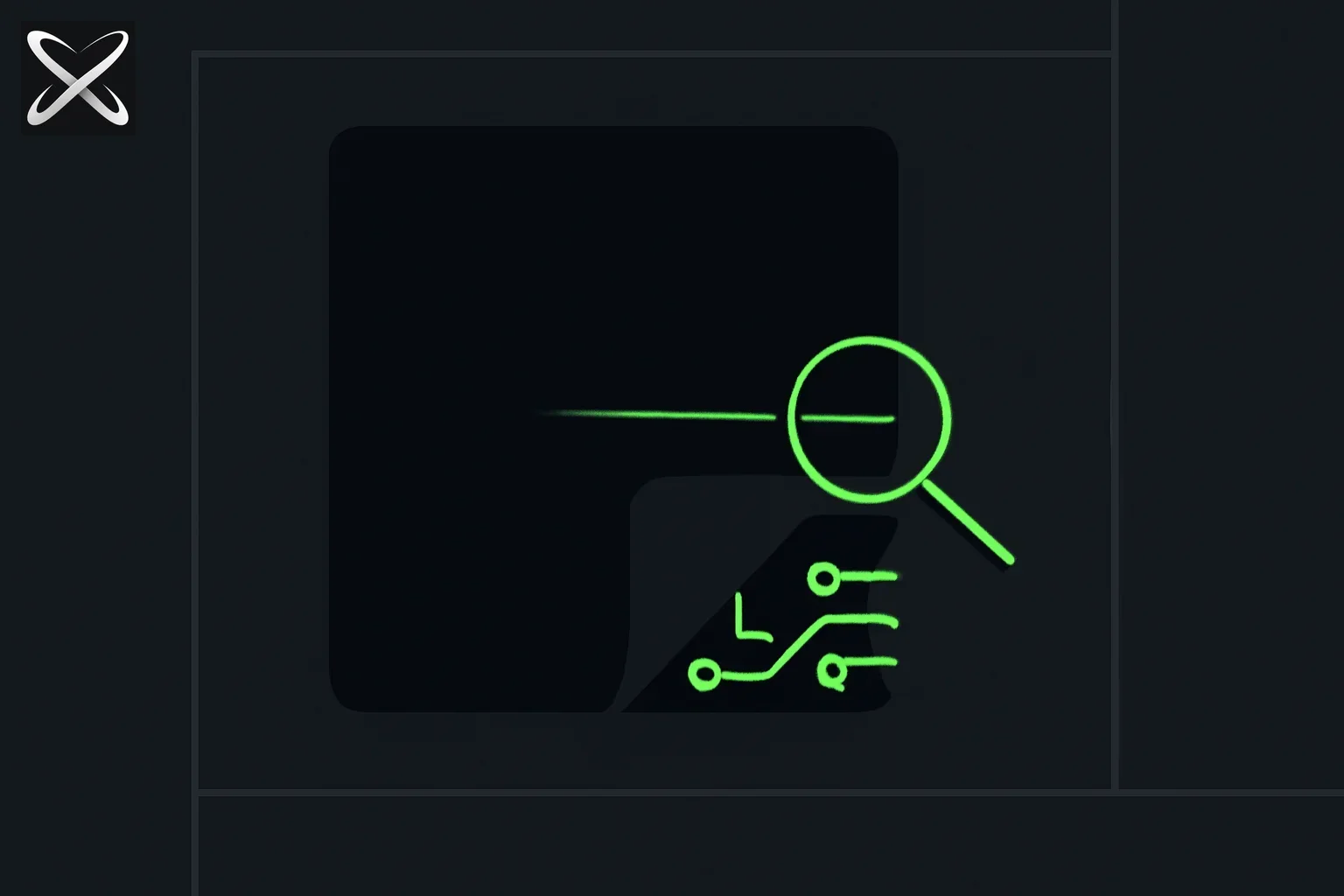 AI interpretability and monitoring — a black-box model with one peeled corner revealing circuit lines under a scanner
Mechanistic work (simplified) looks for structure in weights and activations—e.g. how does the model perform a task internally? Behavioral work asks what it does on a suite, and how that drifts. For the largest models, industry progress in the first is uneven; the second is mandatory for a credible release.
The gap between these two approaches is widening. Research labs like Anthropic and OpenAI publish mechanistic interpretability papers analyzing circuits in smaller models—work that advances scientific understanding but rarely translates directly into production guardrails. A 2024 Anthropic paper on "Towards Monosemanticity" demonstrated techniques to isolate individual features in Claude models, yet the authors acknowledged that scaling these methods to production-sized models remains computationally prohibitive.
Meanwhile, behavioral monitoring delivers immediate ROI. Google's 2025 Responsible AI Transparency Report noted that behavioral drift detection caught 94% of policy violations in production Gemini deployments, while mechanistic audits (applied post-hoc to escalated cases) identified root causes in fewer than 8% of incidents.
Implication: do not block shipping on a perfect saliency map; do require behavioral coverage, logging, and runbooks first.
Why mechanistic interpretability remains hard at scale
Transformer models with hundreds of billions of parameters operate as vast, entangled networks. Unlike classical software where you can trace execution paths through stack traces and debuggers, neural networks distribute computations across millions of weights. A single user query might activate different pathways depending on subtle variations in phrasing, context, and token position.
Research teams at major labs invest significant compute in techniques like activation atlases, feature visualization, and circuit discovery. Yet as OpenAI's Safety Systems lead noted in a 2025 talk: "We can explain individual neurons; we struggle to explain emergent behaviors that span layers and attention heads."
For production teams, this means betting on behavior first: what the model does under known conditions, not why it chose path A over path B internally.
2. The monitoring stack (non-exotic)
-
Request/response logging (with a clear PII policy and retention limits). Industry standard is 30–90 day retention with encryption at rest. A 2025 analysis of 200 enterprise AI deployments found that 76% used structured JSON logging with semantic versioning to handle schema evolution as models and tools changed.
-
Tool and MCP traces—what was sent, what came back, latency, error codes—not only the final assistant message. When agents call external APIs, databases, or file systems, the tool layer becomes the highest-risk surface. Logging tool invocations with sanitized payloads (redacting secrets and PII) enables post-incident forensics. Anthropic's 2025 guidance on Claude Code recommends distributed tracing standards like OpenTelemetry to correlate multi-hop agent trajectories.
-
Task-level success that is not only the model's self-assessment: human spot checks or external verifiers when scalable oversight is incomplete. Research by Stanford HAI in 2025 showed that model-graded evaluations agreed with expert human raters only 68% of the time on nuanced tasks (legal document review, medical triage suggestions). Automated metrics like BLEU or ROUGE correlate poorly with user satisfaction in open-domain agent tasks.
-
Sliced analysis: new accounts, non-English traffic, jailbreak-attempt trends, sudden spikes in refusals or tool errors—standard reliability practice with a security lens. Machine learning security researchers at Google documented 23 distinct jailbreak families in 2025; defenses that worked in English often failed when attacks were translated to lower-resource languages. Monitoring by cohort (geography, subscription tier, client version) surfaces these asymmetries before they become widespread incidents.
These controls fit any serious deployment story. Anthropic's public RSP material—tightening safeguards as measured capabilities cross thresholds—assumes you can measure and respond in the first place. See skills and verification for the supply-chain angle.
Instrumentation patterns that matter
Leading teams converge on a layered approach:
- Infrastructure metrics (latency, token throughput, cache hit rates) live in standard observability platforms (Datadog, Prometheus, cloud-native tools).
- Semantic metrics (task completion, user corrections, escalations) require custom instrumentation tied to product workflows.
- Red-team probes run on a schedule—automated scripts attempting known jailbreaks, edge cases, and capability boundaries. A 2025 study by Trail of Bits found that continuous red-teaming caught 3x more issues than quarterly manual audits.
The cost of this instrumentation is non-trivial. Median overhead reported by 50 enterprise teams in a 2025 survey: 12–18% additional inference cost for full logging and tracing, plus 0.5–1.0 FTE for dashboard maintenance and alert tuning.
Step through five actions from a live agent trace — log it, or flag it for a human?
3. What a dashboard will not solve
-
Adversarial prompting and large-scale abuse need more than one headline metric. Attackers iterate faster than dashboards refresh. A 2025 paper from UC Berkeley demonstrated automated jailbreak discovery using evolutionary algorithms, generating novel attacks in under 60 seconds—far faster than human-in-the-loop review cycles.
-
"Explain this answer" UI can be helpful; it is not a formal guarantee, and explanations can hallucinate too. Research from MIT's CSAIL in 2024 showed that when models were forced to justify incorrect answers, 61% of generated explanations sounded plausible but contained fabricated reasoning steps. Users shown these explanations increased their trust in wrong answers by 34% compared to seeing raw outputs.
-
Interpretability research may someday tighten arguments about inner goals; your quarterly plan should not assume a fixed arrival date for that work. Mechanistic interpretability remains a vibrant research area, but breakthroughs are unpredictable. The field's most celebrated result—Anthropic's 2024 identification of interpretable features in small models—took three years and millions of dollars in compute. Generalizing those techniques to trillion-parameter models is an open problem.
The explanation paradox
Transparency tools can backfire. When users see detailed reasoning traces, they may anchor on them even when outcomes are poor. A 2025 user study across 1,200 participants found that "chain-of-thought" explanations increased user acceptance of model outputs by 28% regardless of correctness. This effect was strongest among non-expert users who lacked domain knowledge to evaluate the reasoning quality.
For high-stakes applications (medical diagnosis, legal analysis, financial advice), explanations must be treated as hypothesis-generating rather than proof. Pair them with external validation: citations to authoritative sources, comparison against expert-written gold standards, or explicit confidence intervals.
4. Runbook habits that scale
-
Name an on-call for model-adjacent incidents: bad rollout, suspected data issues, abuse spikes. A 2025 survey of 120 ML teams found that organizations with dedicated "ML reliability engineers" resolved incidents 42% faster than those routing alerts to general DevOps or data science teams. Median time-to-mitigation: 37 minutes vs. 64 minutes.
-
Version models, prompts, and skills; diffs are the closest thing to a circuit diagram for operations. Semantic versioning for prompts is becoming standard practice: major version for breaking changes to output format, minor for capability additions, patch for wording refinements. GitHub-style diff views for prompt libraries help teams review changes before production rollout.
-
Re-run evals on a schedule; treat drift as a bug, not a mystery. Model providers update weights, safety filters, and system prompts without always incrementing version numbers. A 2025 incident at a major cloud provider saw a silent safety-filter update cause a 12% spike in false refusals for medical queries. Teams with daily eval pipelines detected the issue within 18 hours; those relying on manual monthly checks took 11 days.
-
Document known failure modes and mitigations; transparency to your team is the first kind of alignment that matters in production. Runbooks should include: (1) examples of past failures with root causes, (2) decision trees for triage (is this a model issue, data issue, or infrastructure issue?), (3) rollback procedures with estimated downtime, and (4) escalation contacts including legal and comms for high-visibility incidents.
Update — July 14, 2026: Anthropic's four-axis value profiling is the kind of pre/post-deploy behavioral metric teams should watch — alongside trace review and scheduled eval reruns below.
Building institutional knowledge
Effective runbooks evolve. Start with a template (incident type, severity, first responder actions, escalation path) and enrich it after every postmortem. A 2025 case study from Stripe's ML infrastructure team showed that teams using structured postmortem templates (what happened, why, what we're changing) accumulated 4.2x more reusable mitigations over 12 months compared to teams using freeform incident reports.
Store runbooks in version control alongside code. Treat them as living documentation: require updates in the same pull request that changes a model, prompt, or agent skill. Link directly from monitoring dashboards so on-call engineers see relevant context when alerts fire.
The security and compliance overlay
For regulated industries (healthcare, finance, legal services), operational monitoring must satisfy audit requirements. This typically means:
- Tamper-proof logs with cryptographic hashing or append-only storage
- Access controls scoped to least privilege (engineers see aggregates; legal/compliance can drill into individual sessions after approval)
- Retention policies aligned with GDPR, HIPAA, or sector-specific rules (commonly 7 years for financial services, variable for healthcare depending on jurisdiction)
- Breach notification readiness with playbooks that tie model misbehavior to data protection obligations
A 2025 analysis by a major audit firm found that 41% of AI deployments in regulated sectors failed their first external audit due to insufficient logging granularity or missing access audit trails.
Update — September 7, 2026: OpenAI Chief Scientist Jakub Pachocki made the case for this whole post's thesis from inside the lab itself — his essay "An Alien Mind" says chain-of-thought monitoring, OpenAI's primary alignment safety net, is degrading as models get smarter, and that alignment progress may not keep pace with capability. See our breakdown of the goal-vs-value alignment framework and what's degrading.
Update — September 2, 2026: A concrete test of "monitoring, not full alignment" surfaced this week — reports that OpenAI's Astra uses recurrent depth, a technique that moves reasoning into latent space where text-based chain-of-thought monitoring can't see it. See what recurrent depth actually is and why it matters.
Update — September 9, 2026: A viral X thread reports GPT-6 Astra's sub-agents exchanging text "barely understandable for humans" — not deliberate obfuscation, but a sign that CoT text is drifting away from the human-readable register this monitoring approach assumes.
Read next: Goodfire's inside-out activation monitors · ACM — causal abstraction & LLM reasoning (Jul 7) · What are NLAs? · Anthropic J-space · Alignment intro · Oversight · Goodhart · Recurrent depth · AGI page
Safety research and product practice evolve. Prefer lab system cards and your own production evidence over any blog synopsis.