



Dharma-AI, a lab that builds small specialized language models, published the Dharma Field Extractor on November 4, 2026. It is a 2-billion-parameter model that takes a document image and returns structured JSON. In the company's Hugging Face post, it says the model "outperform[s] every frontier LLM we tested, at a fraction of the cost."
That is a vendor claim on a vendor benchmark. This post explains what the model does, what the numbers say, and how to check them on your own documents.
TL;DR: claims and caveats
| Question | Answer |
|---|---|
| What is it? | A 2B model that turns a document image into typed JSON fields |
| Two modes? | Open (find every field) and schema-directed (fill your exact schema) |
| Base model? | DharmaOCR-LITE v1.1, 2B, with a LoRA adapter trained on 43,384 examples |
| Benchmark? | 546 documents, 3 request scenarios, 1,638 cases, built by Dharma-AI |
| Headline score? | 0.834 against Claude Opus 5 at 0.816 and GPT-5.6 Luna at 0.741 |
| Cost claim? | About 6x to 147x lower, using GPU time on one L40S at 2.24 dollars per hour |
| Independent check? | None found on launch day |
| Weights and license? | Not confirmed in the text we read; the post links to a demo and a model page |
What does the model do?
OCR returns the text on a page. A field extractor returns the values you care about, in a shape another system can use. Dharma-AI's example is a supplier invoice that arrives every morning, where you need four things: supplier, invoice number, due date and total.
The post describes two request modes:
- Open. You supply no schema. The model reads the page, decides from layout and context which parts are fields, and returns key-value pairs.
- Schema-directed. You give field names and a type for each (string, number or boolean). The output follows the schema exactly, with the same keys and no extras. A field that is not on the document comes back as null instead of an invented value.
The null behavior is the part to test first. Frontier models can fill a requested field with a plausible guess. A model that returns null for an absent field is easier to trust in a pipeline.
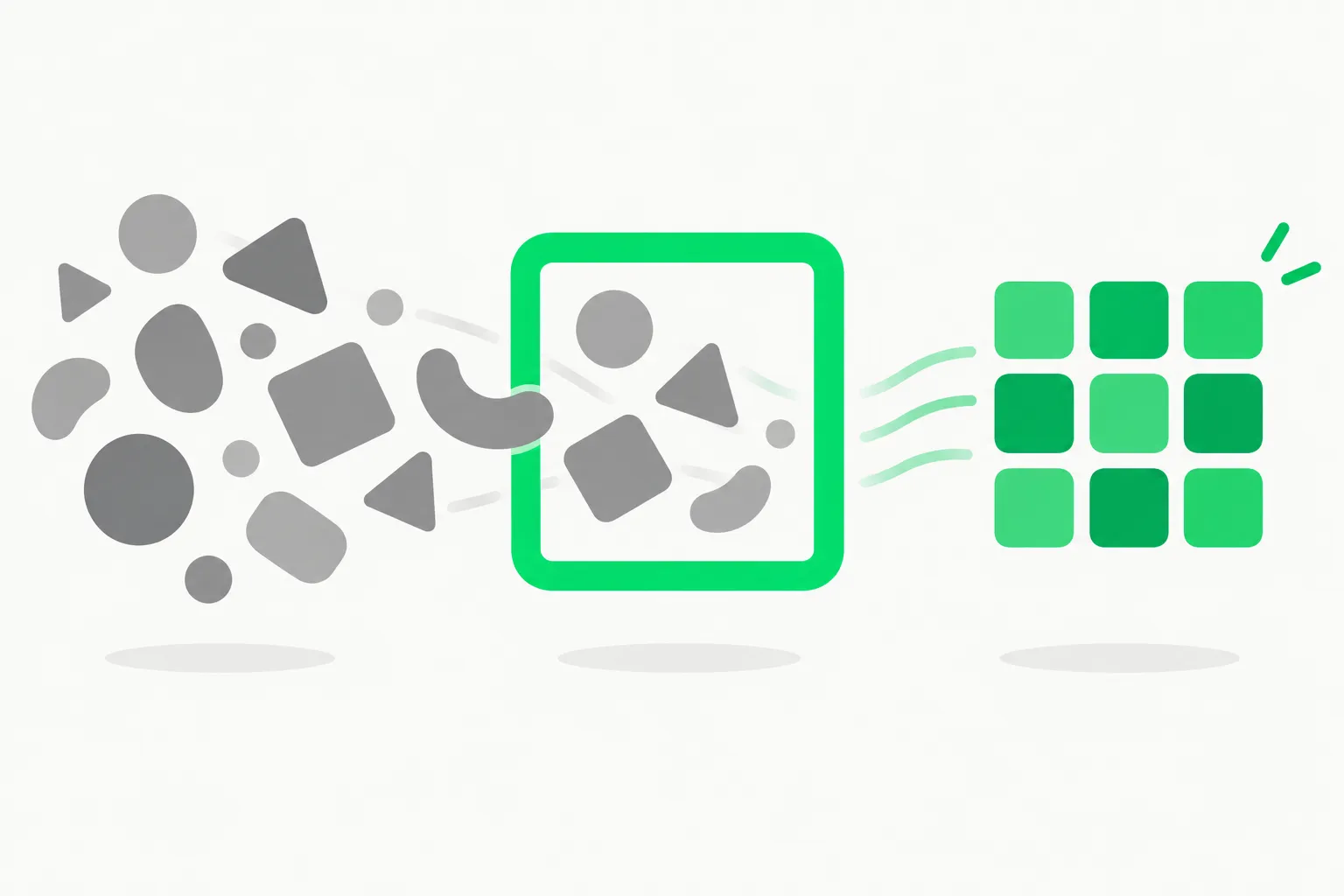 Gray shapes passing through a green frame and emerging as neat blocks, showing document to JSON field extraction
How was it trained?
The base is DharmaOCR-LITE v1.1, a 2B version of the lab's OCR model. Dharma-AI describes it as specialized through supervised fine-tuning and DPO. On top, the team trained a LoRA adapter on 43,384 examples covering both request modes.
The data has three streams, all annotated at field level:
- English multi-domain documents from the public web.
- Real Brazilian documents in Portuguese, sourced internally.
- A smaller multilingual share for other European and Asian languages.
Document types include receipts, commercial invoices, forms, bank statements, ID documents and synthetic documents. The lab's earlier OCR paper is on arXiv as 2604.14314, per the post's source list. Our earlier coverage of the lab's inference work is in the VocabX post on cutting inference cost 77%.
What does the benchmark measure?
The benchmark has 546 documents across three scenarios, for 1,638 cases:
- Extract every field with no schema.
- Fill a partial schema that names only real fields.
- Fill a schema that also includes deliberately nonexistent fields.
The score multiplies three things: field-level F1 matched by path (including table position), the Levenshtein similarity of matched values, and the share of outputs that are valid JSON. The sources include public sets such as CORD, DocVQA, WildReceipt, SROIE and FUNSD, plus Brazilian invoice and ID datasets. SROIE and FUNSD were held out of training.
Dharma-AI compared the model with four frontier configurations. It reports 0.834 for its model, 0.816 for Claude Opus 5 (the closest) and 0.741 for GPT-5.6 Luna (the widest gap, 9.3 points). The quality gap runs from 1.8 to 9.3 points.
What to keep in mind
- Dharma-AI wrote the benchmark and ran the rivals. The mix of documents, the scoring formula and the prompts all favor whoever designed them. The lab says SROIE and FUNSD were held out of training, but it does not say how it separated the other benchmark sources from its training data.
- The score formula is a composite. Multiplying F1, string similarity and valid-JSON rate rewards formatting discipline. A frontier model that writes extra prose around the JSON loses points even if its values are right.
- A 1.8-point gap is small. Against Claude Opus 5, 0.834 versus 0.816 may be within noise for a different document mix. The post does not give confidence intervals.
- Frontier models ran with reasoning set to low. The post says so. A higher effort setting could change the ranking, and might change the cost too.
What about the cost claim?
Dharma-AI says the model costs roughly 6 times less than GPT-5.6 Luna and roughly 147 times less than GPT-5.6 Sol. The two sides are priced differently. Frontier figures use measured average tokens per page, reasoning tokens included, against list prices. The Dharma figure is GPU time on a single L40S at 2.24 dollars per hour, because the model is self-hosted.
The post is candid that "this is not a sales price." Self-hosted cost depends on hardware, volume and latency targets. If your GPU sits idle most of the day, the real cost per page rises. If you run a steady batch, it falls. A fair comparison uses your own volume.
Small specialized models beating bigger ones on a narrow task is a pattern we have tracked, for example in Coinbase's fine-tuned Qwen3.5 9B fraud agent. The lesson there and here is the same: a well-bounded task with plenty of labeled data favors specialization, and a vendor write-up is a starting point, not proof.
Why this lab's thesis matters for builders
Dharma-AI's stated position, from its Hugging Face organization page and its OCR paper, is that specialized small models beat general frontier models on bounded tasks. The paper put an earlier 3B DharmaOCR-LITE above commercial APIs on Brazilian Portuguese, and the Field Extractor post says the gap held when newer models arrived.
For a team that processes the same kinds of forms every day, the implication is practical. If a task has a fixed schema, plenty of labeled examples and a high volume, a small tuned model can be cheaper, faster and easier to keep inside your own network. If your documents vary widely, or you need reasoning across many pages, a frontier model still has the edge. The honest approach is to measure both on your own sample and keep the frontier model as a fallback for pages where the small model returns null or invalid JSON.
How does it compare with other document models?
| Model or tool | What it does | Our coverage |
|---|---|---|
| Dharma Field Extractor | Document image to schema-shaped JSON, 2B | This post |
| LlamaIndex OCRIA 1.4B | Document parsing model | OCRIA post |
| MiniCPM-OCR 1.0 | Open document parsing with a quality judge | MiniCPM-OCR post |
| Baidu Unlimited-OCR 2 | Hundred-page parsing, MIT | Unlimited-OCR post |
| Interfaze 1 Lite | Deterministic OCR and extraction | Interfaze post |
Most of these focus on faithful text and layout. The Field Extractor targets the next step, mapping values to a schema. If you already parse with one of those tools, an extraction model sits after it, or replaces both for narrow forms.
How to test it on your own documents
- Build a gold set. Collect 100 to 200 of your real documents. Write the correct value for each field by hand.
- Fix a schema. Use your production key names and types. Include two or three fields that are absent from some documents.
- Run both sides. Send the same documents and schema to the extractor and to the frontier model you use now. Keep reasoning settings the same across runs.
- Score per field. Count exact matches, near matches and nulls. Track invalid JSON separately.
- Check the hard cases. Look at skewed scans, handwriting, stamps and multi-page tables.
- Price your volume. Compute GPU hours per thousand pages for your latency target, and compare with token spend.
- Review privacy. Self-hosting keeps documents in your environment. That is often the real reason to choose a small model, ahead of price.
What is still unknown
- Weights, license and availability. The post links a demo and a model page, but we did not confirm the license or whether weights are downloadable. Check the model card before planning a deployment.
- Latency. The post gives cost but not pages per second.
- Languages beyond English and Portuguese. The multilingual share is smaller, and no per-language scores appear in the text we read.
- Layout failure modes. The post shows two successes on held-out samples. It does not show failures.
Bottom line
The Dharma Field Extractor is a credible example of a small model aimed at one job: schema-shaped extraction from documents. The 0.834 score and the 6 to 147 times cost figure come from Dharma-AI's own benchmark and cost model. They are worth testing, not worth quoting as settled. Run your own gold set before you switch.
Details reflect Dharma-AI's November 4, 2026 Hugging Face post. Scores, prices and availability can change.