



Update — September 11, 2026: V4.1 Flash GA compresses global KV cache to 890 bytes/token (~75% less HBM than V4-Flash) — see DeepSeek V4.1 Flash KV cache HBM reduction. Earlier: V4.1 Flash beta.
The model isn't new — the ten days between its API debut and this weight release are the actual story. On September 1, 2026, DeepSeek pushed the full weights for DeepSeek-V4-Flash-Vision-Exp to Hugging Face under an MIT license — a 305B-parameter multimodal model that explainx.ai first covered when it went live on DeepSeek's API on August 21. What changed isn't the benchmark numbers or the model's capabilities. What changed is that anyone can now download it, run it on their own hardware, and fine-tune it — for free.
DeepSeek calls it its first native vision model, and it's the same one behind the headline that's been circulating since launch: DeepSeek's own reported benchmarks put it close to Anthropic's Opus 4.8 on multimodal agent tasks. That claim needs context this piece will get to — Opus 4.8 is not Anthropic's current model anymore, and Fable 5.1 and Mythos 5.1 launched the same week as this open-weight release.
TL;DR
| Question | Answer |
|---|---|
| What shipped on Sept 1? | Open weights for DeepSeek-V4-Flash-Vision-Exp on Hugging Face, MIT license |
| Is the model new? | No — it went live via DeepSeek's API on August 21, 2026. This is the same model, now downloadable |
| Parameter count | 305B total (Hugging Face model card), vs. 284B for the underlying V4-Flash MoE text backbone — the gap is the vision tower and aligner |
| Architecture | MoE with DFlash attention, Hyper-Connections, and DSpark speculative decoding; only a fraction of 305B activates per token |
| Vision-capable? | Yes — DeepSeek's first native vision model in the V4 line |
| Benchmark claim | Near-Opus-4.8 on multimodal agent tasks; beats Opus 4.8 on 3 of 11 published benchmarks, trails on the rest by 1–12 points |
| License | MIT — permissive, no copyleft, commercial use allowed |
| Hosted API pricing | Existing V4-Flash rates, images cost up to 384 tokens each, no vision surcharge |
What "open-sourcing" adds that the API launch didn't
DeepSeek's August 21 announcement made deepseek-v4-flash-vision-exp usable through Chat Completions, the Anthropic-compatible Messages API, and the OpenAI-compatible Responses API — but only as a hosted model behind DeepSeek's own endpoint. That's the same distribution model most frontier labs use: you get access to run inference, not the weights themselves.
Publishing the weights on Hugging Face under MIT — one of the most permissive licenses available, with no field-of-use restrictions, no usage-tier gating, and no copyleft obligation — changes what a team can do with it. You can now:
- Self-host it on your own GPUs instead of depending on DeepSeek's API uptime or pricing changes (the same pricing DeepSeek raised by 50–1,100% in August, a fact worth remembering before assuming hosted pricing stays where it is today).
- Fine-tune it on domain-specific visual tasks — document parsing, chart reading, screenshot-driven QA — without sending training data through a third-party API.
- Run it air-gapped, which matters for regulated industries where sending images to an external API is a non-starter regardless of price.
- Serve it through your own inference stack (vLLM, SGLang, or similar) at whatever cost structure your own hardware gives you, rather than DeepSeek's rate card.
None of that was possible with the API-only release. This is the pattern DeepSeek has followed with the rest of the V4 family too — see explainx.ai's coverage of V4 Pro's benchmarks and open weights and V4 Flash 0731's ARC-AGI numbers, both of which shipped as real downloadable weights rather than API-only previews.
305B parameters — where the number comes from
The Hugging Face model card lists 305B total parameters. DeepSeek's own description of the underlying V4-Flash MoE backbone puts that model at 284B total / roughly 13B active per forward pass. The 21B gap between 284B and 305B is the vision tower, image aligner, and auxiliary modules DeepSeek added on top of the existing text model — not a wholesale re-architecture.
The model card describes the build process directly: it "builds on the DeepSeek-V4-Flash architecture by incorporating visual modules and undergoing continued training to unlock visual understanding capabilities." That's consistent with what explainx.ai observed from DeepSeek's own benchmark split in August — text-agent scores barely moved versus plain V4-Flash-0731, while multimodal-agent scores jumped, which is exactly what you'd expect from bolting a vision path onto a frozen-ish text backbone and continuing training rather than retraining from scratch.
Because it's still MoE, the practical inference cost tracks closer to the ~13B active-parameter figure than the 305B total — the same efficiency story that made V4-Flash cheap to serve in the first place.
The benchmark numbers, again — and what changed since August
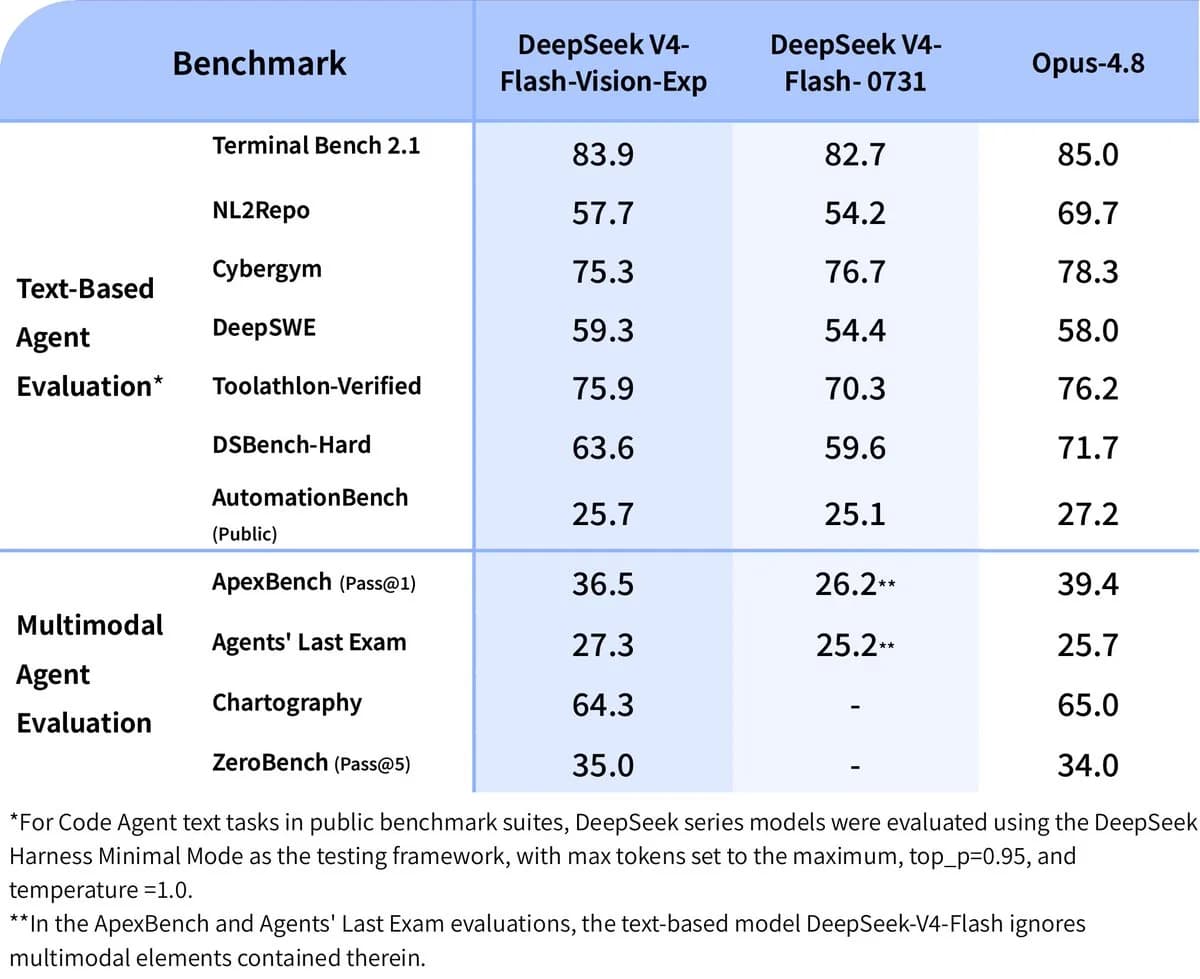
The numbers behind "near Opus 4.8" haven't moved since the API launch. DeepSeek split its evaluation into text-based agent tasks and multimodal-agent tasks:
Multimodal agent benchmarks (V4-Flash-Vision-Exp vs. Opus 4.8):
| Benchmark | V4-Flash-Vision-Exp | Opus 4.8 | Result |
|---|---|---|---|
| ApexBench (Pass@1) | 36.5 | 39.4 | DeepSeek trails by 2.9 |
| Agents' Last Exam | 27.3 | 25.7 | DeepSeek leads by 1.6 |
| Chartography | 64.3 | 65.0 | DeepSeek trails by 0.7 |
| ZeroBench (Pass@5) | 35.0 | 34.0 | DeepSeek leads by 1.0 |
On text-agent benchmarks, the gap is wider in places — NL2Repo shows DeepSeek at 57.7 against Opus 4.8's 69.7, a 12-point gap, while DeepSWE actually favors DeepSeek (59.3 vs. 58.0). Across the full set of benchmarks DeepSeek published, V4-Flash-Vision-Exp wins on roughly 3 of 11 and trails on the rest by 1 to 12 points. That's a real, credible result for an open-weight model — and also not the same thing as "matches Opus 4.8," which is the shorthand that's spread furthest since launch.
None of these numbers are independently verified yet — they come from DeepSeek's own benchmark harness (DeepSeek Harness, minimal mode, max reasoning tier), the same caveat that applied to V4 Flash 0731's DeepSeek-reported numbers before ARC Prize verified them separately. Self-reported multimodal-agent benchmarks with no third-party reproduction yet are worth treating the same way — promising, not settled.
Why "near Opus 4.8" reads differently in September than it did in August
This is the context that gets lost when a benchmark comparison travels through a few rounds of retweets and headline compression. Opus 4.8 is not Anthropic's current model. By the time this open-weight release landed on September 1, 2026:
- Opus 5 had already shipped as Anthropic's next flagship after Opus 4.8.
- Fable 5.1 and Mythos 5.1 launched the same week, on the same day this weight release happened — the same underlying model with different safety configurations, priced at $10/$50 per million input/output tokens with 75%-cheaper cache reads than the prior Fable generation.
- Anthropic's own API documentation now lists Opus 4.8 as a fallback target that Fable 5.1 routes to under certain refusal conditions — a role reserved for a still-capable but no-longer-frontier model, not the newest one.
None of that makes DeepSeek's result less real. Matching or beating a model that was frontier-class within the last several months, in an open-weight, MIT-licensed, self-hostable package, is a genuinely strong outcome for a model whose active parameter count is a fraction of what most closed frontier models run. But "near Opus 4.8" in September 2026 is closer to "near a very good model from a couple of generations back" than "near the frontier" — a distinction worth keeping straight before repeating the headline as evidence DeepSeek has closed the gap with Anthropic's current lineup.
The practitioner math: self-host vs. pay for hosted vision
For a team building an agent that needs to read screenshots, charts, or documents as part of a longer tool-use loop, the real decision isn't "DeepSeek vs. Opus" in the abstract — it's a cost-and-control tradeoff across three real paths:
| Path | Per-image cost | Control | Best for |
|---|---|---|---|
DeepSeek hosted API (deepseek-v4-flash-vision-exp) | Up to 384 tokens/image at existing V4-Flash rates, no vision surcharge | Low — dependent on DeepSeek's uptime and future pricing | Teams wanting the cheapest hosted option today, accepting API-provider risk |
| Self-hosted DeepSeek weights (this release) | GPU compute only, no per-token bill | High — full control, air-gap capable, fine-tunable | Teams with GPU capacity, regulated data, or high enough volume that hosting beats renting |
| Hosted GPT-4o-class / Claude / Gemini vision | Typically several dollars to tens of dollars per 1,000 images depending on provider and resolution | Low — closed weights, provider-set pricing | Teams prioritizing frontier-class accuracy over cost, or without GPU ops capacity |
The honest tradeoff: DeepSeek's benchmarks put it close to — not equal to — a model that's already a generation behind the current frontier. If your workload genuinely needs frontier-tier vision accuracy (fine detail, adversarial charts, ambiguous document layouts), a current hosted model likely still wins on raw capability. If your workload is high-volume, cost-sensitive, and tolerant of being a few points behind on the hardest cases — screenshot-reading agent steps, bulk document triage, chart-to-data extraction — the open weights remove both the per-token bill and the dependency on one vendor's API terms staying stable, which DeepSeek's own August price hike already demonstrated they won't necessarily do.
For teams evaluating whether self-hosting makes sense at all versus staying on a hosted provider, explainx.ai's broader closed-source vs. local open-source alternatives comparison and llama.cpp guide for running GGUF models locally cover the operational side of that decision — GPU memory budgeting, quantization tradeoffs, and serving stack choices — in more depth than this post's scope.
Limits carried over from the API release
The API-era constraints still apply to anyone deploying the open weights, since the model itself hasn't changed:
| Limit | Value |
|---|---|
| Supported image formats | JPEG, PNG, GIF, WebP |
| Max images per request | 600 |
| Max image dimension | 8,192 px/side; drops to 4,096 px/side at 15+ images per request |
| Per-image token cost (hosted API) | Capped at 384 tokens regardless of resolution |
| Where images are allowed | User messages only |
Self-hosting removes the request-size and per-image-token accounting DeepSeek's hosted API enforces, but a self-hosted deployment inherits the same underlying model behavior — including the "exp" designation. This is still an experimental release, not a production-hardened GA model; DeepSeek's own track record (V4-Flash went through a 0731 revision before V4 Pro's 0813 GA) suggests a more polished, non-experimental successor is likely to follow.
What this means for what you build or pay
If you already evaluated deepseek-v4-flash-vision-exp through DeepSeek's API in August and liked it, this release doesn't change your capabilities — it changes your exit options. You're no longer locked into DeepSeek's hosted pricing or uptime to keep using the model; you can move it to your own infrastructure whenever the economics favor it. For teams that hadn't evaluated it yet, the MIT license lowers the bar for a serious trial: no API key, no rate limits, no dependency on a vendor that just raised prices once this year already.
The bigger-picture read: open-weight vision-capable models are closing the multimodal-agent gap to frontier labs faster than most builders assumed a year ago — but "closing the gap to Opus 4.8" is a moving target, and Opus 4.8 moved out from under this headline before the weights even landed.
Related reading
- DeepSeek V4-Flash-Vision-Exp: A Multimodal Model That Nears Opus-4.8
- DeepSeek V4-Pro: Agent Coding Benchmarks, 1M Context, and API Economics
- DeepSeek V4 Flash 0731 Scores 89% on ARC-AGI at $0.02/Task
- DeepSeek V4 Pro Launch: Codex, Responses API, and New Pricing
- DeepSeek V4 Prices Just Went Up — Does It Really Match GPT-5.6?
- Claude Fable 5.1 and Mythos 5.1: Benchmarks, Pricing, and Safeguards
- Roboflow Benchmark: GPT-5.6 Sol vs. Gemini 3.5 Flash Vision
- Closed-Source AI vs. Local Open-Source Alternatives
- Official: DeepSeek-V4-Flash-Vision-Exp on Hugging Face · DeepSeek Vision API Guide
Model specs, license terms, and benchmark figures are accurate as of the publication date and sourced from DeepSeek's Hugging Face model card and API documentation — verify current figures before making production decisions, since DeepSeek has iterated on this model family quickly all year.