



Cloudflare shipped Search for Agents on November 25, 2026: one dashboard toggle provisions an AI Search instance for your zone, indexes your pages, and publishes a search API on your own domain. The design extends the same idea as Markdown for Agents—make machine clients cheap to serve—but adds discoverability and retrieval so coding agents stop brute-force crawling long doc trees.
TL;DR
| Question | Answer |
|---|---|
| What changed November 25? | New Search for Agents Quick Action auto-creates AI Search + crawl + /.well-known/search |
| Who can turn it on? | All Cloudflare customers, including Free, within AI Search quotas |
| How do agents find it? | agent:endpoint / agent:instructions meta tags on every HTML page (or Markdown front matter) |
| What comes back? | Markdown chunks, not a generated chat reply |
| New HTTP method? | Native support for QUERY (RFC 10008) with text or JSON body |
| Pairs with what? | Markdown for Agents, Agent Readiness checklist, existing AI Search pricing |
Why Cloudflare added a toggle
Until today, wiring site search for agents meant manually creating an AI Search project, pointing crawlers at your sitemap, exposing an API, and hoping harnesses guessed the URL. Cloudflare's post contrasts that with Markdown for Agents, where content negotiation already strips HTML to text at the edge. Search for Agents closes the loop: index once, advertise everywhere, query under your hostname.
That matters for teams building on MCP hosts or coding harnesses. A Claudian session that would otherwise fetch dozens of /docs/** pages can issue one search call—if your zone publishes the endpoint and your WAF allows the agent's client fingerprint.
How to enable Search for Agents
Cloudflare documents two paths:
- Dashboard — open your zone, Quick Actions, enable Search for Agents.
- API — same setting for automation-first teams (details in developer docs).
Once enabled, Cloudflare creates an AI Search instance, starts crawling the zone, and links the instance from the Quick Actions panel so operators can tune reranking, caching, or other AI Search options later.
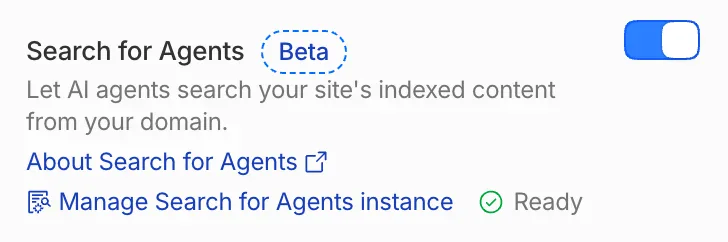 Cloudflare Search for Agents dashboard quick action toggle enabling zone-wide agent search
Image: Cloudflare
Pricing follows existing AI Search meters: ingestion, stored index bytes, and query volume count against Workers Free and Paid included usage, then bill at published AI Search rates. Cloudflare does not describe Search for Agents as a separate SKU in the November 25 post—it is packaging on top of AI Search.
Discoverability: meta tags agents can read
Search is useless if the harness never learns the URL. Cloudflare injects machine-readable instructions on each HTML response:
<meta name="agent:instructions" content="Use this search API to find relevant content across this site...">
<meta name="agent:endpoint" content="https://developers.cloudflare.com/.well-known/search?q={query}">
<meta name="agent:method" content="GET">
<meta name="agent:documentation" content="https://developers.cloudflare.com/ai-search/how-to/search-for-agents/">
When Markdown for Agents is on, an Accept: text/markdown request receives equivalent agent: fields in YAML front matter instead of <meta> tags—useful for clients that already negotiate Markdown per our content negotiation guide.
Practical takeaway: after you flip the toggle, spot-check one production URL with and without Accept: text/markdown to confirm tags appear through your caching rules. Stale HTML at the edge would delay discoverability even though the index is warm.
Querying: GET, QUERY, and Markdown hits
GET with query string
Cloudflare's example:
curl "https://developers.cloudflare.com/.well-known/search?q=cloudflare+artifacts"
The response is a ranked list of Markdown documents with scores, not a chat completion. That matches how many teams want RAG: return citable chunks and let the agent model synthesize.
Natural-language questions work the same way when reranking is enabled:
curl --get "https://developers.cloudflare.com/.well-known/search" --data-urlencode "q=What is the maximum push size for Cloudflare Artifacts?"
QUERY method (RFC 10008)
Cloudflare also supports the QUERY verb co-authored by Cloudflare engineer James Snell:
curl -X QUERY 'https://developers.cloudflare.com/.well-known/search' \
  --data 'What is the maximum payload size per ingestion request in Basin Pipelines?'
JSON bodies work when you set Content-Type: application/json with a {"q":"..."} object. QUERY is designed for idempotent search with a body, avoiding awkward GET length limits—relevant for agent frameworks that already speak modern HTTP clients.
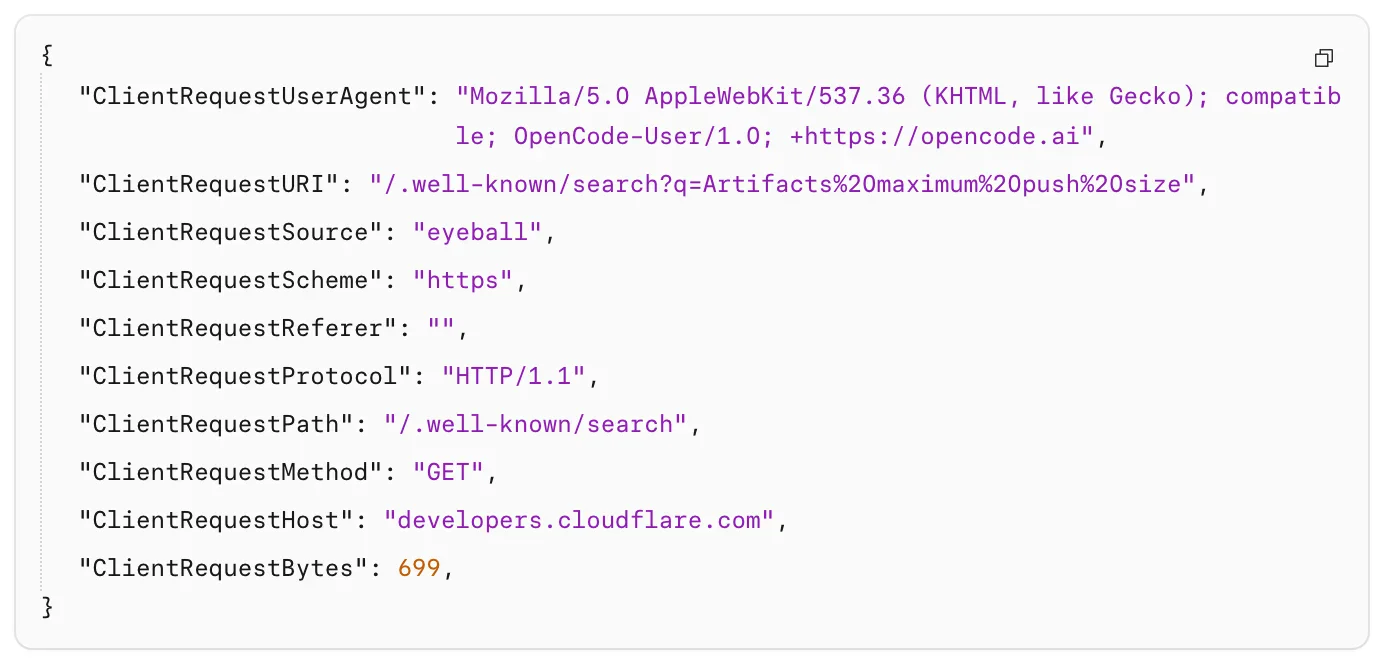 Search for Agents HTTP request log showing agent discovering search API
Image: Cloudflare
What developers saw in OpenCode
Cloudflare enabled Search for Agents on its own developer documentation before launch. In an OpenCode session asking about maximum push size for Cloudflare Artifacts, logs show the agent:
- Reading
agent:endpointfrom the homepage. - Calling
/.well-known/searchwith the question. - Answering from returned Markdown within seconds.
Cloudflare reports agents reuse the endpoint repeatedly in one session instead of re-crawling the site map—a pattern that shows up in their traffic charts for developer docs. That is the operational proof point: discover once, query many.
For builders comparing harnesses, the flow is similar in spirit to wiring Exa or Linkup through AI Gateway, but scoped to your origin and without per-query partner billing beyond AI Search itself.
Still a full AI Search instance
Behind the toggle sits a normal AI Search project in your account. Cloudflare lists capabilities unchanged:
| Capability | Agent impact | Human impact |
|---|---|---|
| Reranking / cache knobs | Better relevance for NL questions | Same index serves both |
| Public REST or MCP | Expose search to non-HTTP agents | Optional |
| Workers binding | Call from edge code | Pair with Agents SDK patterns |
| AI Search embed snippet | N/A | Human search box on marketing pages |
That means Search for Agents is an on-ramp, not a walled garden. Teams that later need cross-site retrieval still use Web Search API or self-hosted Firecrawl pipelines.
Security, bots, and Agent Readiness
Cloudflare explicitly warns that discoverability ≠ authorization. Requests still pass:
- Bot Fight Mode and AI Crawl Control
- WAF custom rules
- Rate limits you configure at the zone
Pair the launch with Cloudflare's Agent Readiness checklist (authentication hints, payment rails, content policies). explainx.ai covered AI traffic overtaking humans and prompt injection on crawled pages; searchable Markdown reduces crawl volume but does not sanitize untrusted HTML you indexed yesterday.
For security reviewers: treat /.well-known/search like any other authenticated API—log queries, alert on exfil patterns, and segment draft content from production crawls if your CMS mixes previews into the same hostname.
How this fits the agent-readable web stack
Think of three Cloudflare layers readers already mix:
- Markdown for Agents — cheap per-page text.
- AI Search indexing — semantic retrieval over the corpus.
- Search for Agents — discovery + hosted endpoint on your domain.
Together they push sites toward the llms.txt vision—machines learn where to look—without each company hand-writing llms-full.txt for every release.
| Pattern | Best for | Weak when |
|---|---|---|
| Full-site crawl by agent | Tiny marketing sites | 5,000-page doc portals |
| Markdown negotiation only | Token-starved readers | Need ranked multi-doc answers |
| Search for Agents | Owned documentation with frequent updates | Paywalled or per-user content |
| Web Search API | Live internet facts | Proprietary knowledge bases |
What to do Monday morning
- Enable on a staging zone first — confirm crawl scope, exclude
/adminpaths, and watch AI Search ingestion costs. - Run one harness test — ask a coding agent a question only answered deep in docs; verify it picks
agent:endpointwithout custom prompts. - Align with Bot Fight Mode — allowlist trusted agent subnets if you operate corporate harnesses.
- Document internally — link engineers to Cloudflare's AI Search limits page; Free tiers still cap queries.
- Back-link from your status page if you rely on search during incidents (same discipline as nginx patch posts for ops visibility).
Pricing and quota questions operators ask
Cloudflare does not publish a separate price list for Search for Agents beyond AI Search. Operators still ask the same questions we see on AI Gateway credit threads:
| Operator question | What to verify in dashboard |
|---|---|
| Will Free tier index my whole blog? | Crawl limits and storage caps on Workers Free AI Search |
| Do failed queries bill? | AI Search query metering; check docs for error handling |
| Can I cap spend? | Workers Paid budgets and AI Search alerts |
| Does reranking cost extra? | Instance settings after the toggle creates the project |
Treat the toggle like turning on a new data pipeline: ingestion runs once, then every agent hit is a query line item. Teams that already serve Markdown for Agents should expect more agent traffic on fewer bytes, but not zero marginal cost.
Enterprise buyers comparing hyperscaler stacks should note this lands the same week as Google-managed Gemini sandboxes and Amazon Bedrock agent evaluation playbooks. Cloudflare's bet is edge-hosted discoverability for sites you already proxy—not training a frontier model.
If your docs team already maintains structured URLs and sitemaps, the toggle is mostly operational glue. You still own information architecture, redirect chains, and which hosts belong in the crawl allowlist. Search for Agents does not replace a content audit; it surfaces whatever you already publish to the edge.
Limits Cloudflare does not solve
- Paywalled or personalized content still should not land in a global index without access controls.
- Non-HTML assets (PDFs, binaries) need explicit AI Search source rules—same as before the toggle.
- Answer quality depends on crawl freshness; agents may read stale limits tables if you ship pricing changes without reindex latency in mind.
- Competitor harnesses outside Cloudflare's ecosystem must implement QUERY support themselves; curl works, but not every SDK yet.
Related on explainx.ai
- Markdown for Agents content negotiation guide
- Cloudflare Web Search API through AI Gateway
- Cloudflare AI traffic and agent training policy
- MCP protocol explainer
- Firecrawl scraping for agent RAG
- NCSC guidance on agentic offensive tooling
Release details reflect Cloudflare's November 25, 2026 blog post and developer documentation as accessed the same day.