



Scientists use Claude most for analyzing data and writing papers, and least for the two things they say matter most: coming up with ideas and gathering data. That is the central finding of a report Anthropic published on November 5, 2026, based on 207,049 research sessions across Claude, Claude Code and Claude Science.
The report matters because it is one of the first large looks at what researchers actually ask an AI model to do, not what surveys say they do. It also tests a simple idea: do scientists use AI where it works best? Anthropic's answer is yes, with caveats we cover below.
TL;DR: what the report found
| Question | Answer from the report |
|---|---|
| How big is the sample? | 207,049 sessions on consumer plans, August 2 to September 30, 2026 |
| Which products? | Claude and Cowork (128,914 sessions), Claude Code (78,135), plus a Claude Science sample |
| Top task? | Data analysis: 33.7% of Claude sessions, 48.1% of Claude Code sessions |
| Second task? | Writing and communication: 32.0% on Claude, 17.6% on Claude Code |
| Biggest gap? | Ideation is 4.2% of Claude sessions against 7.1% of researcher time |
| Which fields lean in? | Computer science, mathematics, statistics, economics |
| Which lag? | Health, medicine, lab-based physical sciences |
| Speed-up scenario? | Up to about 2x in some fields with current AI; up to 15x in a full-automation hypothetical |
How did Anthropic measure this without reading private research?
Anthropic uses a language model as a classifier. It reads each session and assigns a label from a fixed taxonomy called SciNet. The labels, such as "chemistry" or "data cleaning," are the only information the research team keeps.
SciNet has 7,262 tasks across 34 fields and 318 subfields. A first classifier decides whether a session is scientific work. A second assigns field, subfield and task.
Anthropic says the classifiers do not extract open-ended details such as datasets, hypotheses, methods or unpublished findings. Results are reported only in aggregate and only for cells with a minimum number of distinct accounts. The sample covers consumer plans only.
This is the same privacy-preserving approach behind earlier work such as the Economic Index report. The new report cites that earlier framework for its measures of task length, skill level and autonomy.
Which fields use Claude the most?
Fields with more researchers tend to produce more sessions. The log-log correlation is 0.79 on Claude and 0.62 on Claude Code. But the size of a field does not explain everything.
On Claude, the largest fields by session share are computer science (11.9%), engineering (8.4%) and medicine (7.7%). Relative to headcount, the formal sciences stand out. So do the social sciences. Chemistry and medicine sit below the line, because so much of that work happens at a bench or with patients.
Claude Code is more concentrated. Computer science is only 4.3% of the world's researchers but 32.7% of Claude Code sessions. Among subfields, artificial intelligence and machine learning make up 5.0% of Claude sessions and 15.2% of Claude Code sessions, from just 1.2% of researchers. Computational biology, computational linguistics and computational neuroscience also show strong adoption. Economics is the one social science that heavily uses Claude Code, as a comparatively quantitative field.
If you code with agents, the pattern will look familiar. Our Claude Code commands reference covers the tool that now sits inside many research workflows.
What tasks do scientists hand to Claude?
The report groups work into eight categories and compares each category's share of sessions with its share of researcher time, estimated from SciNet.
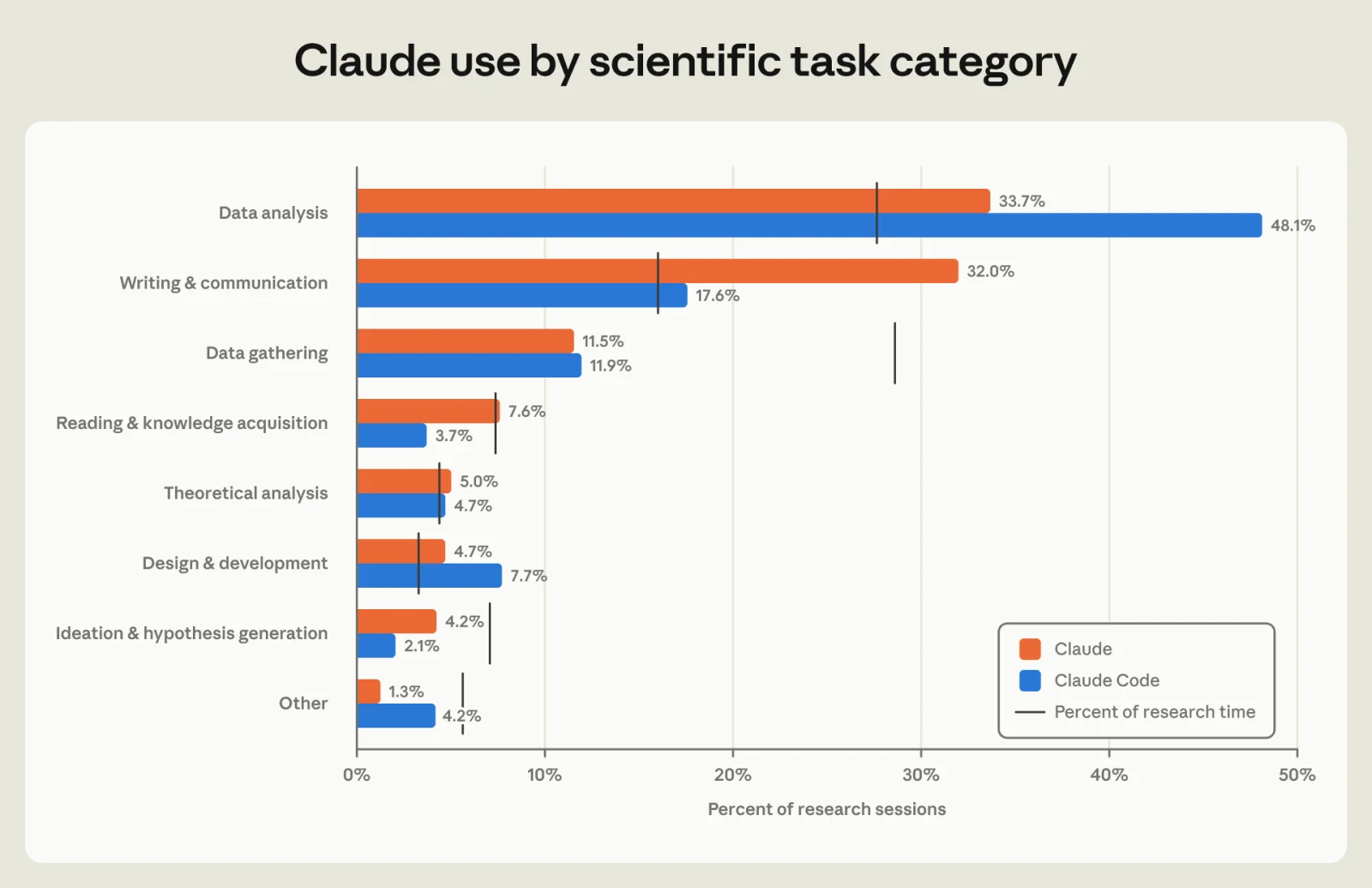 Claude scientists usage by research task category: data analysis and writing dominate while data gathering and ideation lag
Image: Anthropic
| Task category | Claude share of sessions | Claude Code share | Share of researcher time |
|---|---|---|---|
| Data analysis | 33.7% | 48.1% | 27.6% |
| Writing and communication | 32.0% | 17.6% | 16.0% |
| Data gathering | 11.5% | 11.9% | 28.6% |
| Ideation and hypothesis generation | 4.2% | 2.1% | 7.1% |
At the level of single tasks, drafting manuscripts is the most frequent on both products: 18.6% of Claude sessions and 11.1% of Claude Code sessions. On Claude, the next most common are reviewing and synthesizing literature (6.8%) and responding to peer reviewer comments (6.7%). On Claude Code, they are designing and building artifacts (4.8%) and visualizing data (4.6%).
Data gathering is underused mostly where it is physical, such as collecting clinical or biochemical data. Digital collection, such as pulling archival text or online data, can even be overrepresented.
Do scientists want AI for the work that matters most?
Not yet. Anthropic also surveyed 528 scientists, mostly in life and health sciences. Their self-reported AI use matches the session data: heavy for analysis and writing, lighter for ideation and data gathering.
When asked which category matters most for producing an important result, respondents ranked ideation first and data gathering second. Those are the two categories where AI use is lowest. The mean importance score for ideation was 35.6 points out of 100.
Anthropic offers several explanations. Much of data gathering is physical. For ideation, scientists may prefer to think for themselves, or may believe AI is weaker there. The report also warns that ideation is woven into many other tasks and is hard to classify, so it may be undercounted.
One caveat is important. Survey respondents were recruited from applicants to Anthropic's AI for Science and related grant programs, in the US and Canada. The report itself says they are likely heavier AI users than the typical scientist.
What changes with Claude Science?
Claude Science is the specialized product that connects Claude to research tools and databases. Anthropic examined biology and biomedical sessions to compare it with general Claude and Claude Code.
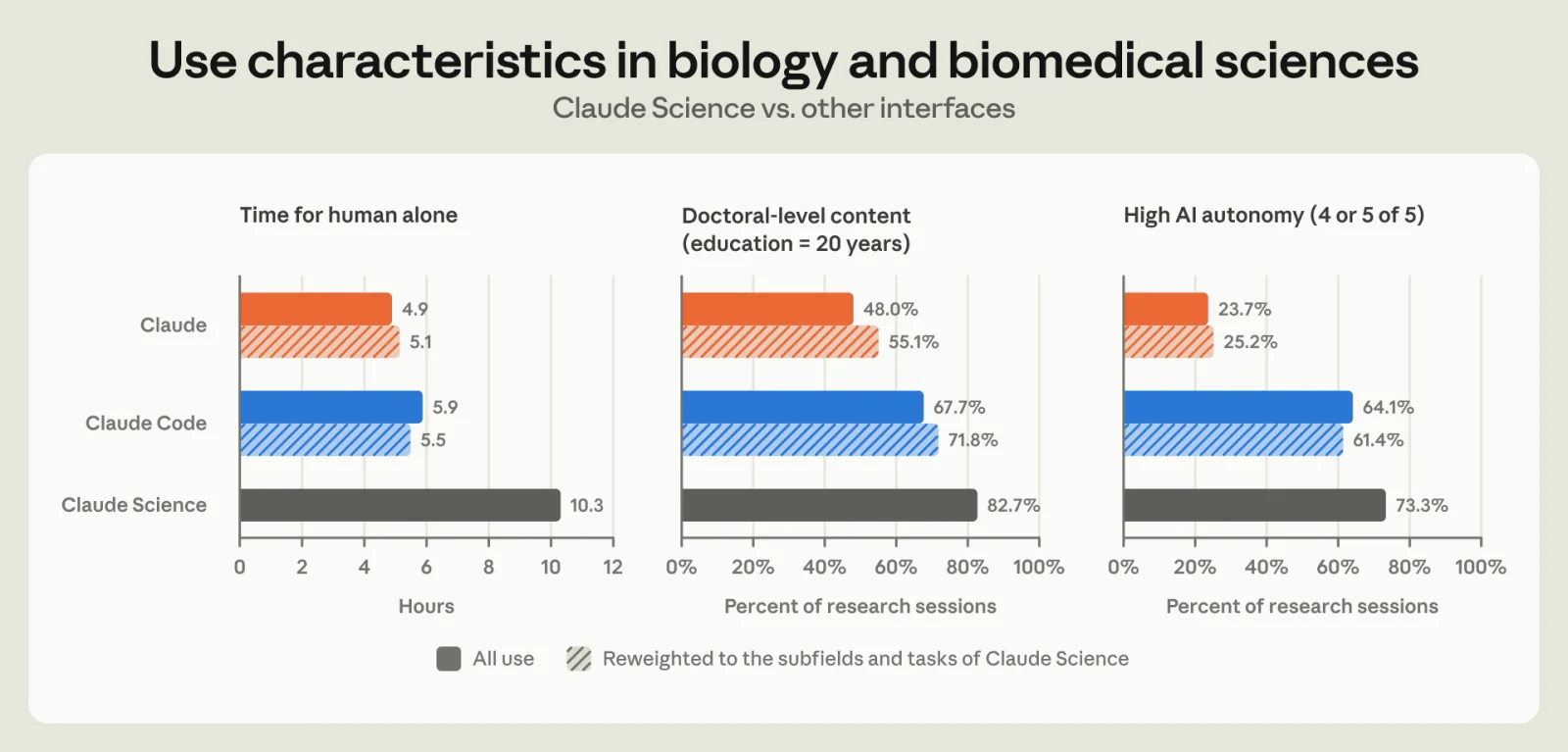 Claude Science sessions in biology compared with Claude and Claude Code on task time, doctoral-level content and autonomy
Image: Anthropic
The findings are striking:
- Biomedical sciences and biology make up over 50% of Claude Science sessions.
- Ideation and hypothesis generation is about 8% of sessions, roughly equal to its share of researcher time. That is about twice its share on Claude.
- A task such as proposing mechanistic models of protein-protein or protein-ligand interaction is 5.6x more likely on Claude Science than on Claude.
- Sessions represent about 10.3 human hours of work, against 4.9 on Claude and 5.9 on Claude Code.
- Over 80% of use is estimated to need doctoral-level training, against roughly 50 to 70% elsewhere.
- Over 70% of sessions run with a high degree of AI autonomy, against 23.7% on Claude and 64.1% on Claude Code.
Anthropic adds a caution: any paid user can access Claude Science, but adopters probably have more demanding use cases. So the differences describe patterns of use, not proof that the product causes harder work.
For concrete examples of that deeper work, see our coverage of Claude solving the first prokaryotic vault structure, Claude finding a novel enzyme system and the multi-agent virus research.
Does usage really track what AI can do?
Anthropic built a measure of "theoretical AI capability". For each task, SciNet lists the steps a scientist performs. A classifier compares pairs of steps and picks which one AI does better. A Bradley-Terry model, the same family of model behind Elo chess ratings, turns those comparisons into a score.
The result: usage rises sharply with the score. Tasks in the lowest 20%, such as purifying reaction mixtures or participant observation, get very little use. Tasks in the top 20%, such as visualizing data and applying statistical tests, get about twice the expected use on Claude and about four times on Claude Code.
Other correlations with capability score:
| Task characteristic | Correlation with AI capability |
|---|---|
| Suitability for reinforcement learning | +0.78 |
| Cognitive work | +0.69 |
| Physical work | -0.57 |
| Regulatory restriction | -0.38 |
| Interpersonal work | -0.31 |
The reinforcement learning link is the most interesting. Tasks where success is easy to verify, examples can be simulated and feedback is fast are where AI is strongest, and where scientists use it most. Health sciences use Claude less than their capability scores predict, which Anthropic suggests may reflect rules on medical data and the difficulty of integrating AI.
Note the limit here: these capability scores come from an LLM classifier, not from lab tests of what Claude can do. It is a model of capability, judged by a model.
How much faster could research get?
Anthropic describes three scenarios. The first assumes wide adoption of current capabilities. The second and third assume AI automates 75% or 100% of non-physical research steps. In every scenario researchers still do the physical steps.
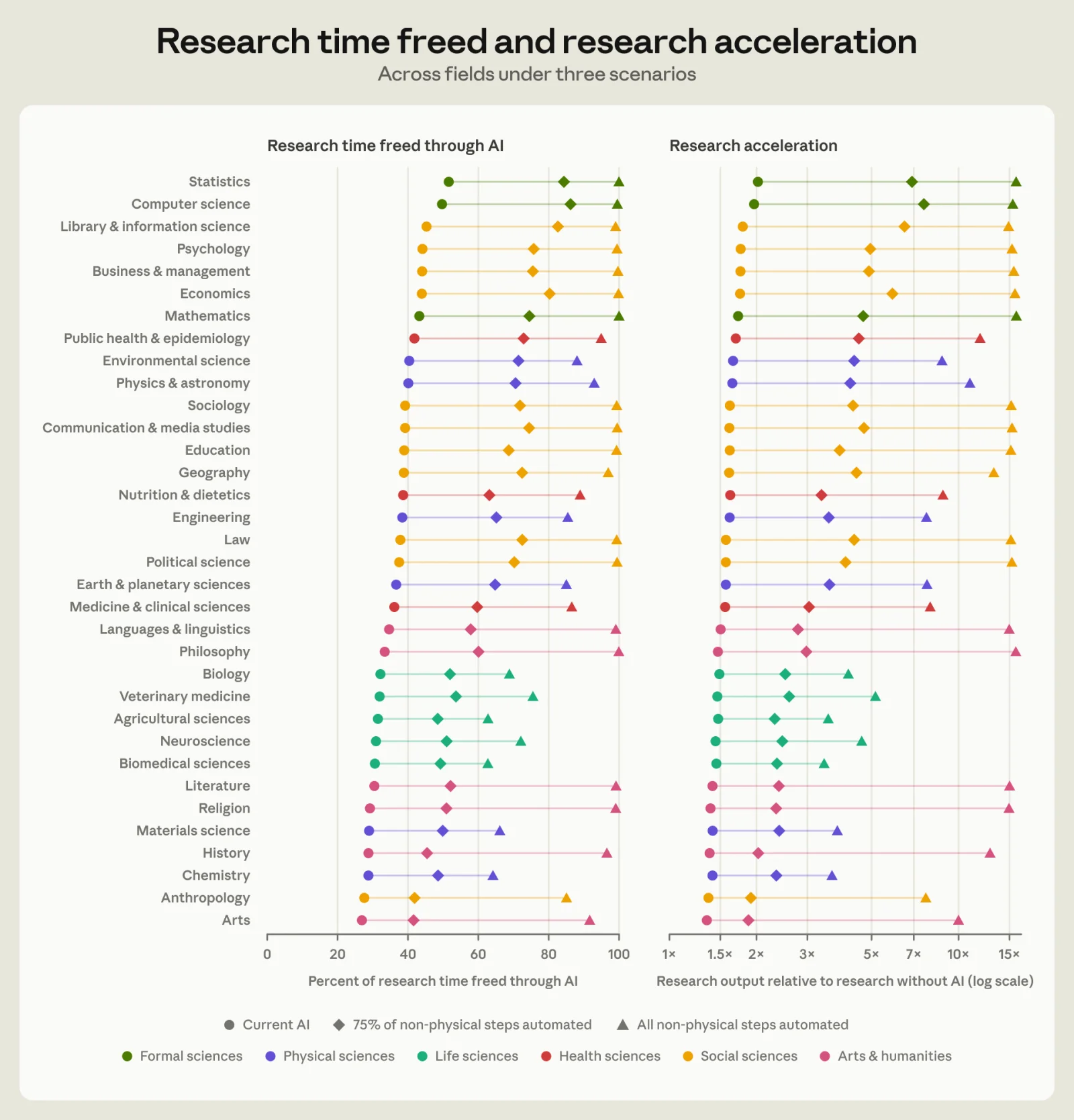 How scientists use Claude: research acceleration scenarios by field, from 2x with current AI to 15x if non-physical work is automated
Image: Anthropic
- Current AI: output could roughly double in some fields, mainly through task-level help. The figure reads about 1.35x to 2x across fields.
- Full non-physical automation: fields such as computer science and statistics could reach as much as 15x.
- Bench sciences: chemistry and biology rise only three- or fourfold, held back by physical bottlenecks.
Anthropic is explicit that these are "illustrative scenarios, not forecasts." It also notes a feedback loop: the fields with the most potential, such as computer science and machine learning, are the ones that build AI. Faster AI research could produce more capable AI, which could speed research further.
In the survey, about 40% of active AI-using researchers expect AI models to carry out full research projects on their own by 2030. Anthropic's chart also shows 16% answering "never" for the full research cycle with no human involved.
What are the risks the report names?
The authors write that faster discovery brings benefits but also risks. Less human oversight could allow dangerous or unethical research to be pursued. AI could reshape researchers' careers and their sense of purpose. The report does not claim to settle either point.
What should researchers and builders take from this?
- Expect the biggest gains in computational work. If your research is mostly data, code and text, the report suggests you already use AI where it is strongest.
- Do not mistake usage for value. Heavy use of AI for writing says what is easy to delegate. It does not show that papers improved.
- Ideation is the open frontier. Specialized tools nearly doubled the share of ideation sessions. That is where product builders have room.
- Physical bottlenecks stay. Lab automation and robotics, not better chat, decide the speed of bench science.
- Treat the source with care. Anthropic studied its own product users on consumer plans. Enterprise, API and rival-tool users are outside the sample.
If you work with AI agents on research data, the safety angle also matters: autonomy was high in Claude Science sessions. AgentBeam is the agent security platform from the explainx.ai team for stopping agents before they take dangerous actions.
For how the same company tracks work use more broadly, read the Economic Index and our summary of the Team plan for scientists. For non-science uses of Claude's agentic mode, see top Claude Cowork use cases.
What this report does not tell us
- It measures sessions, not outcomes. No discoveries are counted.
- It excludes teaching, peer review of others' papers and administration by design.
- Subfield shares for low-volume subfields are noisier, which Anthropic flags.
- Session counts are not weighted by time or importance.
- The study period is two months, August 2 to September 30, 2026.
Related reading
- Claude Science: the AI workbench for scientists
- Claude Team plan for scientists
- Anthropic Economic Index: Cadences
- Claude and the first prokaryotic vault structure
- Claude discovers a novel enzyme system
- Multi-agent research on viruses
- AI drug discovery: clinical evidence
- Official report: How scientists use Claude
Figures and details are accurate as of November 5, 2026, from Anthropic's published report. Numbers may change if Anthropic revises the report.