



Anthropic says Claude helped its biology team solve the first 3D structure of a vault particle from a prokaryote. The company published the work on November 4, 2026 in a research post. The vault comes from a bacteriophage, a virus that infects bacteria. It is built from 96 copies of a single protein. Anthropic's headline numbers are a purification that dropped from about three days to about 90 minutes, and a first structural model ready 34 hours after processing began.
The function of vaults is still unknown. This work does not solve that. It gives researchers a simpler, faster system to study, and it is a detailed look at how Anthropic now uses Claude inside a wet-lab project. This post covers what was done, what Anthropic admits went wrong, what is still unverified, and why it matters for anyone following AI for science.
TL;DR: the questions readers ask first
| Question | Short answer |
|---|---|
| What is new? | The first 3D structure of a vault particle from a prokaryotic (phage-derived) source |
| Who did it? | Anthropic's life sciences team, with Claude, advised by vault co-discoverer Dr. Leonard Rome |
| How big is the particle? | 96 copies of protein L05, about 9.5 megadaltons, roughly 54 nm long and 45 nm wide |
| How fast was it? | Purification in about 90 minutes instead of days; first model in 34 hours |
| What is still unknown? | What vaults do, and whether they form in the phages and bacteria where they naturally occur |
| Is the data public? | A preprint is submitted to bioRxiv; structures and data are promised "soon" |
What is a vault particle?
A vault is a large, hollow shell made of protein. Vaults sit in nearly all cells of the human body. Leonard Rome and Nancy Kedersha discovered them in 1986. Under an electron microscope the ribbed shell reminded them of a cathedral's vaulted ceiling, which gave the particle its name. In mammals the shell has 78 copies of the major vault protein, arranged as two identical halves joined in the middle. Its mass is about three times that of a ribosome.
Vaults appear across most of the eukaryotic tree, from slime molds to humans. That suggests they do something useful. Researchers have proposed roles in moving molecules between the nucleus and the cytoplasm, protecting cells from toxic compounds such as cancer drugs, and supporting innate immunity. None of these proposals has been confirmed. Mice bred without vault proteins develop normally, so there is no obvious defect to follow up. Vaults are also missing from the lab organisms biologists use most, such as baker's yeast, fruit flies and nematode worms.
Anthropic frames the open question simply: why would evolution keep something this large if it had no important job? Its team chose prokaryotes because bacteria grow quickly and are simpler to study than mammalian cells. Bacterial relatives of human proteins have helped before. Versions of cGAS-STING signaling, gasdermins and viperins in bacteria revealed the microbial origins of human immune defenses.
How Claude was used, step by step
Anthropic describes three stages. At each one it says Claude did real work, and it also describes where the model needed correction.
Step 1: search 15 billion proteins
The team used Claude Science to search for relatives of the vault protein across a database of about 15 billion predicted proteins. The relatives turned out to be rare but widely spread. They appear in 29 major bacterial groups (phyla) and four archaeal groups, yet in fewer than 1% of species with a sequenced genome. Related proteins had been spotted in genomes before, but to Anthropic's knowledge nobody had shown that they assemble into vaults.
The team picked 44 candidates and tested each in a cell-free system to see which genes made full-length protein. Claude turned each protein sequence into DNA tailored to the host cell, added the control sequences that switch a gene on, and prepared the designs for ordering. The best performers moved into living E. coli, where 15 of 24 produced soluble protein.
Step 2: a faster way to isolate the particles
The standard method for eukaryotic vaults spins a sample through a tube of increasingly dense sugar and takes about three days. The team wanted to try size-exclusion chromatography instead. In that method a sample flows through a column of porous beads. Small molecules get stuck in the pores, while huge particles such as vaults come out first.
Anthropic says Claude first argued against the idea, because clumps of misfolded protein also come out in that first fraction. The team went ahead anyway, and Claude then helped make it work. It recommended a specific column and ways to track the vault protein and check that particles had formed. It also proposed loading the contents of ruptured cells straight onto the column with no purification beforehand. The scientists were reluctant, because the columns are expensive and raw E. coli lysate can clog or contaminate them. It worked. The optimized method takes about 90 minutes from cells to microscopy grid. Anthropic notes it is not the first group to isolate vaults on sizing columns.
Under the microscope, seven of the 15 proteins had assembled into vault-like particles. Cryo-EM confirmed the vault shape for four of those seven: two from phages and two from bacteria.
Step 3: map the structure with cryo-EM
Cryo-electron microscopy flash-freezes many copies of a particle, images them with an electron beam and combines the images into one 3D model. The team chose one phage protein, L05, because it formed complete, closed particles well. Working in an internal multi-agent harness with access to internal compute, Claude set up the open-source RELION processing software and ran each step, while the scientists advised on analysis decisions. A first full model was ready in 34 hours. The final maps were ready about a week after processing began. Anthropic estimates that the first model would normally have taken weeks.
What the structure shows
The L05 vault has 96 protein copies, 48 per half, with a combined mass of about 9.5 megadaltons. The mammalian version has 39 copies per half. The phage vault is shorter and wider, roughly 54 nanometers long and 45 wide, compared with 67 by 40 in mammals. Because it is rounder, it encloses about 25% more volume. Its wall protein is built from seven repeating segments, not the nine in mammalian vaults, and its end caps are flatter. Anthropic says it is among the largest protein shells identified in prokaryotes.
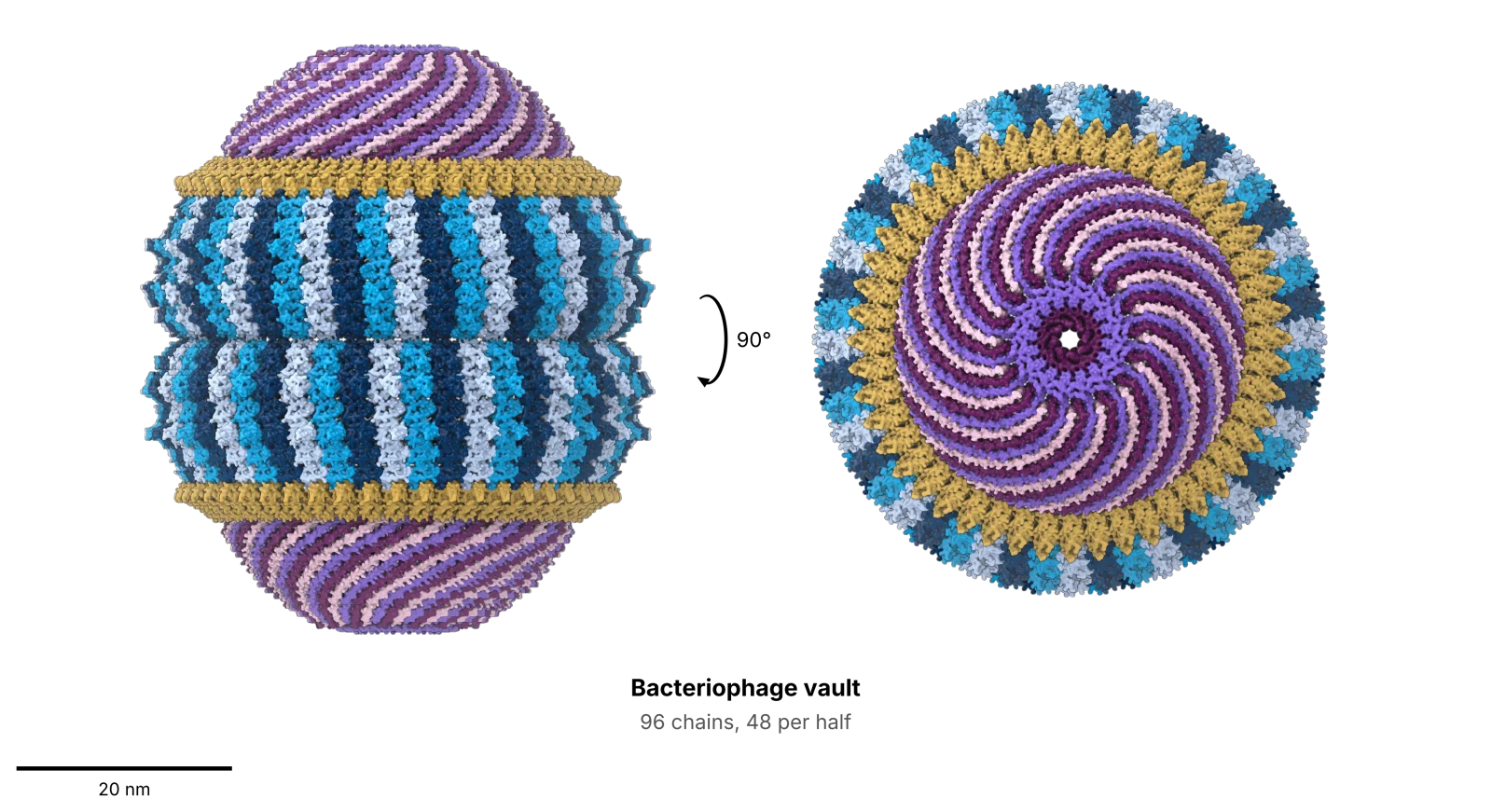 Anthropic vault particle cryo-EM structure of the L05 vault and its cap
Image: Anthropic
The caps close in three steps, like a tiered dome. In every group of three neighboring copies, one chain ends at the first step, one at the second, and one continues to the tip. The three copies are identical along the wall but take different shapes in the cap.
Engineering a bigger vault
The team made 15 altered versions of the protein, most with changes where neighboring copies touch. Some single changes near the cap stopped the shell from closing. Instead of sealed vaults, they saw open, rosette-like particles. That shows the region is needed to seal the shell.
They also tried making the vault larger. They copied two of the seven wall segments, giving nine, the same number as in the human vault. The protein still assembled, into larger particles that enclosed about 20% more volume. Anthropic says this shows how vaults could have changed size during evolution by duplicating pieces of their own wall without breaking assembly. It also suggests how vaults could be adapted for biotechnology, for example as nanocapsules that deliver enzymes. That is a suggestion, not a demonstrated product.
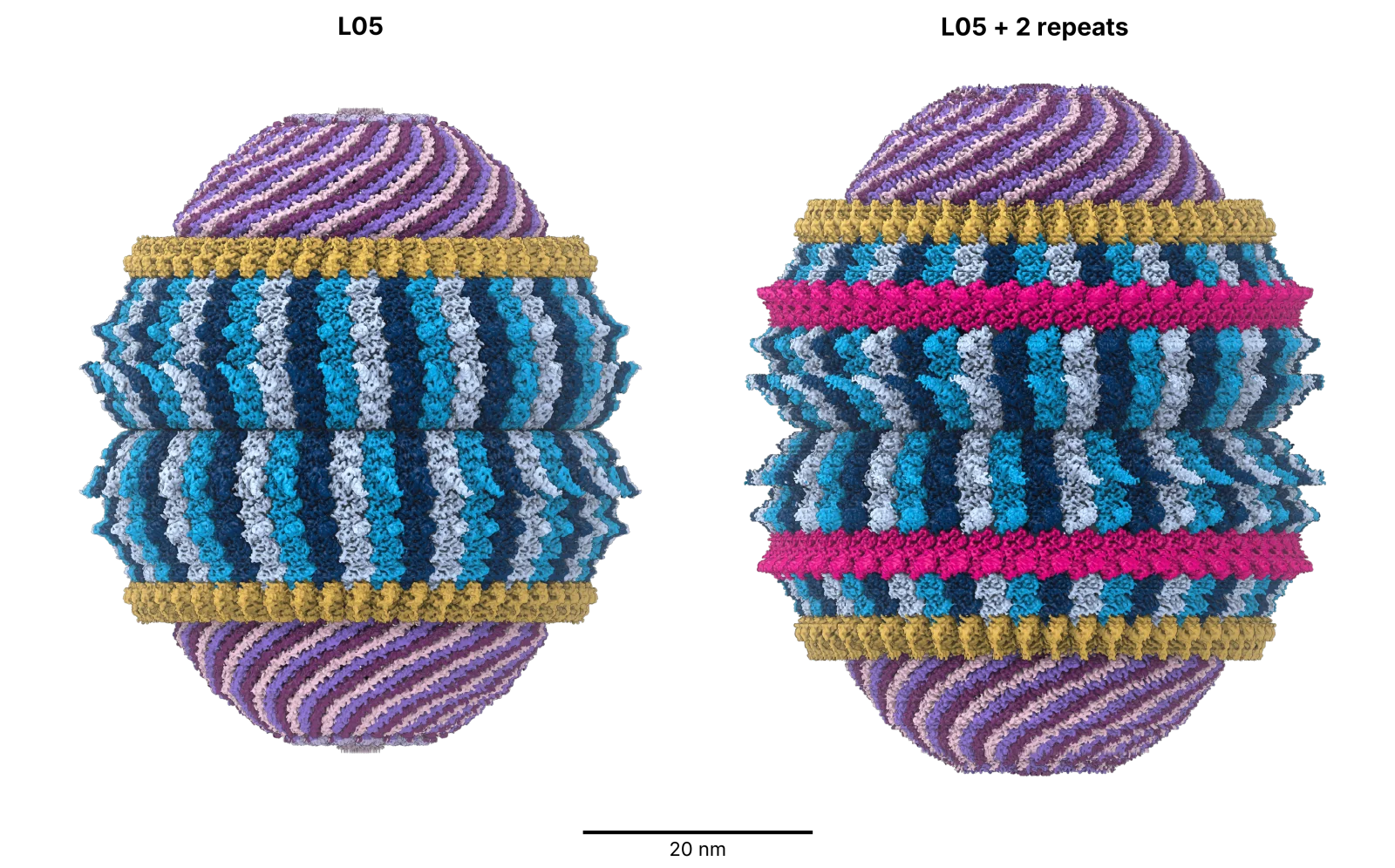 Engineered larger vault particle with two extra wall segments compared with the natural L05 vault
Image: Anthropic
Where Claude went wrong
The post is open about errors, which makes it more useful than a pure success story.
- A protocol Claude wrote called for a growth medium with an additive that interferes with getting DNA into cells. That set the project back by two weeks.
- Early in cryo-EM processing, Claude skipped a standard step and produced a flawed map blended with its mirror image. The team told it, in the post's words, "Please let's do normal things unless they don't work."
- In areas the team knew well, it caught mistakes quickly. In areas it did not know, mistakes cost time.
Anthropic says it shared its lab notes with the ML researchers who train Claude, so the failures could inform the data the model learns from. It also says Claude got better over the project as new models arrived, with fewer errors in DNA construct design and better spotting of experimental pitfalls. Those are Anthropic's own observations. No outside lab has audited them.
The open question: an unknown molecule
One feature of the structure is unexplained. A pocket partway up each of the 96 protein copies holds a small molecule that shows clearly in the map. The team has not identified it. Claude noted that its shape resembles coenzyme A, a common helper molecule that cells use to shuttle chemical groups. If it is coenzyme A or something similar, it could be an early hint about function. For now it is only a resemblance.
Dr. Rome, who advised the team and was a paid consultant who gave feedback on the manuscript, said in the post that figuring out function remains "enormously challenging" and that Anthropic's finding suggests "a complicated function and an interesting ride." Anthropic discloses the consulting payment.
Claimed versus verified
| Claim | Source | Status |
|---|---|---|
| First 3D structure of a prokaryotic vault | Anthropic | Stated by Anthropic; preprint not yet live at publication, so not independently reviewed |
| Purification in about 90 minutes | Anthropic | Lab's own measurement; sizing columns were used by others before |
| First model in 34 hours, normally weeks | Anthropic | The "weeks" is Anthropic's own estimate |
| Vault function | None | Unknown; coenzyme A resemblance is a hint only |
| Vaults form in natural phages and bacteria | None | Not tested; made only in E. coli so far |
| Typical labs can do most of this | Anthropic | Claim; cryo-EM analysis used hundreds of GPUs |
To check the work yourself, watch for the bioRxiv preprint and for the structure and data release Anthropic promises. A deposited map and model will let structural biologists test the 96-copy architecture directly.
Why this matters
For readers following AI, the key point is the shape of the claim. Anthropic is not saying Claude made a discovery alone. It says a team with limited structural biology experience took on an unfamiliar problem and finished in under four months, because Claude covered gaps in knowledge and sped up analysis. The team also says it screened dozens of candidates, prepared the microscope samples and solved the structure in that time. That is a statement about workflow speed and expertise, which is also where the risks sit: errors in unfamiliar areas cost the team time because they could not spot them.
This is the latest in a run of Anthropic science posts. In October we covered Claude-designed protein binders for scorpion toxin and Claude Science building the first complete UV map of the sky. The company has also widened its programs for outside researchers, including the guest investigator program for life sciences and the AI for science expansion with credits for foundations and institutions. On the drug side, see what is and is not preclinical in Anthropic's six-partner results. For the wider view of how Claude is shaping research habits, read the Bootloops piece on Claude-shaped science.
The caution matters as much as the speed. A faster pipeline produces more candidate structures, and each still needs human judgment on which results to trust. Anthropic's own mirror-image map is a clean example: a plausible-looking result that a trained eye had to reject.
What to do if you work in a lab
- Treat the 90-minute purification as a method to test, not a given. Anthropic reports it for vault proteins in E. coli lysate.
- Keep a human who knows the field in the loop for each analysis decision. Anthropic's own team did.
- Log the failures. Anthropic fed its lab notes back to its model team.
- Read the preprint when it appears before you copy any protocol.
- If you have an idea for vault function, or a system to test it, Anthropic's post lists two researcher contacts.
Related reading
- Claude and scorpion toxin protein binders
- Claude Science and the first complete UV map of the sky
- Anthropic guest investigator program for life sciences
- Anthropic AI for science expansion
- Anthropic drug development partners
Details in this post come from Anthropic's November 4, 2026 research post and may change when the preprint and data are released. Follow @explainx_ai for updates.