




Claude Fable 5.2 can paint photoreal scenes without calling a diffusion image model — by writing Python that places hundreds of thousands of simulated brushstrokes on a canvas. Anthropic staff published the demos in November 2026, weeks after the Fable 5.2 and Mythos 5.2 launch. Developer Jake Eaton said one parking-garage piece used roughly 700,000 strokes. Engineer Michael Graczyk ran a 111-stroke bird study with no undo, forcing the model to paint over mistakes.
This post explains what the engine does, how it differs from Midjourney-style diffusion, and what it implies for agent builders who already route coding work through Fable 5.2 versus Opus 5.5.
TL;DR
| Question | Answer |
|---|---|
| Image model used? | No, in Eaton's published runs |
| How output is built | 1,000–2,000 line Python driving a simulated brush engine |
| Big demo stroke count | ~700,000 for a photo-like garage scene (Eaton) |
| Small controlled demo | 111 strokes, bird at sunrise (Graczyk thread) |
| Personas | Fictional artists like "Dermot Hale" with consistent style |
| Robot tie-in | RoboDojo Sim scores cited in secondary reports; physical arm tests mixed |
How does Fable 5.2 paint without generating pixels?
Mainstream image tools such as Stable Diffusion or Midjourney refine noise into pixels inside a neural network. The Fable 5.2 demos take the same path as agentic coding: the model writes a program, runs it through Anthropic's code execution surface, and commits geometry stroke by stroke.
Eaton's November thread on X states each favorite piece is a Python program of one to two thousand lines that places every stroke through a simulated paint engine with different bristles. He says Claude does not use an image model, and does not render or trace from a photo in advance. That matches how Fable 5.2 formalization and PCB demos also rely on long code loops instead of a separate modality model.
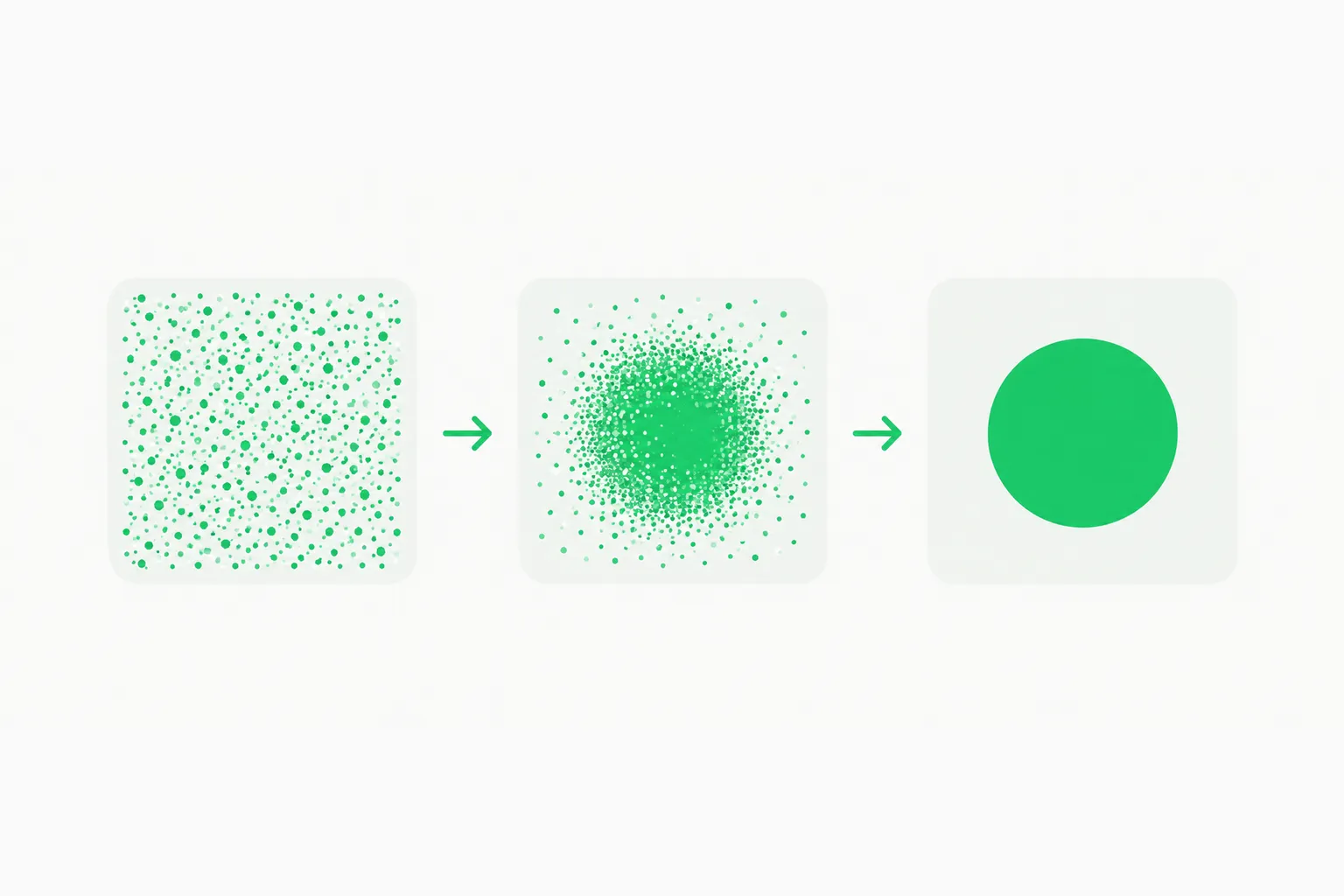 Diffusion noise resolving into a shape beside brush strokes, contrasting Fable 5.2 simulated brushstroke painting with pixel diffusion models
The approach is closer to agentic tool loops — pick a tool, evaluate, revise — except the "tool" is custom physics code the model authors itself, like the hand-drawn timelapse agent debates but with executable canvas state.
What did the 700,000-stroke garage demo show?
Eaton asked Fable 5.2 for a painting as indistinguishable as possible from a photograph. The result, shared on X, is a shopping cart in a parking garage built from roughly 700,000 simulated brushstrokes.
Independent write-ups citing Eaton's thread add color on process: he steers with comments, Claude revises brush and paint engines, and personas accumulate thousands to hundreds of thousands of strokes depending on ambition.
Treat the stroke count as demo metadata from Eaton, not an Anthropic product spec. What matters for builders is cost and time: programs that emit hundreds of thousands of coordinate lines can burn output tokens fast, echoing Playcode reports on Fable max effort for image-like tasks.
Personas, critique of Opus 5.5, and consistency
Eaton said he started after hearing that Opus 5.5 paintings only imitated real art. His Fable 5.2 prompts ask the model to invent artists with backstories and period-consistent styles. Examples from his thread include "Dermot Hale", who paints weather in thick oil in unscenic places like retail parks, and "The Tidewright" for coastal scenes.
That mirrors how showcase posts treat Fable: long-horizon creative consistency, not one-shot diffusion luck.
The 111-stroke bird experiment and the no-undo rule
Graczyk's experiment, summarized by The Decoder citing his X posts, constrained Fable 5.2 harder:
- Only code could simulate bristles, wet paint, and canvas texture.
- Each stroke had to appear as its own coordinate line.
- No undo once a stroke landed.
The demo video tracks 111 strokes forming a bird at sunrise. Graczyk reported the first stroke used color #30346a, width 90 pixels, and wobbling waypoints — about seven pixels of jitter on purpose, because human arms do not draw perfectly straight lines.
When the bird's back looked too thin, the model laid a bolder stroke over it, reframing edge noise as feathers. In a 280-stroke dusk scene, a late lighting pass smeared props on a table; Fable repainted the tubes and cup. It also posed two painters so outer hands hold brushes and inner shoulders touch, matching prompt-level spatial reasoning.
Those corrections are the same self-correction pattern Mollick highlighted in expert judgment tests: strong where the task is inspectable step by step, expensive where each step is irreversible.
Robotics, RoboDojo Sim, and physical limits
 A robotic arm applying a stamp in sequence, illustrating Claude Fable 5.2 brushstroke planning tied to RoboDojo Sim and physical robot demos
Anthropic's launch narrative already ties Fable 5.2 to long-horizon physical reasoning, including electronics with Diode and RoboDojo sim work. Decoder reports that researcher Aris Zhu compared Fable 5.2 and GPT-6 Astra painting Van Gogh's Starry Night with real arms, citing Anthropic figures of 64.9% versus 29.8% on RoboDojo Sim.
The same piece notes real-world limits: Astra painted faster, and only Astra stood a domino on edge by slowly opening the gripper to use gravity. Treat Zhu's clips as single comparative demos, not a public leaderboard file on anthropic.com.
Still, the through-line is clear: stroke planning under constraints in software and motor control under noise in hardware are one research thread for frontier labs — see also frontier model comparison for where RoboDojo and Remote Labor Index sit on Anthropic's tables.
What developers are saying
Hacker News did not front-page the painting thread when this post was filed; discussion clustered on X and in newsletters. In the parallel Fable 5.2 launch thread (item 50429906), builders focused more on $8/$40 pricing and Opus versus Fable routing than on art engines — consistent with our launch-day HN summary.
Skeptics on social mirrors asked whether the garage piece secretly built a 3D scene then scripted strokes on top. Eaton's public claim is the opposite: no tracing, no upstream image model. Reproducing the dispute means publishing prompts, code, and execution logs, which Anthropic has not packaged as a product feature.
How to try brushstroke painting on Fable 5.2
- Use code execution on Fable 5.2 (
claude-fable-5-2) with enough output token budget for long programs plus stroke arrays. - Prompt constraints explicitly: require logged strokes, no external image APIs, and persona docs if you care about style consistency.
- Start small like Graczyk's 111-stroke rule before attempting six-figure stroke counts.
- Measure cost per finished piece, not list price per million tokens — agent art behaves like long-horizon agent bills.
Anthropic documents model access in its November 9 release notes and models overview.
Token cost and when not to use brush engines
Brushstroke painting is a stress test for output length, not a default production path. Each stroke line costs tokens; six-figure stroke counts can dwarf a single diffusion call even after Fable 5.2's twenty percent price cut.
Rules of thumb:
- Use diffusion or vendor image APIs when you need one marketing still quickly.
- Use brush engines when you care about inspectable intermediate state, robotics transfer, or research on irreversible action.
- Cap runs with max output tokens and logging so finance can reconcile bills against output-token inflation reports.
If your team routes art and code through one agent, keep the same model router you use for Fable versus Opus coding: Opus for iteration, Fable for long programs, Haiku for thumbnails — not one model for every medium.
Watermarks, provenance, and disclosure
Anthropic's broader policy stack still applies. Fable 5.1 and 5.2 watermarking covers text on consumer surfaces; image outputs that flow through official APIs may still pick up C2PA or statistical signals depending on channel. Brushstroke PNGs exported from code execution should be treated like any other model output in EU transparency workflows — label them, keep prompts, and store run logs if regulators ask.
For press and social posts, Eaton's demos are research communication, not a shipped Claude Paint SKU. Do not promise customers photoreal walls without benchmarking latency, cost, and rights on your own prompts.
How this fits the November 2026 Fable story
Brushstroke painting is not a new SKU. It is evidence that Fable 5.2's code loop can absorb visual domains without bolting on a separate diffusion endpoint — the same week Anthropic pushed IPO roadshow compute stories and Amodei pacing comments we covered elsewhere.
If you are choosing models this week, treat painting demos as a stress test for token throughput and tool discipline, not as proof Fable replaces Sunburst or third-party image APIs for production marketing assets. For routing math, keep Fable versus Opus and output-token inflation open beside this article.
Related reading
- Claude Fable 5.2 and Mythos 5.2 launch and pricing
- Top things built with Fable 5.2
- Fable 5.2 code ownership prompting
- Anthropic Fermat formalization in Lean
- AI labs output-token inflation
- Claude agentic art and hand-drawing fake timelapses
Stroke counts and persona names are taken from Jake Eaton's and Michael Graczyk's public posts as summarized on November 15, 2026. RoboDojo Sim percentages appear in secondary reporting citing Aris Zhu, not in a standalone Anthropic benchmark PDF we could link.