




On November 9, 2026, ByteDance Seed Team announced Seedream 5.5, its next-generation still-image model aimed at professional production loops rather than one-shot thumbnails. The headline features are stable multi-turn editing (the lab demos 100 rounds on one subject), native RGBA assets, and lower text corruption in the team's own benchmarks.
For builders, the practical question is whether an image API can survive a long edit chain without drift. Seedream 5.5 is ByteDance's bet that pixel-level preservation and transparent PNG output matter as much as single-prompt realism. The same day rollout hits Jimeng, Doubao, and Volcano Engine surfaces, putting it in the same ecosystem as Seedance 2.5 video and the open Axion 1.0 agent models.
What Seedream 5.5 adds
The official post frames image models as workflow tools: teams need repeatable quality, not lottery outputs. Three upgrades carry that story.
Multi-turn editing without drift
Most image editors still suffer compounding error: change the sweater, and the wall color shifts; swap a prop, and faces soften. Seedream 5.5 claims targeted training so non-edited regions stay fixed at the pixel level, with less color bleed and less detail loss across chains.
The demo pipeline runs 100 successive edits on one portrait, changing clothes, jewelry, and table objects while still adjusting small items like rings and glasses. Separate demos walk through floral still lifes, interior remodels, and watch-face UI tweaks, all using the previous image as input.
That design maps directly to how designers actually work in Figma-adjacent tools and ad comps. It also matches what agent harnesses need when a coding or creative agent loops on “make it bluer” ten times. For agent stacks, see how DeerFlow 2 and other ByteDance harnesses treat long runs; image models with stable state reduce rollback work.
Native RGBA and compositing
Seedream 5.5 generates images with an alpha channel, including partial transparency. ByteDance Seed shows a snowy owl with feather edges, glass lettering with brush textures, and character sheets reused across scenes without manual matting.
For e-commerce and motion pipelines, that cuts a common bottleneck: exporting a subject, cleaning edges, then re-importing to After Effects or a web layout. Competing APIs often return opaque JPGs and push you to a separate matting step; here transparency is a first-class output mode.
Realism and text
The post emphasizes less plastic skin, more believable materials, and dense small text in layouts like newspaper spreads and butterfly infographics with Chinese captions.
On metrics, ByteDance Seed ran MagicArena evaluations across six production verticals (e-commerce, marketing, film, gaming, office productivity, fashion). Versus Seedream 5.0 Pro, it reports higher usability rates in every category, with film and office productivity more than doubling.
Benchmarks ByteDance published
GSB preferences on structure and realism
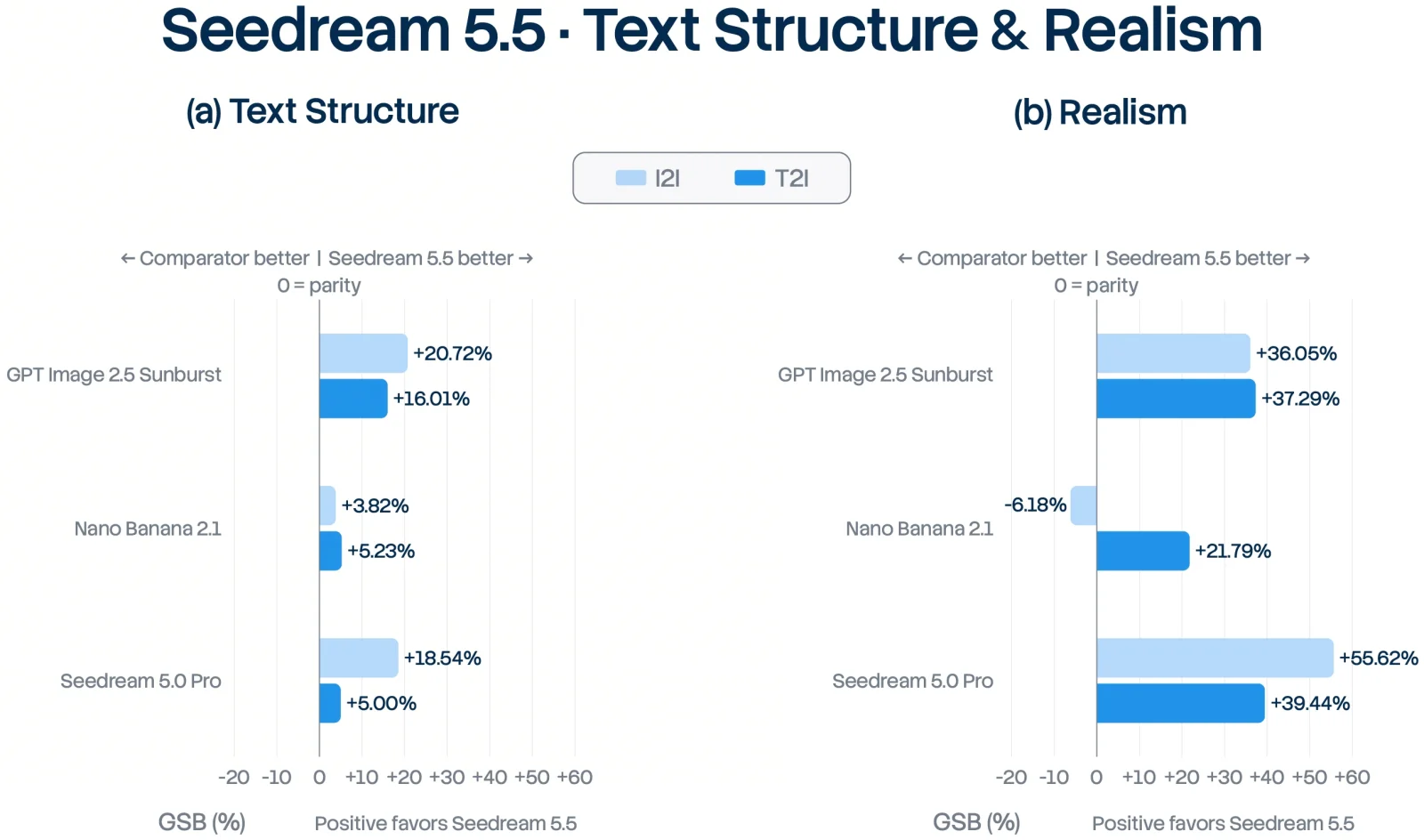 Seedream 5.5 GSB text structure and realism benchmark chart from ByteDance Seed
Image: ByteDance Seed
Experts scored Good/Same/Bad (GSB) pairs on text structure and realism for both text-to-image and image-to-image tasks. Seedream 5.5 shows positive GSB margins against 5.0 Pro in all four comparisons, peaking at +55.62% on image-to-image realism. The blog also names GPT Image 2.5 Sunburst and Nano Banana 2.1 as external references, claiming leads on text structure and text-to-image realism in those pairings.
Treat GSB as vendor-run human preference, not your SKU accuracy test. Still, the direction matches the text-corruption numbers below.
Text corruption rates
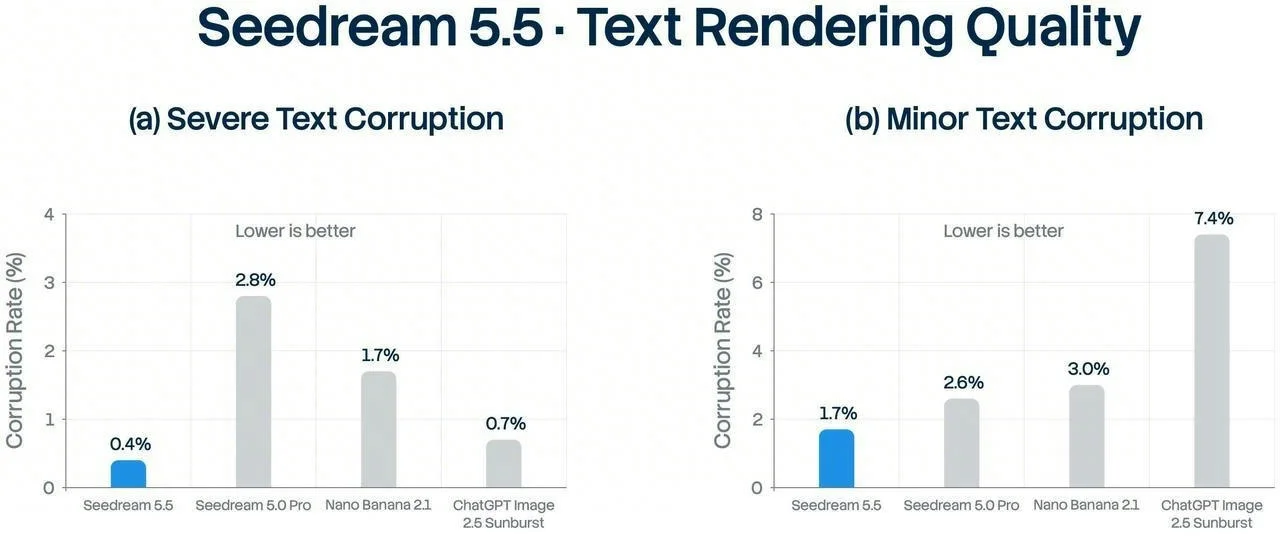 Seedream 5.5 severe and minor text corruption rate comparison chart
Image: ByteDance Seed
On Chinese and English evaluations with dense small text, ByteDance Seed reports:
| Metric | Seedream 5.5 (per blog) |
|---|---|
| Severe text corruption | 0.4% |
| Minor text corruption | 1.7% |
The post says both rates fell substantially versus Seedream 5.0 Pro. Secondary coverage from IT之家 notes that Seedream 5.0 Pro still struggled with complex Chinese glyphs in hands-on tests as of July 2026, so 5.5 is positioned as a fix for known pain in CJK markets.
Where to try Seedream 5.5 today
The Seedream 5.5 product page mirrors the blog demos. Consumer rollout paths listed on launch day include:
- Jimeng web
- Doubao app and web
- Doubao Work skills entry
- Volcano Ark Experience Center, listed as Doubao-Seedream-5.5
The English announcement does not publish API price tables or max resolution. IT之家 reports that Seedream 5.5 API billing keeps an input image + output image structure with no text token charges, and cites roughly ¥0.28 per 2K square edit, under half of Seedream 5.0 Pro in their example. Verify on Volcano Engine before budgeting production.
International builders comparing vendors should still benchmark against Meta Muse Image at $0.01 and Alibaba CommerceGen Studio throughput claims. ByteDance is optimizing for edit chains and transparency, not the cheapest single 1024×1024.
How this fits ByteDance's media stack
ByteDance Seed now spans video (Seedance), agents (Axion, DeerFlow), and still images (Seedream). Seedream 5.5's blog explicitly mentions future agent workflows and a Pro tier in the series, signaling that image tools will plug into the same automation story as coding agents.
For governance context in China and abroad, remember ByteDance remains a major Nvidia RTX Pro buyer under export rules. Image API access and on-device apps can move on different timelines than frontier training clusters.
Practical guidance for developers
- Test your edit depth. Run your real prompt chain (10–30 rounds) and measure background drift. Vendor demos at 100 rounds are marketing; your lighting and SKU overlays may fail earlier.
- Validate text legally. Low corruption rates still are not spell-check. For packaging and regulated labels, keep human sign-off; compare with multimodal token budgeting if you pair image models with VLMs for OCR verify.
- Plan alpha workflows. If you composite in web or video pipelines, test RGBA edges on hair, glass, and motion blur. Premultiplied alpha bugs still happen downstream.
- Watch for Pro weights/API. The blog promises a Seedream 5.5 Pro series. If you need on-prem or fine-tunes, wait for model cards rather than assuming this launch includes weights.
Limitations and open questions
- No open weights in this announcement.
- Benchmarks are in-house (MagicArena, GSB). Independent Arena or LM-style leaderboards are not cited on the English page.
- 100-round claim is a demonstrated upper bound, not a guaranteed SLA for every prompt class.
- Competitor names in charts (GPT Image, Nano Banana) are vendor labels; confirm exact API SKUs when you reproduce tests.
Competitive landscape in late 2026
Still-image APIs moved from “one prompt, one PNG” to edit-native interfaces in 2026. OpenAI, Google, and Meta each ship image models with some edit or inpaint path, but few vendors publish round-count stability as a headline metric. ByteDance is betting that production designers—e-commerce operators, ad agencies, and Douyin-native studios—will pay for chains that do not wreck backgrounds.
Against Meta Muse Image at a cent per still, Seedream 5.5 is not trying to win on unit cost alone. IT之家’s launch-day note positions API edits around ¥0.28 for a 2K square, still cheap by Western API standards but optimized for Chinese product surfaces first.
For video-adjacent work, teams often pair a still editor with Seedance clips or with general VLMs for QA. If you route prompts through agents, budget vision tokens when you send hundred-round histories back to a critic model—most teams snapshot only every N rounds.
Evaluation checklist before you switch pipelines
Use this sequence on your SKUs and brand fonts, not ByteDance’s demo portraits:
- Baseline still: generate hero image at target resolution; archive hashes of background patches you care about.
- Ten-round stress: apply localized edits (color, crop props, swap logos). After round 10, diff untouched regions—measure color ΔE in LAB if you have tooling.
- Text torture: render your longest legal disclaimer in Chinese and English; count glyph substitutions manually. Compare against the blog’s 0.4% / 1.7% corruption claims only on your strings.
- RGBA handoff: import into your compositor; check fringe halos on hair and glass. Premultiply correctly before video export.
- Cost projection: if you bill per edit, model chain length × price using Volcano’s live calculator once your account shows Doubao-Seedream-5.5.
Document failures with seeds and prompts. That dataset becomes training material if ByteDance ships a Pro fine-tune later.
What a “Pro” tier might change
The November 9 post ends with a Seedream 5.5 Pro series tease and mentions agent workflows. Historically, ByteDance has split consumer Jimeng access from Volcano enterprise SKUs. Expect Pro to add resolution, concurrency, or style locks—not necessarily open weights.
Watch the ByteDance Seed news index and Volcano Engine changelogs. If you need on-prem, track whether weights follow the Axion 1.0 Apache release pattern or stay API-only like most frontier image APIs.
Energy and infrastructure context
Image models do not make headlines for gigawatt data centers, but they ride the same GPU supply crunch as LLMs. ByteDance remains among the largest Nvidia card buyers under US export rules. Consumer launches can stay available even when training clusters face policy friction—a pattern we also see in environmental pushback on AI buildouts.