




On November 11, 2026 Tether AI Research published BotPsy, a 0.8B-parameter agent model built on Qwen3.5-0.8B that targets function calling and multi-step tool workflows on phones and laptops—with Apache 2.0 weights for research and education. The Hugging Face post argues many routines do not need frontier cloud models, and that sub-billion agents can be cheaper, more private, and less hostage to API policy changes.
If you are shipping local agents—calendar helpers, device automations, or personal research bots—BotPsy is one of the few sub-1B releases that publishes six agent benchmarks and a full training recipe, not only a merge on top of a base chat model.
TL;DR: BotPsy at a glance
| Question | Answer (per Tether's Nov 11, 2026 post) |
|---|---|
| Base model | Qwen3.5-0.8B |
| Size class | 0.8B parameters |
| License | Apache 2.0 (research and education) |
| Formats | Safetensors + GGUF (bf16, Q8, Q4) for QVAC / llama.cpp |
| Headline claim | ~2x agentic scores vs base on BFCL v4, ACEBench, τ-bench |
| Vs 2B sibling | Beats Qwen3.5-2B-Think on 5/6 tool benchmarks in their table |
| Safety | 21% unsafe rate in their red-team harness vs 36% for base |
| Intended use | Low–medium difficulty personal assistant tasks—not high stakes |
Numbers are author-reported unless you reproduce the eval harness yourself.
Why another sub-billion agent model matters
Cloud agents are easy to prototype and expensive to operate at scale. A personal assistant that searches, reads mail, or calls home APIs can burn millions of tokens if every step hits a frontier endpoint. Small models also reduce vendor lock-in: the Hugging Face post explicitly lists deprecation risk and limited customization as reasons to host locally.
Tether already ships on-device speech with TranscribePsy. BotPsy extends the same QVAC story from audio to tool-use agents, sitting beside other local stacks covered in Perplexity Computer running locally on a Mac and Liquid on-device reasoning models.
 Local on-device agent language model running tool calls without cloud API dependency
Benchmarks: what BotPsy claims to beat
Tool-use and agent suites
Tether compares BotPsy-0.8B against Qwen3.5-0.8B-Think (base), Qwen3.5-2B-Think, LFM2.5-1.2B-Think, and MiniCPM5-1B-Think on six benchmarks: BFCL v4, ACEBench, τ-bench, Claw-Eval, BrowseComp-Plus, and ToolSandbox.
Reported highlights from the blog:
| Benchmark | BotPsy-0.8B | Qwen3.5-0.8B base | Qwen3.5-2B-Think |
|---|---|---|---|
| BFCL v4 | 44.0 | 23.4 | 37.7 |
| ACEBench | 58.7 | 30.1 | 55.4 |
| τ-bench | 51.5 | 23.2 | 46.5 |
| ToolSandbox | 64.6 | 30.5 | 41.2 |
| Claw-Eval | 46.5 | 39.3 | 48.9 |
| BrowseComp-Plus | 4.5 | 1.9 | 2.8 |
The blog states BotPsy roughly doubles base tool-use capability and leads the ≤1.2B class on five of six suites.
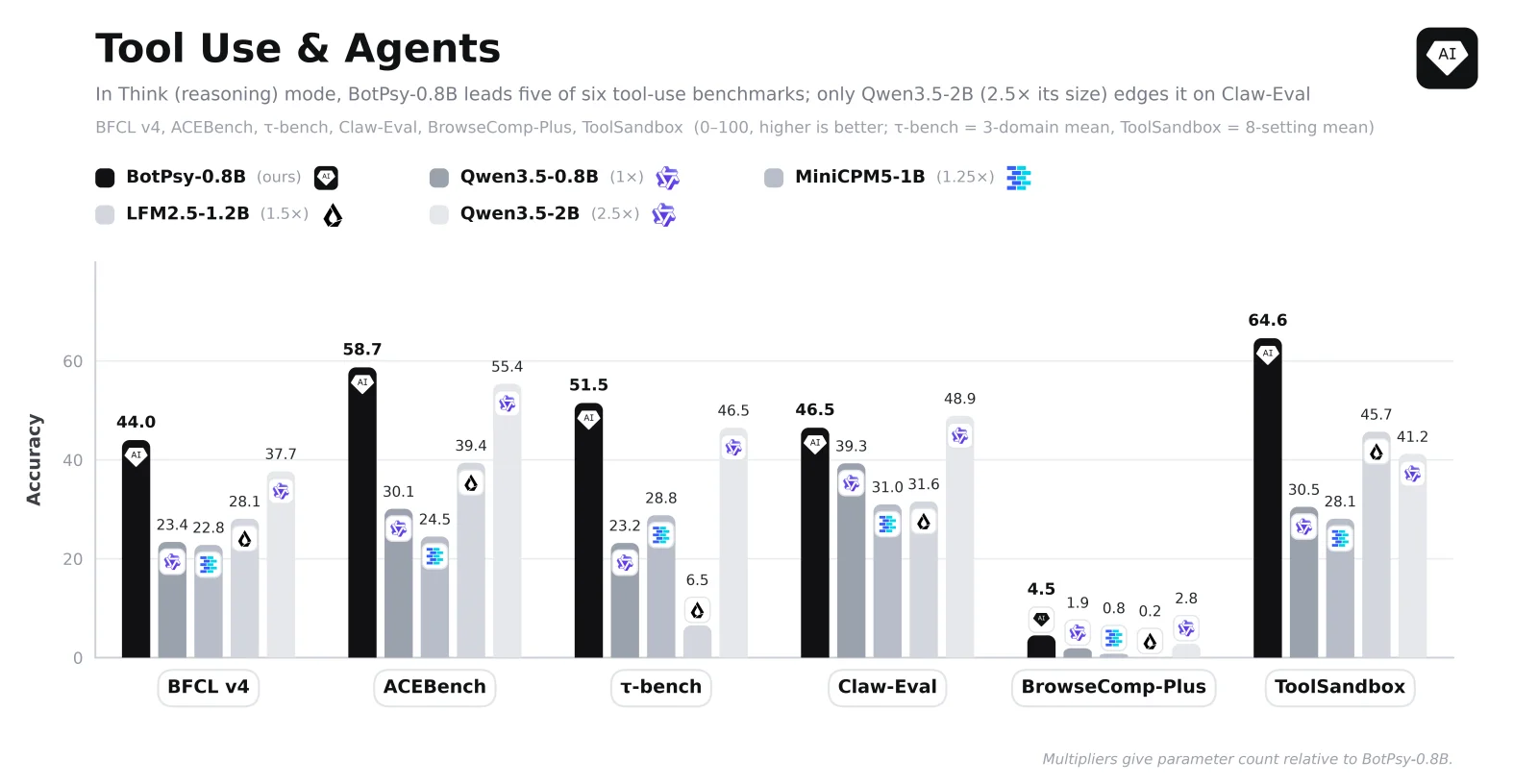 BotPsy 0.8B on-device agent model tool-use benchmark scores versus sub-1.2B rivals
Image: Tether AI Research / Hugging Face
Multi-turn customer-service style tasks
On τ²-bench telecom, BotPsy reports 82.5 vs 69.3 for Qwen3.5-2B-Think. On BFCL v4 multi-turn, it rises from 7.5 (base) to 46.1, which the authors contrast with 23.8 for the 2B model.
That matters because multi-turn tool loops are where tiny models usually collapse—either they forget policy or they call tools with drifting arguments. The results rhyme with why enterprises benchmark assistants on τ²-style benches instead of single-shot trivia.
Knowing when not to call tools
A capable agent must decline when no tool applies. On BFCL v4 hallucination tests, BotPsy scores 86.1, the highest among models tested in the post. On ACEBench special cases (incomplete requests, wrong parameters), it scores 51.3 vs 13.7 for the base model.
That behavior is underrated in hobby agent demos but decisive in production—see eBay blocking third-party shopping agents for how uncontrolled tool loops create platform risk.
Knowledge vs tool specialization
Tool training did not erase knowledge entirely: GPQA Diamond moves from 33.2 to 38.1 and MMLU-Pro from 41.6 to 48.9 in the authors' tables, best among ≤1.2B models tested. The blog still warns that knowledge scales with parameters and BotPsy should call tools for facts rather than act as a standalone knowledge model—similar philosophy to Hugging Face System One decision APIs that push structured decisions instead of long free text.
Training recipe: four stages, three feedback types
BotPsy is not a single SFT pass. The Hugging Face blog describes:
- Supervised fine-tuning on multi-turn tool trajectories, parallel and multi-step calls, and no-tool cases.
- Multi-teacher on-policy distillation from three Qwen3.5-4B specialists (tool use, reasoning, instruction following) with per-token reverse KL.
- RL round 1 with DAPO and fine-grained tool-call rewards inspired by ToolRL-style partial credit.
- RL round 2 mixing math, code, knowledge MCQs, instruction following, structured outputs, and simulated workplace tool use.
The post includes stage-by-stage capability curves showing SFT boosts tools but hurts knowledge, then distillation recovers general skills before RL adds further gains—useful reading if you are building your own agent skills distillation pipeline.
Safety, efficiency, and deployment notes
Red-teaming numbers
Automated red-teaming across six harm categories reports 21% unsafe responses for BotPsy vs 36% for its base and 35–47% for some 1B-class rivals in the same table. Under prompt-injection attacks tied to untrusted tool output, unsafe rate falls from 46% (base) to 31%.
Those rates are still too high for unsupervised customer support. The blog's own Intended Use section says BotPsy is not for high-stakes use.
Reasoning token efficiency
On questions all five models answer correctly, BotPsy uses about 3× fewer reasoning tokens than base on GPQA Diamond and 2.7× fewer on MMLU-Pro, with loop rates collapsing on IFBench in their charts. For on-device latency, shorter chains matter as much as raw accuracy.
How to try BotPsy
The post links Hugging Face safetensors and GGUF quantizations for QVAC SDK and llama.cpp. Typical local stack:
- Pull weights from the model card linked in the blog.
- Pair with a host app that exposes tools (calendar, search, files) with explicit schemas.
- Add policy prompts and human confirmation for irreversible actions—the model will not supply enterprise governance for you.
Compare setup friction with Janestreet's agent-skills tutor repo if you want a skills-first harness instead of a monolithic assistant binary.
What Tether says comes next
The vision section mentions Hypersearch P2P queries, QVAC Fabric local fine-tuning, delegating heavy compute to home PCs, and agent-to-agent messaging on trusted LANs—all on-device control themes. Treat that as roadmap prose, not shipped product.
Hardware and runtime expectations
Tether positions BotPsy for phone-class deployment via GGUF quantizations. Realistic planning:
| Precision | Likely role | Caveat |
|---|---|---|
| bf16 | Laptop prototyping | Higher RAM, best tool-call fidelity in author tests |
| Q8 | Daily-driver phone experiments | Watch thermals on long multi-turn loops |
| Q4 | Offline demos | Expect JSON/schema errors to rise; revalidate tools |
You still need a host process implementing schemas—same lesson as Expo Exact contract runtime posts about typed tool surfaces. BotPsy does not ship a calendar, browser, or payments stack.
On Apple silicon, compare latency against Liquid's on-device reasoning line: BotPsy is smaller but more tool-specialized.
Benchmarks readers should rerun before betting products
Tether lists six suites—each measures a different failure mode:
- BFCL v4 — schema adherence and multi-turn calls.
- ACEBench — messy user phrasing and special cases.
- τ-bench / τ²-bench — long customer-service dialogues with policy.
- Claw-Eval — claw-style tool environments where 2B still wins slightly.
- BrowseComp-Plus — web research (everyone scores near zero).
- ToolSandbox — simulated app integrations.
Copy the authors' lesson: optimize the benchmark that matches your app group—commerce vs device control vs messaging—not the unweighted mean. Figure 7 in the blog breaks scores by app group for simple vs complex scenarios; mobile assistants heavy on device settings should study that slice before trusting the headline average.
Open weights and licensing nuance
Apache 2.0 for research and education is broader than many "open" models that block distillation or commercial fine-tunes. Still read Tether's Intended Use guardrails: they flag high-stakes automation and document 21% unsafe generations in their harness.
If you bundle BotPsy into a consumer app, your privacy policy must state on-device inference clearly—regulators already scrutinize default cloud assistants. Pair with Hugging Face's open-source security tradeoff essay when security asks why you chose local weights.
What people are asking
| Question | Honest answer |
|---|---|
| Is BotPsy better than Claude or GPT for agents? | Not on hard tasks. It targets low–medium personal workflows at sub-billion cost. |
| Can I fine-tune BotPsy on my mail? | Apache weights allow research fine-tunes; check the license scope and your privacy policy. |
| Does BotPsy include tools? | No. It is weights plus eval claims; you build the tool host. |
| How does it relate to Qwen3.5? | It is Qwen3.5-0.8B plus Tether's four-stage post-training. |
Limitations you should plan for
- BrowseComp-Plus scores are single digits for everyone—web research is still hard at this scale.
- Lower-resource languages lag on instruction following per the blog's Figure 2 discussion.
- Banking-style τ³ tasks stay near zero for all models tested—do not point BotPsy at treasury workflows.
- Benchmarks are internal reproductions; wait for community runs before betting a product roadmap on the table.
Related reading on explainx.ai
- Tether TranscribePsy on-device speech
- Hugging Face System One decision APIs
- What are agent skills?
- Janestreet agent skills tutor
- Raindrop and τ²-bench on service agents
- eBay blocks uncontrolled shopping agents
Model names, scores, and release details follow Tether's November 11, 2026 Hugging Face post.