



Anthropic published a guest essay on November 6, 2026 with a blunt thesis: an AI that hands a scientist a model that fits the data has not given them understanding. The authors, AI for Science grantees Jakob Macke, Daniel Gedon and Stefan Wahl of the ELLIS Institute Tübingen and the University of Tübingen, argue that AI should return a whole range of plausible models, not one winner. Read the original post on anthropic.com for the interactive figures. This article explains the argument in plain terms.
TL;DR
| Question | Answer from the essay |
|---|---|
| What are the three steps of modeling? | Build the model, constrain it with data, interpret what it says |
| Where has AI made the most progress? | Constraining, through simulation-based inference (SBI) |
| What is new in building? | LLM agents write code for candidate models, run them, compare with data and revise |
| What is the main warning? | A single best-fit model hides other models that fit equally well |
| What is the hardest step? | Interpretation |
| Is there proof on unsolved problems? | Not yet. Tests mostly rediscover known models |
Why start with Hodgkin and Huxley?
 A flask of green liquid in a science lab, illustrating AI scientific models built from experimental data
Hodgkin and Huxley shared the 1963 Nobel Prize in Physiology or Medicine, as the Nobel Prize site records.
The essay opens in 1951. The Cambridge computer was out of action for six months, so physiologist Andrew Huxley solved the equations for a squid nerve cell on a hand-cranked mechanical calculator. It took him over three weeks.
The model they built with Alan Hodgkin modeled the cell membrane as an electrical circuit. One part was an educated guess: to fit the data they had to raise one variable to the fourth power. They offered a hypothesis that multiple charged particles had to move into place before a gate opened. Decades later, another team found the structure of a related potassium channel protein, and it had four identical pieces around a central pore. The model had helped predict a structure it was never fit to.
The authors draw a lesson. An AI could plausibly find equations like these in an afternoon. But "simply knowing the fourth power did the job was not enough; what mattered was knowing that a simpler version of the model did not work." They cite Richard Hamming: "The purpose of computing is insight, not numbers."
What are the three steps of scientific modeling?
The authors break the Hodgkin-Huxley approach into steps that most modeling follows, in loops.
- Building: decide what the model is made of and what shape its equations take.
- Constraining: tune adjustable parameters to fit real measurements.
- Interpreting: ask what the model says about the real system.
If the numbers fail or the interpretation makes no sense, scientists go back and revise. AI now touches each step, and the essay goes through them in order of AI's progress.
How does AI constrain models with simulation-based inference?
This is where machines have made the most progress, according to the authors. They use a restaurant bill as the analogy. A group dinner came to $120, but you do not know who ordered what. Many combinations fit. Nerve-cell models work the same way: different combinations of gate parameters give near-identical electrical activity.
The classic fix is Bayesian inference, which returns every parameter set that works reasonably well as a probability distribution. But it is often impractical for complex models because it requires calculating how likely the measurements are under every possible set of numbers.
Simulation-based inference gets around that with computation. You:
- Pick random parameters.
- Run the model and record the output.
- Repeat, perhaps 100,000 times for a Hodgkin-Huxley model and millions for larger ones.
- Train a neural network so that, given an output, it returns the range of parameters that could have produced it.
All SBI needs is a simulator: parameters in, data out. Running the simulations is expensive and can take weeks. Afterward, a trained network infers from new data in seconds. The essay lists uses where speed matters: working out roughly where in the sky two neutron stars collided, fast enough to point telescopes at the event, plus applications in cosmology, structural biology and geophysics.
For nerve-cell models, the distribution shows which parameters the data pins down, where more than one explanation is plausible, and where another experiment would help most.
Can LLM agents build the model itself?
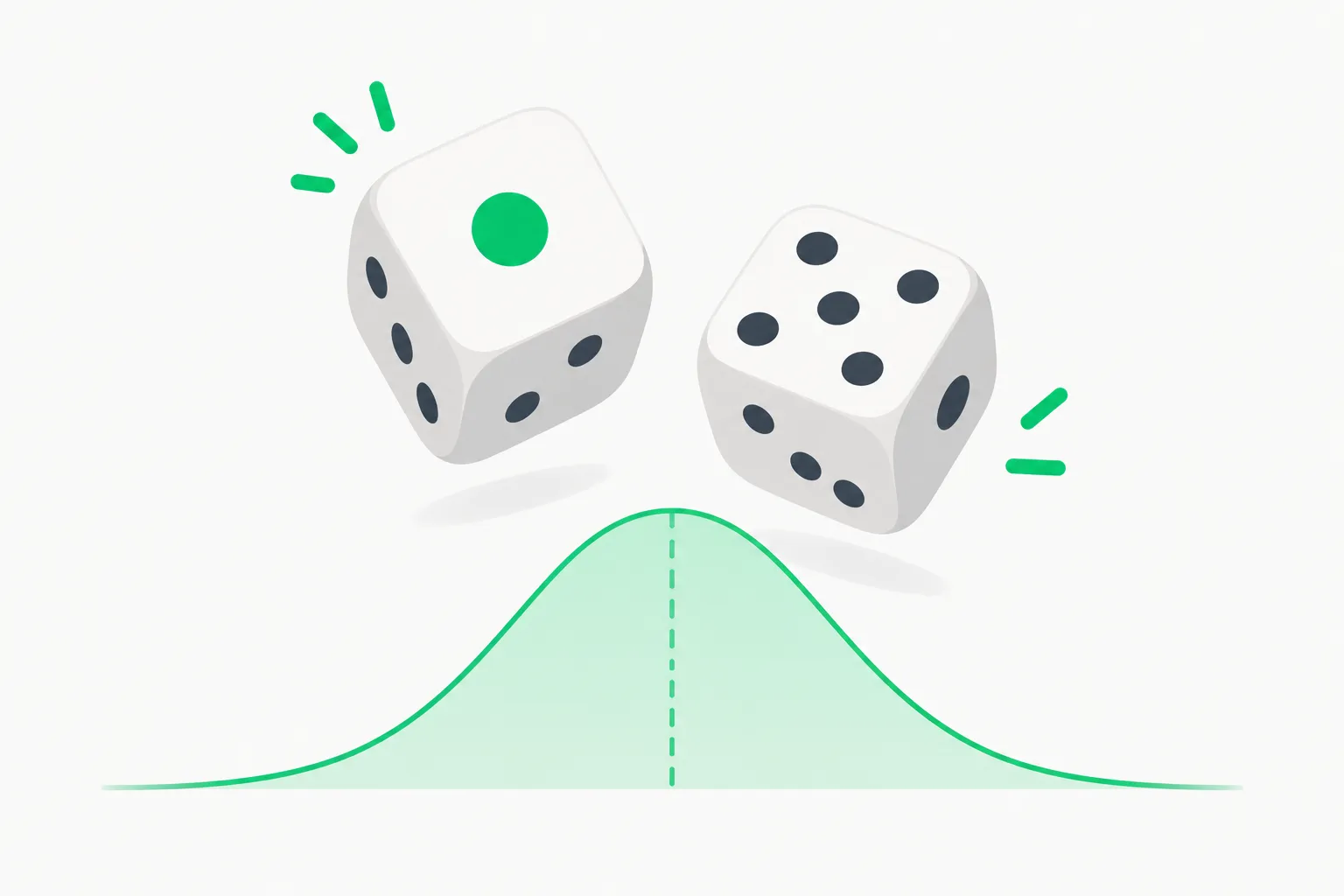 Dice with a bell curve beneath, showing a spread of plausible AI scientific models instead of one best fit
Building is the step once thought to be human-only. The authors describe a pattern that several systems have adopted in the past two years: given data and a natural-language description of a system, an LLM-based agent writes code for candidate models, runs them, constrains the parameters, compares output with real data and revises, perhaps by changing the form of an equation. The loop repeats until the model replicates the data well enough.
The catch is the same as with parameters. Run an agent twice on the same data and it may return two different, equally good models. An agent that returns only one hides the rest.
The authors' answer is to treat building like constraining. Ask for the whole range:
- The AI proposes many candidates.
- Each is weighted by how well the data supports it. Candidates that need a lot of flexibility to fit get less credit than ones that fit naturally.
- Weak ones drop out, and the AI proposes variations on the stronger ones.
What you get is a distribution of plausible models. If every survivor shares a feature, the data likely favors it. If survivors disagree, the evidence is thin there, which points to the next experiment.
They add a caution: "We shouldn't get too far ahead of ourselves." These systems have mostly rediscovered models scientists already know. Evidence for problems with no known answer is sparse.
Why is interpretation the hard part?
Hodgkin and Huxley's four-particle idea carried weight because of what they had ruled out. They also noted that higher powers might fit slightly better, but that the gain "was not considered to be worth the additional complication." The equations explained other facts too: why cells have a firing threshold, why nerve pulses share one shape, and why a slowly rising current never fires the cell.
Philosophers call a theory intelligible if you can work out its consequences without running it. That works for a handful of variables. For thousands, the equivalent might be boiling the model down to a few mechanistic ideas that suffice to rebuild it.
The authors call interpretation the hardest step to hand over, because fit is measurable and understanding is not. They mention two proposals:
- Judge understanding by intervention. See how well an AI predicts what a system does when you disturb it.
- Judge it by human benefit. Ask whether the outputs help human scientists understand the problem better. Their example is an AI system for designing quantum experiments that writes a short program generating setups for a whole family of related experiments, so a physicist can read the design principle straight off the program.
In both, having a full distribution of models is crucial. A single model cannot say which of its parts the data constrains, so it is easy to read meaning into parts that are not. If you block all of a cell's sodium gates, every data-compatible model may agree. If you block only some, they may disagree, and that disagreement is a hint for the next experiment.
What happens when models get too big to read?
Famous models like Hodgkin-Huxley are compact because people had to build and interpret them. As AI takes over more work, the size limit lifts. The authors point to the fruit fly: its brain has more than 100,000 neurons, and researchers now have a full wiring diagram. Large-scale models built on it already predict activity across the fly's visual system. Questions like how much behavior can be predicted from wiring alone were not askable before.
At that scale there is rarely one correct model. They quote George Box: "All models are wrong but some are useful." The question shifts from which model is right to which properties every data-compatible model shares. Climate science already works this way, reporting the spread across many simulations, and so do particle physicists at the Large Hadron Collider, who map which versions of a theory are ruled out.
The most useful experiments, they say, will be those that rule out the most remaining models, even if a human would not find them the most interesting.
What can builders take from this?
The essay is not a product launch, but it has practical consequences if you build research agents.
- Return sets, not single answers. If your agent proposes a model, formula or hypothesis, have it return several with weights and the evidence for each.
- Log the failures. Record which alternatives failed and why. That record is what the authors say produced the insight in 1951.
- Report what is pinned down. Ask for a list of parameters the data constrains and those it does not.
- Test on unknowns. Rediscovering known models is a good sanity check, not proof of discovery.
This lines up with the day's other science release. OpenAI's BioBasicsBench shows an agent that groups gel bands correctly but attaches the wrong meaning to them, which is the same fit-versus-understanding gap. For earlier science coverage see Anthropic's life sciences verification program, the Nature work on AI-designed physics experiments, how language models solve math and disease problems, and Google's jagged frontier report. For Claude in a lab setting, see Anthropic Vault and cryo-EM and the Claude scientists report.
What is still unknown?
- The essay is an opinion and review piece by grantees, not a new benchmark or model release. It reports no new numbers beyond the examples cited.
- It does not name a product or a Claude model that implements the approach.
- It says evidence for success on open problems is sparse.
Treat it as a framework for judging science agents, not as evidence that they work.
Bottom line
The authors want AI to do what Hodgkin and Huxley's slow work did: deliver not just the model that fits, but "an account of which parts are pinned down by the data, which are still open, which alternatives failed along the way, and what new puzzles were uncovered." If you build or buy science agents, ask for that account every time.
Details are from the Anthropic post dated November 6, 2026 and may be revised by the authors.