



Amazon Textract Insights reached general availability on November 20, 2026, giving teams a managed way to describe document fields in natural language and get structured answers with confidence and page coordinates. AWS positions it as an alternative to stitching OCR, classifiers, and a general LLM yourself.
Quick answer
| Piece | Detail (per AWS post) |
|---|---|
| API entry | StartDocumentInsights (async) |
| Input | S3 PDF/PNG/JPEG/TIFF, up to 3,000 pages per job |
| Blueprint | JSON Schema + natural language field descriptions |
| Splitting | Optional multi-document split inside one scan |
| Outputs | Values + confidence + page/bbox grounding |
| Pricing | Per page, not per token |
| Insights Regions | Documented list in AWS guide; Insights not yet in Tokyo/Zurich though Core expanded there |
The problem AWS targets
Mortgage, insurance, and healthcare inboxes rarely arrive as clean single-form PDFs. A typical file mixes W-2s, bank statements, handwriting, and receipts in one scan.
AWS describes two painful paths:
- Custom pipelines that chain OCR, splitting, classification, an LLM, and human review—heavy to build and operate.
- General LLMs that answer fluently but omit page citations or stable confidence, which blocks straight-through processing.
Textract Insights collapses that into one asynchronous Textract workflow with explicit vs inferred field types on the blueprint.
How blueprints and projects work
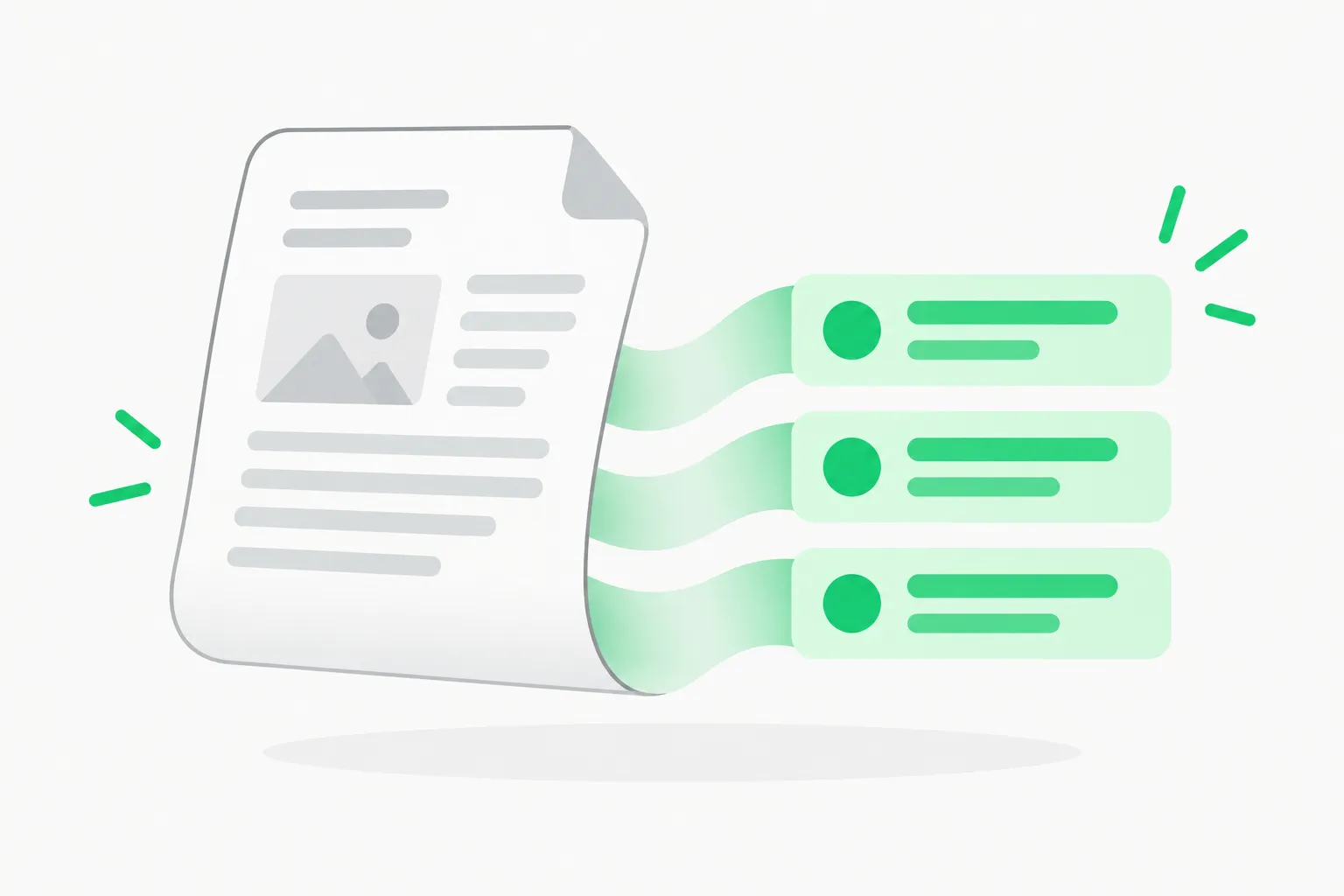 JSON Schema blueprints for mixed mortgage and claims document packets
A blueprint is JSON Schema where each field includes:
- A natural language description of what to extract.
- An inference type choosing verbatim read vs inferred content.
AWS ships public blueprints for common US tax and identity forms (W-2, 1040, 1098, passport, birth certificate). You can add custom blueprints for proprietary forms.
A project groups blueprints. For mixed packets you attach every expected document type, enable splitting, and submit one file from your bucket.
Example workflow in the AWS post
A 26-page mortgage PDF might include W-2, payslips, bank statements, and handwritten notes. You create a project with public blueprints for the standard forms plus a custom blueprint for loan-officer notes, then call StartDocumentInsights once. Results land in your output S3 bucket with grounding metadata.
That pattern mirrors how teams already use Amazon Bedrock AgentCore for agents, but here the unit of work is document evidence, not chat turns.
Confidence, grounding, and audit
 Handwriting and table fields with confidence scores for human review
Insights returns:
- Explicit fields read from the page.
- Inferred fields derived from document content.
- Confidence on each value.
- Grounding with page index and bounding box.
AWS argues reviewers and auditors can click back to the source region, which is the difference between demo automation and production automation with sampling.
Symbeo (CorVel) quoted in the post says mixed medical layouts motivated them to try Insights and to use confidence to focus human review. That is one customer statement, not a benchmark.
Textract Core updates in the same announcement
The GA post also documents Textract Core improvements:
- Better tables and handwriting.
- 40 languages on DetectDocumentText and AnalyzeDocument.
- Core GA in Asia Pacific (Tokyo) and Europe (Zurich), bringing Core to 18 Regions.
Insights is not yet available in those two new Core Regions per AWS. Plan Region routing before you architect compliance boundaries.
Security and encryption
AWS documents three layers:
| Asset | Encryption behavior |
|---|---|
| Projects and blueprints | AWS owned keys default; optional customer managed KMS on create |
| Job intermediate data | Transient; deleted when job completes; optional KMS per request |
| Output bucket | Your bucket default encryption on written results |
Cross-Region inference for Insights routes compute inside the geography of request origin (example: US requests stay in US). Core APIs still run in the Region you call.
If you already run SageMaker document workflows, decide whether Insights replaces a custom GPU pipeline or sits beside it for packets under 3,000 pages.
Pricing and FinOps
Insights charges per page without token metering. That helps finance teams forecast mortgage season volume but punishes dense scans if every page is billed.
Compare with:
- Open OCR cost trends for pure OCR without generative fields.
- Sarvam Prism calibrated confidence models if you self-host classification elsewhere.
Run a pilot sample to set confidence thresholds before you auto-approve payments or clinical codes.
Getting started checklist
- Pick a Region where Insights is listed in the Textract developer guide.
- Create blueprints from AWS public templates or your own JSON Schema.
- Create a project and attach blueprints for every doc type in mixed mailbags.
- Wire S3 input/output IAM policies least-privilege.
- Call StartDocumentInsights and monitor async completion.
- Tune thresholds on a labeled validation set from your domain.
AWS lists re:Invent session registration for intelligent document processing in the post footer—useful if you need hands-on labs.
How this fits AWS agent strategy
Document grounding complements agent payments and marketplace moves AWS covered in x402 AgentCore payments and BMW agent governance patterns. Agents that act on loan or claims data need cited fields, not free-text summaries alone.
For Microsoft-centric shops comparing Copilot document skills, see Microsoft 365 Copilot researcher agents and our Copilot in Outlook guide—different stack, same audit problem.
Limitations to plan for
- Language coverage is six languages for Insights; Core OCR is broader.
- 3,000-page cap per job still requires batching for enormous archives.
- Inferred fields need stronger human oversight than verbatim reads.
- Regional GA gaps may block single-Region residency promises until Insights expands.
Explicit vs inferred fields in production
Blueprints force you to label whether a value must be read verbatim or inferred from context. That distinction should drive automation policy:
| Field type | Typical automation | Human review trigger |
|---|---|---|
| Explicit read | Straight-through when confidence high | Low confidence or missing bbox |
| Inferred | Always sample audit | Policy changes, legal hold |
| Split packets | Route sub-docs to specialists | Mismatch between classifier and blueprint |
Mortgage and claims teams often blow budgets when they treat every LLM field as equal. Insights encodes the difference in schema, which is why AWS pitches auditable automation instead of chat-only extraction.
IAM, buckets, and job hygiene
StartDocumentInsights needs read on input buckets and write on output buckets. Least-privilege means per-project prefixes, not account-wide s3:*.
Intermediate job artifacts are transient per AWS, but your output objects persist with whatever retention policy you set. If documents contain PCI or PHI, pair Insights with KMS CMKs on both project metadata and job requests, and log CloudTrail events on job creation.
Cross-Region inference routes inside geography; it does not replace your data residency contracts. Legal teams still ask which Region stores outputs at rest.
Comparing Insights to roll-your-own Bedrock flows
Many teams already run Bedrock Converse or Agents on PDF text extracted elsewhere. Insights keeps OCR, split, match, extract, ground inside Textract’s SLA boundary.
Roll-your-own stacks win when you need custom tool use, multi-hop reasoning, or models AWS does not host. Insights wins when you want page-linked evidence without maintaining GPU pipelines.
If you are standardizing on AgentCore harness hooks, treat Insights as a tool output feeding agents, not a replacement for orchestration.
Operational rollout pattern
A sane enterprise rollout usually runs four weeks:
- Week 1 — Labeling: Subject-matter experts mark 200–500 pages with gold fields.
- Week 2 — Blueprint authoring: Translate labels into JSON Schema descriptions; reuse AWS public templates where possible.
- Week 3 — Threshold tuning: Plot confidence vs accuracy; set cutoffs per field type.
- Week 4 — Shadow mode: Run Insights parallel to legacy OCR; diff only grounded fields.
Skipping shadow mode is how teams discover inferred fields look perfect in demos but fail on scanned fax noise.
Finance and healthcare angles
The GA post quotes Symbeo on medical bills with heterogeneous layouts. Finance teams mirror the same pain on loan packets and KYC folders.
Regulators care about traceability, not model fluency. Grounding boxes give compliance officers a click path to evidence, similar in spirit to ECHR lawyer sanction coverage where missing citations carried professional consequences—different domain, same need for sources.
Mixed-language and scanned mail realities
The GA post limits Insights languages to six European languages plus English. Core OCR now reaches forty languages, but Insights field extraction may not match that breadth yet.
Teams with bilingual packets should test whether splitting misclassifies sub-documents when headers appear in multiple languages. Fax-heavy pipelines should expect lower confidence on inferred handwriting fields; tune review queues accordingly instead of blaming the model generically.
Metering and finance controls
Per-page billing rewards pre-cleaning scans: remove blank pages upstream when policy allows, and avoid resubmitting unchanged files during threshold tuning.
Tag AWS Cost Explorer lines by project ID so mortgage, claims, and HR teams see their own spend. Insights jobs that fail mid-split still teach you which blueprint definitions are ambiguous.
re:Invent and docs
AWS links Accelerate intelligent document processing with Amazon Textract at re:Invent in the announcement footer. If you attend, bring real anonymized packets to test splitting on non-demo PDFs.
Primary references to bookmark:
- Textract developer guide for Region lists and API parameters.
- Textract pricing for per-page math on peak season volume.