




Ai2 published LitPivot on October 23, 2026, a research-ideation system built with collaborators at the University of Pennsylvania. According to Ai2's post on Hugging Face, it organizes literature around the part of a research proposal you are editing, offers critiques backed by excerpts from the papers you choose, and suggests revisions you can accept, edit or reject. It will be presented at UIST 2026 in Detroit, and the paper is on arXiv as 2604.02600.
The headline result: in a study with 17 researchers, two blinded domain experts rated ideas developed with LitPivot as better grounded in the literature than ideas built with a plain text editor and an AI question-answering tool. This post explains the idea, how the interface works, what the study does and does not show, and what it means for people using AI in their own research.
Quick reference
| Item | Detail |
|---|---|
| What | LitPivot, a literature-aware editor for early research ideas |
| Who | Ai2 with the University of Pennsylvania |
| Venue | UIST 2026, Detroit |
| Retrieval | Papers found through Asta Paper Finder |
| Structure | Idea split into problem, contribution and evaluation |
| Main study | 17 researchers, within-subject comparison with a baseline |
| Follow-up | 5 researchers on their own projects, 30-minute sessions |
| Rating | Two blinded domain experts, one criterion: use of relevant literature |
The idea: research ideas change when you read
Ai2 starts from an observation most researchers will recognize. Encountering a new paper can change an idea's trajectory. You may find someone already did your proposed contribution, or you may find an unresolved problem in the paper that points somewhere new. Ai2 calls this a literature-initiated pivot.
To check how common this is, the team analyzed meeting notes from four completed computer science projects and found 21 literature-initiated pivots. They fell into two types: differentiating an idea from existing work to establish novelty, and aligning an idea with existing work to build on it. The LitPivot project itself went through two pivots before the team settled on its contributions.
In a formative study, five researchers wrote proposals using a text editor and standard search tools. They struggled to develop their idea while critically evaluating it against the literature. When a paper challenged an idea's novelty, they wanted concrete suggestions for how to revise it, supported by prior work. Those findings shaped how LitPivot's assessments work: each pairs a critique grounded in literature with a specific suggestion for the selected part of the idea.
How LitPivot works
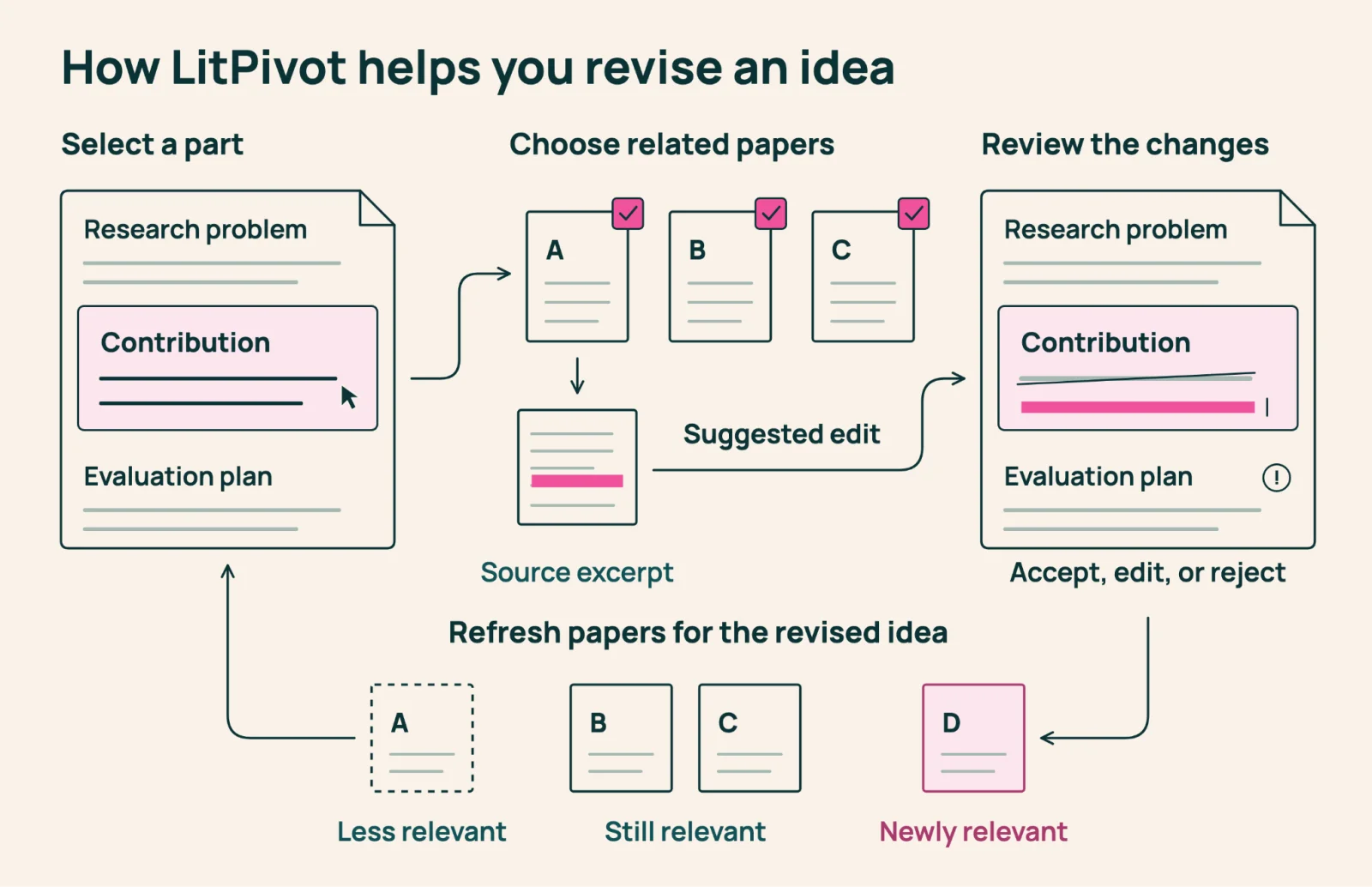 LitPivot workflow: select a proposal facet, choose papers, review a supported edit, and refresh the literature as the idea changes
Image: Ai2
The workflow, as Ai2 describes it:
- Write a short proposal in an editor and turn on facet highlighting. This segments the idea into a problem, a proposed contribution and an evaluation plan.
- Click a facet. An adjacent panel groups related papers based on the selected facet. For example, selecting the evaluation facet groups papers by the evaluation methods they use. The most relevant groups are highlighted.
- Pick papers and request an assessment. The system critiques the facet and suggests a revision, with supporting quotes attached.
- Review and decide. The researcher accepts, edits or rejects the suggestion. The literature is then reranked for the revised facet.
- Handle knock-on effects. Changing one facet can leave another outdated, so LitPivot flags passages that may need revision, such as an evaluation plan that no longer tests a changed contribution.
Each facet gets its own related-paper set and relevance ranking, and the assessment differs by facet:
| Facet | What LitPivot looks for |
|---|---|
| Problem | Evidence that the problem exists and reasons it matters |
| Contribution | What the selected papers already address versus the limitations and future work they describe, to find remaining gaps |
| Evaluation | Whether the proposed tests address the research question, and how similar work has been evaluated |
The design choice worth noticing is that the researcher controls both the draft and the evidence. Papers are not silently chosen by a model; the person picks which ones the system uses, and can change that as the idea develops. Ai2 contrasts this with scientific-writing environments and agentic assistants such as Claude Code, saying LitPivot explores a different workflow: choosing literature to assess an idea against, using that evidence to revise, and reconsidering which papers matter as the idea changes.
What the study found
In the lab study, 17 researchers each developed one assigned idea with LitPivot and another with a baseline: a text editor plus an AI tool for asking questions about selected papers. Both conditions used the same paper collection. Two domain experts, unaware of which system was used, rated the proposals on a single criterion: how well they used relevant literature to support and justify the idea. LitPivot proposals scored higher.
Participants also reported:
- a stronger understanding of the surrounding literature,
- greater self-reported improvement in their ideas' novelty, and
- greater self-reported improvement in usefulness, than with the baseline.
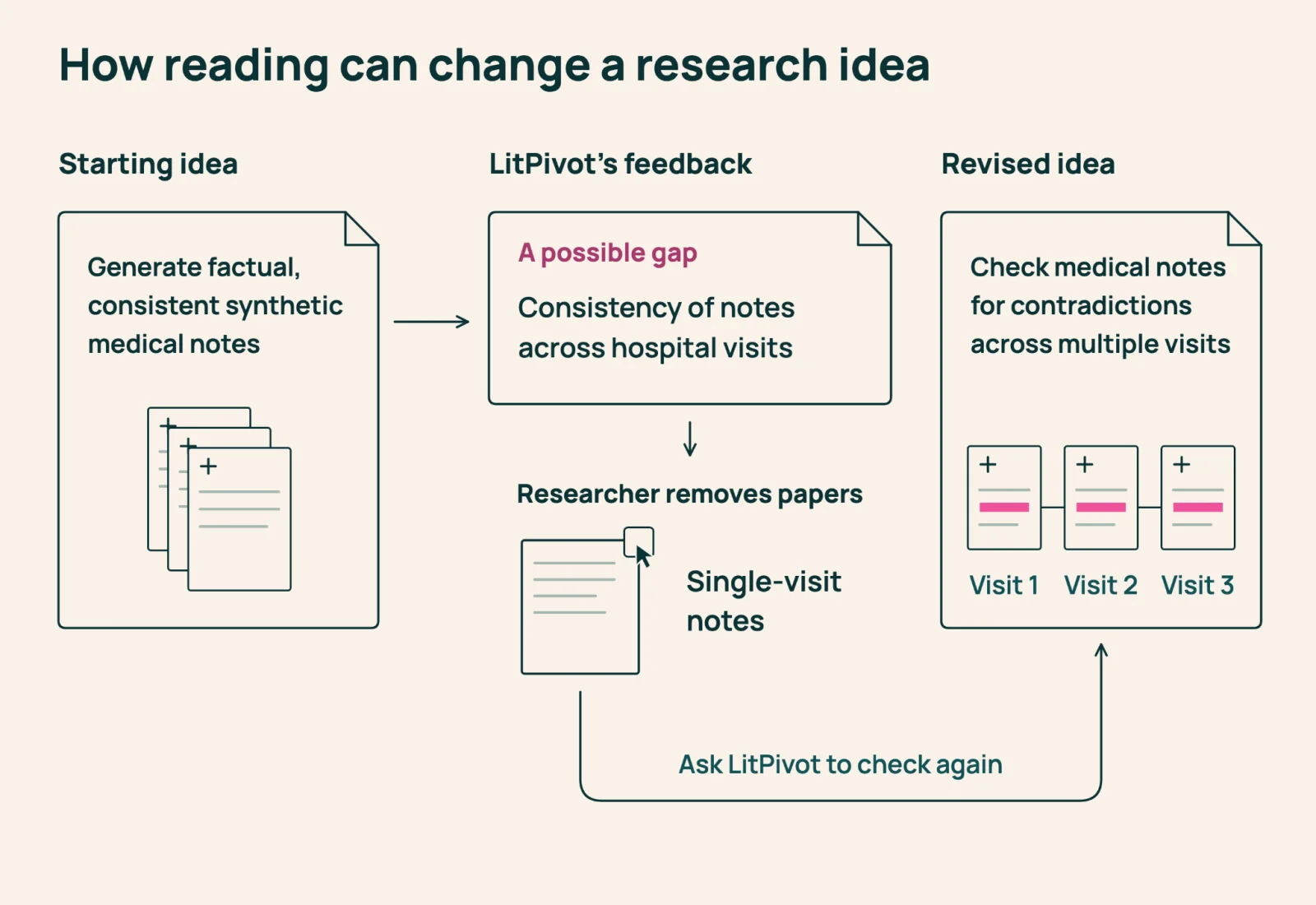 A researcher refines a proposal about synthetic medical notes into checking contradictions across multiple hospital visits
Image: Ai2
Ai2 gives one example. A participant began with a proposal to generate consistent, factual synthetic medical notes. LitPivot identified consistency across multiple hospital visits as a potential gap in the selected literature. The participant reviewed abstracts and removed papers about single-visit notes. After another assessment, they narrowed the idea to detecting contradictions across notes from multiple visits. Ai2's takeaway is that revising an idea and choosing the evidence used to assess it inform each other.
In a follow-up study, five researchers used LitPivot on their own ongoing projects during 30-minute sessions. Two used it to vet new ideas, and three used it to refine the framing of more mature ones. One researcher said seeing parallel concepts from different domains helped them reframe their contribution. Ai2 concludes that the tool can support both early exploration and refinement, and suggests the approach might extend to longer writing tasks such as a paper's introduction.
How to read the evidence
- Small samples. Seventeen researchers in the main study and five in the follow-up are typical for human-computer interaction work, and enough to show a direction, not to establish an effect size for all research fields.
- A narrow rating. Experts judged one thing: use of relevant literature. That is not the same as whether the idea is good, original or will succeed. The post does not claim otherwise, and it separately reports participants' perceptions of novelty, which are self-reported.
- A particular baseline. The comparison was against a text editor and an AI tool for asking questions about papers, with the same collection. It is not a comparison with other research assistants.
- Computer science focus. The pivot analysis used four computer science projects. Whether the same facets fit other fields is untested in this post.
- Authors' own system. As with most system papers, the researchers who built the tool ran the study.
Ai2's own earlier work is a useful caution here. Its recent study, "Old Ideas, Novel Problems," examines the limits of automated novelty evaluation. LitPivot's answer is to keep the human in the loop and make the evidence explicit instead of asking a model to decide novelty alone.
Where it fits in Ai2's science tools
Ai2 places LitPivot in a family of projects aimed at helping researchers formulate testable ideas and examine evidence. Its post lists:
- Asta, including Theorizer (theory generation from published findings), synthesis, and AutoDiscovery (hypothesis generation and testing on data),
- HARPA, which generates hypotheses informed by emerging research trends,
- Scideator, for recombining elements of prior work and assessing novelty, and
- IdeaSynth, for iterative refinement with literature-grounded feedback.
For more of Ai2's recent output, see our posts on its cited research report model AstaBrief, the FairStress fairness benchmark, the OlmoEarth v1.3 planet embeddings and the HiRO-ACE v2 weather emulator. For another view of AI in scientific practice, read our piece on Claude-shaped science and bootloops.
What this means for how you work
You cannot download LitPivot from this announcement, since the post describes a research system and a paper. But the workflow is easy to borrow with the tools you have:
- Split your idea into problem, contribution and evaluation before you search. Searching for each facet separately surfaces different papers.
- Choose the evidence yourself. Pick the papers an assistant should critique your draft against, and drop ones that do not apply, as the participant did with single-visit note papers.
- Ask for critique with quotes. Require supporting excerpts so you can check each claim against the source.
- Recheck the other facets after every change. A revised contribution can make your evaluation plan stale.
- Treat novelty verdicts as hints. Automated novelty evaluation has known limits, so confirm novelty by reading the papers yourself.
If you use AI tools to summarize papers, remember the cost of a wrong citation. Keep the original excerpt in view, and verify each quote against the paper before relying on it.
What to watch next
- A public release of LitPivot or its ideas inside Asta.
- Results in fields beyond computer science.
- Larger studies, and comparisons with other AI research assistants.
- The UIST 2026 presentation in Detroit, where the paper's full method details will be discussed.
Related reading
- AstaBrief: Ai2's 8B model for cited research reports
- Ai2 FairStress fairness benchmark
- OlmoEarth v1.3 planet embeddings
- HiRO-ACE v2 extreme weather emulator
- Claude-shaped science and bootloops
- Sources: Ai2 post on Hugging Face, LitPivot paper on arXiv
Details are accurate as of October 23, 2026 and come from Ai2's announcement; the arXiv paper may differ in wording and detail.