



Update — July 20, 2026: PsyArXiv study — AI advice kills "I don't know" (44%→3% ignorance admission; confidence 30%→76% with weak Step 3.5 Flash).
A junior developer pastes an error into Claude without reading it. The fix appears in seconds. The bug is gone. So is the learning opportunity. Repeat this two thousand times and you get someone who can ship code but freezes when production breaks at 2 AM.
This is AI-driven de-skilling: the systematic erosion of human capabilities caused by over-reliance on AI tools that bypass the deliberate practice required to build expertise. The term adapts labor economist Harry Braverman's 1974 deskilling thesis — originally about industrial automation stripping craft knowledge from workers — to the age of agentic coding.
The evidence that this is happening is no longer anecdotal. In 2026, multiple randomized controlled trials, global developer surveys, and industry hiring data converge on the same conclusion: AI coding tools boost short-term output at the cost of long-term skill formation, and the developers most at risk are the ones who can least afford it.
| Dimension | Finding | Source |
|---|---|---|
| Comprehension deficit | AI-assisted devs scored 17% lower on post-task quiz | Anthropic RCT (Jan 2026) |
| Code independence | 24% of juniors cannot write code without AI | BairesDev survey (June 2026) |
| Maintenance failure | 77% failure rate in AI-blackout maintenance task | Epistemic Debt study (2026) |
| Debugging atrophy | Majority of candidates could not explain their own code | Industry interview reports (2026) |
| Entry-level hiring | Junior implementation roles down 17% year-over-year | Job market data (2026) |
| AI experience demand | Postings requiring AI tool experience up 340% | Job market data (2026) |
What AI-Driven De-Skilling Actually Looks Like
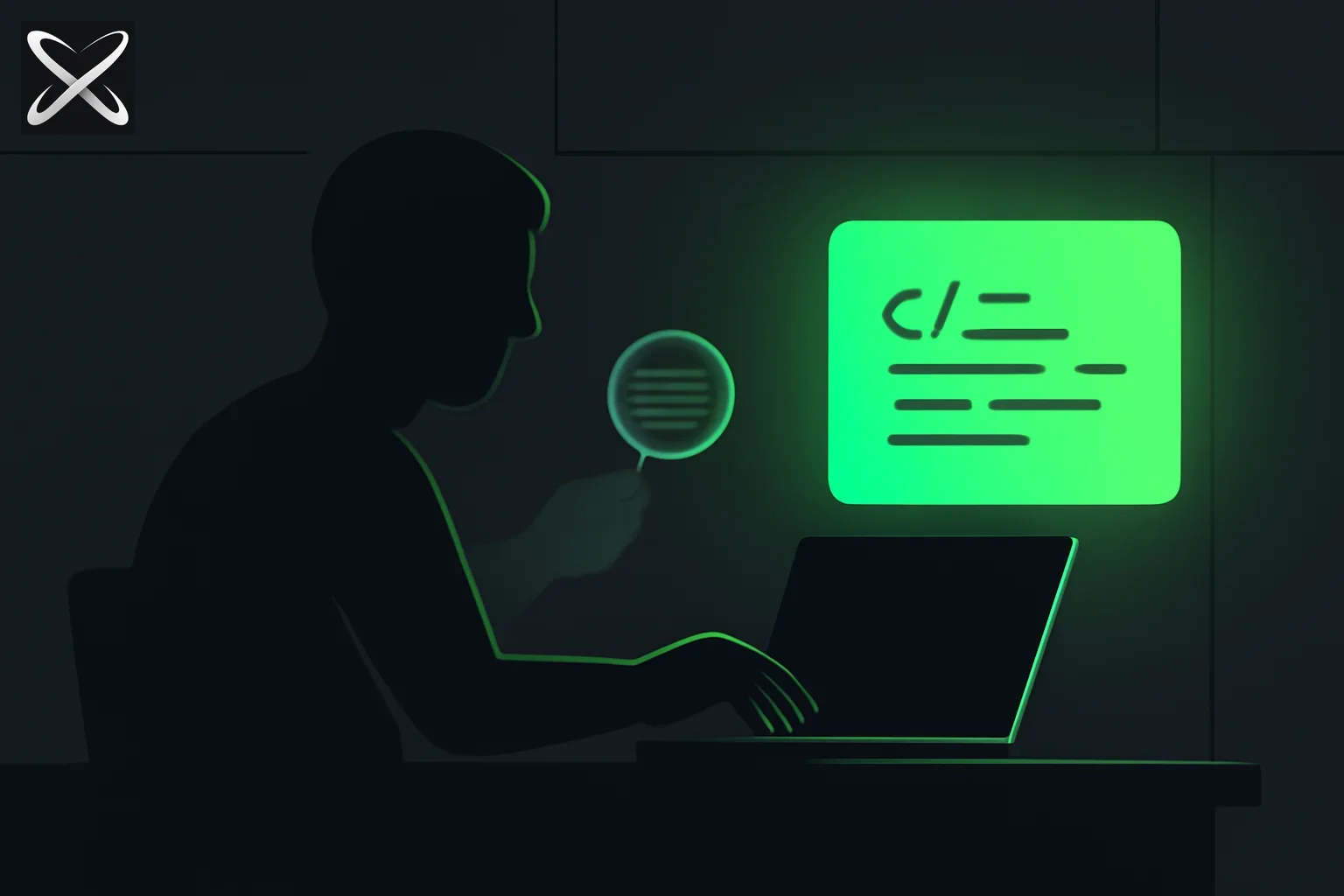 AI de-skilling diagram: a developer's debugging magnifying glass shrinking while an AI-generated code block grows
De-skilling is not a prediction about the future. It is a measurable phenomenon happening now, in four distinct forms.
The Comprehension Gap
Anthropic's January 2026 randomized controlled trial is the cleanest measurement to date. Fifty-two developers — all Python users, all unfamiliar with the Trio async library — were split into two groups. Both received documentation and web search access. One group also got an AI coding assistant.
The result: the AI group scored 17% lower on a comprehension quiz administered minutes after completing the task. The productivity gain the AI group was promised did not reach statistical significance. They were slower to learn and no faster to ship.
Shen & Tamkin's independent replication at a research lab found the same pattern: AI use impaired conceptual understanding, code reading, and debugging abilities. The effect size was large (Cohen's d = 0.738, p = 0.01).
The Confidence-Illusion Gap
BairesDev's June 2026 global survey of 1,569 developers across 77 countries captured a striking asymmetry: 85% of junior developers say AI has improved their understanding of software development, but only 16% of senior developers believe juniors fully understand the AI-generated code they submit.
This is not a measurement disagreement — it is a documented blind spot. Novices using AI tools consistently overestimate their own competence. The "Epistemic Debt in Generative AI-Scaffolded Novice Programming" study found that unrestricted AI users suffered a 77% failure rate in a subsequent 30-minute AI-blackout maintenance task, compared to only 39% in a scaffolded group. The AI users thought they were learning. They were not.
The Debugging Atrophy
Hiring managers in 2026 report a pattern that did not exist three years ago: candidates who can generate working code from scratch but cannot debug code they did not write. One interviewer documented that most candidates reached for an AI tool within the first minute of seeing an error, before forming a single hypothesis of their own. A majority could not walk through their own committed code line by line. Several had shipped code containing functions or fields that do not exist in the libraries they claimed to use — hallucinations that survived because tests mocked around them.
The Mid-Level Wall
The most insidious form of de-skilling is invisible until it is too late. Entry-level implementation roles declined 17% between January 2025 and January 2026. Job postings requiring AI tool experience increased 340% in the same period. The ramp into the profession is shifting: juniors now spend their first years orchestrating AI code generation rather than writing code themselves. The skills that previous generations built by accident — debugging unfamiliar code, reading large codebases, reasoning about systems — are no longer forced by the tooling. Developers who skip them arrive at year three with the output history of a senior and the intuition of someone who never struggled.
Why AI De-Skilling Hits Juniors Hardest
The mechanism is straightforward and grounded in cognitive science. AI tools do not merely speed up coding — they change what the developer thinks about. When a junior pastes a task into Claude and receives complete code, they bypass the cognitive processes that build mental models: parsing the problem, decomposing it into steps, iterating on a flawed first attempt, and debugging the result.
A summary circulating in psychology circles puts it precisely: "Adults who offload thinking to AI lose capacity they built. Children may never build it at all." A senior engineer who uses Copilot for boilerplate retains the ten years of debugging intuition they accumulated before the tool existed. A junior who writes their first 10,000 lines through AI never accumulates that intuition in the first place. The two situations look identical from the outside. They are completely different on the inside.
The AIRELI Persona Taxonomy, from a 2026 controlled study of 21 developers, identifies three distinct patterns:
| Persona | Behavior | Comprehension Outcome |
|---|---|---|
| Self-sufficient | Uses AI selectively, verifies output independently | Deep understanding retained |
| Understanding-gated | Uses AI for execution, retains conceptual control | Moderate understanding |
| AI-steered | Delegates end-to-end, accepts output uncritically | Minimal comprehension |
The AI-steered persona is the de-skilling risk profile. These developers complete tasks quickly but cannot explain, debug, or modify the output without AI. The study found that aggregate comparisons between AI and No-AI conditions masked these stark internal differences — the persona lens revealed the true variation.
This is consistent with the interaction patterns identified by Shen & Tamkin. Developers who used AI for conceptual questions — "explain how this pattern works" — scored 65-86% on comprehension assessments. Developers who used AI primarily for code generation scored below 40%. The difference is not about whether AI is used. It is about how.
The Structural Incentive Problem
Individual developers are not solely to blame. The organizational pressures are real: ship faster, close more tickets, show output. AI tools deliver on the metrics that managers track. The costs — fragile code, shallow understanding, graduates who cannot debug — accumulate on a different balance sheet.
GitClear's analysis of millions of commits found that the rate of churned code (lines added and removed within two weeks) has roughly doubled since Copilot went mainstream. METR's randomized study found that developers using AI tools felt 20% faster but were measured 19% slower — they generated more code but spent the saved time verifying and reverting it. The productivity gain surfaces as narrative, not data.
The "spurious productivity" framing from the NSF-funded SPACE framework study captures this: surface-level acceleration that obscures redistributed effort. AI shifts cognitive load from code generation to code verification, from writing to reviewing, from creating to debugging. The total effort may not decrease — it just moves to a different, less visible phase of the workflow.
How to Prevent AI-Driven De-Skilling
The evidence does not support banning AI tools. It supports using them deliberately. The same studies that document de-skilling also identify the interaction patterns that preserve learning.
| Strategy | How It Works | Evidence Base |
|---|---|---|
| Hypothesis first | Form your own guess before consulting AI | Builds the mental model even when wrong |
| Explain before accept | Verbalize why the AI suggestion works | Forces cognitive engagement (Shen & Tamkin) |
| AI-free debugging | Fix one bug per week without AI | Maintains debugging pathways |
| Conceptual prompting | Ask AI to explain, not generate | 65-86% comprehension (vs <40% for generation) |
| Teach-back protocol | Explain the code to someone else after writing it | Closes the confidence-illusion gap |
| Critique-the-AI phase | Actively test and modify AI output | Builds verification skills |
The strongest recommendation across all studies is the same: treat AI as a consultant, not a contractor. The developers who retain skill formation do not use AI to bypass thinking. They use it to accelerate thinking they are already doing. They scaffold their own learning by asking conceptual questions, verifying output, and periodically working without AI.
For organizations, the implication is that onboarding programs and code review processes need to account for the de-skilling risk. Pair programming with seniors who challenge AI output, structured AI-free coding intervals, and explicit expectations around code ownership all mitigate the effect. The companies that treat AI as a productivity lever without addressing skill formation will find themselves with a workforce that can generate code but cannot own it.
The Senior Engineer of 2035
The question that keeps engineering leaders up at night is not whether AI can write code. It is where the next generation of senior engineers, architects, and technical leads will come from if the current generation of juniors never builds the foundation.
The seniors of 2035 are the juniors of 2026. If those juniors spend their formative years orchestrating AI output without understanding it, the industry faces a bottleneck that no amount of inference compute can solve. Debugging legacy systems, incident response, system architecture — these are skills that require deep understanding, not prompt engineering.
The developers who will thrive are the ones who treat the productivity boost as a gift of time and use that time to build deeper understanding, not to skip it. The tools will keep getting better. The skill of using them well — and knowing when not to — will only become more valuable.
Related Reading
- Update — September 16, 2026: A viral essay from a senior DeepSeek kernel engineer reframes this debate at the top of the skill ladder — not job loss, but the specific craft of hand-optimization becoming obsolete within a year. DeepSeek engineer: "I have to bury my talent in yesterday" →
- Update — September 15, 2026: A new study found frequent video gamers test cognitively better, unrelated to mental health — the opposite pattern from de-skilling, and a useful contrast on what active engagement actually protects. Video games build cognitive reserve; heavy AI reliance may do the opposite →
- AI resolves your incidents — are you still able to? — the same de-skilling mechanism in incident response, backed by Bainbridge's 1983 "Ironies of Automation" research
- Microsoft Says Coding Is "Worth It Now More Than Ever" — X Disagreed — the viral tweet and what we think actually matters: framework literacy, not manual syntax
- The Generative AI Learning Penalty: same pattern in 26,811 students — homework scores up 18%, exam scores down 20%, same outsourcing mechanism as the de-skilling effect above
- LLM simulation games for learning: the ChipTycoon HN debate (Aug 10)
- Should you manually retype LLM code? The cognitive debt debate (Aug 4)
- "If You Want Taste, You're Gonna Have to Eat" — Jason Liu's essay, explained — the judgment-side companion to this deskilling story
- Ethan Mollick on deskilling with AI — individual vs team risk — the same mechanism seen in low-stakes chores rather than coding
- Should Developers Stop Reading AI-Generated Code?
- AI advice kills "I don't know" — cognitive surrender study (Jul 20)
- GLM-5.2 vs Claude Fable 5: Kilo Code's Planning Benchmark
- Lars Faye — AI coding will prevent expertise (Aug 25)
- What Are Agent Skills? Complete Guide
- Loop Engineering: The New Paradigm Beyond Prompt Engineering
- AI Benchmarks in 2026: Complete Guide
- Claude Code for Large Codebases
- "LLMs as a Cognitive Virus": A New Paper Models AI Dependence as an Epidemic — a mathematical framework for the tipping point this deskilling pattern feeds into
Research cited: Anthropic "How AI Assistance Impacts Coding Skills" (Jan 2026); Shen & Tamkin "How AI Impacts Skill Formation" (arXiv 2601.20245); BairesDev Dev Barometer (June 2026); Alakmeh et al. "AIRELI Persona Taxonomy" (ICPC 2026); Sankaranarayanan et al. "Epistemic Debt in AI-Scaffolded Novice Programming" (arXiv 2602.20206); Catalan et al. "Cognitive Engagement with ACAs" (CHI 2026); Prather et al. "The Widening Gap" (ICER 2024); NSF "The Fast and Spurious" (SPACE framework, 2026). All findings are accurate as of publication date. Version specs, model capabilities, and research results may change.