



A Wall Street Journal report published on November 26, 2026 says memory chip shortages have pushed companies worldwide to set up procurement "war rooms," and that prices for some chips have risen about tenfold in a year. We could not read the paywalled article itself. This post works from summaries of it and from research figures we can check, and it says which is which.
The cause is not in dispute. AI data centers want huge amounts of memory for training and running models, and the three firms that make nearly all of it, Samsung Electronics, SK Hynix and Micron, are struggling to add supply fast enough. What is in question is the size of the price move, and that depends on which chip you mean.
TL;DR: reported vs checkable
| Claim | Status |
|---|---|
| Some memory chip prices up 10x in a year | The WSJ's reported figure for certain chips; not an average and not independently checked here |
| Companies are running procurement war rooms | Reported by the WSJ, as summarised by other outlets |
| DRAM revenue up 177% in 2026 | IDC projection, cited by GEP |
| Conventional DRAM contract prices up 90 to 95% quarter on quarter early in the year | TrendForce forecast, cited by GEP |
| Shortage lasts until new factories open in 2028 | Expectation reported in the WSJ summary |
| Firms are bribing chipmakers | Appears in some secondary summaries only; unconfirmed |
| Consumer price hikes at Apple, Microsoft, Amazon, Meta | Relayed from the report; not checked against company pages |
What the WSJ reported
As summarised by Hindustan Times and other outlets that relayed it, the story opens at Blackmagic Design, an Australian video gear maker, where chief executive Grant Petty has watched his team grow frustrated by rising memory prices. It then widens to firms across the industry. The reported details:
- Companies have set up procurement war rooms and scour online listings for scarce chips.
- Prices for certain memory chips have surged tenfold over the past year.
- Chip suppliers are asking for binding contracts with longer terms and higher upfront payments.
- Procurement executives are under pressure to secure supply or risk their jobs.
- Taiwanese flash-drive maker Apacer took out loans so it has cash ready when chips become available.
- Motorola cut storage and display size on its latest phones while raising the starting price.
- Even Elon Musk has had trouble securing long-term commitments, according to the summary.
- Thieves have targeted chip supplies for resale.
Treat these as the report's claims, relayed by rewrites. The most colourful detail, bribery, appears in some rewrites only, and others word it more softly.
Is 10x plausible?
For some parts, yes; as a general figure, no. Research firms describe steep but smaller average moves. IDC describes a memory market where demand is materially outpacing supply, and projects DRAM revenue up 177% in 2026. TrendForce raised its forecast for conventional DRAM contract prices to a 90 to 95% quarter-on-quarter jump early this year, among the steepest on record, per the GEP procurement analysis.
Averages and single parts differ. A chip that was cheap, short-lived in supply and sold on the spot market can rise by an order of magnitude while contract prices for large buyers rise by a fraction of that. That is the most likely reading of "some chips rose 10x." Without the underlying price table, we cannot name the parts.
 Stacked memory chip beside a gauge pointing high, showing memory chip shortage price pressure on DRAM
Why AI demand squeezes everyone else
Memory makers earn more on the high-bandwidth memory (HBM) that sits beside AI accelerators, so they have shifted production toward it. GEP says Samsung, SK Hynix and Micron have moved capacity toward the high-bandwidth chips that feed AI accelerators, which leaves less for the DRAM that goes into phones, laptops and consoles. Allocation then goes to buyers with committed agreements and credible demand signals.
The squeeze also reaches power components in every server rack, such as voltage regulators, converters and current sensors. These parts also go into vehicles, industrial equipment and medical devices, so a carmaker's sourcing team competes with a data center build-out for the same hardware.
We have followed the pressure from several sides: Apple and Samsung cutting 2027 phone shipment targets, Dell's record AI server backlog, reports of 40-week B300 lead times and Sam Altman's unannounced Korea visit about memory.
Which products got more expensive?
As relayed from the report, and not yet checked against each company's price page:
| Product | Reported change |
|---|---|
| Apple MacBook | Up 100 to 500 dollars, depending on the model |
| iPhone 18 Pro and Pro Max | Up 100 dollars |
| Microsoft Xbox | Up 33%, to 600 dollars |
| Amazon Echo Dot | Up 60%, to 80 dollars |
| Meta Quest 3 | Up 50 dollars, to 350 dollars |
Company pages are the place to confirm any price before you act on it. The pattern matters more than the individual figures: the memory shortage is now visible at the cash register, not only in server quotes.
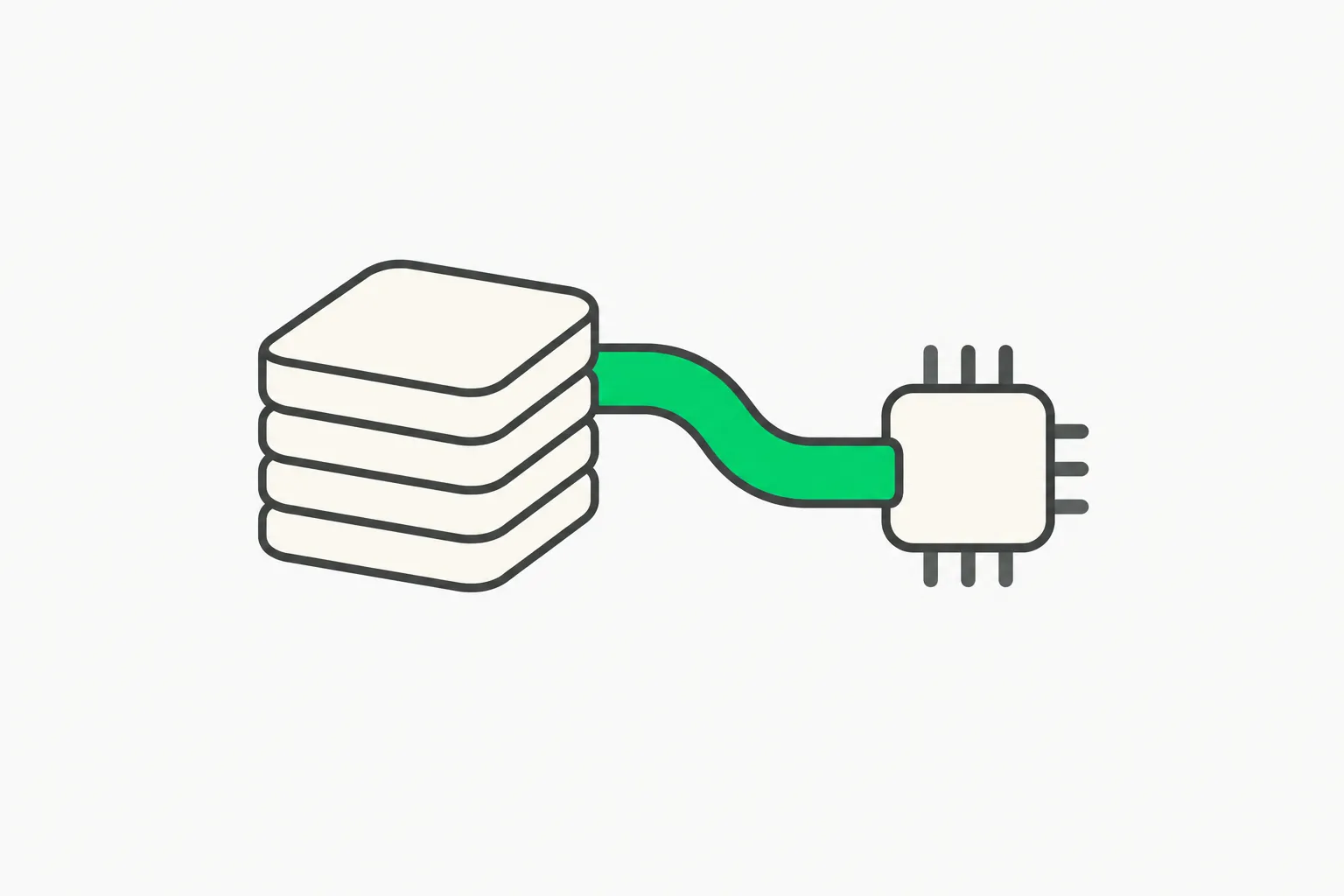 A green channel joining a stack of wafers to a small chip, standing for high-bandwidth memory pulling supply from ordinary DRAM
How long will it last?
The report says relief is expected when new factories come online in 2028, even if predictions of a slowdown in data center construction prove right. Memory fabs take years to build, so a demand slowdown does not quickly help buyers. Early in 2026, Tom's Hardware reported that senior executives were already flying abroad to meet suppliers face to face, because allocation, lead times and geopolitical friction now govern supply chains. Nine months later the same pressure has spread from AI labs to consumer electronics makers.
What people are asking
Is it only AI causing this? AI is the driver the reporting names, and the supply side explains why: capacity moved to HBM. Other demand exists, but GEP's analysis frames AI infrastructure as the force setting prices for everyone else. Competition now extends beyond the AI sector into automotive, industrial and medical buyers.
Why can't makers just build more? New fabs take years. The report points to 2028 for new factories. Until then, existing capacity is split between higher-margin HBM and conventional DRAM, and the split favours HBM.
Will RAM prices drop soon? The reporting gives no sign of a near-term fall. If data center building slows, prices could ease at the margin, but the report says the shortage is expected to last until new factories open even in that case. Check current spot and contract prices before you plan a purchase, since they change weekly.
Why do suppliers want longer contracts? When supply is scarce, a seller wants certainty that a buyer will keep paying. Longer terms and larger upfront payments move risk to the buyer. For a start-up, that can tie up cash. A company like Apacer, reported to have taken out loans to be ready when chips become available, shows how far the cash pressure goes.
Does this affect running AI locally? Yes, indirectly. More RAM and bigger GPUs cost more, which raises the price of a local setup. Smaller or quantized models that fit in less memory become more attractive. See our coverage of how Inkling 2 Mini runs in 4 GB of GPU memory for one example of fitting a model into a tight budget.
How should I read a price headline like "10x"? Ask which part, which market (spot or contract), and over which period. A tenfold rise in a single part on the spot market is a different fact from a tenfold rise in what a large buyer pays. The research figures above show contract prices rising sharply but less than that.
What to do if you buy hardware or cloud
- Get quotes with expiry dates. Prices move quickly, and a quote with no end date is a risk for the seller, so expect short windows.
- Consider longer contracts if you can forecast demand. Suppliers are reported to want longer terms and higher upfront payments. That helps supply and hurts cash.
- Design for less memory where you can. Smaller models, quantization and context limits cut memory need.
- Do not assume cloud is immune. Servers need the same memory, so cloud prices can follow with a lag.
- Watch for scams. Scarcity pushes buyers to online listings, where counterfeit or stolen parts exist. The report notes thieves have targeted chip supplies.
What this means for what you build or pay
For builders, memory is now a line item worth tracking next to GPU hours. If you run local models, the cost of more RAM or a bigger GPU may rise. For founders, hardware products with thin margins will either raise prices or cut specs, as Motorola reportedly did. For marketers, expect higher device prices to shape holiday demand and to make "upgrade" offers harder.
What we could not verify
- The original WSJ text, including the exact parts and the price table behind the 10x claim.
- The bribery detail, which appears only in some secondary summaries.
- The list of consumer price rises, which we have not matched to company price pages.
- Whether the 2028 relief estimate comes from the WSJ's own reporting or from analysts it quotes.
Related reading
- Apple and Samsung cut 2027 phone shipment targets on the AI DRAM shortage
- Dell Q3 FY27: record AI server backlog
- Nvidia B300 40-week lead times: claimed vs verified
- Altman's Korea visit and HBM talks: what is reported
- Kioxia and Nvidia SCADA on GB200 NVL72
- CBS: Nvidia partners that are Chinese-owned
Details are accurate as of November 26, 2026. Prices and forecasts change quickly.