



Kioxia says it has shown, with Nvidia, a way to push effective GPU memory past one petabyte by using flash. In a November 26, 2026 release distributed via Business Wire, the company described a proof of concept on an Nvidia GB200 NVL72 rack with 144 Kioxia XD8 Series SSDs, using Nvidia's SCADA software. The setup showed the potential to process a database of 2 trillion vectors.
The result is a hardware demonstration, not a product. But it points at a real pressure: AI datasets are growing faster than high-bandwidth memory, which is scarce and expensive. This post explains the design, checks the numbers, and says what the release does and does not show.
TL;DR: the demo in numbers
| Item | What Kioxia reports |
|---|---|
| Hardware | Nvidia GB200 NVL72 rack, 18 server nodes |
| Storage | 144 Kioxia XD8 Series 7.68 TB E1.S NVMe SSDs |
| Raw flash | About 1.1 PB |
| Per node | 8 SSDs, nearly 60 TB of flash-based extended memory |
| Software | Nvidia SCADA and Storage-Next technologies |
| Access size | 512 bytes |
| Scale shown | Potential to support 2 trillion 512-byte vectors |
| Status | Proof of concept; both firms still evaluating feasibility and performance |
What SCADA is
Kioxia defines Nvidia SCADA, short for Scaled Accelerated Data Access, as "a software library designed to extend effective GPU Memory capacity using NVMe SSDs, including for fine-grained data access using small block sizes." In plain terms, it lets a GPU read data from SSDs in small pieces instead of staging big chunks through the host first.
The release says processing large datasets with HBM alone can force teams to split work into smaller segments and move data back and forth between memory and slower storage. SCADA and the Storage-Next software aim to make the larger dataset reachable from the GPU side, so that the working set is not capped by HBM.
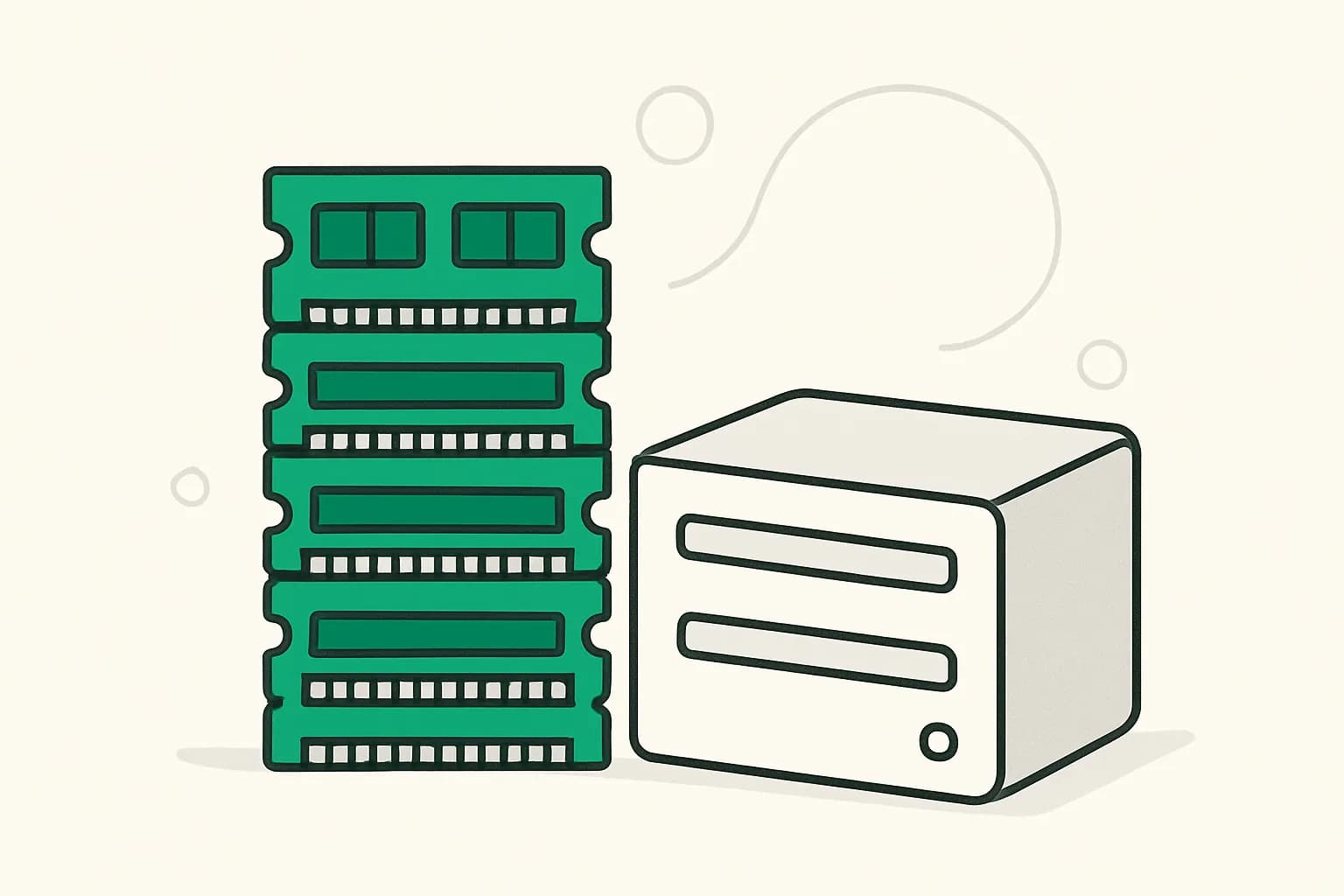
 A shelving unit of dot clusters with one cell lit, picturing a large vector database held on flash
Checking the arithmetic
The numbers in the release are consistent.
- 144 drives times 7.68 TB is about 1,106 TB, which matches "approximately 1.1 PB" of raw flash.
- Eight drives per node across 18 nodes gives 144 drives.
- 2 trillion vectors at 512 bytes each is about 1.02 PB.
That last figure is worth noticing. The vector data alone fills close to all of the raw flash, which leaves little room for indexes, copies or error-correction overhead. The release says the system has the "potential to support" this scale, and a footnote says the proof-of-concept testing was performed as of November 26. It does not claim a full 2-trillion-vector run with measured query speed. Treat it as a capacity-feasibility demonstration.
Why 512-byte access matters
Many storage systems are tuned for large sequential reads. Vector search and graph neural network workloads often fetch many small, scattered records. A 512-byte access size matches that pattern, and it is why the same day's separate GP2 Series announcement matters: Kioxia says its GP2 SSD delivers over 18 million random read IOPS at a 512-byte block size, nearly double the GP1 Series announced in August 2026. Small-block random read speed is the number that decides whether flash can feed GPUs.
The demo used the XD8 Series, not the GP Series. Kioxia says it continues to develop both. The release does not say which drives a future product would use.
What Nvidia said
Jason Hardy, Nvidia's VP of Storage Technology, is quoted in a summary of the release: "The intelligence of AI agents will increasingly depend on the knowledge they can access, not just the compute power they consume." He said SCADA and Storage-Next aim to improve memory efficiency and extend the effective capacity of GPU memory so that agents can reach far larger knowledge bases.
That framing ties the work to agent memory and retrieval. A larger retrievable store, kept close to the GPU, is the goal. Whether flash can serve it at useful latency is the open question.
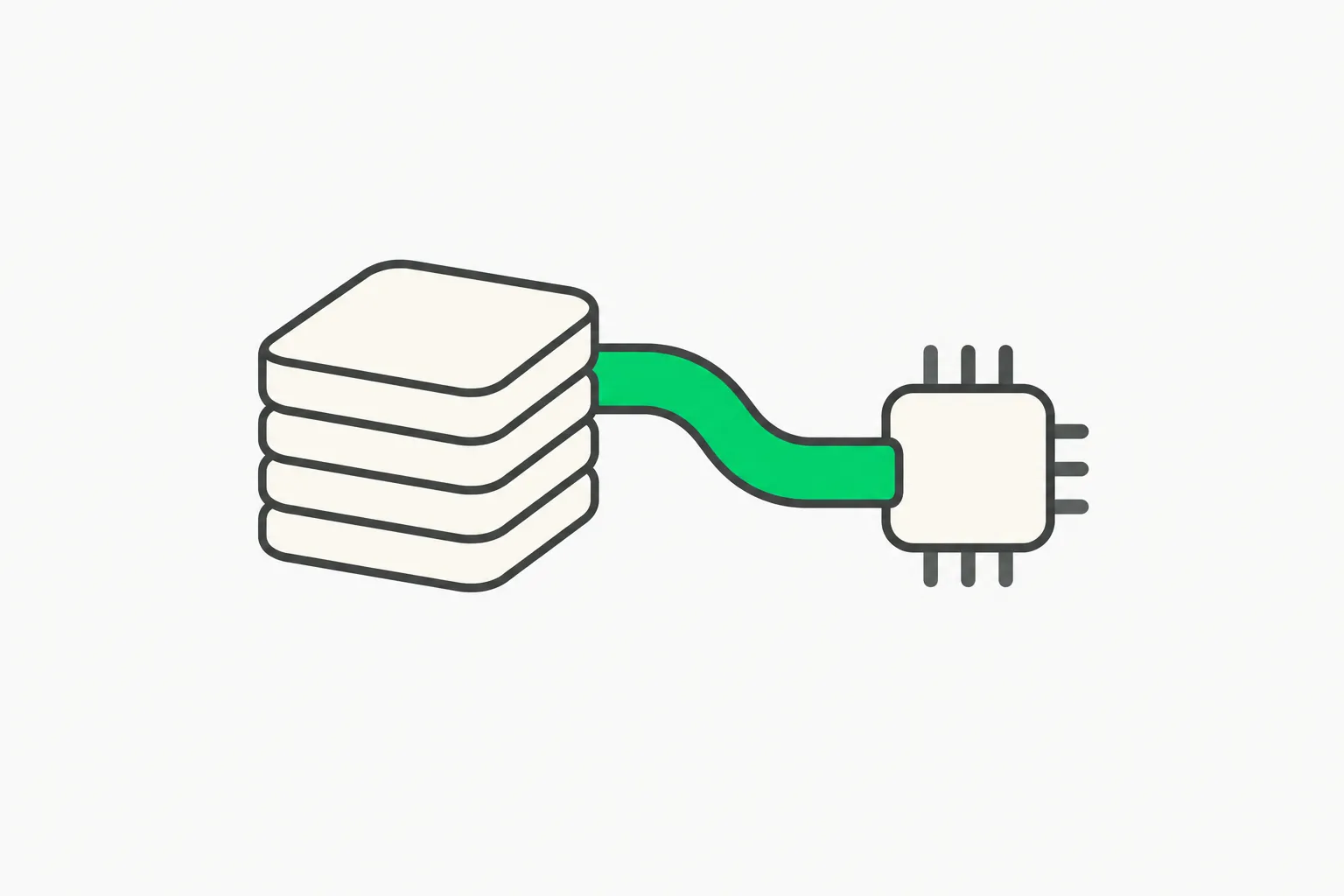 A green channel joining stacked wafers to a small chip, picturing high-bandwidth memory next to slower flash
The memory ladder: where flash sits
AI systems use a ladder of memory types. Each step down holds more data and answers more slowly.
| Tier | Typical role | Trade-off |
|---|---|---|
| HBM on the GPU package | Model weights, active data | Fastest, smallest, most expensive per byte |
| Host DRAM | Overflow, caches | Larger, but reached over a slower link |
| NVMe SSD | Datasets, checkpoints, indexes | Much larger and cheaper per byte, slowest of the three |
The conventional way to use the bottom tier is to have the CPU read blocks from the SSD and hand them to the GPU. That works well for big, sequential reads and badly for millions of tiny random ones, because the CPU becomes the bottleneck. SCADA, as Kioxia describes it, is aimed at the second case: fine-grained access with small blocks, so the GPU can ask for the 512 bytes it needs rather than a large block that mostly goes unused.
This is why the demo is described as extending "effective" GPU memory. The flash does not become HBM. It becomes a tier that software can reach directly, and the software hides the fact that the data lives elsewhere. Whether that illusion holds depends on how many small reads per second the drives can serve and how well the GPU can hide the wait, which is exactly what the release leaves unmeasured.
Who would use it first
The release names two workloads: large vector databases and graph neural networks. Vector databases store embeddings used for search and for retrieval in agents. Graph networks work on relationships between items, such as users and products, and need many small lookups. Both are limited by how much of the graph or index can sit near the GPU.
Teams working at the scale of billions of vectors already split indexes across many machines. A rack that can hold a trillion-scale index on its own would simplify that. But the release does not show query accuracy, update speed or cost, so any claim of a simpler stack is a guess today.
Reading vendor storage demos
A short checklist for any "petabyte of GPU memory" headline:
- Capacity is not performance. Ask for random-read throughput and tail latency at the block size your workload uses.
- Raw is not usable. Raw flash is before redundancy, indexes and spare area. The vector data in this demo would nearly fill the raw capacity, so a real deployment would need more drives.
- Proof of concept is not production. The release says both firms are still evaluating feasibility and performance.
- Ask who tested it. Here, the testing was done by Kioxia and Nvidia, as a footnote states.
- Check the date. The footnote dates the testing as of November 26, 2026.
What the release does not say
- No latency or throughput. There is no measured query time, bandwidth or tail latency for the demo.
- No comparison. There is no head-to-head against a CPU-memory or HBM-only setup.
- No product or price. SCADA is described as software under evaluation, and no ship date appears.
- No workload names. The release mentions vector databases and graph neural networks in general terms.
- Vendor source. The numbers come from Kioxia and are footnoted as its and Nvidia's proof-of-concept testing.
How this fits the memory squeeze
HBM is the scarce part of AI servers. Flash makers want a bigger role. Our report on SK Hynix becoming Kioxia's largest shareholder covers the ownership side, and our Kioxia Q2 results post looks at demand for AI NAND and the claim that 2027 supply is sold out. A demo that makes flash look like part of GPU memory is good for the story Kioxia wants to tell.
Memory shortages already reach consumer hardware; see our post on Apple and Samsung phone shipment cuts tied to the AI DRAM shortage. And for another approach to the HBM bottleneck from China, see the Huawei custom HBM ISSCC 2027 paper. Nvidia's own software work on memory is covered in our NVFP4 attention post.
What this means for builders and buyers
If you run large vector search. Today you shard across GPU memory or fall back to CPU and disk. SCADA-style access, if it matures, could let one rack hold a far larger index. Do not plan around it yet; ask Nvidia and your storage vendor when SCADA will be available and what latency to expect.
If you buy AI servers. Treat this as a signal about direction. Storage vendors are positioning flash next to GPUs. Ask for measured numbers on your own query mix.
If you build agents with big knowledge bases. The pitch is that retrieval can live closer to the GPU. Until numbers appear, keep your current retrieval design and test new options on real data.
If you follow memory stocks or supply. The release gives no revenue or order data. It is a technical demonstration.
How to follow up
Watch Kioxia's newsroom and Nvidia's developer pages for SCADA documentation, benchmark data and any availability notes. Also look for independent tests; the release is vendor-authored. We will update this post if measured results appear.
Related reading
- SK Hynix becomes Kioxia's largest shareholder
- Kioxia Q2 results and the sold-out 2027 claim
- Apple and Samsung 2027 phone shipment cuts and the DRAM shortage
- Huawei custom HBM at ISSCC 2027
- Nvidia NVFP4 attention on Blackwell
- Dell Q3 FY27 AI server backlog
Details reflect the Kioxia release of November 26, 2026. The demo is a proof of concept and is not a product announcement.