



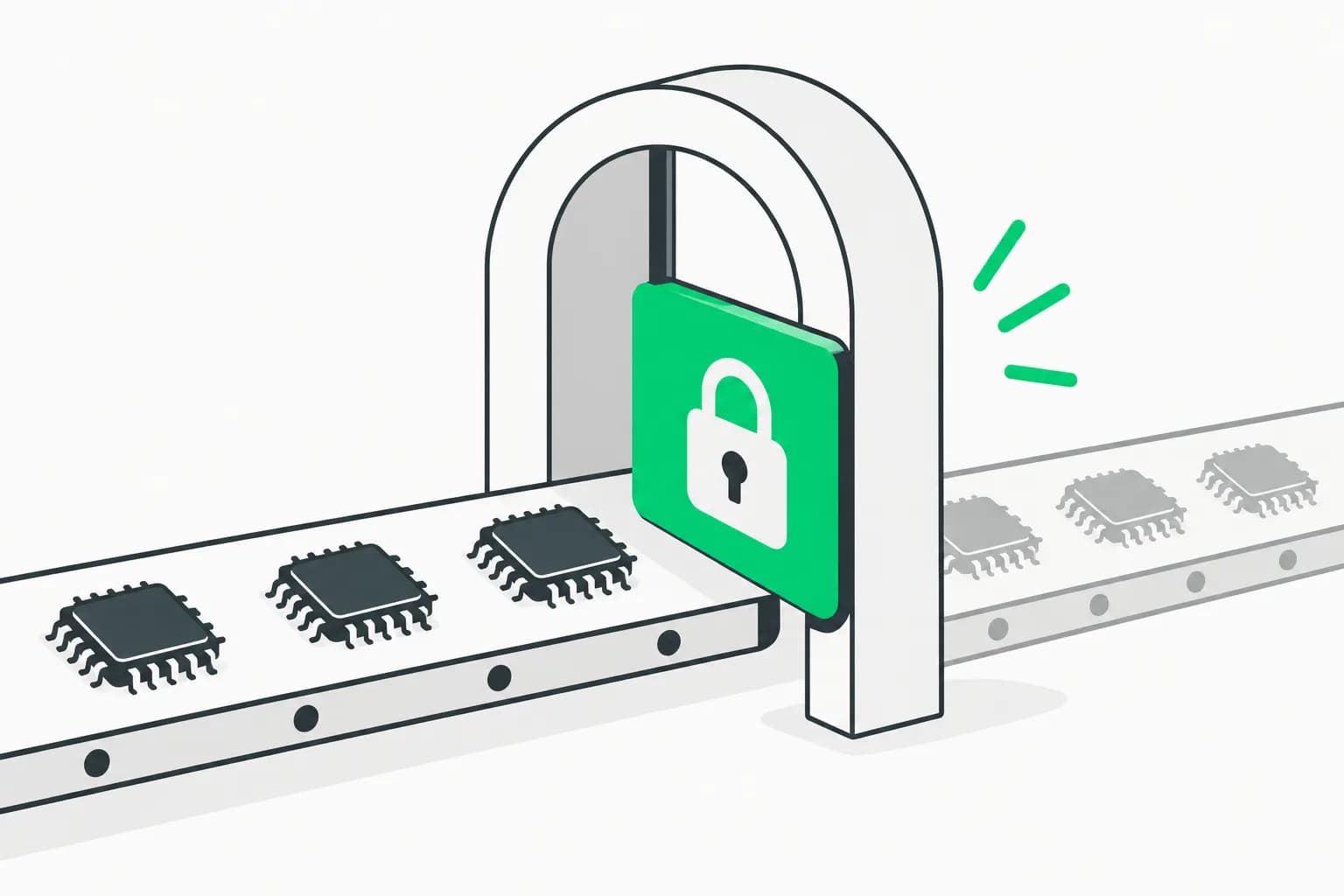
The US Treasury on October 22, 2026 published a proposed rule that would let it ban, or require notice of, American investments in foreign adversaries' companies working on AI systems, semiconductors, quantum, supercomputing, hypersonics and biotechnology. It is a notice of proposed rulemaking that implements the Comprehensive Outbound Investment Security (COINS) Act, which Congress passed inside the Fiscal Year 2026 National Defense Authorization Act, according to Treasury's announcement. Nothing is final yet: comments come first, and final regulations will set the effective date.
For AI builders the practical question is narrow but real: who can fund, join or supply a company that works on frontier AI in a country the US treats as an adversary. This post lays out what Treasury says, what outside reporting adds, and what remains to be checked in the full notice. For the wider policy backdrop see our coverage of the US move to block China's remote GPU access and the 2026 AI export-control timeline.
TL;DR: the Treasury COINS Act proposal
| Question | Answer |
|---|---|
| What is it? | A notice of proposed rulemaking updating the Outbound Investment Security Program (OISP) |
| Which law does it implement? | The COINS Act, part of the FY2026 NDAA |
| What would US persons have to do? | Notify Treasury of certain deals with "notifiable" technology firms; be barred from certain deals with "prohibited" technology firms |
| Sectors | Semiconductors and microelectronics, AI systems, quantum, high-performance computing, hypersonics, biotechnology |
| Countries | Treasury says "foreign adversaries"; AP reports China, Russia, North Korea and others |
| Dollar threshold | Not in Treasury's release; AP reports $50,000 |
| Is it in force? | No. Proposal only; final rule sets the effective date |
| Where to comment | Treasury says the deadline is in the NPRM on regulations.gov |
What Treasury actually said
Treasury's announcement says the proposed regulations would require US persons to notify it about certain transactions involving covered foreign persons engaged in notifiable technologies, and would prohibit certain transactions involving covered foreign persons engaged in prohibited technologies. Treasury would set the technical parameters that decide which products and technologies fall into each bucket.
The notice also covers who is bound (including controlled foreign entities of US persons), categories of covered transactions, definitions, excepted transactions, what a notification must contain, a process for non-binding feedback and confidential submissions, a knowledge standard based on reasonable and diligent inquiry, and penalties for violations.
Treasury's own quotes frame it as national security policy. Secretary Scott Bessent said the department is "committed to putting America's national security first" and that the rule would strengthen the existing program so adversaries cannot use US investment to build critical technologies. Assistant Secretary for Investment Security Christopher Pilkerton said the rules are designed to address risks that arise when foreign adversaries try to benefit from US investment in key technology sectors.
How this builds on the existing program
The history matters, because the 2026 rule changes scope rather than inventing the concept.
- 2023: President Biden's executive order restricted US outbound investment in semiconductors, quantum computing and AI going into China, and Treasury set up the Outbound Investment Security Program, as the AP summarizes it.
- Early 2025: Treasury's earlier final rule took effect; law-firm summaries from that period describe a prohibit-or-notify structure covering semiconductors, quantum and AI. See Holland and Knight's overview.
- December 2025: Congress codified the program through the COINS Act and widened it to more technologies and more countries, per the AP.
- October 22, 2026: Treasury proposes the regulations that put those statutory changes into practice.
The Congressional Research Service has a primer on outbound investment regulation that is useful context. One search result summary says Congress directed Treasury to issue regulations within 450 days of enactment, which would put the statutory deadline around March 2027. We have not verified that date against the statute, so treat it as unconfirmed.
What is new: the sector list
Compared with the original program's trio of chips, quantum and AI, Treasury's list now adds high-performance computing and supercomputing, hypersonic systems and biotechnology. Treasury says biotechnology is added under the Secretary's authority to define technologies beyond those named in the COINS Act.
The AP, in its report carried by ABC News, says the AI category is described by Treasury as "superintelligence," abbreviated SI. Treasury's press release lists "artificial intelligence systems" among the statutory sectors, while the NPRM's own list of areas reportedly uses "super intelligence systems." The exact technical definition, and where the line falls between a notifiable and a prohibited AI system, sits in the notice itself. If you work on frontier models, read that definition in full before drawing conclusions.
Countries and thresholds: what is and is not confirmed
Treasury's press release does not name countries or dollar thresholds. The AP reports:
- The rule covers China, Russia, North Korea and other countries of concern, and the December 2025 law also names Cuba and Iran.
- It applies only to investments above $50,000 and would exclude many financial investments, including stock purchases.
We could not confirm either point against the Federal Register text in the time available, so we attribute both to the AP.
Reactions from lawyers and analysts
The AP quotes several observers:
- Craig Singleton of the Foundation for Defense of Democracies said the proposal "sends an important signal to markets" and that screening recognizes capital can accelerate military-relevant capabilities as surely as technology transfer.
- Jason Chipman of WilmerHale said the rule "will require more substantial compliance programs to manage risk."
- Ryan Majerus of King and Spalding called it "just the first step in a fairly long process."
Those three views are a fair summary of the debate: national-security hawks welcome the signal, compliance lawyers expect more work, and everyone agrees the details will move.
What this means for what you build or fund
This is policy with a practitioner consequence, mostly for founders and investors.
| If you are... | What to check |
|---|---|
| A US-based AI startup with overseas investors | Whether any investor is a covered foreign person, or controlled by one, in a listed sector |
| A VC or fund with limited partners abroad | How the knowledge standard (reasonable and diligent inquiry) applies to LP due diligence |
| A company building chips, HPC or AI systems with a China or Russia affiliate | Whether your technology could fall in a prohibited or notifiable category once Treasury sets technical parameters |
| A developer using open or closed models | Almost certainly nothing directly: this governs investment, not model use |
| A researcher or lab | Whether collaboration involves capital contributions, not just joint publication |
The last two rows are our reading, not Treasury's. The rule governs capital flows and transactions, not whether you can use a model or publish a paper. Export controls on chips and model access are separate regimes; we explain how they interact in our posts on China's response limiting overseas access to its own top models and China's playbook of free models and cheap compute.
How it connects to chip smuggling and espionage cases
The outbound rule is one of several overlapping tools. Export controls try to stop hardware from going out; outbound screening tries to stop capital and know-how from following it; enforcement cases target the gaps. The Super Micro contractor guilty plea in a $2.5 billion server smuggling case and the Taiwan indictments over smuggled B300 servers show the hardware side, while the CIA deputy director's comments on spying on Chinese AI and chip firms show the intelligence side.
Taken together, the policy direction in 2026 is consistent: treat frontier AI compute, chips and the money behind them as strategic assets. For a broader scorecard of what has actually been restricted this year, see our AI ban scorecard.
What to watch next
- The comment period. Treasury says the deadline is in the NPRM on regulations.gov. Industry groups, venture funds and AI companies are likely to push on definitions and the knowledge standard; we have not seen any filings yet.
- The technical parameters. Treasury says it will define notifiable and prohibited technologies. The thresholds for AI systems (for example, compute or capability tests) are the most consequential detail and the part most open to change.
- The final rule date. Treasury says final regulations will set the effective date. Law firms quoted by the AP expect a long process.
- Chinese and Russian responses. Beijing has previously described US investment curbs as economic coercion in other contexts; we have not seen an official response to this proposal.
- Overlap with export controls. Expect questions about how outbound notices interact with licensing for chips and model weights.
Questions people are asking
Does this ban buying Nvidia stock? The AP reports many financial investments, including stock purchases, would be excluded, and the rule applies above $50,000. Treasury's release does not state this; verify in the notice.
Does it stop me from using Chinese open-weight models? Nothing in Treasury's announcement addresses model use. The rule concerns US persons' investments and transactions.
Is this the final word? No. Treasury calls it a proposal, and final regulations will come later.
Why is biotechnology on an AI list? Treasury says it added biotechnology under COINS Act authority to define technologies beyond those named in the law. The reasons are not spelled out in the release.
The bottom line
Treasury's proposal widens a policy that began in 2023 and that Congress wrote into law: US money is not supposed to help adversaries build advanced AI, chips, supercomputers, hypersonics or biotech. The details that decide who is affected, such as definitions, thresholds and the knowledge standard, are in the notice and will change before the rule is final. If you take investment from abroad or invest abroad, read the notice and consider commenting.
Related reading
- Trump replaces Biden AI chip rules to block China's remote GPU access
- The 2026 AI export-control timeline
- China may restrict overseas access to its top AI models
- China's playbook of free models and cheap domestic compute
- Super Micro contractor guilty plea in the Nvidia server smuggling case
- Taiwan indicts 9 over smuggled Nvidia B300 servers
- AI ban scorecard: what actually got banned in 2026
Sources: US Treasury press release, Associated Press via ABC News, Congressional Research Service.
Details are accurate as of October 22, 2026; the proposal may change before a final rule.