




Tencent founder Pony Ma said he is willing to redeploy half of the company's staff to AI-native businesses, according to a Bloomberg report published on November 12, 2026. The words come from people who attended the event, not from a transcript. Tencent has not said which employees would move, when, or into which units.
This matters beyond one company. Tencent runs WeChat, a large games business and a cloud arm, and it ships its own Hunyuan models. When the founder of a company that size says half the organization should face AI, the line gets read as a signal for the whole sector. It also set off a layoff rumor that Tencent's side has already pushed back on.
TL;DR: what is reported, denied and unknown
| Question | Answer | Source basis |
|---|---|---|
| What did Ma say? | He would redeploy 50% of personnel to AI-native businesses | Bloomberg, unnamed attendees |
| Is it a layoff? | No cuts announced; a person close to Tencent called the layoff claim untrue | Startup Fortune, citing Chinese media |
| How many people move? | Unknown; about 50,000 or 58,000 is reader arithmetic | Not a Tencent figure |
| Is there a timeline? | None published | Bloomberg and secondary reports |
| Next checkpoint | Q3 results on November 18, 2026 | FourWeekMBA summary |
What Pony Ma reportedly said at the anniversary address
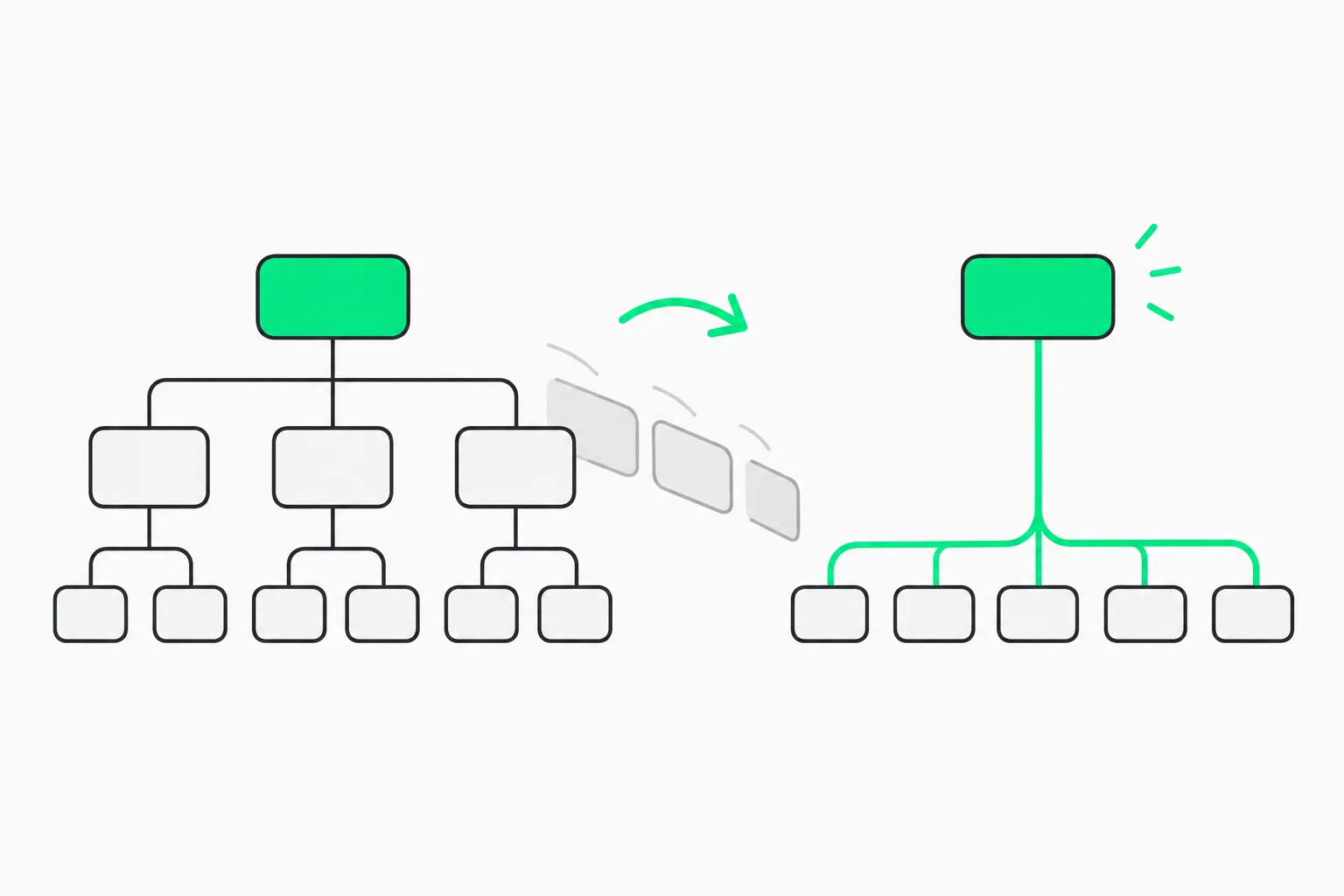 Org chart flattening from several management layers to one wide layer, illustrating Tencent AI workforce restructuring
Bloomberg's report of November 12, as relayed by Startup Fortune and FourWeekMBA, says Ma spoke at Tencent's annual anniversary event, which Startup Fortune calls the company's 28th. It describes an "Age of Discovery" framing.
The key image is military. Existing businesses are the army. AI efforts are the navy. Per the report, Ma said: "The army must leverage AI to maximize its efficiency, while we redeploy 50% of our personnel to the navy to support AI-native businesses."
Two readings are possible, and the sources lean toward the softer one. FourWeekMBA quotes the people with knowledge of the event as saying the remarks "came across more as a push for all employees to harness AI, rather than a sweeping overhaul." The same article says Ma also called for a nimbler structure with less mid-tier management.
That second point is concrete. Fewer management layers is a structural change, and it is the kind of change that often precedes headcount moves. It is also the part with the least detail so far.
What is the layoff rumor, and what did Tencent say?
Startup Fortune reports that posts claiming Tencent would cut 50% of staff spread quickly on Chinese social media. One version cited 8,000 people. The traffic reportedly crashed Tencent's employee circle on Maimai, a career-gossip platform.
A person close to the company told Chinese media the layoff claim is "completely untrue." According to that account, half the staff would raise efficiency in core businesses and the other half would explore AI-native products and growth.
Treat these denials with the right weight. The first comes from an unnamed person. Tencent had not issued a formal public statement when the stories ran, and FourWeekMBA notes that Tencent did not respond to Bloomberg's request for comment. Bloomberg itself describes fears of job cuts on Chinese social media but no actual cuts, and says the planned structural changes are unclear.
How many people is "half"?
Headcount depends on the source, and the gap is worth knowing before anyone repeats a number.
- Bloomberg describes the workforce as about 100,000 people, which implies roughly 50,000 for half.
- Tencent's interim report, per FourWeekMBA, shows 115,927 employees at June 30, 2026, up from 111,221 a year earlier. That is a 4.2% rise. Half of that is about 58,000.
- Neither number comes with a Tencent statement on how many people would actually change roles.
So "50,000 jobs moved" is arithmetic on a rounded figure, applied to a remark that attendees described as more of a push for all staff to use AI than a sweeping overhaul. Do not read it as a plan.
What the filings show: capex is rising while payroll is flat
The most solid numbers in this story are in the financial statements, not the speech. FourWeekMBA summarizes Tencent's interim report and its August 12, 2026 second-quarter release:
| Metric | H1 2026 | H1 2025 | Note |
|---|---|---|---|
| Capex | RMB 84.7 billion | RMB 46.6 billion | Up about 82% |
| Total remuneration cost | RMB 64.5 billion | RMB 65.0 billion | Down about 1% |
| Capex to payroll ratio | about 1.31 | about 0.72 | Author's arithmetic |
| Q2 capex | RMB 52.8 billion | n/a | Release says up 176% year on year |
Capex and payroll figures come from Tencent's own reports as quoted by FourWeekMBA. The ratios, the percentage changes beyond Q2 and the 58,000 estimate are that author's calculations, so check them against the filing before you cite them.
The same summary reports non-current prepayments for capital assets of RMB 81.1 billion at June 30, up from RMB 14.1 billion at the end of 2025, and net cash down 60% in Q2 to RMB 58.2 billion. It also lists Hy, Yuanbao, CodeBuddy, WorkBuddy and Xiaowei as the new AI products in the release, with Q2 non-IFRS operating profit of RMB 75.6 billion, or RMB 86.1 billion excluding new AI products.
The pattern is clear even without the ratios. Spending on chips and data centers is growing fast. Spending on people is not. If the AI push is to be staffed, it will largely be staffed by moving people, not by adding them. That is the practical meaning of a redeployment framing.
The compute side: chips, leases and bond sales
Tencent's AI bet is also a financing story. Startup Fortune, citing the Financial Times, reports a five-year, $7 billion lease for about 100,000 advanced AI chips through Oracle's Asia data centers. We covered the details and the export-control questions in our Tencent and Oracle chip lease post.
The same article says Tencent's second bond sale of 2026, about $5 billion, followed a record $4.66 billion raise in June. FourWeekMBA adds that Tencent's market value is down about 33% this year, to roughly $470 billion, per Bloomberg. These are the report's figures, not our verification.
The author of the Startup Fortune piece argues the reallocation reads as pressure rather than confidence. That is an opinion in the article, not a reported fact, and we do not endorse it. The facts that support it are the falling market value and rising capex. The facts against it are that no cuts were announced and that Ma's remarks were described as a push for all staff to use AI.
How does Ma's January message compare?
The November remark builds on earlier statements. Startup Fortune notes that in January, at a staff meeting reported by the South China Morning Post, Ma said Tencent had been "slow in taking action" on AI and that AI was the only business line worth heavy spending. He said the priority was integrating the Hunyuan model into existing businesses, and he disclosed an internal beta of Yuanbao Party, an AI social feature in the Yuanbao assistant. The January speech carried no new capex or product targets.
Read together, the arc is consistent. January: AI is the priority and we were late. November: half the organization should be pointed at AI-native work, and the rest should use AI to be faster. What is new is the scale of the number, not the direction.
Why this matters for builders and teams
 Moving boxes on a conveyor, illustrating employees redeployed into AI-native businesses at Tencent
If you work at or sell to a large platform company, three practical points follow.
- Expect internal reorganization before external products. Flatter structures and moved teams usually show up as slower approvals and new owners long before they show up as new apps.
- Read headcount stories as budget stories. With payroll flat and capex rising, the question is where scarce people go, and AI-native units are claiming them.
- Beware of single-number headlines. "Half of 100,000" invites a layoff reading that the sources do not support. Rumors of this kind move fast, which is why the denial and the "push for all employees" reading matter.
This fits a wider pattern we have tracked. American Express tied a 5% job cut to AI preparation. SUSE cited automation and AI for cutting about 10% of staff. Those were cuts. Tencent's remark, as reported, is about moving people rather than removing them, and that difference is the central open question.
On the model side, Tencent keeps shipping. Our posts on the HY4 release and on Tencent's chief AI scientist and open weights show what the AI-native side already produces. For the competitive frame, see the ByteDance 2030 frontier claim and our guide to top Chinese AI companies.
What is still unknown
- Which units, and how many people, would move. Tencent has not said.
- Whether any restructuring involves reduced headcount or mid-tier management cuts, as Ma's call for a nimbler structure might imply.
- What Tencent will say officially. A formal statement, or silence, will tell you how literal the 50% figure was meant to be.
- Whether new capex guidance follows. Ma's January speech included none, and reports on the November speech mention none.
The next hard data point is the third-quarter report scheduled for November 18, 2026, per FourWeekMBA. Watch for headcount at September 30, capex, and any language about the AI-native units.
How to read this kind of story
A founder's speech reported by anonymous attendees is a weak source for numbers and a decent source for direction. Here the direction is well supported by the filings: capex up sharply, payroll flat, a list of new AI products, and a stated plan to integrate AI into the core. The number, 50%, is the weakest part, and a person close to the company has denied it means layoffs.
If you cite this story, attribute the remark to Bloomberg's reporting, state that it comes from attendees, and keep the layoff rumor clearly labeled as unconfirmed and denied. That is the version that will still be accurate after the November 18 results.
Related reading
- Tencent HY4 official release: 770B model, vision and computer use
- Tencent and Oracle: 100,000 AI chips on a five-year lease
- Tencent's Yao Shunyu on AI biology and HY4 open weights
- American Express 5% job cuts, AI agents and MCP
- SUSE to cut about 10% of staff, citing automation and AI
- AI agents and zero-employee startups
- ByteDance's Zhang Yiming and the 2030 frontier claim
- Top Chinese AI companies and startups guide
Details reflect reporting available on November 12, 2026. Tencent has not published a transcript or a formal statement, and figures may change after its November 18 results.