



Most image generators you use today do not draw pixels directly. They draw in a compressed space made by a VAE tokenizer, then decode the result back to an image. That tokenizer quietly decides how sharp the final picture can be and how easily the diffusion model can learn. A new paper, RoAR-VAE, from Tsinghua University and Microsoft Research, proposes a recipe it says balances both, and its repository describes itself as "an open recipe for a VAE comparable to FLUX.2-VAE". The paper page, the arXiv listing and the GitHub repo are public, but the code and checkpoints are not released yet.
This is a technical story, so we will keep it practical: what the idea is, what numbers the authors report, and what to check once the weights land. For the broader pipeline, see our explainer on how diffusion image generation works.
TL;DR: the questions readers ask
| Question | Answer |
|---|---|
| What is it? | A training recipe for a visual tokenizer (VAE) that is both faithful and easy for diffusion models to learn |
| Who is behind it? | Yang Yue, Fangyun Wei, Yitong Wang, Jinjing Zhao, Henry Zheng, Dong Chen and Gao Huang, at Tsinghua University and Microsoft Research |
| Core idea | Robust prediction: generation-relevant information should stay recoverable from corrupted latents |
| Headline numbers | +2.19 average generation score over the strongest baseline tokenizer; +16.93 points small-text reconstruction accuracy over FLUX.1-VAE |
| Released? | Paper and README only; training code, inference code and checkpoints are listed as coming soon |
| Should you switch tokenizers? | Not yet. Wait for weights and independent tests |
Why does the tokenizer matter so much?
A latent diffusion model has two stages. A VAE compresses an image into a small grid of latents and can decode it back. Then a diffusion model learns to generate those latents from noise. If the VAE throws away fine detail, no diffusion model can recover it, so small text and textures suffer. But if the VAE keeps every detail in a messy, high-entropy way, the diffusion model has a harder time learning, so generation quality and training speed suffer.
That tension is the problem the paper calls latent diffusability: the tokenizer must preserve fidelity while producing latents a diffusion model can learn efficiently. Recent image models that rely on custom or upgraded VAEs, such as FLUX.3 Klein and the Krea line covered in our Krea 2 technical report post, show how much attention this layer gets. Some teams go the other way and drop the VAE entirely, as in SperID Iris, a pixel-space model.
 A green bead balances on a curved rail between a feather and a target disc, illustrating the fidelity versus learnability trade-off in a VAE tokenizer
What did the authors find with REPA-E?
Prior work improves diffusability in two ways, per the abstract: semantic alignment, or joint tokenizer and diffusion training. The authors took REPA-E, a representative joint-training method, and ran an ablation. They removed its diffusion objective and its dedicated generative blocks, kept only the semantic prediction from corrupted latents, and found comparable downstream generation performance under a matched setting.
The README explains why that matters. In REPA-E, the diffusion loss does not directly update the VAE encoder; the extra encoder supervision comes from predicting semantic features from noisy latents. So the useful ingredient seems to be the noisy prediction, not the joint diffusion training. The authors call the simplified version RobustAlign.
How does RoAR-VAE work?
The general principle is robust prediction: generation-relevant information should remain recoverable from corrupted latents. The paper instantiates it with two objectives:
- RobustAlign predicts pretrained semantic features from corrupted latents, preserving high-level structure such as objects and layout.
- RobustRecon reconstructs the clean image from corrupted latents, retaining fine-grained spatial and appearance information such as textures and boundaries.
Together they form the Robust Alignment and Reconstruction VAE. The README's reasoning is that semantic features capture object structure but can miss textures and edges, so the second objective fills the gap.
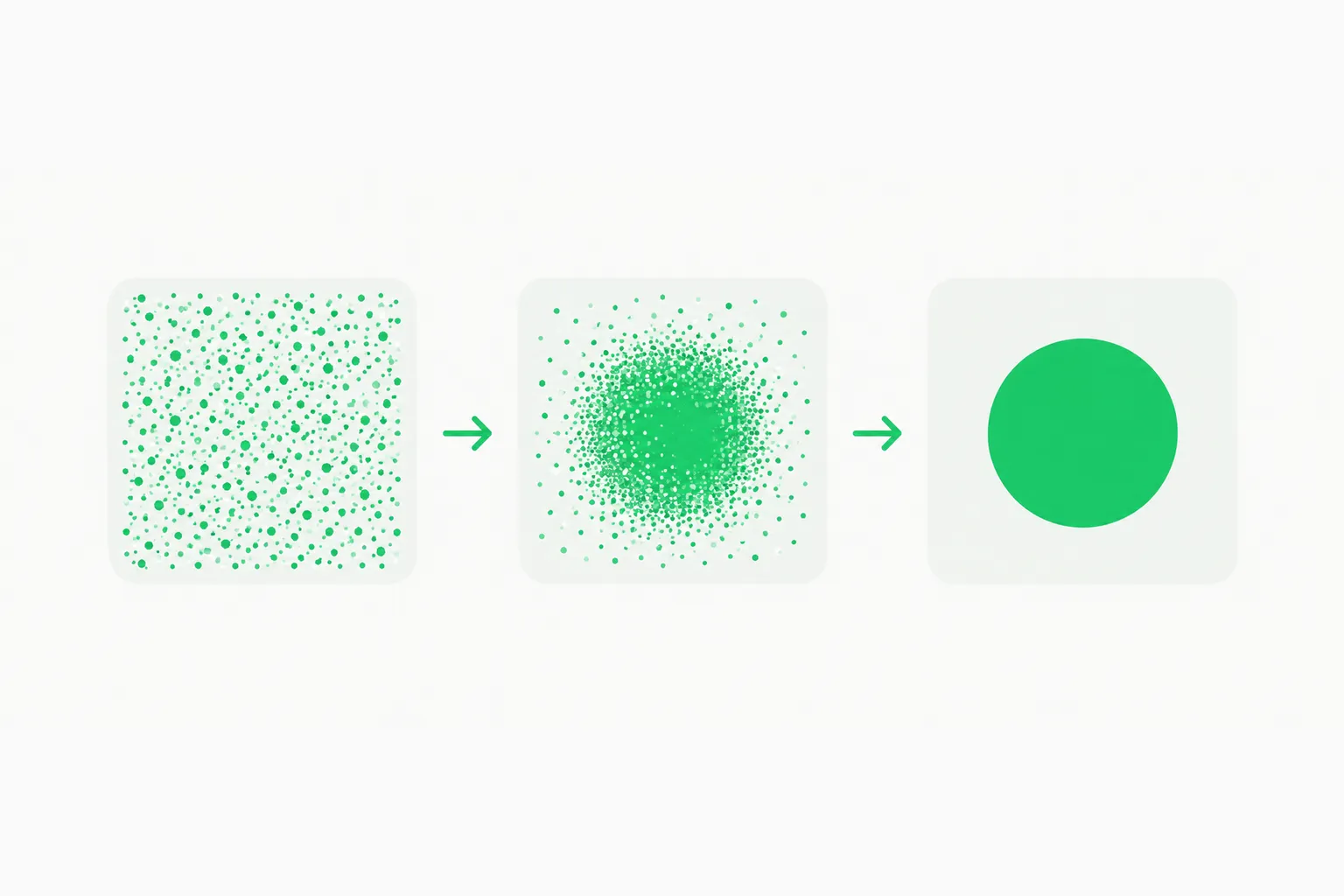 Three panels where speckles resolve into a clean green shape, illustrating noise in diffusion latents
The authors also offer a mechanism, hedged as "our analysis suggests". Robust prediction makes useful information more accessible in high-variance latent directions. Those directions keep more signal under noise, and diffusion models tend to learn them earlier. In plain terms, the tokenizer is nudged to put the important stuff where a diffusion model finds it first.
What are the reported results?
The abstract gives two numbers, both from the authors' own experiments:
| Claim | Figure |
|---|---|
| Average generation benchmark performance vs strongest baseline tokenizer, same training budget | +2.19 points |
| Small-text reconstruction accuracy vs FLUX.1-VAE | +16.93 percentage points |
The README adds charts plotting reconstruction error (LPIPS) against average generation score, where the authors say RoAR-VAE combines lower reconstruction error with a higher generation score, plus text-to-image samples and reconstruction comparisons. We could not reproduce those figures here, and the repository's images are not licensed for reuse in this post, so use the repo directly to see them.
Two cautions. First, the generation gain is measured "under the same training budget", which is a fair controlled setup but not the same as a full-scale training run. Second, the small-text comparison is against FLUX.1-VAE, an older reference than the FLUX.2-VAE the repo says it is comparable to. The README does not give us a number for the head-to-head with FLUX.2-VAE, so the "comparable" wording is a claim to verify, not a result we can quote.
How does it compare with the other routes to a better tokenizer?
It helps to line up the strategies the paper and our earlier coverage touch on.
| Route | Idea | Trade-off |
|---|---|---|
| Semantic alignment | Pull the VAE's latents toward features from a pretrained vision encoder | Cheap to add, but pure semantics can miss textures and boundaries, which is the gap RobustRecon targets |
| Joint tokenizer and diffusion training (REPA-E) | Train the VAE and the diffusion model together | Heavier training setup; the authors' ablation suggests much of the benefit came from one component |
| Robust prediction (RoAR-VAE) | Predict semantics and the clean image from corrupted latents | Keeps the standard two-stage pipeline; claims need independent checking |
| No tokenizer at all | Generate directly in pixel space | Avoids the VAE ceiling but shifts the cost to the generator |
The appeal of the third row is operational. A tokenizer trained on its own, with no diffusion model in the loop, can be swapped into an existing latent diffusion pipeline without redesigning the generator, which is how most open image stacks are built.
Questions to ask when the weights arrive
Tokenizer papers are easy to over-read, because reconstruction metrics and generation metrics can disagree. Before trusting any tokenizer claim, including this one, ask:
- Same budget, same data? The paper says the generation gain holds under the same training budget, which is the right control, but you should confirm the baselines were trained identically.
- Which generation benchmarks make up the average? A 2.19-point average can hide a large gain on one benchmark and nothing on another.
- Does it help your content? Small-text reconstruction is the headline, so test on posters, UI screenshots and documents, not just photographs.
- What does it cost at inference? A tokenizer that decodes slowly or needs a larger latent grid changes the economics of the whole model.
What can you do with it today?
Honestly, read it, and wait. The README's Code section says, in so many words, that training code, inference code and pretrained checkpoints will be released there. Until then there is nothing to download or fine-tune. When weights appear, a sensible checklist:
- Check the license before building on it.
- Run your own reconstruction test on text-heavy images, screenshots and faces, since small-text fidelity is the headline claim.
- Compare latent statistics, not just reconstructions. If you train diffusion models, train a small one on RoAR-VAE latents and on your current VAE's latents with the same budget.
- Check channel count and compression ratio, which decide memory and speed, and which the paper abstract does not state.
Open tokenizers matter because many open image models, like Qwen-Image 2.1 Turbo and MOSS-Image, inherit their ceiling from the VAE underneath. A drop-in, better-behaved tokenizer would help the whole open ecosystem, which is why this recipe is worth tracking even before code lands.
Limits and open questions
- No released artifacts. Everything here is from the abstract and README.
- Authors' benchmarks. The generation gain is the team's own measurement against baselines they selected.
- Unstated specifics. The abstract does not tell us the baselines list, latent dimensions or training data.
- Mechanism is a hypothesis. The high-variance-direction explanation is described as what the analysis suggests.
- Affiliation note. Microsoft Research is one of two listed affiliations, so this is a joint academic and industry paper, not a Microsoft product release.
Why it matters
Image model quality headlines usually go to the diffusion backbone. But the tokenizer sets a hard ceiling on text rendering and fine detail, the very things users complain about, and a recipe that raises that ceiling while also speeding up diffusion training would be broadly useful. The simplicity of the finding is also notable: if removing most of a joint-training method barely changes results, then a lot of complexity in the field may be unnecessary.
Related reading
- How diffusion image generation works
- SperID Iris: 3B pixel-space image model with no VAE
- FLUX.3 Klein open weights guide
- Krea 2 technical report
- Qwen-Image 2.1 Turbo: how to run
- MOSS-Image open text-to-image model
- Primary sources: paper page, arXiv, GitHub
Details are accurate as of October 20, 2026, and come from the authors' abstract and README. Check the repository for released code.