



Short-term rental hosts and some landlords are adding third-party AI apps from the Ring Appstore that turn outdoor cameras into guest counters and rule-violation spotters—not just motion alerts. Cybernews reported the trend on November 4, 2026, updated November 5, describing tools that estimate occupancy, detect possible parties, and verify whether cleaners arrived. Ring's own ZoneGauge listing and developer pages state what data each app touches.
The shift matters for anyone building or deploying vision models: consumer hardware plus an app store turns surveillance into a subscription SKU. It also sits next to the wider fight over plate readers and facial recognition in cities.
TL;DR: apps, prices, and claims
| App / category | What it claims | Price signal | Camera requirement |
|---|---|---|---|
| ZoneGauge | Live occupancy estimate for a defined outdoor zone; no stored images per Ring listing | About $4.99/month per property on Ring Appstore | Ring outdoor camera |
| GuardCat | Summaries for guest check-outs, cleaners, possible rule issues | About $7.99/month per camera in Cybernews | Ring cameras + subscription |
| LawnWatch (cited by Cybernews) | Pet waste and clutter detection | About $2.99/month in Cybernews | Outdoor Ring |
| Noise and WiFi crowd tools (Cybernews) | Decibel-only monitors, WiFi headcount gadgets | Varies by vendor | Often disclosed in listings |
Agents that act on your behalf need rules. See how explainx helps secure your agents →
What Ring's Appstore says about ZoneGauge
Ring hosts a product page for ZoneGauge, developed by Haven Systems. Ring states the app answers how many people are in a zone—a deck, patio, or driveway—using an existing outdoor camera. Key bullets on the official Appstore page:
- Snapshots are processed instantly and never stored, according to the listing.
- No facial recognition and no video recording by the app.
- Hosts set an occupancy limit and get alerts when the estimate exceeds it.
- Requires a Ring outdoor camera, motion detection enabled, a Haven Systems account, and a ZoneGauge subscription.
The privacy disclosures on the same page say data is not used for AI model training, is used only to provide the service, and that Ring videos are not manually reviewed at ZoneGauge. Retention is listed as zero days for videos.
That is a cleaner privacy story than many analytics vendors—but it is still computer vision on people without their direct consent, and Ring notes estimates may be imprecise.
What Cybernews and other outlets add
Cybernews describes hosts using AI to count guests, detect parties, and check cleaners. It quotes marketing from GuardCat promising alerts that matter instead of endless pings, and cites hosts on forums pairing noise monitors, door cameras, and WiFi crowd detection.
IBTimes UK summarized the same ecosystem on November 2, noting automated alerts do not prove a rule was broken, that camera placement matters, and that Airbnb bans indoor cameras in listings.
Privacy advocates quoted in Cybernews worry that guests may not know third-party AI is analyzing footage, that policies are fragmented, and that models mis-count.
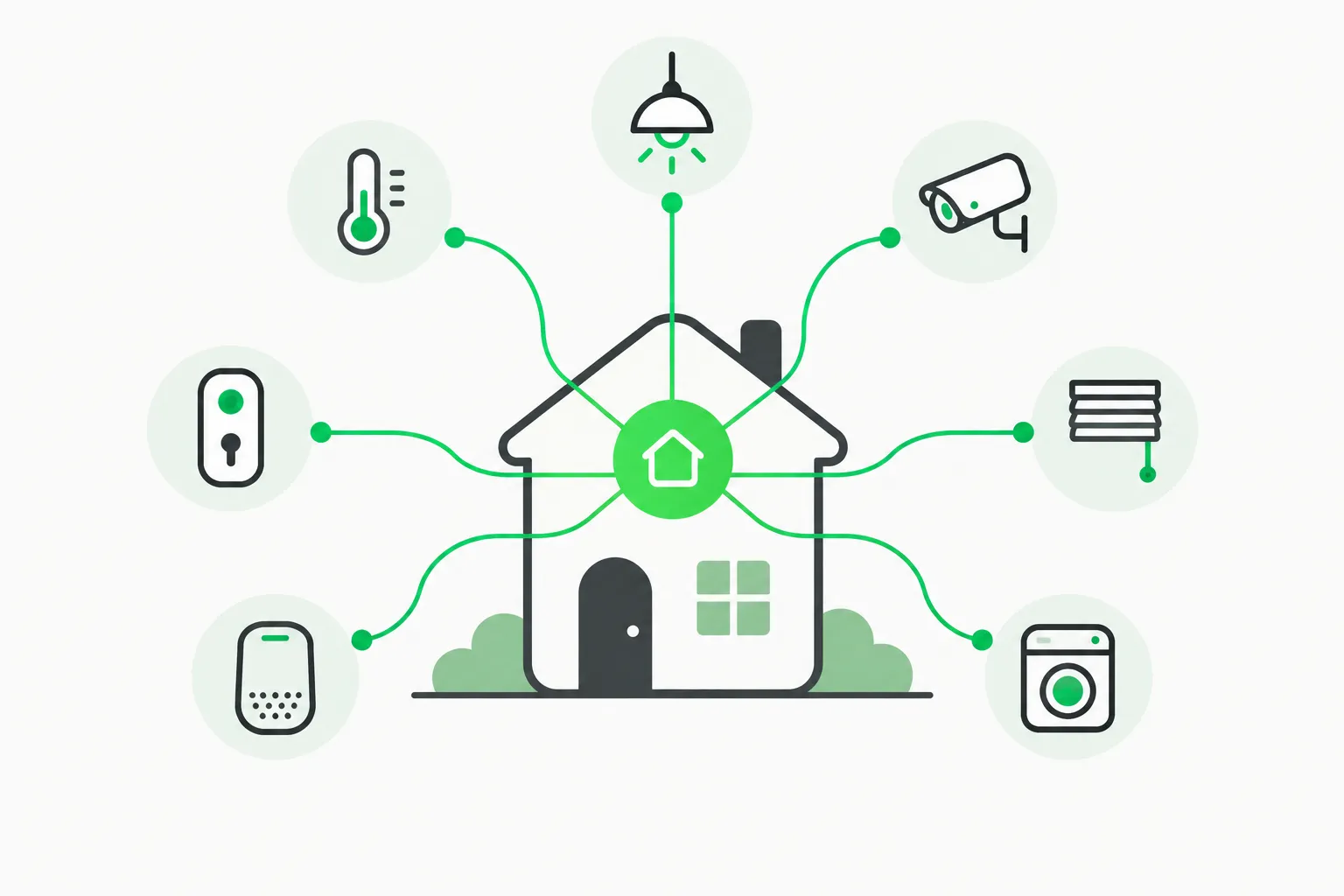 Smart home hub linking cameras and third-party Ring AI apps for landlords
Why this is different from a normal Ring doorbell
A standard Ring notification says motion happened. These apps add semantic labels: too many people, early check-in, cleaner late, possible party. That is the same product pattern as enterprise video intelligence—compress video into events—but sold to individual landlords for monthly fees.
For builders, the stack is familiar:
- Camera feed from Ring APIs.
- Vision model estimating people or activities.
- Alerting through Ring or a parallel app.
The governance layer is weaker than in enterprise deployments: no uniform consent UI for guests walking up a driveway.
Legal and platform context
IBTimes and Cybernews both stress that legality depends on jurisdiction and placement. Recording people in private spaces, capturing activity beyond property lines, or processing biometric identifiers can trigger state and federal rules. Our coverage of smart glasses misuse and protest tactics and adversarial clothing against face detection shows how fast public norms are shifting around camera AI.
Airbnb's indoor camera ban pushes hosts toward outdoor analytics, but outdoor cameras still film guests, contractors, and passersby. The EU AI Act and US policy guide covers the European approach, which is a reference point; US law remains a patchwork.
Ring's Appstore includes per-app privacy labels—motion events, email, live view access, and whether developers train models on data. Guests rarely see those labels.
What hosts, guests, and builders should do
Hosts and landlords
- Disclose cameras and analytics apps in the listing, not only hardware.
- Prefer outdoor placement that minimizes public sidewalk capture.
- Treat AI counts as signals, not evidence for fines or deposit claims.
Guests and tenants
- Ask which apps are active and request vendor privacy policies.
- Know local two-party consent rules for audio if microphones are in the stack.
Builders shipping vision analytics
- Copy the ZoneGauge pattern only if you can honor short retention and clear no biometric claims—regulators will ask.
- Separate counting people from identifying people in product copy and in the model pipeline.
- Document error rates; occupancy estimates will be wrong at night, in rain, and during deliveries.
People publishing footage
If you film protests, deliveries, or property walkthroughs, blurring faces and plates before upload reduces harm if models later scan the clip. The explainx.ai team's BGBlur doorbell and bystander guide walks through GDPR-style thinking for camera footage that catches neighbors.
For teams that deploy agents with camera or doorbell integrations, restrict what automated workflows can do with guest video. AgentBeam, from the explainx.ai team, stops AI agents before they take dangerous actions—relevant when an agent might re-share clips or file automated complaints.
What people are asking
Is this facial recognition? ZoneGauge says no, and Ring publishes that flag on the Appstore page. Occupancy counting can still feel like identification when alerts land on a specific booking or tenant file, so product lawyers separate counting from naming in terms of service.
Do guests have to opt in? Cybernews highlights disclosure gaps. STR platforms require camera notices in listings, but a guest may not read which AI tier sits behind the camera. That is closer to enterprise video analytics consent fights than to a simple doorbell ping.
Can cities ban these apps? Not uniformly. Some states restrict audio recording; others regulate biometric processing. Federal bills like the Tlaib Flock proposal target government purchase of mass surveillance, not a host subscription, but the politics rhyme.
What if the model miscounts? IBTimes warns that automated alerts do not prove a violation. A delivery surge, Halloween trick-or-treaters, or overlapping motion zones can trip occupancy alerts. Hosts who automate fines on weak signals invite disputes.
How this connects to wider AI surveillance news
Congress is still debating federal funding for plate readers and biometrics, per the Tlaib Flock bill coverage. Retailers are testing drive-thru recognition with unclear biometrics claims, which we tracked in Starbucks drive-thru AI. The Ring app economy shows the same technology shrinking into consumer subscriptions.
Cybernews also notes hosts mix these tools with noise monitors that read decibels only, WiFi crowd sensors, and guest screening before arrival. The AI layer is one part of a broader short-term rental compliance stack, similar to how enterprises stack computer-use agents on top of legacy monitoring.
How Ring app privacy labels compare
Ring publishes structured App Privacy fields for third-party developers. On ZoneGauge, Ring states the developer may access video recordings, live view, motion events, and account identifiers, and may share data with service providers or when required by law. The same page says the developer will not use Ring data to train AI models, which matters because many vision vendors quietly repurpose customer footage unless contracts forbid it.
For compliance teams, the checklist looks like this:
| Check | Why it matters |
|---|---|
| Read the Appstore privacy table, not only marketing copy | Obligations differ per app |
| Confirm retention days | ZoneGauge lists zero-day video retention |
| Ask whether biometrics are claimed off | Occupancy models can still feel biometric to regulators |
| Map subprocessors | Cybernews warns guests may not know third parties exist |
| Log which property uses which app | Helps answer a guest DSAR or state AG inquiry |
None of that replaces legal review in your jurisdiction. It does separate Ring the camera vendor from Haven Systems, GuardCat, or lawn analytics vendors when an incident lands in the inbox.
If you are building similar vision analytics
Founders cloning this pattern should expect three engineering constraints hosts already feel:
- Ring API rate limits and outage windows — alerts must degrade gracefully when the hub is offline.
- False positives on occupancy — wind-blown decorations, reflections, and delivery stacks break naive counters; IBTimes warns hosts not to treat alerts as proof.
- Consent UX — enterprise buyers sign DPAs; consumers walk past a sticker. A B2B product needs audit logs; a consumer SKU needs plain-language disclosure in the rental contract.
If your roadmap includes agents that file tickets when a camera sees too many people, add human approval before money-moving actions.
 Face-detection grid without identity, illustrating Ring AI occupancy without named facial recognition
Related reading
- Tlaib bill targets federal funding for Flock and biometrics
- Smart glasses misuse and bans
- Digital camouflage against AI surveillance
- EU AI Act and US AI regulation guide
- Trump 60 Minutes remarks on AI guardrails
- Blue wave midterms and AI accountability
App prices and feature bullets are accurate as of November 4–9, 2026, per Ring Appstore pages and Cybernews. Ring and third-party developers may change terms without notice.